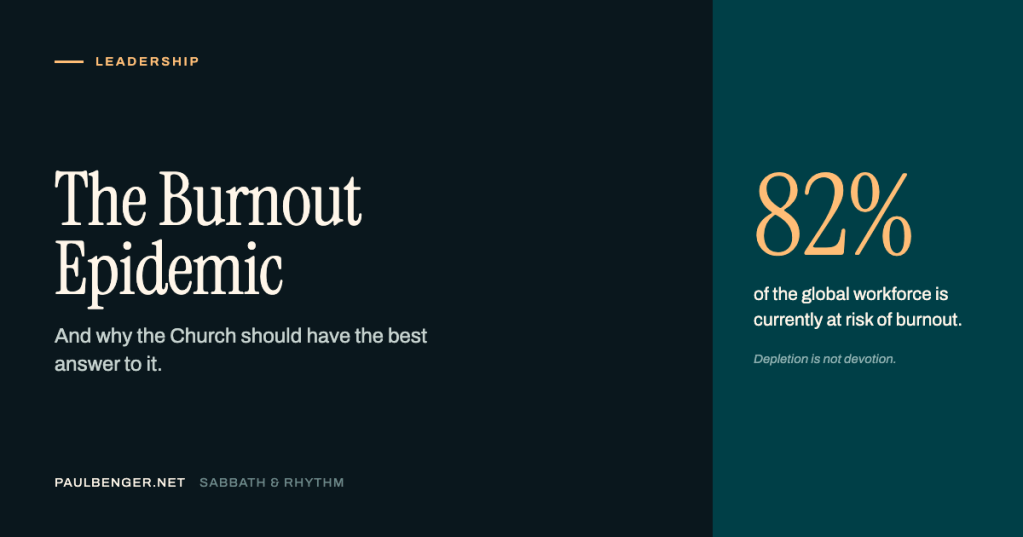
Here’s a number that stopped me: 82% of the global workforce is currently at risk of burnout.
Not experiencing mild tiredness. Not going through a busy season. At risk of systemic collapse — the kind of exhaustion where your body, your mind, and your soul start to shut things down one by one.
And the research adds something that makes it worse: there is zero correlation between working more than fifty hours a week and actual productivity. Zero. One study found no measurable difference in output between someone working seventy hours and someone working fifty-five. The extra hours were theatre, not fruit.
Somewhere along the way, we confused being overwhelmed with being effective. We started wearing fatigue like it was evidence of significance. As Rich Wilkerson Jr puts it: “Depletion is not devotion. Busy is loud. Fruit is quiet.”
Here’s the thing that should trouble every pastor and church leader reading this: the world is in a burnout epidemic, and we should have the best answer to it. We didn’t invent mindfulness or wellness retreats or the four-day work week. We are the custodians of something far older and far wiser — Sabbath. Not our idea. God’s. Built into the fabric of creation before the Fall, before the first sin, before anything went wrong. We inherited it from the biblical wisdom that shaped Israel, and it was given to humanity as a gift long before the church existed.
So why are so many leaders in the church among the worst at practising what we preach?
God Rested Before You Did
Before we talk about what to do, we need to understand what Sabbath actually is — because most of us treat it like a maintenance stop rather than a theological statement.
Genesis 2:2–3 says: “On the seventh day God had finished his work of creation, so he rested from all his work. And God blessed the seventh day and declared it holy.”
This is before the Fall. Before sin, before brokenness, before the curse. Rest is not God’s remedy for a broken world — it’s built into the architecture of a good one. The very first full day Adam and Eve experienced was not a day of work. It was a day of rest with God.
Then God formalised it at Sinai. The Sabbath command is one of the longest in the Ten Commandments — God knew we’d try to skip it. He still knows. Most of us do.
Tim Keller captures why this matters so much: “To practise Sabbath is a disciplined and faithful way to remember that you are not the one who keeps the world running, who provides for your family — not even the one who keeps your work projects moving forward.”
That’s it. That’s the whole thing. Sabbath is not primarily about recovering your energy. It’s about confessing that you are not God. It’s a weekly declaration of trust — that the world will continue to turn, the church will continue to breathe, the mission will continue to advance, even when you stop.
Most of us intellectually agree with that. Very few of us functionally believe it.
The Prophet Who Had Enough
One of the most honest scenes in all of Scripture sits in 1 Kings 19.
Elijah has just called down fire on Mount Carmel in one of the most dramatic moments in Old Testament history. A generation of Israelites have turned back to God. It’s the kind of day you frame on the wall. And then Jezebel sends a message: “By this time tomorrow, you’ll be dead.”
Elijah runs. And collapses under a broom tree. And prays: “I have had enough, Lord. Take my life; I am no better than my ancestors.”
He falls asleep.
Notice what God does not do. He does not give Elijah a leadership development programme. He does not produce a five-point plan for spiritual resilience. He sends an angel who touches him and says simply: “Get up and eat.” Twice. Then God asks, gently: “What are you doing here, Elijah?”
Sleep. Food. A question. A journey. And eventually, the still small voice.
God’s response to a burned-out prophet is tenderness, not a productivity hack. It is rest, nourishment, and presence — in that order. The great wins of Elijah’s ministry did not come in spite of that season of collapse. They came after God had walked him through it.
If you are a leader who is currently sitting under your own broom tree — tired in ways you can’t fully explain, disillusioned after what felt like a great season — this story is for you. God is not disappointed in you. He is looking for you.
Sabbaticals Don’t Fix Sabbaths
Here’s what I tell leaders who tell me they’re planning a sabbatical: “That’s good. But sabbaticals don’t fix sabbaths.”
A sabbatical is a reset. Sabbath is a rhythm. And it is rhythm that sustains us.
We treat sabbaticals like crash diets — a three-month fix for what a broken daily and weekly pattern has created. But if the rhythm doesn’t change, the cycle repeats. You come back refreshed for six months, and then you’re right back where you started.
Israel learned this the hard way. The chronicler tells us (2 Chronicles 36:20–21) that the seventy years of Babylonian exile were, in God’s accounting, the land catching up on the seventy Sabbath years Israel had skipped across 490 years. God enforced the rest they had refused. The exile was not just judgement — it was recovery. The land finally got what it had been owed.
Don’t think you’ll be the exception.
Rick Warren gives leaders a framework I keep returning to: “Divert daily, withdraw weekly, and abandon annually.” Daily — something that’s not work, that replenishes rather than depletes. Weekly — the actual Sabbath rhythm, not church on Sunday but a full day of cease and delight. Annually — and this is the one we most misunderstand — not a spiritual retreat, not a working sabbatical, but a proper holiday. Fully disconnected. Genuinely joyful. The kind of time where you’re not catching up on reading, not journalling your leadership insights, not secretly checking your emails — just gone. Present to the people you love in a place that has nothing to do with your work. The third one only works if the first two are already in place. You cannot build a rhythm crisis-by-crisis.
Let me be direct about what I am not saying. This is not a case for laziness, minimal effort, or a generation of leaders who treat rest as cover for lack of commitment. The Bible honours diligence. Proverbs is full of it. Paul writes about labouring to the point of exhaustion for the gospel. Nehemiah’s teams worked through the night. Jesus himself worked with an intensity that alarmed his family. Hard work is not the enemy — I believe in it deeply, and I think the church should model it.
What I’m describing is not less work. It’s better work — disciplined, sustained, and properly rhythmed. A leader who works five or six focused, well-rested days will consistently outproduce — and outlast — a leader who works seven frantic ones. The research bears this out: productivity actually declines after fifty hours a week. What looks like more effort is often less output, dressed up in exhaustion.
John Mark Comer puts the cultural diagnosis sharply: “Hurry is violence on the soul.” And we are a generation of leaders who have made our peace with hurry. We’ve called it commitment. We’ve baptised it in the language of the Kingdom. But frantic is not faithful. And depletion is not devotion.
What Sabbath Actually Requires
There’s a detail in the Exodus wilderness narrative that I find myself coming back to.
God provided manna for Israel every day in the desert. Six days a week, it appeared. On the sixth day, a double portion fell so there was enough for the seventh. But on the seventh day — nothing. And those who went out to gather anyway found nothing there.
Sabbath is God’s test: Do you trust Me to provide?
Jesus reframes it in Mark 2:27: “The Sabbath was made for man, not man for the Sabbath.” It is not a burden to perform — it is a gift to receive. A Father saying: you don’t have to keep producing to prove your worth to Me. Stop. Rest. Let Me be God for a day.
And in Mark 6:31, Jesus pulls his disciples away from the urgent crowds — “Come with me by yourselves to a quiet place and get some rest” — not because the crowds weren’t real, but because his disciples were more use to those crowds as rested people than as depleted ones.
There is a version of leadership that protects the calendar. Great leaders protect the capacity. Clarity, creativity, and genuine spiritual influence are not available on empty.
The Invitation
Jesus says this in Matthew 11:28–30, and I want you to read it slowly: “Come to me, all you who are weary and burdened, and I will give you rest. Take my yoke upon you and learn from me, for I am gentle and humble in heart, and you will find rest for your souls.”
The invitation is for people who are already tired. Not people who have figured out their rhythms. Not people with healthy boundaries and excellent work-life integration. People who are weary and burdened — and that might be you.
He offers not a technique but a relationship. Learn from me. Come and inhabit the pace of someone who was never in a hurry, who regularly withdrew to pray, who slept through storms, who paused for individuals in the middle of crowds.
We have a saying at Ikon: Rhythm is more powerful than encounter, but an encounter has the power to change your rhythm. If you’re reading this exhausted, maybe this is your encounter. Let it change the rhythm.
The world is burning out at record rates. The church should have the best answer. We have Elijah’s God — the one who feeds before He commissions. We have the Sabbath — built into creation’s DNA as a declaration that you are not the Messiah. We have Jesus — who said come, not perform.
Stop calling depletion devotion. Start practising what we’ve been preaching.
“If you don’t take a Sabbath, something is wrong. You’re doing too much. You’ve got to quit, one day a week, and just watch what God is doing when you’re not doing anything.” — Eugene Peterson
Related: Don’t Build from Insecurity — on the identity roots of leadership exhaustion. The Capacity Gap — on building a leadership life that can carry more.


Leave a Reply