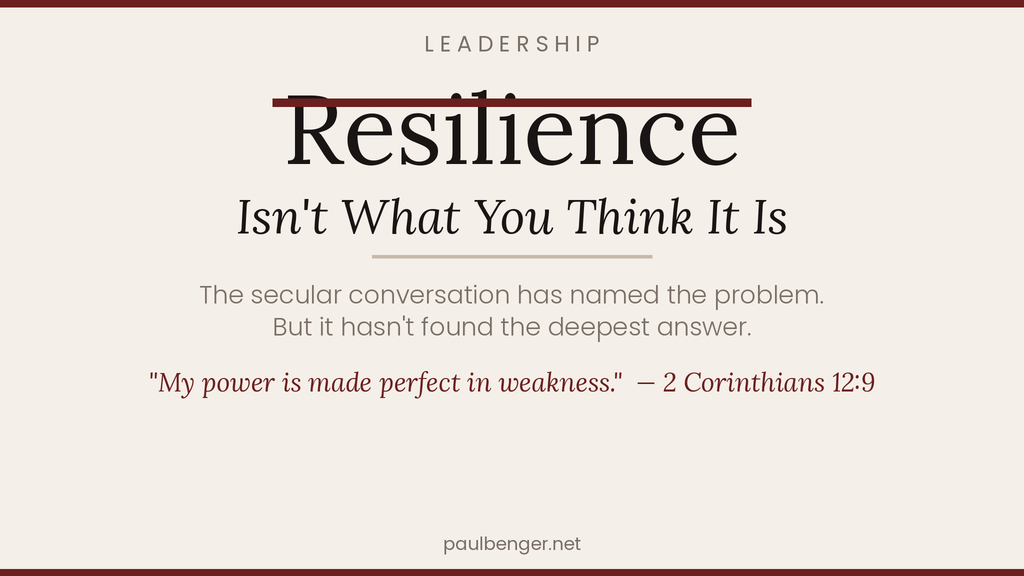
Something is shifting in the leadership conversation around resilience. After years of celebrating the leader who pushed through, absorbed more, took the hits and kept going, the narrative is finally changing. Article after article in 2026 is drawing the same distinction: resilience is not endurance. It’s not the ability to absorb more. It’s the capacity to adapt, reset, and respond — and it requires rest, not just grit.
This is a genuinely better conversation, and it’s long overdue.
But it still hasn’t gone far enough. Because even the updated version of resilience — the adaptive, bouncing-back, rest-as-performance-strategy version — is still fundamentally a conversation about self-management. It’s still asking the question: how do I develop the inner resources to handle more?
And I want to suggest that the Christian answer begins somewhere else entirely.
The Problem With Even the Better Definition
Nassim Nicholas Taleb, in his landmark book Antifragile, draws a distinction that’s useful here. He says there are three kinds of systems. Fragile systems break under stress. Resilient systems resist stress and return to where they were. But antifragile systems actually get stronger because of stress. They don’t just bounce back — they come back different.
The leadership world has been trying to move everyone from fragile to resilient. The better thinkers are now trying to move people toward antifragile. And this is closer to the truth.
But Christianity goes somewhere even that framework doesn’t reach.
Because the goal isn’t just getting stronger from stress. It’s being transformed through it — into something you couldn’t have become any other way. And that transformation is not something you engineer. It’s something you receive.
What Paul Actually Discovered
The central text for the Christian understanding of resilience is not where most people would look for it. It’s not a passage about courage or perseverance. It’s a passage about weakness — and a prayer that went unanswered.
Paul, the most consequential leader in the history of the church, had what he calls a “thorn in the flesh.” He doesn’t tell us exactly what it was — scholars have debated it for centuries. What he does tell us is that it was painful enough that he asked God to remove it, not once, but three times.
God said no.
Instead, God said something that has been changing lives for two thousand years:
“My grace is sufficient for you, for my power is made perfect in weakness.” (2 Corinthians 12:9)
And this is where Paul’s response transforms the conversation entirely. He doesn’t grieve the unanswered prayer. He doesn’t redouble his own efforts. He doesn’t construct a strategy for managing through the limitation. He says:
“Therefore I will boast all the more gladly about my weaknesses, so that Christ’s power may rest on me. That is why, for Christ’s sake, I delight in weaknesses, in insults, in hardships, in persecutions, in difficulties. For when I am weak, then I am strong.” (2 Corinthians 12:9–10)
This is not motivational language about pushing through. This is a theological statement about where power actually comes from. Paul is not saying he’s strong in spite of the weakness. He’s saying he’s strong because of where the weakness drove him — to the place of total dependence on God.
The limit is not the problem to be solved. The limit is the location of grace.
The Difference That Changes Everything
There are two kinds of perseverance, and they look almost identical from the outside.
The first is pride-rooted perseverance. It sounds like: I will not be beaten. I am stronger than this. I will push through. It’s driven by the refusal to admit limitation — and it is, frankly, the dominant mode of most high-performing leaders. It can last for years. It produces impressive results right up until the moment it produces collapse.
The second is Spirit-rooted perseverance. It sounds like: I cannot do this. But He can. And He does His best work here. It’s not the absence of effort — Paul worked harder than almost anyone in the New Testament. But it is the absence of the illusion that the strength originates in you.
The difference between them is not visible in the output. It’s visible in what’s happening inside the leader when the pressure increases. Pride-rooted perseverance grips harder. Spirit-rooted perseverance lets go — and discovers that dependence on God is where strength resides.
And the result, over time, is entirely different. Nietzsche said what doesn’t kill you makes you stronger — but that’s still the language of self-sufficiency. Paul said something different: when you run out of yourself, God doesn’t just sustain you — he transforms you. Not because you endured. Because you depended.
Naming Your Limits Is the First Act of Strength
One of the most countercultural things a Christian leader can do right now is name their limits — not as an apology, not as a confession of failure, but as a theological statement about what kind of creatures we are.
We are finite. That is not a flaw in the design. It is the design.
Jethro told Moses, at the height of his influence, “What you are doing is not good — you will only wear yourselves out.” (Exodus 18:17–18) Moses received it. He restructured his entire leadership model on the basis of an honest assessment of his limits. And the movement he led didn’t collapse — it flourished.
The Psalmist who wrote Psalm 84 understood this too. “Blessed are those whose strength is in you.” Not those whose strength is remarkable. Not those whose strength impresses. Those whose strength is in you — in God. Because that is the only strength that compounds over time rather than depleting over time.
The burnout epidemic hitting leaders right now is not, at its root, a problem of poor self-management. It is a problem of mislocated strength. Leaders who are running on their own resources, without genuine community, without real rest, without the spiritual replenishment that comes from dependence on God, are not resilient. They are just fragile systems that haven’t broken yet.
The Question That Reframes Everything
The secular resilience conversation asks: how do I bounce back?
The Christian question is different: what is God building in me through this?
Not because suffering is good in itself. But because the God of Scripture is not absent from suffering — he is at work in it. And the leader who can ask that second question, and mean it, is not managing their stress better. They are operating from a fundamentally different source.
Paul’s description of the Spirit’s role in weakness is worth sitting with: “The Spirit helps us in our weakness. We do not know what we ought to pray for, but the Spirit himself intercedes for us through wordless groans.” (Romans 8:26) The Spirit doesn’t eliminate the weakness. The Spirit inhabits it.
You don’t get resilient by developing better coping strategies. You get genuinely strong by learning where strength actually comes from — and then going there, consistently, before the pressure makes the decision for you.
The limit you’re facing right now is not the end of the road.
It is very possibly the beginning of something you could not have found any other way.
Related: The Burnout Epidemic — and Why the Church Should Have the Best Answer — on why rest is not the opposite of productivity. The Loneliness of Leadership — and the Answer Nobody Is Saying Out Loud — on why genuine community is essential for the long haul. The Capacity Gap — on moving from full to overflowing.



Leave a Reply