• Leave No Trace: How Japan’s football fans are leaving a trace we all need

    It was the 2022 FIFA World Cup. Morocco had just beaten Japan. The stands were electric, then suddenly empty — 45,000 people filtering out into the Doha night.

    And the Japanese fans stayed behind.

    Not to celebrate. Not to grieve. They reached into their bags — not for scarves or flags — but for blue plastic bin bags. And then, quietly, methodically, they got to work. Row by row, section by section, collecting the cups and wrappers and confetti left behind by the entire stadium.

    No announcement. No ceremony. Just work.

    When they finished, they bowed. And left.

    This wasn’t a World Cup novelty. If you’ve watched Japanese football at home, you’ve seen the same thing — fans cleaning the stands after every match, home or away, win or loss. It’s not a campaign. It’s a culture. Rooted in a deep conviction about shared spaces: you don’t leave your mess for someone else. You take responsibility. You leave it better than you found it.

    Japan lost the game that night.

    But the images of those fans — with their blue bin bags in a stadium they had no obligation to clean — went global. News outlets ran it. Rival supporters spoke about it. People who’ve never watched a football match in their lives shared it on social media.

    They were trying to leave no trace.

    Instead, they left the most significant trace of all.


    Custodians, Not Owners

    In Legacy, his brilliant study of All Blacks rugby culture, James Kerr describes something quietly radical at the heart of New Zealand’s most famous team.

    Players are not owners of the jersey. They are custodians.

    Every player who pulls on the black shirt receives it from those who came before. Their job is not merely to perform — it’s to leave the jersey in better condition than when it arrived in their hands. The legends who wore it elevated it. Your job is to elevate it further, then pass it on.

    The question embedded in All Blacks culture isn’t “Did I win?” It’s “Did I leave this better than I found it?”

    The difference matters more than it might seem. Winning is about the moment. Custodianship is about what comes after.

    You can win a game and erode a culture. You can lose a game and strengthen one. The Japanese fans lost the match. They won something larger — and they weren’t even trying to.


    Give Careful Thought to Your Ways

    There’s a moment in the book of Haggai where God interrupts his people with something that sounds less like prophetic thunder and more like a firm hand on the shoulder.

    “Now this is what the Lord Almighty says: ‘Give careful thought to your ways. You have planted much, but harvested little… Give careful thought to your ways.’” (Haggai 1:5–7)

    The people weren’t idle. They were busy. Building things, maintaining things, keeping things running. But God’s question cuts clean through the activity:

    Is what you’re building actually getting better?

    The temple — the dwelling place of God among his people, the thing that most mattered — was in ruins. Not through dramatic collapse, but through gradual neglect while everyone focused on their own concerns. The shared thing, the sacred thing, had quietly slipped.

    God’s word here isn’t condemnation. It’s an invitation to pause and be honest. Is this working?

    The hardest part of Haggai isn’t the rebuke — it’s the question. Because the people could easily defend themselves: “We’ve been busy. We’ve been faithful. We’ve been working.” And they had been.

    But busyness isn’t the same as building. Activity isn’t the same as improvement. And maintaining what you’ve received is not the same as leaving it better.


    The Paradox of the Bin Bag

    Here’s what strikes me most about those Japanese fans: they weren’t trying to make history. They were trying to be faithful to something — a cultural value about care, about shared responsibility, about leaving spaces better than you found them. Not for recognition. Not for headlines. Because it’s right.

    And yet. That quiet faithfulness became the headline.

    The people not trying to leave a trace left the most memorable one.

    Peter captures something of this when he writes: “Each of you should use whatever gift you have received to serve others, as faithful stewards of God’s grace in its various forms.” (1 Peter 4:10) Stewards. Not owners. People entrusted with something that was never really theirs to begin with.

    Jesus pushed it further still: “Whoever wants to save their life will lose it, but whoever loses their life for me will find it.” (Matthew 16:25)

    The greatest traces are often left by people who weren’t trying to leave one.


    Three Questions Worth Consideration

    Do we see ourselves as owners or custodians?

    Owners ask: What can I get from this? Custodians ask: What can I give to this? Owners protect their position. Custodians protect the thing they’ve been entrusted with. The difference is subtle but it shapes everything — decisions, culture, how we respond to criticism, how we treat the people who come after us.

    Is it actually getting better?

    Maintenance matters. But maintenance isn’t legacy. Every team, every organisation, every church tends toward entropy unless someone is actively working against it. The question God asked through Haggai is still alive: You’ve been busy — but is it getting better?

    Not globally. Locally. Specifically. Is the thing in your hands right now in better condition than when you received it?

    What would it look like to serve without claiming?

    The Japanese fans didn’t hold a press conference. They didn’t announce what they were doing. They just picked up the rubbish and left. And the world noticed.

    Some of the most significant work you’ll ever do will be the work nobody sees. The early starts. The quiet standards. The attention to detail when no one is watching. The consistent commitment to excellence that slowly, invisibly, becomes the culture.

    That’s not nothing. That’s legacy.


    Leave It Better

    The All Blacks don’t wait for a crisis to ask whether they’re improving. The Japanese fans — still at it at the 2026 World Cup, still arriving with blue bin bags, still cleaning stadiums they had no obligation to clean — don’t wait until things fall apart before they act. It’s not a gesture. It’s a culture. A discipline repeated until it becomes identity.

    And Haggai’s people needed a prophet to ask the question we should be asking ourselves without prompting.

    Give careful thought to your ways.

    Not as a rebuke. As a practice. Something built into the rhythm of your week — not because something has gone wrong, but because the thing in your hands deserves honest attention.

    So. What’s in your hands?

    One team. One relationship. One process. One responsibility. Is it better because of you? Or have you accepted fine when you once demanded excellent? Have you been maintaining what you inherited instead of improving it? Have you been busy but not building?

    Give careful thought to your ways.

    We don’t maintain legacy. We build it or we erode it — slowly, daily, in decisions no one is watching.

    The jersey is in your hands. Someone handed it to you. Someone is waiting to receive it from you.

    Leave it better.
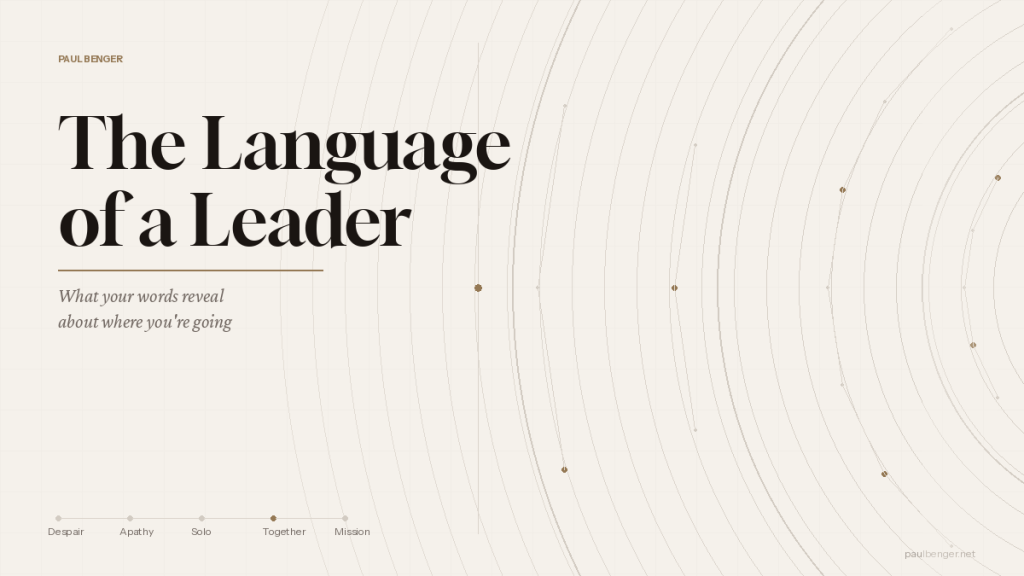
  • The Language of a Leader: What Your Words Reveal About Where You’re Going

    Imagine you could sit invisibly in the back of your leadership team meeting this week.

    Not to assess the agenda, or evaluate the strategy, or check whether people came prepared. Just to listen. Listen to the actual words your leaders use when they talk about the future, about challenges, about the people they’re trying to reach.

    What would you hear?

    Would you hear “we’ve tried that before” — or “what if we approached it differently?” Would you hear “I don’t think we have the capacity for that” — or “let’s work out how we make this possible”? Would the dominant pronoun in the room be I or we?

    Here’s the thing I’ve come to believe as a leader and a coach: the language of your team is the most honest diagnostic tool available to you. More honest than your strategy documents. More honest than your stated values. More honest than the culture you say you’re building.

    What people say — in the corridor, in the meeting, under pressure — is what they actually believe. And what they actually believe is what they’re actually building.

    “Death and life are in the power of the tongue.” — Proverbs 18:21

    That’s not just a spiritual observation. It’s a leadership one.


    Language Is Not Neutral

    Dave Logan, John King, and Halee Fischer-Wright spent years researching workplace culture and came to a striking conclusion: you can identify the health of any team simply by listening to the language. Not what people claim to believe — what they actually say. They documented their findings in Tribal Leadership: Leveraging Natural Groups to Build a Thriving Organization (HarperBusiness, 2008), and the diagnostic is as relevant to church teams as it is to any corporate organisation.

    Language doesn’t just describe the culture of a team. It creates it.

    Every phrase a leader uses sets an invisible permission level in the room. Every unchallenged statement becomes a precedent. Every disempowered sentence — spoken casually, unreflectively — slowly lowers the collective ceiling.

    And the reverse is equally true. Leaders who use language that is owned, future-focused, and possibility-oriented gradually shift what their teams believe is achievable.

    Jesus understood this. “Out of the overflow of the heart, the mouth speaks,” He said (Matthew 12:34). Which means: if you want to know what’s happening in the heart of your team’s culture, don’t look at the vision statement on the wall. Listen to what comes out of people’s mouths when things get hard.


    The Five Stages — Where Is Your Team Right Now?

    Logan and his colleagues identified five stages of team culture, each characterised by a dominant language pattern. I’ve paraphrased the stage descriptions here to reflect what they actually sound like in a ministry context — but the research behind each one is robust.

    As you read, ask yourself: which stage most accurately describes your team’s default language — not your best moments, but your ordinary Tuesday?

    Stage 1 — “Nothing will ever change.” Despair and alienation. Language is cynical or resigned. People have effectively given up — on the organisation, on the possibility that anything can be different. You rarely find a whole team here, but you’ll encounter individuals at this stage. They need pastoral care before they need coaching.

    Stage 2 — “I’m stuck and I can’t see a way forward.” Apathy and passivity. People talk as though circumstances are simply happening to them — as though they have no agency over their situation. Language is flat and disengaged. They’re not hostile; they’ve just stopped believing their voice or effort makes a difference. This is where empowered language reframes begin to do real work.

    Stage 3 — “I’m doing well — better than most around me.” This is the most important stage to understand, because it looks like health. Stage 3 produces results. But the dominant pronoun is I, not we. Leaders at Stage 3 compete rather than collaborate, manage in one-to-one conversations, and keep everyone dependent on them. Logan’s research found that approximately 49% of workplace culture sits here. It looks like high performance. But it has a ceiling — and it doesn’t multiply.

    Stage 4 — “We’re achieving something together.” The pronoun shifts. Information flows freely. Leaders stop being the hub of every conversation and start connecting people to each other. Culture becomes something people own and actively protect. This is where teams begin to outperform their resources — because they’re genuinely pulling together. For a church team, Stage 4 is where shared mission starts to feel real.

    Stage 5 — “We’re part of something far bigger than us.” Rare, and rarely sustained. A team gripped by a possibility larger than any internal agenda. Language becomes expansive and generous. Most teams visit Stage 5 briefly — in moments of breakthrough, revival, or extraordinary unity. The task is to recognise it when it arrives, understand what created it, and cultivate those conditions deliberately.

    Now — honestly — where does the language in your team mostly live?

    The move from Stage 3 to Stage 4 is the most significant shift a leader can make. And it almost always starts with the leader’s own language.


    The Phrases That Are Quietly Lowering Your Ceiling

    Most disempowered language isn’t dramatic. It doesn’t announce itself. It lives in throwaway phrases — and it accumulates.

    Here’s a simple diagnostic. In your meetings, are you hearing language from the left or the right? Disempowered / Empowered

    • “have to…””I choose to… “
    • “I get to…””I can’t…” “Up until now I haven’t…”
    • “That’s just how I am” “That’s who I’ve been, not who I’m becoming”
    • “We’ve always done it this way” “What if there’s a better way?”
    • “I’ll try…” “I will… I commit to…”
    • “They won’t let me…” “I haven’t yet found a way to…”
    • “It’s impossible” “I don’t yet see how”
    • “Yeah, but…” “Yes, and…”

    The reframe that I’ve found most powerful in coaching conversations is “up until now.” When a leader says “I can’t lead that kind of conversation” — the coaching response is “Up until now, you haven’t.” It honours the past without letting it define the future. It creates the possibility of change without dismissing where someone actually is.

    This is also deeply scriptural. Think about Numbers 13 and 14. The twelve spies came back from Canaan with the same facts. Same land. Same cities. Same inhabitants. But ten of them said: “We seemed like grasshoppers in our own eyes.” Caleb said: “We should go up and take possession of the land, for we can certainly do it” (Numbers 13:30).

    Same data. Different language. Different futures.

    The ten spies weren’t stupid. They were disempowered – probably by their language on reconnaissance – and their language shaped the direction of an entire nation for forty years.


    Three Things Every Leader Needs to Know About This

    1. You are always modelling, whether you intend to or not.

    Within minutes of a leader speaking, the room calibrates to their language patterns, their emotional register, their level of agency or passivity. You are the linguistic thermostat. If your language hedges, the team hedges. If your language owns and commits, the team begins to own and commit.

    2. What you tolerate becomes the culture.

    What goes unchallenged in a meeting becomes permission. A leader who lets “we can’t do this” pass without a gentle reframe has, in effect, endorsed the limitation. You don’t have to be heavy-handed about it — but you do need to notice, and name it.

    3. You have the authority to speak identity ahead of reality.

    This might be the most powerful thing a leader can do with language. It is the pattern of God Himself: He called Abraham “father of many nations” before a single child was born. He named Simon “Peter — the Rock” while he was at his most impulsive. He declared Gideon a “mighty warrior” while he was hiding in a winepress (Judges 6:12).

    Speaking identity ahead of reality is not flattery. It is a specific, observed, grounded statement about growth in motion. Leaders who do this consistently build people who can eventually see their own potential — because someone named it before they could.


    A Few Questions to Take Into Your Next Meeting

    You don’t need to announce a language initiative. Just start paying attention.

    • What is the dominant pronoun in your meetings — I or we?
    • What phrase does your team use most often that quietly limits what’s possible?
    • Is there someone you lead who needs you to speak identity over them this week — not encouragement, but a specific, observed statement about who you see them becoming?
    • If a stranger sat in on your team meeting, what stage would they hear?

    Language shapes culture the way water shapes stone — slowly, continuously, and more powerfully than anything more dramatic. The leaders who take this seriously don’t make announcements about it. They quietly, consistently model what they want to see, gently challenge what they want to eliminate, and speak into people what those people cannot yet see in themselves.

    Over time, the room changes.

    Because the language changed first.

  • Living The Disrupted Life

    There is a word that gets used a great deal in leadership and technology circles: disruption.

    In those circles, it means something being overturned, made obsolete, replaced by something better. The disruption of the taxi industry. The disruption of retail. The disruption of media. The old thing dies; the new thing rises; the world is changed. And nobody asks whether the old thing had a say in the matter.

    The Gospel is disruptive in exactly that sense. But it is not interested in your industry. It is interested in you.

    Over the past six weeks, we have traced what happens when the Gospel is allowed to do what it actually does — not merely inform us, not merely add religious content to an otherwise unchanged life, but fundamentally reorder it. We have looked at six dimensions of that reordering: identity, desire, community, power, security, and purpose. Each one a site of disruption. Each one an invitation to die to something smaller and rise to something larger.

    This is the final post in the series. But it is not a conclusion so much as a beginning. Because the disrupted life is not something you achieve. It is something you inhabit — one disrupted day at a time.


    One Disruption, Six Faces

    It is worth pausing to see what these six disruptions have in common — because they are not really six separate things. They are six faces of one transformation.

    The disruption of identity asked: Who tells you who you are? And the Gospel answered: not your achievements, not your failures, not the verdict of anyone who has ever looked at you — but the One who formed you and redeemed you. Your life is hidden with Christ in God. (Colossians 3:3)

    The disruption of desire asked: What is your heart actually running toward? And the Gospel offered not suppression but transformation — the slow, Spirit-worked reordering of appetite, until what you want most begins to align with what you were made for.

    The disruption of community asked: Can you love people who cost you something? And the Gospel gave us the radical fellowship of Acts 2 as our answer — not a comfortable gathering of the like-minded, but a community forged by shared mission, shared sacrifice, and a shared Lord who has already broken down every dividing wall.

    The disruption of power asked: What do you do with influence when you have it? And the Gospel pointed to a man who possessed all authority in heaven and earth — and picked up a towel.

    The disruption of security asked: What are you standing on? And the Gospel offered not the removal of uncertainty but a deeper ground: the unchanging character of a God who refuses to waste anything, who can redeem even what He did not send.

    The disruption of purpose asked: What is your life for? And the Gospel answered with the poiema — God’s masterpiece, crafted for works prepared in advance — and with the Great Commission, still backed by all authority, still accompanied by the promise of presence.

    These are not independent disruptions. Pull on any one of them and you find the others. You cannot have a transformed identity without transformed desires. You cannot live on mission without a community to go with. You cannot serve without having released your grip on power. They are facets of a single revolution — the revolution that happens when the death and resurrection of Jesus becomes the shape of your life.


    The Shape of It: Death and Resurrection

    Paul, writing to the church in Rome, names that shape precisely:

    “We were therefore buried with him through baptism into death in order that, just as Christ was raised from the dead through the glory of the Father, we too may live a new life.” — Romans 6:4

    Buried. Raised. New life. That is the pattern. Not the pattern of improvement — the gradual optimisation of an existing self. The pattern of death and resurrection: the old thing must actually die before the new thing can actually live.

    This is why the disrupted life is uncomfortable. Not because God is arbitrary, but because you cannot be raised without first dying. The discomfort of the disruption of identity is the discomfort of letting a false self go. The discomfort of the disruption of power is the discomfort of releasing something you were gripping. The discomfort of the disruption of community is the discomfort of loving past the point of convenience.

    Every disruption we have explored has this same death-and-resurrection structure. That is not coincidence. It is design. The cross is not merely the event that saved you — it is the pattern that shapes you.

    Paul says the same thing to the Galatians: “I have been crucified with Christ and I no longer live, but Christ lives in me.” (Galatians 2:20) This is not a once-for-all statement about the past. It is a present-tense reality — a way of inhabiting every day. The disrupted life is the cruciform life: cross-shaped, at every point.


    Counter-Formed People

    The Apostle Peter gives us the most compressed description of what the disrupted community looks like from the outside:

    “But you are a chosen people, a royal priesthood, a holy nation, God’s special possession, that you may declare the praises of him who called you out of darkness into his wonderful light. Once you were not a people, but now you are the people of God; once you had not received mercy, but now you have received mercy.” — 1 Peter 2:9–10

    Four identities stacked on top of one another. Chosen people. Royal priesthood. Holy nation. God’s special possession. And all of them pointing toward the same function: you exist to declare — to make visible, to embody, to announce — the one who called you out of darkness.

    The disrupted life is always, in the end, a witness. Not because you are trying to be impressive, but because a life shaped by the Gospel is genuinely strange by the world’s standards. The person who does not need to dominate in order to feel secure is strange. The person who loves generously without keeping score is strange. The person who faces loss without being destroyed is strange. The person who serves without needing credit is strange.

    This is what Peter means by holy — not morally superior, but set apart. Distinct. Visibly different. The world has its own formation programme, running constantly: the liturgies of consumerism, self-promotion, and the pursuit of comfort. The disrupted life is a counter-formation — shaped by a different story, a different Lord, a different end.

    The Heidelberg Catechism, written in 1563, opens with a single question: What is your only comfort in life and in death? And its answer is one of the most beautiful sentences in the history of Christian thought: That I am not my own, but belong — body and soul, in life and in death — to my faithful Saviour Jesus Christ.1

    Not my own. That is the summary of everything this series has been working toward. The disrupted identity, the disrupted desire, the disrupted power — all of it flows from this one reorientation: I am not my own. I belong. And belonging to Him is the only security that cannot be shaken, the only purpose that can hold the weight of a life, the only identity that nothing can take.


    Not by Trying Harder, but by Training Wisely

    Here is what the disrupted life is not: a project of sheer willpower, pursued through gritted determination.

    Dallas Willard, one of the twentieth century’s most penetrating thinkers on spiritual formation, made a distinction that should permanently reframe how we approach transformation: “Grace is not opposed to effort. It is opposed to earning. Effort is action. Earning is attitude.”2

    We do not become the kind of person who lives the disrupted life by trying harder. We become that person by training wisely — by deliberately engaging the means that actually produce transformation at the level of character and desire. Willard called these the means of grace: Scripture, prayer, community, solitude, service, worship. Not performance. Training. The kind of training that shapes the person who can then, almost without effort, live the way Jesus lived.

    He also observed that genuine transformation comes through what he called the Golden Triangle: the activity of the Holy Spirit; the spiritual disciplines we deliberately practise; and the suffering and difficulty that come to us uninvited, which God refuses to waste.3

    All three are present in the disrupted life. The Spirit is at work in us — doing what no amount of willpower could produce. The disciplines are available to us — means of staying pliable, attentive, and receptive. And the hard seasons — the losses, the disappointments, the disruptions we did not choose — are not accidents. They are the third point of the triangle, the unplanned formation that, held rightly, produces what nothing else can.


    Three Postures for the Long Haul

    Stay surrendered

    The disrupted life is not a one-time choice. It is a daily returning to the posture of open hands — releasing, again, the control you reached for overnight. Jesus’ invitation in Matthew 16 was not decide once; it was take up your cross daily. The surrender is renewed every morning. That is not weakness. That is how cruciform people are shaped.

    Practise together

    The disrupted life was never designed to be lived alone. The transformation of the person happens in and through the community — the friction of genuine fellowship, the sharpening that comes from shared mission, the encouragement of people who see you on your bad days and call forth what God sees. Find people who are pursuing the same counter-formation. Submit to being known by them. That community is both the context of your transformation and its most visible fruit.

    Trust the whole process

    You will not arrive at the disrupted life as a completed project. You will keep being disrupted — by your own remaining sin, by the stubbornness of old desires, by the parts of you that have not yet been touched by the resurrection. That is not failure. That is the path. Willard’s VIM model — Vision, Intention, Means — is not a formula for fast results. It is a framework for a whole life.4

    The vision is the person you are becoming in Christ. The intention is the settled decision to pursue it, not merely admire it. And the means are the practices, the community, the disciplines, and even the hard seasons that close the gap between what the Gospel declares and what you actually live.


    The Miracle Is Still Happening

    We began this series with a miracle at a wedding in Cana — water turned to wine. We end here.

    The miracle-working Jesus has not retired. The Spirit is still being poured out. The works prepared in advance are still waiting to be done. The commission still stands, backed by all authority, accompanied by the promise of presence to the very end of the age.

    The disrupted life is not a burden. It is a release — from the exhausting, ultimately futile project of constructing your own significance, into the freedom of a life that is for something vast enough to deserve your whole self.

    We were buried with him.

    We were raised with him.

    We too may live a new life.

    That is the disruption. And it is magnificent.


    Post 7 of 7 in the Disruption series. Thanks for reading — and for taking the disruption seriously.

    Footnotes

    1. Heidelberg Catechism, Q&A 1 (1563). ↩
    2. Dallas Willard, The Great Omission: Reclaiming Jesus’s Essential Teachings on Discipleship (HarperOne, 2006), p. 61. ↩
    3. Dallas Willard, Renovation of the Heart: Putting on the Character of Christ (NavPress, 2002), pp. 85–90. See also John Ortberg, Soul Keeping: Caring for the Most Important Part of You (Zondervan, 2014), pp. 40–44 for an accessible introduction to the Golden Triangle. ↩
    4. Willard, Renovation of the Heart, pp. 77–84. ↩

  • The Disruption of Purpose – living on mission

    There is no shortage of purpose in our culture.

    TED talks, self-help shelves, personality frameworks, coaching industries — all of them are, at their heart, in the business of helping you answer one question: what is your life for? Find your why. Discover your calling. Build your legacy. Live your best life.

    This is not a bad impulse. The hunger for purpose is one of the most fundamentally human things about us. We were made to be for something.

    The problem is not that our culture cares about purpose. The problem is that the answer it keeps offering is, in the end, too small. A purpose built around personal fulfilment, individual legacy, or even doing good things on your own terms is a purpose that will not hold the weight of a human life — let alone the call of the gospel.

    Because the gospel has disrupted your purpose. And the disruption is magnificent.


    You Are a Masterpiece — With a Mission

    The Apostle Paul, writing to the church in Ephesus, makes a statement that should permanently reframe how any follower of Jesus understands their existence:

    “For we are God’s handiwork, created in Christ Jesus to do good works, which God prepared in advance for us to do.” — Ephesians 2:10

    The Greek word translated “handiwork” is poiema — the same root from which we get the word poem. We are God’s work of art. His masterpiece. Not a utility, not a project, not a raw material to be shaped by cultural hands — but something crafted with intention, with beauty, with deliberateness.

    And the poiema has a purpose built into it. “Created in Christ Jesus to do good works, which God prepared in advance.” Before you were born, before you had formulated a personal mission statement, before you had discovered your strengths or identified your values, before neuroscience got into your head, God had already prepared the works that would constitute the meaning of your life.

    This is not the purpose industry’s answer to the question. This is its disruption. Your purpose is not discovered by looking inward. It is received by looking to the One who made you — and then stepping into the works He has already laid out.


    A Commission, Not a Suggestion

    Before he ascended, Jesus gathered his disciples on a hillside in Galilee and gave them something that has shaped the whole of Christian history since:

    “All authority in heaven and on earth has been given to me. Therefore go and make disciples of all nations, baptising them in the name of the Father and of the Son and of the Holy Spirit, and teaching them to obey everything I have commanded you. And surely I am with you always, to the very end of the age.” — Matthew 28:18–20

    Notice the order. Authority comes first — all authority in heaven and on earth. Then the commission: therefore go. The mission does not rest on our capability, our resources, or our cultural influence. It rests on the authority of the risen Jesus. And that authority is absolute.

    This is not an invitation to those who feel particularly gifted for evangelism. It is a commission to the whole community of Jesus-followers. The disruption of purpose is this: if you have encountered the risen Jesus, your life is no longer oriented around your own agenda. It is oriented around his.

    John 20:21 frames the same commission with startling intimacy: “As the Father has sent me, I am sending you.” The pattern for mission is the incarnation itself. Jesus was sent into the world — not to shout at it from a distance, not to critique it from the outside, but to enter it, to take up residence in it, to love it from within. And that is the shape of the mission he hands to us.


    The Apostolic Genome

    The early church had a DNA that was explosive. It was, by nature, a movement — sending, multiplying, advancing, turning cities upside down (Acts 17:6). They had, in Alan Hirsch’s language, an apostolic genius wired into them from the beginning.1

    But something happens to movements over time. Movements become monuments. Pioneers become settlers. Apostolic urgency gives way to pastoral maintenance — and before long, a community that was sent out has turned entirely in. The wine has been turned back to water.

    Hirsch identifies what he calls mDNA — the missional DNA of the church — as having six elements, all of which must be active simultaneously: Jesus is Lord, disciple-making, a missional-incarnational impulse, an apostolic environment, organic systems, and communitas — the deep bonds formed not through comfortable fellowship but through shared mission.2

    The insight that cuts deepest is that last one. Community gathers around shared interests. Communitas — the deeper thing — forms around shared mission. When people struggle together, advance together, take risks together for the sake of the gospel, something is forged that no shared hobby or social event can produce.

    The church was never designed to be a comfortable gathering for the already-convinced. It was designed to be a community on mission — a people sent into the world just as Jesus was sent into the world. Lesslie Newbigin, one of the twentieth century’s most penetrating missiologists, put it this way: “The Church is the hermeneutic of the gospel.”3 (hermeneutic = meaning or explanation) The community of Jesus-followers does not merely carry the message. The community is the message. How we live together, how we love, how we sacrifice, how we welcome — all of it is either a compelling advertisement for the kingdom or its embarrassing contradiction.


    What Living on Mission Actually Looks Like

    There is a version of “living on mission” that sounds large and demanding and reserved for a particular type of person — the church planter, the missionary, the evangelist. If that is your picture, the gospel wants to disrupt it.

    N.T. Wright argues that Christian mission is participation in God’s ongoing work of new creation — and that this work is happening everywhere, in every sphere, through every faithful act of love, justice, beauty, and service.4 The person who repairs broken things with excellence and care, the teacher who sees each student as made in God’s image, the businessman who conducts commerce with honesty and generosity — all of these are participating in the renewal of the world when they do their work as unto God and in love for their neighbour.

    Mission is a posture before it is a programme.

    It is the posture of attentiveness — noticing the people in front of you, the names you learn at the coffee shop, the colleague who is quietly struggling, the neighbour you have always meant to speak to. Jesus did his most extraordinary work in the margins — in conversations by wells, at tax collectors’ dinner tables, with people the religious establishment had written off. He was perpetually present to people. That is the missional life.

    It is also the posture of empowerment. Acts 1:8 is not an aspiration — it is a promise: “You will receive power when the Holy Spirit comes on you; and you will be my witnesses.” You do not live on mission in your own strength, on your own resources, with your own courage. The same Spirit who raised Jesus from the dead is at work in you — equipping, emboldening, going before you into the spaces you inhabit.


    Movement, Not Monument

    At Ikon Church church our declaration bears repeating here: “We are a movement, not a monument. We are pioneers. We are multipliers, not maintainers.”

    Every generation faces the temptation to preserve what was built rather than risk what is next. To protect the institution rather than advance the mission. To invest in the comfort of the gathered rather than the reaching of the lost. Craig Groeschel is right: “The greatest enemy of future success is present success.”5

    The question for every church, every leader, every follower of Jesus is not: how do we maintain what we have? It is: what has God prepared in advance for us to do? What are the poiema works of this generation, in this city, in these relationships, in these spheres of influence?

    The wine is not gone. The miracle-working Jesus has not retired. The Spirit is still being poured out. The commission still stands, still backed by all authority in heaven and on earth, still accompanied by the promise of his presence to the very end of the age.

    Fill the jars with water. Bring your ordinary, your obedience, your availability. He will do the rest.


    Three Moves

    Know your poiema

    Before the Great Commission is a strategy, it is an identity. You are God’s masterpiece, crafted with intentionality, designed for specific good works. Spend time asking: What has God uniquely equipped me to do? What works has he placed in my path — not in theory, but in the actual people and places and opportunities of my actual life? Mission begins with attentiveness to what is already in front of you.

    Go where people are

    Jesus ate with tax collectors. He stopped for the woman with the bleeding. He called fishermen from their nets. The incarnation is the model: enter the world of the people you are called to love. The missional life rarely looks like organised outreach. It looks like genuine friendship with people outside the church, sustained over time, with no agenda other than love and the willingness to speak when the moment comes.

    Receive the power

    You are not sent alone. Acts 1:8 is the precondition, not the afterthought. Ask for the Spirit’s filling. Make space for it. Trust that the God who calls also equips — that the works prepared in advance come with the resources to accomplish them.

    The disruption of purpose is not a burden. It is a release — from the exhausting, ultimately futile project of constructing your own significance, into the freedom of a life that is for something vast enough to deserve your whole self.


    Post 6 of 7 in the Disruption series. The final post brings it all together — what does it actually look like to live the disrupted life? Coming next: Living the Disrupted Life.

    Footnotes

    1. Alan Hirsch, The Forgotten Ways: Reactivating Apostolic Movements (Brazos Press, 2006), pp. 19–34. ↩
    2. Ibid., pp. 81–100. See also Alan Hirsch & Tim Catchim, The Permanent Revolution: Apostolic Imagination and Practice for the 21st Century Church (Jossey-Bass, 2012). ↩
    3. Lesslie Newbigin, The Gospel in a Pluralist Society (SPCK, 1989), p. 222. ↩
    4. N.T. Wright, Surprised by Hope: Rethinking Heaven, the Resurrection, and the Mission of the Church (SPCK, 2007), pp. 205–220. ↩
    5. Craig Groeschel, widely cited; cf. Winning the War in Your Mind (Zondervan, 2021). ↩

  • The Disruption of Security

    Here is one of the defining paradoxes of modern life.

    We have more control over our circumstances than any generation before us. We can curate our environment, manage our reputation, optimise our health, insure against almost every conceivable risk, and monitor our children’s location from a device in our pocket. We have more tools for managing our world than anyone in human history ever possessed.

    And we are more anxious than any generation on record.

    Those two facts are not in spite of each other. They are because of each other. The more we build our security on what we can control, the more we have to lose — and the more terrifying the thought of losing it becomes. The pursuit of control is not the path to security. It is, in the end, its own kind of prison.

    Jesus knew this. And he had something disruptive to say about it.


    Look Again

    The crowds following Jesus in Matthew 6 were not wealthy people with complicated portfolios. They were ordinary people living genuinely precarious lives — subsistence farmers, day labourers, fishermen. They knew what it meant to worry about food and clothing. And Jesus said this:

    “Therefore I tell you, do not worry about your life, what you will eat or drink; or about your body, what you will wear. Is not life more than food, and the body more than clothes? Look at the birds of the air; they do not sow or reap or store away in barns, and yet your heavenly Father feeds them. Are you not much more valuable than they?” — Matthew 6:25–26

    Notice what Jesus does not say. He does not say: nothing bad will happen to you. He does not promise the absence of difficulty or the guarantee of comfort. What he does is redirect the gaze. Look at the birds. Look at the lilies. Before you look at your circumstances, look at your Father.

    The disruption of security is not the removal of uncertainty. It is the reorientation of trust.

    “But seek first his kingdom and his righteousness, and all these things will be given to you as well.” (Matthew 6:33) The issue is not what you have or don’t have. The issue is what you are seeking — and whether the God you claim to trust is actually the foundation of your security or merely an addition to it.


    The Illusion We’re Protecting

    The problem with control-based security is not just that it fails us when circumstances shift — though it does, always, eventually. The deeper problem is what it costs us while it appears to be working.

    To maintain the illusion of control, we grip tightly. We refuse to be vulnerable. We manage outcomes rather than living openly. We plan obsessively for every contingency rather than holding our plans with open hands. And in doing so, we cut ourselves off from the very things that make life rich: genuine risk, genuine love, genuine trust, genuine faith.

    Nassim Taleb, in Antifragile, makes a distinction that is profoundly useful here.1 Some things are fragile — they break under pressure. Some things are merely resilient — they absorb pressure and recover. But some things are antifragile — they actually gain from disorder, uncertainty, and stress. They are made stronger by the very things that would destroy something fragile.

    The security that Jesus offers is not fragile. It does not depend on circumstances remaining stable. Nor is it merely resilient — bouncing back after hardship. It is antifragile: a trust in God that can be deepened by adversity, because its foundation is not in what happens around us but in the unchanging character of the One who holds us.

    The writer to the Hebrews anchors this:

    “Keep your lives free from the love of money and be content with what you have, because God has said, ‘Never will I leave you; never will I forsake you.’ So we say with confidence, ‘The Lord is my helper; I will not be afraid.’” — Hebrews 13:5–6

    The ground of Christian security is a promise, not a circumstance. And a promise made by the God who raised Jesus from the dead is not subject to market conditions.


    God Uses Everything

    There is a distinction worth pausing over — one that goes to the heart of what it means to trust God with security.

    There are things God sends. And there are things God doesn’t send — suffering He did not design, circumstances born of human failure or evil or simple randomness — that He nonetheless uses.

    This is not a trivial theological point. It is the point on which genuine trust is actually tested. It is easy to trust God when life is going well and you can trace his hand in the blessings. The harder, deeper question is: Can I trust God in what I cannot explain? Can I find him in the things he did not ordain?

    Joseph had every reason to answer no. Betrayed by his brothers, sold into slavery, falsely accused, forgotten in prison — none of this was God’s intention in any direct sense. And yet Joseph, looking back across the wreckage of a decade, said to the very brothers who had destroyed his early life: “You intended to harm me, but God intended it for good.” (Genesis 50:20)

    God used this. Nothing was wasted. Not even the worst of it.

    Paul, writing from a Roman prison — not exactly a place of comfort or control — said: “And we know that in all things God works for the good of those who love him, who have been called according to his purpose.” (Romans 8:28) All things is a sweeping claim. It does not mean all things are good. It means all things are workable for God — that there is nothing in your life, however broken or painful or confusing, that is outside his redemptive reach.

    The cross is the ultimate evidence. The worst thing that has ever happened — the murder of the Son of God — became the means of the world’s salvation. God did not send the cruelty of Calvary. But he used every moment of it.

    This is the foundation of genuine security: not that life will make sense as it unfolds, but that nothing is outside the purposes of a God who is present in every moment — including the moments that feel most abandoned.


    The Practice of Attentiveness

    This is where the ancient Christian practice of the Examen becomes profoundly practical.

    Developed by St Ignatius of Loyola in the sixteenth century, the Examen is a daily prayer of review.2 At its heart is a single conviction: God is findable in everything. Not just in the spiritual highlights, the answered prayers, and the moments of clarity — but in the ordinary, the difficult, the confusing, and the painful. The practice asks: Where was God today? Where did I notice his presence — and where did I miss it?

    The Examen trains a particular kind of attentiveness. It forms the soul to look for God in all things, because Ignatius believed that God is at work in all things — including things we would not have chosen. Reviewed through the lens of the Examen, even a hard day becomes a place where God was active. Even a conversation that went wrong becomes a moment to ask: What was God doing there? What was he offering me?

    This is not spiritual denial or toxic positivity. It is a hard-won theological conviction: that the God who holds the universe together does not take days off. He is present. He is working. And if we learn to look, we will find him — in the expected places and the unexpected ones.

    John Mark Comer, reflecting on his own daily practice of the Examen, writes that it fundamentally shifted his relationship with anxiety — not by removing uncertainty, but by training his attention away from worst-case scenarios and toward the actual presence of God in the actual moments of his actual life.3

    That is the disruption of security. Not a better set of circumstances. A different place to stand.


    Three Postures

    Release the grip

    What are you controlling that you need to release? Somewhere in your life, almost certainly, there is a plan you are holding too tightly, a future you are trying to manage, a relationship you are trying to orchestrate. Jesus’ invitation is not to be passive or irresponsible. It is to seek first — to give the primary energy of your attention to God and his kingdom, trusting that the rest will find its right place.

    Open hands are not weak hands. They are the hands that can receive.

    Practice finding God in everything

    Begin the Examen. Even a simple version: at the end of each day, spend five minutes asking two questions. Where did I feel most alive and connected to God today? And: Where did I feel most distant, most anxious, most resistant? Over time, this practice does something quiet and profound — it trains you to notice that God was present in both answers. The moments of distance are as much a part of his curriculum as the moments of closeness.

    The soul that learns to find God in everything — including what it did not choose — is a soul that cannot easily be destabilised.

    Anchor in the unchanging

    Circumstances will shift. Plans will change. Things you did not expect will arrive, some of them unwelcome. The question is not whether that will happen. The question is what you are standing on when it does.

    “Never will I leave you; never will I forsake you.” This is the bedrock. Not a feeling. Not a season of spiritual warmth. A promise made by the God who keeps his word — the same yesterday, today, and for ever. (Hebrews 13:8)

    Let the things that can be shaken be shaken. What remains is what was always worth standing on.


    “Therefore do not worry about tomorrow, for tomorrow will worry about itself. Each day has enough trouble of its own.” — Matthew 6:34

    Jesus is not dismissing your tomorrow. He is returning you to today — to the present moment where God actually lives and where trust is actually exercised. Not the hypothetical future where everything might go wrong. Today. This moment. Where God is already at work, already present, already using everything.

    You were not made for the false security of control. You were made for the true security of a God who holds you — in what he sends and in what he doesn’t send, in what you understand and in what you cannot, all the way home.


    Post 5 of 7 in the Disruption series. Next: the question of what your life is actually for — and the surprising freedom of having that answered for you. The Disruption of Purpose.

    Footnotes

    1. Nassim Nicholas Taleb, Antifragile: Things That Gain from Disorder (Allen Lane, 2012), pp. 3–18. ↩
    2. Ignatius of Loyola, Spiritual Exercises (c. 1548). For an accessible introduction to the Examen, see James Martin SJ, The Jesuit Guide to (Almost) Everything (HarperOne, 2010), pp. 88–110. ↩
    3. John Mark Comer, The Ruthless Elimination of Hurry: How to Stay Emotionally Healthy and Spiritually Alive in the Chaos of the Modern World (Hodder & Stoughton, 2019), pp. 144–148.

  • The Disruption of Power

    It starts with the front seat.

    Who sits there? Who gets the biggest slice? Who has the most to say, the most people listening, the most pull in the room? We laugh at children squabbling over car seat position — but we never really outgrow it. We just trade the car seat for bigger things: the title, the platform, the corner office, the follower count, the seat at the table.

    Power is the oldest human obsession. And the gospel has something disruptive to say about it.


    What the World Does With Power

    Jesus watched his disciples argue about who would be greatest in his kingdom. This was not a subtle disagreement — Matthew 20 records the mother of James and John lobbying Jesus directly for the best seats. The others found out and were indignant, which tells you they were probably thinking the same thing.

    Jesus called them together and said:

    “You know that the rulers of the Gentiles lord it over them, and their high officials exercise authority over them. Not so with you. Instead, whoever wants to become great among you must be your servant, and whoever wants to be first must be your slave — just as the Son of Man did not come to be served, but to serve, and to give his life as a ransom for many.” — Matthew 20:25–28

    He doesn’t condemn ambition. He redirects it. Greatness is not abolished — it is redefined. And the redefinition is so complete that it constitutes a total inversion of every power system the world had ever known.

    Lord Acton famously observed that “power tends to corrupt, and absolute power corrupts absolutely.”1 History has confirmed him with depressing consistency. Empire after empire. Leader after leader. The pattern is almost mechanical: accumulate power, misuse power, become what you once opposed. The world’s story of power is, with rare exceptions, a story of domination — of those on top pressing down on those beneath.

    Jesus looked at that system and said: Not so with you.


    The Revolutionary Challenge to Power

    Rabbi Lord Jonathan Sacks observed that one of the most radical contributions of the Hebrew Bible to human civilisation was its unflinching challenge to power. In a world of god-kings and absolute rulers, the prophets of Israel alone dared to stand before the powerful and say: you are accountable to a law you did not make.

    Nathan confronts David. Elijah confronts Ahab. Amos confronts the prosperity of the northern kingdom. The prophetic tradition, Sacks argued, was the world’s first systematic speaking of truth to power — and it was made possible by a conviction that the King of kings stands above every human throne.2

    This is the tradition Jesus steps into and radicalises. In him, the prophetic challenge to power is not merely spoken — it is embodied. The one with all authority in heaven and earth picks up a towel.


    The Kenosis: When Power Kneels

    The Apostle Paul had seen enough of human power — Roman power, religious power, his own former power as a persecutor of the church — to know how it worked. And so his description of Jesus in Philippians 2 lands with the force of a quiet detonation:

    “In your relationships with one another, have the same mindset as Christ Jesus: who, being in very nature God, did not consider equality with God something to be used to his own advantage; rather, he made himself nothing by taking the very nature of a servant, being made in human likeness. And being found in appearance as a man, he humbled himself by becoming obedient to death — even death on a cross.” — Philippians 2:5–8

    Theologians call this the kenosis — from the Greek word meaning to empty or pour out. Jesus, who possessed every conceivable form of power, chose not to use it for his own advantage. He did not leverage his divine authority to secure his position or protect his reputation. He poured himself out.

    John 13 makes it visceral. Jesus — knowing that all authority had been given to him, knowing that Judas was about to betray him, knowing that the cross was hours away — got up from the table, wrapped a towel around his waist, and washed his disciples’ feet. The hands that formed the universe cleaned the dirt from between the toes of men who would abandon him before morning.

    That is not weakness wearing the costume of humility. That is the most concentrated exercise of power in human history — and it looked nothing like anyone expected.


    The Most Revolutionary Letter You’ve Never Read

    One of the shortest books in the New Testament might be the most socially explosive.

    Paul writes to Philemon — a wealthy, respected Roman citizen and slave-owner who is also a follower of Jesus. The subject is Onesimus, his runaway slave, who has encountered Paul in prison and become a believer. Under Roman law, Onesimus is property. A runaway slave could be executed. The power dynamic is entirely clear: Philemon at the top, Onesimus at the bottom, Paul a prisoner with no leverage.

    And then Paul writes this:

    “No longer as a slave, but better than a slave, as a dear brother… welcome him as you would welcome me.” — Philemon 1:16–17

    Rome said Onesimus was property. Paul said he was family. Rome said Philemon had all the power. Paul said: use it to lift, not to crush. And notice — Paul could have commanded. He had the apostolic authority to do so. Instead, he appeals “on the basis of love.” He models the very thing he is asking for: power used in the service of the other.

    That single letter planted a seed that would eventually bring the entire institution of slavery under judgment. Disruption doesn’t always arrive with a fanfare. Sometimes it comes in a short letter from a prison cell.


    Disruptive Power in Practice

    When Nelson Mandela walked out of 27 years on Robben Island, he had every human reason to grasp for revenge. To crush his oppressors as they had crushed him. Instead, he invited his former prison guards to his presidential inauguration. He wore the Springbok jersey — long a symbol of apartheid — to unite a fractured nation. He chose forgiveness over vengeance, service over domination.

    Mandela once said: “Resentment is like drinking poison and then hoping it will kill your enemies.”3 He understood something Jesus demonstrated: that the willingness to lay down power is not weakness — it is the most destabilising force on earth.

    Will Guidara, who turned Eleven Madison Park into the world’s best restaurant, discovered the same principle in a secular context. His book Unreasonable Hospitality documents a culture built not around the prestige of the establishment but around the radical practice of seeing people.4 One of his team noticed tourists who had never tasted a New York hot dog. Someone went out, bought hot dogs from a street cart, and they were served on fine china at the world’s finest restaurant.

    Guidara concludes: “The greatest luxury is making people feel seen.”5

    That is a secular observation of a kingdom truth. Everywhere Jesus went, people felt seen — the woman at the well, the leper, the children the disciples tried to turn away, the thief on the cross. He used every encounter not to consolidate his position but to restore someone’s dignity.

    Henri Nouwen captured the posture required of those who follow him:

    “The way of the Christian leader is not the way of upward mobility in which our world has invested so much, but the way of downward mobility ending on the cross.”6


    Three Marks of Disrupted Power

    Use power to lift others

    Wherever God has given you influence — in your family, your team, your workplace, your church — the question is not how do I consolidate this? but who can I use this to lift? Power is a stewardship, not a possession. Sacks put it well: the measure of a society is not the greatness of its powerful but the dignity it affords to those with none.7

    See people differently

    Paul told Philemon to look at Onesimus again — not as property, but as a brother. Who have you written off? A colleague, a family member, someone who has disappointed or frustrated you? The gospel calls us to look again, through the lens of what Christ has done for them, not what they have failed to do for us.

    Live cross-shaped

    Greatness, in the kingdom, looks like sacrifice. Influence looks like service. Power looks like picking up the towel.

    Not so with you is not a call to abdicate leadership — it is a call to lead like Jesus, with basin and towel rather than sword and throne. The cross was Rome’s instrument of domination. God turned it into his demonstration of love.

    That is the disruption of power. And we are invited to live it — every day, in every room, with every person who crosses our path.


    Post 4 of 7 in the Disruption series. Next: the thing we work hardest to protect — and why the gospel has other ideas. The Disruption of Security.

    Footnotes

    1. Lord Acton, letter to Bishop Mandell Creighton, 5 April 1887. ↩
    2. Jonathan Sacks, The Dignity of Difference: How to Avoid the Clash of Civilizations (Continuum, 2002), pp. 51–57. See also Jonathan Sacks, Morality: Restoring the Common Good in Divided Times (Hodder & Stoughton, 2020), pp. 180–185. ↩
    3. Nelson Mandela, attributed in multiple sources; widely cited from interviews and speeches, 1990s. ↩
    4. Will Guidara, Unreasonable Hospitality: The Remarkable Power of Giving People More Than They Expect (Optimism Press, 2022). ↩
    5. Ibid., p. 147. ↩
    6. Henri Nouwen, In the Name of Jesus: Reflections on Christian Leadership (Crossroad, 1989), p. 62. ↩
    7. Sacks, Morality, p. 231. ↩
  • The Disruption of Community

    In 2024, psychologist Jonathan Haidt published data that should stop every church leader cold.

    In The Anxious Generation, Haidt documents what he calls the “great rewiring” of childhood — the decade from 2010–2015 when smartphones and social media displaced the relational habits that had structured human life for millennia. The result is a generation that is, by nearly every measurable indicator, lonelier, more anxious, and more socially isolated than any before it.1

    But Haidt is careful to note that the crisis didn’t begin with teenagers. It began with adults who had quietly accepted a vision of the good life built around individual fulfilment — and then handed that vision, via an algorithm, to their children.

    We were made for community. And we have slowly, almost imperceptibly, let it go.


    The Story We’ve Been Told

    Carl Trueman, in Strange New World, traces the rise of what he calls “expressive individualism” — the modern belief that the self is an inner psychological reality to be discovered and expressed, rather than a creature shaped by community, tradition, and covenant.2

    This is not simply a secular drift. It is a formation — and it runs deep. We have been discipled by a culture that tells us that our highest purpose is to be true to ourselves, that our deepest needs are personal rather than communal, and that relationships are valuable insofar as they serve our individual growth and wellbeing.

    Philosopher James K.A. Smith puts it this way: we are not primarily thinking things or believing things — we are loving things. And what we love is shaped by the practices that surround us.3 The liturgies of modern consumer culture — the scroll, the stream, the curated feed — form us into isolated individuals who experience community as an accessory rather than a necessity.

    This is the broken normal we have inherited. And it is the normal that the gospel refuses to accept.


    The Disruption

    From the very beginning, we were made for relationship — with God, with one another, with the world around us. But since the Fall, all of those relationships have fractured. And here is the subtle tragedy: we have gotten used to it.

    Distance from God feels normal. Conflict and isolation in human relationships feel normal. We have normalised the brokenness. And because it is normal, we barely notice how much we are missing.

    Then Jesus enters. And what He brings is not comfort for the broken status quo. It is disruption.

    The early church, described in Acts 2, is one of the most counter-cultural communities in the history of the world:

    “They devoted themselves to the apostles’ teaching and to fellowship, to the breaking of bread and to prayer… All the believers were together and had everything in common. They sold property and possessions to give to anyone who had need. Every day they continued to meet together in the temple courts. They broke bread in their homes and ate together with glad and sincere hearts, praising God and enjoying the favour of all the people.” — Acts 2:42–47

    Read that slowly. This is not a small group that meets fortnightly. This is a community that ate together daily. That sold possessions. That organised their entire economic and social life around one another. By every measure of modern individualism, this community was extreme. By the measure of the gospel, it was simply normal.

    It was the disrupted life made visible.


    A New Command and a New Standard

    When Jesus gathered His disciples on the night of His betrayal, He gave them something He called a new commandment:

    “A new command I give you: love one another. As I have loved you, so you must love one another. By this everyone will know that you are my disciples, if you love one another.” — John 13:34–35

    The Old Testament had already commanded love for neighbours. So what is new here?

    Two things. First, the standard: not “as yourself” but “as I have loved you.” Jesus is raising the benchmark from natural affection to cruciform love — love that costs something, love that does not calculate its own interests first. Second, the function: this love is explicitly witness. The watching world will know who you are not by your theology or your buildings or your programmes, but by the quality of your love for one another.

    The Apostle Paul takes this further in Ephesians 2, reminding a fractured church that Christ himself “has destroyed the barrier, the dividing wall of hostility… His purpose was to create in himself one new humanity” (Ephesians 2:14–16). The gospel doesn’t just reconcile individuals to God. It reconciles people to each other. If you think the gospel is only about your personal salvation, Paul would gently suggest you’ve missed the width of it.


    Not an Ideal. A Reality.

    It is tempting, faced with a vision this demanding, to spiritualise it into something we admire from a safe distance.

    Dietrich Bonhoeffer refused to let us do that. Writing from within a Christian community in Nazi Germany — a context where the cost of community was literally mortal — he said this:

    “Christian community is not an ideal we must realise; it is a reality created by God in Christ in which we may participate.”4

    This is the thing we must not miss. The community described in Acts 2 is not a target we strain toward. It is a reality we are invited into. Christ has done the reconciling work. The wall is down. The family exists. Our task is not to build it but to inhabit it — to live as though the dividing walls are already broken, because they are.

    James K.A. Smith would add that we inhabit it through practice. The communal rhythms of Acts 2 — teaching, fellowship, breaking bread, prayer — are not incidental to the community. They form the community. Shared liturgies create shared loves. You cannot sustain the kind of community described in Acts 2 without the practices that make it possible: eating together, praying together, opening homes, bearing burdens, returning after offence.5

    Community is not what happens when sufficiently nice people gather. It is what forms when a people submit themselves, together, to the shaping power of the gospel.


    Three Invitations

    1. Refuse the comfortable distance

    The normalised version of church is attendance. You show up, you sing, you listen, you leave. The gospel calls us to something categorically different: devotion. Acts 2:42 uses that word deliberately. The early believers were not occasional participants. They were committed to one another’s formation, care, and witness.

    Where are you settling for attendance when the gospel is calling you to devotion?

    2. Open what you have

    The Acts 2 community sold possessions. That is not presented as a heroic exception — it is presented as the natural outflow of shared life in the Spirit. Generosity is what happens when you stop seeing your resources as primarily yours.

    This is radical in a culture of scarcity anxiety. But it is resurrection logic: the God who raised Jesus from the dead is not short of provision. We live from abundance, not fear.

    3. Love past convenience

    Bonhoeffer again: “We belong to one another only through and in Jesus Christ.”6 That means the basis of our community is not compatibility, common interests, or even mutual affection. It is a shared Lord. And that means the community extends further than feels natural — to those who are different, difficult, or costly to love.

    Jesus was clear: loving people who love you back is no great achievement (Luke 6:32). The disruption of community is the call to love past the point of convenience, all the way to the enemies and strangers and people who exhaust you.

    That is where the world sits up and pays attention.


    The Community the World Is Waiting For

    Jonathan Haidt, who is not a Christian, has spent years documenting the social collapse produced by the triumph of individualism. In The Righteous Mind, he concluded that humans are “90% chimp, 10% bee” — fundamentally self-interested, but with a latent capacity for collective life that, when activated, produces extraordinary things.7

    He is right about the capacity. He is right about the hunger. What he does not have is the source.

    The church, at its best, has always been the answer to the loneliness the world cannot name. Not because Christians are nicer, but because we have been drawn into a community that was created not by human effort but by divine act. Christ is our peace. He has made us one.

    The world is looking for what Acts 2 describes — a community where the lonely find belonging, the broken find welcome, and love costs something real.

    It falls to us to live it.


    Post 3 of 7 in the Disruption series. Next: what happens when the gospel disrupts the thing we guard most carefully — power. The Disruption of Power.

    Footnotes

    1. Jonathan Haidt, The Anxious Generation: How the Great Rewiring of Childhood Is Causing an Epidemic of Mental Illness (Penguin Press, 2024). ↩
    2. Carl Trueman, Strange New World: How Thinkers and Activists Redefined Identity and Sparked the Sexual Revolution (Crossway, 2022), pp. 19–42. ↩
    3. James K.A. Smith, You Are What You Love: The Spiritual Power of Habit (Brazos Press, 2016), p. 1. ↩
    4. Dietrich Bonhoeffer, Life Together (Harper & Row, 1954), p. 30. ↩
    5. Smith, You Are What You Love, pp. 79–96. ↩
    6. Bonhoeffer, Life Together, p. 21. ↩
    7. Jonathan Haidt, The Righteous Mind: Why Good People Are Divided by Politics and Religion (Pantheon, 2012), p. 291. ↩
  • The Disruption of Desire

    There’s a phrase that’s become something close to modern gospel.

    You’ve heard it. You’ve probably said it. It shows up in commencement speeches, self-help books, tattoos, and Instagram captions. It’s been repeated so many times it’s become the closest thing our culture has to a creed.

    Follow your heart.

    The problem isn’t that it’s entirely wrong. The problem is that it’s dangerously incomplete. Because the question nobody stops to ask is: what if your heart is following the wrong things?

    The Gospel doesn’t say ignore your heart. But it also doesn’t say follow it. It says something far more radical and far more hopeful than either.

    It says: let me transform it.


    The Heart Has Desires. The Question Are they good ones?.

    Augustine of Hippo, writing in the 4th century, began his Confessions with one of the most honest lines ever committed to paper: “You made us for yourself, O Lord, and our heart is restless until it rests in You.”

    He wasn’t describing a problem with desire itself. He was diagnosing its direction.

    We were made to want. We were made to long, to seek, to hunger for something beyond ourselves. That impulse is not a flaw — it’s the fingerprint of the One who made us in His image. But sin doesn’t destroy desire; it disorders it. It takes what was made to run toward God and redirects it toward everything else: achievement, approval, security, pleasure, power, significance. Good things, often. Just wrong gods.

    C.S. Lewis said it with characteristic precision: “We are far too easily pleased.” Not that we want too much — but that we settle for too little. We trade the ocean for a puddle and call it satisfaction.

    The Gospel comes to us in the middle of that bargain and rejects the deal.


    What Jesus Actually Said About the Heart

    The Psalmist writes something that sounds, on the surface, like God is simply agreeing to give us what we want:

    “Delight yourself in the Lord, and he will give you the desires of your heart.” — Psalm 37:4

    But that’s a misreading. The operative word isn’t give — it’s delight. The promise isn’t that God fulfils your existing desires. It’s that when you delight in God, He shapes what you desire. The desires of your heart become different desires. Reordered desires. Desires that align with what you were actually made for.

    This is not behaviour management. This is transformation at the level of appetite and longing.

    And Paul, writing to the church in Rome, names the same reality:

    “Do not conform to the pattern of this world, but be transformed by the renewing of your mind. Then you will be able to test and approve what God’s will is — his good, pleasing and perfect will.” — Romans 12:2

    Notice the sequence. Transformation comes before discernment. You don’t think your way into new desires — you are renewed into them. The renewing of the mind isn’t a self-improvement project. It’s a surrender. It’s the act of presenting your whole self — Romans 12:1 calls it a living sacrifice — and letting God work from the inside out.

    This is the disruption of desire. Not the suppression of it. Its reordering.


    The Problem With “Following Your Heart”

    Here’s why the cultural instruction to follow your heart is so seductive, and so insufficient.

    Desire is powerful. When something grabs us — a vision, a person, an ambition, a longing — it becomes motivating in ways that no amount of willpower or discipline ever could. The heart moves us. That’s the design.

    But an unexamined heart is a disordered heart. And a disordered heart will pursue genuinely good things — love, significance, success, belonging — in ways that ultimately hollow us out. The leader who wants influence more than they want faithfulness. The minister who craves the crowd’s approval more than God’s. The person who wants to be loved so desperately that they’ve built their entire life around performing for it.

    These aren’t wicked desires. They’re misdirected ones. And misdirection is its own kind of bondage.

    The first thing that reveals this is the moment we decide to change.

    One framework for understanding transformation identifies something painfully accurate: the moment you form an intention — the moment you say I am going to pursue God more than this other thing — disruption immediately follows. The first thing that shows up after intention is not ease. It’s friction. It’s the resistance of old patterns, old appetites, old loyalties asserting themselves.

    This is not failure. This is the process. The covenant — and that word literally means to cut — requires burning the other options. Every genuine transformation involves that kind of grief. You don’t just gain a new desire; you lay down the old ones.

    And that laying down is an act of worship.


    Three Moves

    1. Name what you actually want

    Before you can offer your desires to God, you have to be honest about what they are. Most of us live at a comfortable distance from our own hearts. We say we want God’s will, but underneath that there’s a whole ecosystem of wants we’ve never examined: the need to be seen, the fear of being overlooked, the addiction to productivity, the hunger for control.

    Spend time asking yourself: What do I arrange my life around? What am I most afraid of losing?

    That’s usually a good map to the desires that are actually running you. Name it before God.

    2. Offer them as worship

    Romans 12:1 comes before 12:2. The transformation of the mind follows the presenting of the body. The sequence is deliberate: first, offer yourself. Then watch what changes.

    This is not the culture’s approach to desire — which is either to go get it or suppress it. Paul is describing something altogether different: consecration. Bringing what you want before God and saying, I give you access to all of this. Do what you will.

    That’s exciting and a bit scary at the same time. And that’s also where the deepest freedom lives.

    3. Delight your way into new desires

    You cannot think your way into new desires. But you can delight your way into them.

    This is the wisdom of Psalm 37:4. The pathway to transformed desire is not willpower — it’s worship. It’s drawing close to God through Scripture, prayer, community, and service until what you find yourself wanting changes. Until the things you used to chase lose their grip, not because you suppressed them but because something better captured you.

    Augustine’s restless heart finally found its rest. Not by wanting less, but by wanting rightly.


    The Question Worth Sitting With

    What do you want? Not what you think you should want. Not what you tell people you want. What do you actually want, underneath everything?

    Bring it honestly to God. Not to have it confirmed. Not necessarily to have it taken away. But to have it examined, offered, and — if He wills — transformed.

    The gospel of Jesus doesn’t tell you to ignore your heart. It offers to make it new.

    Follow your heart is a half-truth. The whole truth is better: let your heart be renewed and you desires reordered.


    This is Post 2 in the Disruption series. Next up: what happens when the gospel disrupts not just who you are and what you want — but who you do life with. The Disruption of Community.

  • Disruption: How the Gospel changes us part 1 – The disruption of identity

    She looks like she has it all together.

    The Instagram feed says so. Career. Style. Friends. Even the dog is photogenic. If you scroll through her life online, you’d think she’s confident, secure, thriving. Living the dream.

    But what you don’t see is the constant anxiety underneath. The pressure to maintain the image. The late-night scrolling and comparing. The fear that if people saw the real her, she wouldn’t be enough.

    She’s exhausted — not from work, not from relationships, but from holding together a self she’s not entirely sure is even real.

    I’ve changed her name, but I haven’t changed her story. Because if we’re honest, most of us know exactly what that feels like. The hustle to hold it together. The gap between who we perform and who we actually are.

    Here’s the thing I’ve come to believe: that exhaustion has a name.

    Insecurity always leads to false identity.

    When we don’t know who we truly are — when we’ve lost connection with the voice that first named and loved us — we spend our whole lives building identities to fill the gap. We wear masks. We chase affirmation. We curate a personal brand. We accept labels that were never ours to keep.

    And Jesus walks right into the middle of all of it and says something that should stop us cold.


    The Most Disruptive Sentence Ever Spoken

    “Whoever wants to be my disciple must deny themselves, take up their cross, and follow me. For whoever wants to save their life will lose it, but whoever loses their life for me will find it.” — Matthew 16:24–25

    This isn’t a polite invitation to add a little religion to your existing life. This isn’t Jesus asking to be your life coach or your spiritual wellness guru. This is an all-out disruption. A divine intervention. A holy collision with every version of you that was never the real you.

    We live in an age of self-definition. The culture disciples us — and it does disciple us — to look within, follow our truth, curate our brand. We’re told that the highest virtue is authenticity: be who you want to be. Create your own identity. You are enough, just as you are.

    And into that noise, Jesus stands up and says: “Deny yourself.”

    Not because you don’t matter. But because the self you’ve constructed — the identity assembled from comparison and fear and the relentless need for approval — was never the real you to begin with.

    Tim Keller, who spent decades pastoring in New York City, put it sharply: “If our identity is in our work, rather than Christ, success will go to our heads and failure will go to our hearts.”

    You feel that? The crushing weight of performing your way into significance. The way a bad season at work doesn’t just feel like a professional setback — it feels like an existential threat, because somewhere along the way, what you do became who you are.

    But if you have to protect it to keep it, it’s not who you really are.


    Why We Build the False Self

    Go back far enough and you find the origin of all of this.

    Adam and Eve walked in the garden naked and unashamed. That phrase is one of the most theologically loaded in all of Scripture. They were fully known. Fully loved. Fully secure in who God said they were. Their identity wasn’t something they had to build or maintain or perform. It was a gift — received, not achieved.

    Then sin entered, and insecurity was born.

    They hid. They covered themselves. They invented fig-leaf identities — and we’ve been doing the same thing ever since. The Fall fractured our true sense of self. We lost connection with the voice of God and began listening to every other voice: the voice of comparison, the voice of accusation, the voice of shame.

    When God came looking for them and they explained why they were hiding, He asked one of the most searching questions in the Bible:

    “Who told you that you were naked?” — Genesis 3:11

    Who told you? Who handed you that label? Who gave you that verdict? Because it wasn’t me.

    That question echoes down through every generation. We are all living under identities that were handed to us by voices that were never authorised to define us — by failures that don’t get the final word, by wounds that don’t determine our worth, by a culture that will shift its definition of value again next season.

    Jesus comes to us in the same way God came to the garden: not to condemn, but to find. Not to critique your attempts at building a life, but to offer you a real one.


    Three Moves Towards a Disrupted Identity

    1. Surrender the False Self

    When Jesus says “deny yourself,” He’s not promoting self-loathing. He’s not asking you to disappear. The Greek word aparneomai — deny — means to disown, to say “this is not mine.” It’s the same word used when Peter denied knowing Jesus in the courtyard. I don’t know him. That’s not who I am.

    That’s exactly what Jesus invites us to say about every false identity we’ve built. I don’t know that version of me. That’s not who I am.

    To take up your cross is to embrace the slow death of every identity that was never going to last — so that something genuinely alive can take its place. Jesus is not tinkering with your behaviour. He’s disrupting the root.

    And notice the promise hidden inside the disruption: “Whoever loses their life for me will find it.” This is not just about death — it’s about discovery. It’s about finding out who you really are when you stop working so hard to be who you think you should be.

    What masks do you need to take off?

    2. Anchor Yourself in God’s Voice

    The false self is built on other people’s voices. The true self is built on one voice alone.

    Stop letting your past tell you who you are. Stop letting comparison quietly cripple you. Stop letting the enemy whisper what he whispered to Adam and Eve — you’re not enough — as though that were the final word.

    Instead, begin every day asking: Father, who do You say I am?

    The Apostle Paul, writing from a Philippian prison cell, had arrived at an extraordinary place of settled identity. He’d lost everything the world counts as status — religious credentials, social standing, the approval of his peers. And yet he wrote with a freedom that still reads like oxygen two thousand years later. Why? Because his identity was no longer tethered to anything that could be taken from him.

    When you know who you are in Christ — chosen, loved, forgiven, adopted, redeemed — you no longer need the world to confirm it. Anchor yourself in that voice. Come back to it daily. Return to it when the other voices get loud.

    3. Live by Faith, Not Performance

    Here is the most countercultural thing the gospel asks of us: your identity is not something you achieve. It’s something you receive.

    The temptation — even for followers of Jesus — is to construct a new self by effort. To swap one performance for another. To replace the pursuit of worldly approval with the pursuit of religious approval, and call it discipleship.

    But Paul cuts right through it:

    “I have been crucified with Christ and I no longer live, but Christ lives in me. The life I now live in the body, I live by faith in the Son of God, who loved me and gave himself for me.” — Galatians 2:20

    Crucified — the false self, gone.
    Christ lives in me — not as a resource I access, but as the source of everything I am.
    I live by faith — not performance, not striving, not the exhausting maintenance of an image.

    And then those final words, which are the foundation of everything:

    “Who loved me and gave himself for me.”

    Let that land. The Son of God — the one who spoke the universe into existence — loved you. Not the version of you that you’re trying to become. Not the you that gets it right. You, right now, as you are. And He didn’t love you from a safe distance. He stepped into human history, took on flesh, died a criminal’s death, and rose from the grave.

    For you.


    The Only Identity Worth Keeping

    You are not who your Instagram feed says you are.
    You are not what your career or your failures or your past say you are.
    You are not even who your own heart says you are on a bad day.

    You are who Jesus says you are — and that is the only identity worth keeping.

    So today: lose yourself. Stop clutching the self you’ve built and let the gospel do what it came to do.

    Surrender the false self. Anchor yourself in God’s voice. Live by faith in the Son of God who loved you and gave Himself for you.

    And in Christ — find your real life.


    This is the first post in the Disruption series — exploring how the gospel doesn’t just improve our lives but transforms them from the inside out. Next up: what happens when Jesus comes for the things we want — The Disruption of Desire.

  • Five Signs Your Church Has an Apostolic Heartbeat

    Someone once said that the greatest danger facing the church is not hostility from outside, but irrelevance from within. A church can keep its doors open, fill its calendar with activity, and still have quietly lost the thing that made it dangerous.

    The early church was described by its opponents as people who had “turned the world upside down” (Acts 17:6). That phrase wasn’t a compliment — it was an accusation. And yet it remains one of the most compelling job descriptions in Christian history. These were not polished, well-resourced institutions. They were communities on fire with a mission they couldn’t contain.

    What made the difference? And how would you know if your church still had it?

    Here are five diagnostic markers — not a scorecard, but an invitation to honest reflection.


    1. You Value Sending as Much as Gathering

    The apostolic church’s defining reflex was not accumulation but release.

    In Acts 13, while the Antioch church was worshipping and fasting, the Holy Spirit interrupted with a commissioning: “Set apart for me Barnabas and Saul for the work to which I have called them.” The church responded not by protecting its best leaders but by sending them — its most gifted, most proven, most valuable people — into new territory.

    The uncomfortable diagnostic question here is this: does your church celebrate people in their everyday as much as it celebrates people worshipping together? A church with an apostolic heartbeat has a sending culture — it equips the people in its seats to scatter into the week as missionaries, and it releases its best into new ground and new vision rather than hoarding them for institutional security.

    Ephesians 4:11-12 makes clear that the fivefold gifts — apostles, prophets, evangelists, pastors, teachers — were never intended as titles for the privileged few. They were equipping engines for the whole body: “So Christ himself gave the apostles, the prophets, the evangelists, the pastors and teachers, to equip his people for works of service, so that the body of Christ may be built up.”

    The goal was never a church full of well-served consumers. It was a community of equipped missionaries sent into every arena of life — every workplace, neighbourhood, school, and civic institution.

    The apostolic church sends people to Monday, not just Sunday.


    2. Disciples Are Multiplying, Not Just Decisions Being Recorded

    There is a version of church life that celebrates conversions but quietly struggles to produce disciples. Paul’s instruction to Timothy cuts straight to the issue: “The things you have heard me say in the presence of many witnesses entrust to reliable people who will also be qualified to teach others.” (2 Timothy 2:2)

    Four generations of transmission in one sentence: Paul, Timothy, reliable people, others. The apostolic imagination doesn’t measure success by the size of Sunday’s crowd; it measures it by whether the people it has formed are forming others.

    N.T. Wright, reflecting on Acts, observes: “Acts doesn’t show us a church doing evangelism and then discipleship as two separate programmes. It shows a community so formed by Jesus that its very existence was evangelistic.”

    This is the pattern Luke traces across the whole narrative. The growth summaries in Acts don’t simply count converts — they count mathetes, disciples. The early church wasn’t managing a programme; it was sustaining a culture in which formation was the water everyone swam in.

    A church with an apostolic heartbeat asks not only “How many people came on Sunday?” but “How many people are actively forming someone else?”


    3. The Holy Spirit Is Expected, Not Exceptional

    Acts 2:42-47 gives us the early church’s rhythm: apostolic teaching, fellowship, breaking of bread, prayer, signs and wonders. What is striking is that the supernatural is woven into the ordinary. Signs and wonders were not crisis interventions or conference highlights; they were the expected texture of communal life.

    Gordon Fee wrote that “to be filled with the Spirit means that the Holy Spirit is the dominating influence in our lives.” In an apostolic church, this isn’t confined to the platform on a Sunday. It shapes how the community prays, how it makes decisions, how it responds to one another’s needs.

    The church in Acts 13 didn’t strategise its way to sending Paul and Barnabas. They were worshipping and fasting — and the Spirit spoke. The apostolic heartbeat is attuned to the Spirit’s voice because it has carved out the space to hear it.

    A simple diagnostic: does your community pray with genuine expectation that God will move? Or has prayer quietly become a formality that frames what you were already planning to do? The difference between those two postures is significant.

    “Programs won’t revive the Church — only the presence of God will.” The early church knew this. The question is whether we’ve forgotten it.


    4. Every Person Has a Ministry, Not Just a Seat

    One of the most quietly damaging myths in church culture is that ministry belongs to the professionals. Ephesians 4:12 subverts this completely. The apostles, prophets, evangelists, pastors, and teachers exist “to equip his people for works of service.” The ministers’ calling is to multiply ministry, not monopolise it.

    In Paul’s own words: “Now you are the body of Christ, and each one of you is a part of it.” (1 Corinthians 12:27) A body doesn’t function when only a few of its parts are active. An apostolic church understands that every believer carries a gift — natural, developed, and spiritual — and builds a culture that surfaces and activates those gifts rather than burying them in passive attendance.

    The result, as Ephesians 4:16 describes, is a body that “builds itself up in love, as each part does its work.” Not the pastor building the church. The body building itself — each gift functioning, each person contributing, the whole greater than the sum of its parts.

    A church with an apostolic heartbeat is always asking: who isn’t yet playing their part, and what’s getting in the way? It doesn’t rest until the answer is: nobody.


    5. Your Vision Is Bigger Than Your Building

    When Paul spent two years teaching in the lecture hall of Tyrannus in Ephesus, the outcome wasn’t a thriving local congregation. Luke records that “all the Jews and Greeks who lived in the province of Asia heard the word of the Lord.” (Acts 19:10) Paul’s vision was never the room he was standing in; it was always the region he was standing within.

    The Jerusalem church sent resources beyond its own needs. The Antioch church sent workers to the nations. The Ephesian church became a training hub that seeded an entire region with the gospel. In each case, the church understood itself as a resource for something larger than its own health and growth.

    A church with an apostolic heartbeat asks not only “How are we doing?” but “What is happening in our city, our region, our world — and what is our part in it?” Its generosity overflows its own needs. Its vision embarrasses its current capacity. Its people live with a genuine conviction that they are part of something world-shaping — not metaphorically, but actually.

    Acts 17:6’s accusation still stands as an aspiration: “These people who have turned the world upside down have come here too.”


    An Invitation, Not an Indictment

    These five markers aren’t a performance checklist. They’re an invitation to honest reflection — and, where necessary, to recalibration.

    The good news is that the apostolic genome has not expired. The early church had people so transformed by Jesus that they couldn’t help transforming the world around them. The Spirit who empowered them is the same Spirit available to us.

    The question worth sitting with is not “Are we a good church?” but “Are we a sent church — a disciple-making, Spirit-expectant, gift-releasing, vision-stretching, world-turning church?”

    The early church was not a monument to past glory. It was a movement of present power.

    The wine is still available. The jars still need filling.