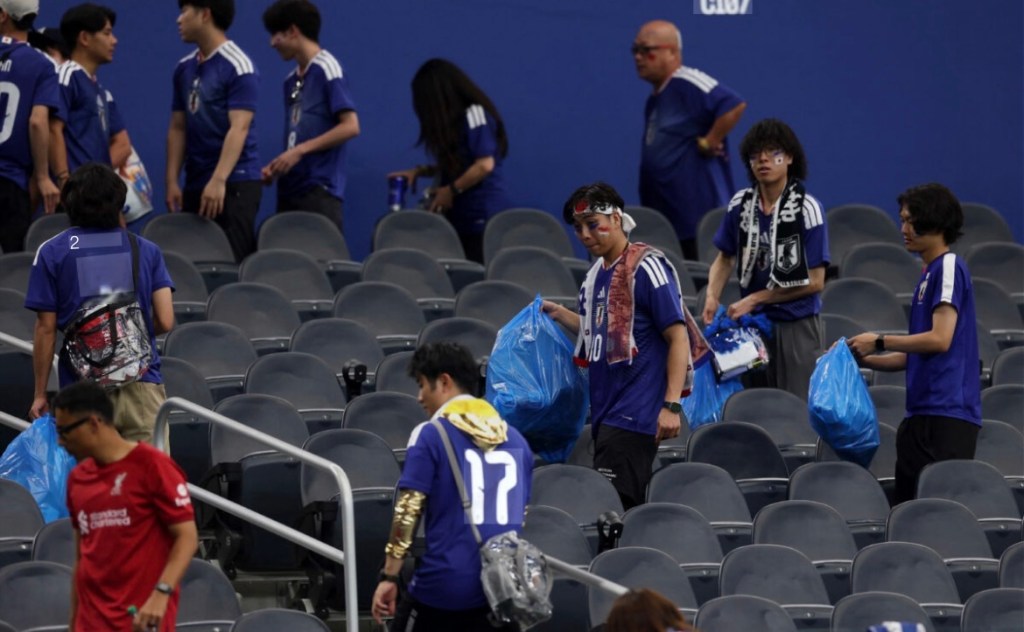
It was the 2022 FIFA World Cup. Morocco had just beaten Japan. The stands were electric, then suddenly empty — 45,000 people filtering out into the Doha night.
And the Japanese fans stayed behind.
Not to celebrate. Not to grieve. They reached into their bags — not for scarves or flags — but for blue plastic bin bags. And then, quietly, methodically, they got to work. Row by row, section by section, collecting the cups and wrappers and confetti left behind by the entire stadium.
No announcement. No ceremony. Just work.
When they finished, they bowed. And left.
This wasn’t a World Cup novelty. If you’ve watched Japanese football at home, you’ve seen the same thing — fans cleaning the stands after every match, home or away, win or loss. It’s not a campaign. It’s a culture. Rooted in a deep conviction about shared spaces: you don’t leave your mess for someone else. You take responsibility. You leave it better than you found it.
Japan lost the game that night.
But the images of those fans — with their blue bin bags in a stadium they had no obligation to clean — went global. News outlets ran it. Rival supporters spoke about it. People who’ve never watched a football match in their lives shared it on social media.
They were trying to leave no trace.
Instead, they left the most significant trace of all.
Custodians, Not Owners
In Legacy, his brilliant study of All Blacks rugby culture, James Kerr describes something quietly radical at the heart of New Zealand’s most famous team.
Players are not owners of the jersey. They are custodians.
Every player who pulls on the black shirt receives it from those who came before. Their job is not merely to perform — it’s to leave the jersey in better condition than when it arrived in their hands. The legends who wore it elevated it. Your job is to elevate it further, then pass it on.
The question embedded in All Blacks culture isn’t “Did I win?” It’s “Did I leave this better than I found it?”
The difference matters more than it might seem. Winning is about the moment. Custodianship is about what comes after.
You can win a game and erode a culture. You can lose a game and strengthen one. The Japanese fans lost the match. They won something larger — and they weren’t even trying to.
Give Careful Thought to Your Ways
There’s a moment in the book of Haggai where God interrupts his people with something that sounds less like prophetic thunder and more like a firm hand on the shoulder.
“Now this is what the Lord Almighty says: ‘Give careful thought to your ways. You have planted much, but harvested little… Give careful thought to your ways.’” (Haggai 1:5–7)
The people weren’t idle. They were busy. Building things, maintaining things, keeping things running. But God’s question cuts clean through the activity:
Is what you’re building actually getting better?
The temple — the dwelling place of God among his people, the thing that most mattered — was in ruins. Not through dramatic collapse, but through gradual neglect while everyone focused on their own concerns. The shared thing, the sacred thing, had quietly slipped.
God’s word here isn’t condemnation. It’s an invitation to pause and be honest. Is this working?
The hardest part of Haggai isn’t the rebuke — it’s the question. Because the people could easily defend themselves: “We’ve been busy. We’ve been faithful. We’ve been working.” And they had been.
But busyness isn’t the same as building. Activity isn’t the same as improvement. And maintaining what you’ve received is not the same as leaving it better.
The Paradox of the Bin Bag
Here’s what strikes me most about those Japanese fans: they weren’t trying to make history. They were trying to be faithful to something — a cultural value about care, about shared responsibility, about leaving spaces better than you found them. Not for recognition. Not for headlines. Because it’s right.
And yet. That quiet faithfulness became the headline.
The people not trying to leave a trace left the most memorable one.
Peter captures something of this when he writes: “Each of you should use whatever gift you have received to serve others, as faithful stewards of God’s grace in its various forms.” (1 Peter 4:10) Stewards. Not owners. People entrusted with something that was never really theirs to begin with.
Jesus pushed it further still: “Whoever wants to save their life will lose it, but whoever loses their life for me will find it.” (Matthew 16:25)
The greatest traces are often left by people who weren’t trying to leave one.
Three Questions Worth Consideration
Do we see ourselves as owners or custodians?
Owners ask: What can I get from this? Custodians ask: What can I give to this? Owners protect their position. Custodians protect the thing they’ve been entrusted with. The difference is subtle but it shapes everything — decisions, culture, how we respond to criticism, how we treat the people who come after us.
Is it actually getting better?
Maintenance matters. But maintenance isn’t legacy. Every team, every organisation, every church tends toward entropy unless someone is actively working against it. The question God asked through Haggai is still alive: You’ve been busy — but is it getting better?
Not globally. Locally. Specifically. Is the thing in your hands right now in better condition than when you received it?
What would it look like to serve without claiming?
The Japanese fans didn’t hold a press conference. They didn’t announce what they were doing. They just picked up the rubbish and left. And the world noticed.
Some of the most significant work you’ll ever do will be the work nobody sees. The early starts. The quiet standards. The attention to detail when no one is watching. The consistent commitment to excellence that slowly, invisibly, becomes the culture.
That’s not nothing. That’s legacy.
Leave It Better
The All Blacks don’t wait for a crisis to ask whether they’re improving. The Japanese fans — still at it at the 2026 World Cup, still arriving with blue bin bags, still cleaning stadiums they had no obligation to clean — don’t wait until things fall apart before they act. It’s not a gesture. It’s a culture. A discipline repeated until it becomes identity.
And Haggai’s people needed a prophet to ask the question we should be asking ourselves without prompting.
Give careful thought to your ways.
Not as a rebuke. As a practice. Something built into the rhythm of your week — not because something has gone wrong, but because the thing in your hands deserves honest attention.
So. What’s in your hands?
One team. One relationship. One process. One responsibility. Is it better because of you? Or have you accepted fine when you once demanded excellent? Have you been maintaining what you inherited instead of improving it? Have you been busy but not building?
Give careful thought to your ways.
We don’t maintain legacy. We build it or we erode it — slowly, daily, in decisions no one is watching.
The jersey is in your hands. Someone handed it to you. Someone is waiting to receive it from you.
Leave it better.


Leave a Reply