• The Capacity Gap

    How to Move from Full to Overflowing

    Picture your leadership like a coffee cup — a large one, obviously, because you’re ambitious. It’s filled right to the brim. Not a drop of room left. And every day, someone comes along and tries to pour more in.

    That’s where a lot of leaders live.

    Not lazy. Not uncommitted. Not lacking in faith. Just full. Stretched to the edge of what they can hold. And somewhere in the middle of all of it, they whisper the quiet lament that nobody quite says out loud: “I wish I could do more. I want to do more. But I’m at capacity.”

    Here’s the thing: that feeling is not a sign you’ve failed. It’s a sign you’ve grown as far as your current container allows. And if you want to carry more — more responsibility, more fruit, more impact — the container has to change.

    Paul captures this beautifully in one of the most quoted but least examined verses in church leadership culture. Ephesians 3:20: “Now to him who is able to do immeasurably more than all we ask or imagine, according to his power that is at work within us.”

    We love that verse. We put it on vision boards and splash it across church screens in bold fonts. But Paul doesn’t write it as a motivational tagline — he writes it as the conclusion of a prayer. And in that prayer, tucked inside Ephesians 3:14–21, is an entire framework for how capacity actually grows.

    There are three moves in Paul’s prayer, and they map directly onto how leadership capacity expands. It starts on the inside. It expands through new frameworks. And it’s sustained through daily discipline.


    1. Capacity Starts on the Inside

    Paul begins his prayer not with strategy or skill, but with the inner life:

    “I pray that out of his glorious riches he may strengthen you with power through his Spirit in your inner being, so that Christ may dwell in your hearts through faith.” — Ephesians 3:16–17

    Before God expands what you carry on the outside, He deepens who you are on the inside. The foundation of increased capacity is not competence — it’s character.

    Craig Groeschel puts it plainly: “Talent can get you to the top, but only character can keep you there.” What he means is this: your skills might open the door to greater responsibility, but your inner life determines whether you can sustain it.

    Think about Joseph. Before he became Prime Minister of Egypt, he spent years in two crucibles — Potiphar’s house and a prison cell. Places where no one was watching, where there was nothing to perform for, where his character was quietly forged. The capacity to govern a nation wasn’t handed to him the moment he was given the keys to Egypt. It was built in the hidden places long before anyone knew his name.

    That’s how it works. The inner life is not the preparation for the real work — the inner life is the real work.

    So before you ask “How do I lead more?”, ask “Who am I becoming?” Before you reach for greater capacity, ask whether your spiritual foundations — your prayer life, your self-awareness, your emotional health, your integrity — can bear the weight of what you’re asking for.

    Because a bigger platform on a weak foundation is not a blessing. It’s a collapse waiting to happen.


    2. Capacity Expands Through New Frameworks

    Once the inside is growing, the outside must change to keep pace.

    Paul prays that believers would “grasp how wide and long and high and deep is the love of Christ” (verse 18) — an expansion of perspective, of framework, of the mental architecture we bring to the world. And two other passages give this practical shape.

    Isaiah 54:2: “Enlarge the place of your tent, stretch your tent curtains wide, do not hold back; lengthen your cords, strengthen your stakes.”

    And Jesus, in Mark 2:22: “No one pours new wine into old wineskins.”

    God wants to pour new wine — new growth, new opportunity, new responsibility — but you cannot receive it in old, rigid structures. The wineskin has to change.

    The most powerful wineskin change for a leader is delegation. And the clearest articulation of it I’ve encountered in modern leadership thinking is this, from Andy Stanley: “Only do what only you can do.”

    Not “only do what you’re good at.” Not “only do what you enjoy.” Only do what only you can do. Everything else should be done by someone else.

    Moses was the greatest leader of his generation — and he was burning out. His father-in-law Jethro walked into the camp, watched him judge disputes from morning to evening with thousands of people queuing, and said something that changed the entire trajectory of Israel’s capacity as a nation (Exodus 18). He didn’t say “work harder” or “pray more.” He said, “Build a framework. Delegate. Stop trying to carry it all.”

    That conversation expanded the capacity of an entire people.

    Here’s the hard truth: many leaders are at capacity not because they lack gifting, but because they’re doing things that someone else could and should be doing. Every time you hold onto a task that belongs to someone else, you’re blocking two people — yourself and them.

    Increased capacity demands the courage to let go.

    What are you currently carrying that needs to be handed on? What is in your hands that was never meant to stay there?


    3. Capacity Is Sustained Through Daily Discipline

    The third move in Paul’s prayer is perhaps the most demanding. He prays that they would “grasp” the full dimensions of Christ’s love — and that word grasp implies effort, pursuit, and sustained commitment. This isn’t a one-time event. It’s a daily orientation.

    Capacity is not a destination. It’s a discipline.

    William Wilberforce didn’t abolish slavery in a season of heroic inspiration. He fought for 46 years — expanding his influence, his resilience, his political wisdom, and his coalition year after year, decade after decade. The capacity that ultimately changed the empire was not granted in a moment. It was built across a lifetime of daily commitment to a cause greater than his comfort.

    Michael Jordan was cut from his high school basketball team. The capacity to become the greatest of all time wasn’t given — it was chosen. Daily. In the gym before anyone else arrived. In the reps no one filmed. In the discipline of refusing to accept his current ceiling as permanent.

    Your capacity today is not your capacity tomorrow — if you train for it.

    John Maxwell talks about the compounding effect of doing important things daily. Small disciplines, consistently applied, produce exponential results. The leader who reads for thirty minutes a day for a year has read over fifteen books. The leader who meets weekly with a mentor for five years has had 260 formative conversations. These things don’t look spectacular in the moment. They’re building something that lasts.

    So: what’s the one daily or weekly discipline — prayer, reading, mentorship, physical health — that you’ve been meaning to start but haven’t? Because capacity isn’t built in grand gestures. It’s built in quiet, faithful, repeated choices.


    From Full to Overflowing

    Paul’s prayer lands on this extraordinary promise:

    “Now to him who is able to do immeasurably more than all we ask or imagine, according to his power that is at work within us, to him be glory in the church and in Christ Jesus throughout all generations, for ever and ever!” — Ephesians 3:20–21

    The phrase that stops me is “according to his power that is at work within us.” The limiting factor in what God does through us is directly connected to what God is doing in us. Our expanding capacity becomes the conduit for His immeasurable power.

    Psalm 23:5 says, “My cup overflows.” That’s the goal. Not just a full cup — an overflowing one.

    Here’s the thing about an overflowing cup: it always refreshes someone else.

    A full cup benefits you. An overflowing one benefits everyone around you.

    The leaders who change the world are not the ones who simply managed their capacity well. They’re the ones who kept expanding it — who kept working on the inside, kept building new frameworks, kept showing up to the daily discipline long after the initial excitement faded.

    The capacity gap is real. But it is not fixed.

    Build your inner life. Build new frameworks. Build the daily habit.

    And watch what God does with a leader who refuses to stay full.

  • The Church is the Goal

    In 2004, the United States assembled what many called the greatest basketball team in history. LeBron James. Carmelo Anthony. Tim Duncan. Dwyane Wade. On paper, they were unbeatable.

    They lost to Argentina.

    Argentina didn’t have better individuals. They had something the Americans didn’t — chemistry. Years of playing together, sacrificing together, trusting each other. They were heading somewhere together, and it showed.

    And here’s what that tournament proved to anyone paying attention: talent alone doesn’t win. Togetherness does.


    We’ve Been Reading the Gospel Too Small

    Most of us have been taught to read the gospel through a very specific lens: How can I be forgiven? How do I get right with God? How do I get to heaven?

    None of those questions are wrong. Personal faith is real. Justification is real. Your salvation is personal and it matters.

    But it’s incomplete — and that incompleteness has cost us something we can barely afford to lose.

    Because the gospel, read in its full biblical sweep, is a story heading somewhere. And when you follow it all the way to its destination, what you find is not a collection of saved individuals. What you find is a people.

    The whole of Scripture has a trajectory. It moves. It builds. There is a direction to it, a gathering momentum, a destination it has been heading toward from the very first page. And once you see it, you can’t unsee it.

    Trace the story from the beginning.

    Genesis 12. God speaks to one man — Abraham. But the content of the promise is entirely corporate: “I will make you into a great nation… and all peoples on earth will be blessed through you.” Not a collection of individually blessed people. A nation. A people with a calling, a story, a direction. God starts with a man but he’s already talking about a movement.

    Sinai. God has just rescued Israel from Egypt — the defining salvation act of the Old Testament, the exodus — and what does he say at the mountain? “You will be for me a kingdom of priests and a holy nation” (Exodus 19:6). Not: you will be a gathering of saved souls. A kingdom. A priestly body for the sake of the whole world. The rescue was real — but the rescue was always going somewhere.

    Corporate identity isn’t an add-on to salvation. It’s the shape of salvation.

    Then Jesus arrives. And what does he say? “I will build my church” (Matthew 16:18). My ekklesia — my assembly, my gathered people. Not: I will save some souls. He announces a destination: a community.

    And then Paul says something in Ephesians 2 that should stop us in our tracks:

    “His purpose was to create in himself one new humanity out of the two, thus making peace, and in one body to reconcile both of them to God through the cross.” — Ephesians 2:15–16

    One new humanity. That’s eschatological language — language about the end, the destination, where everything has been heading. Paul isn’t saying two groups of individuals got forgiven. He’s saying Jesus created something at the cross — a third thing that had never existed before. Not Jew saved. Not Gentile saved. But Jew and Gentile, together, forming one new people. A new humanity. The cross doesn’t just deal with individual sin — it dismantles the walls between human beings and constitutes the community God was always building toward.

    N.T. Wright puts it with characteristic precision:

    “Salvation, in Paul’s world, is not primarily about individual rescue from judgment. It is about the creation of a new people — a new humanity — in whom the ancient divisions of the human race are overcome and God’s cosmic purposes are brought to completion. The church is not an appendage to the gospel. The church is the goal of the gospel.“

    The goal. Not a by-product. Not a useful structure. The destination the whole story was heading toward.

    And the final image of the Bible confirms it. Revelation 21 — when the curtain pulls back on the end of all things — what do we see? Not individuals floating on clouds. We see a city. The New Jerusalem descending from heaven. A city is corporate. A city is community. A city is people ordered together around shared life.

    John Stott writes: “The Bible begins with a garden and ends with a city. That movement is intentional. God’s ultimate purpose is not a collection of saved souls — it is a redeemed community, a new society, a people who bear his image together.”

    A garden with a family. A nation at a mountain. The messiah announcing a church. A city descending from heaven. The whole story is moving in one direction — toward a people, reconciled and gathered, bearing the image of God together for eternity.

    The church is the goal. Everything was heading here.


    What Is Communitas — and Why Does It Matter?

    Victor Turner was an anthropologist who spent his career studying how human communities form. He identified two very different kinds of togetherness.

    The first he called community (or societas) — the comfort of people who share space, preference, or proximity. You live in the same neighbourhood. You attend the same church. You like the same things. It’s pleasant. But it’s relatively shallow. The thing holding you together is convenience, not conviction.

    The second he called communitas — something entirely different. The deep, almost inexplicable bond that forms among people who have faced something together. A shared ordeal. A shared mission. A liminal experience — a threshold moment — that changes everything.

    Think of soldiers who’ve been through combat together. A team that’s survived a brutal pre-season. Missionaries who’ve gone into a hard place side by side. Something happens in those shared experiences that cannot be manufactured through better programmes or cleverer scheduling.

    Jon Tyson captures it well:

    “Communitas is not manufactured through programming; it emerges through shared mission, shared sacrifice, and shared suffering. When a group of people face something bigger than themselves together, they become something to each other they could never become in comfort.”

    The early church was not a social club. It was communitas — and it was communitas because it was a people who knew they were part of a story heading somewhere, and that story was going to cost them something.

    Look at Acts 4:32 — and don’t skip past it too quickly:

    “All the believers were one in heart and mind. No one claimed that any of their possessions was their own, but they shared everything they had.”

    One in heart and mind. Affection and conviction aligned. These were not naturally compatible people — fishermen and tax collectors, Jews and Gentiles, rich and poor. What created this?

    Two verses earlier: they had just been threatened by the authorities. Real opposition. The kind that could cost them everything. And instead of scattering, they prayed together. The Spirit moved. And persecution became the forge.

    Notice what happened to their sense of ownership: they stopped thinking in terms of mine. They now thought in terms of ours. That’s not communism — it’s covenant. And there’s a crucial difference. Communism is enforced. Covenant is chosen. They weren’t compelled to do this. They simply couldn’t imagine doing otherwise.

    That’s what happens when people know they’re heading somewhere together. It rearranges your sense of self. The destination stops being personal and starts being collective.


    Unity Is an Evangelistic Statement

    In John 17, on the night before the cross — hours from Gethsemane, hours from his arrest — Jesus prays. And what does he pray?

    Not for protection. Not for rescue. Not even for the disciples’ safety.

    He prays for us. For unity. For people who would believe through the words of the disciples — that we might be one.

    “That they may all be one, just as you, Father, are in me, and I am in you… so that the world may believe that you have sent me.” — John 17:21

    The standard is Trinitarian. The purpose is missional. Unity, Jesus says, is how the world comes to believe.

    Tim Keller writes: “The gospel is the only force that can unite people across the deep natural divides of race, class, personality, and background into a community that the world cannot explain. When that unity exists, it is one of the most powerful proofs that Jesus Christ is truly Lord.”

    A church genuinely unified across difference — across ethnicity, generation, class, personality — produces something sociology cannot account for. It becomes a visible sign that the story is still moving, still heading somewhere. It becomes an argument for the resurrection that no debate can touch.

    This means disunity is not merely a pastoral inconvenience. It is a missional catastrophe. Every fracture, every gossip-driven division, every frosty relationship between people who once walked together — these aren’t just relational breakdowns. They are a denial, in practice, of what we claim in doctrine. They are people who have stopped moving toward the destination together.


    You’re Part of a Story Still in Motion

    The Argentina squad didn’t win because they were individually brilliant. They won because they were genuinely together — forged by years of shared sacrifice, heading toward a shared goal.

    The early church didn’t turn the world upside down because they were individually gifted. They turned the world upside down because they had communitas — shared mission, shared suffering, shared hope — and the Spirit of God moving among them. They knew the story wasn’t over. They knew they were part of something heading somewhere. And that changed everything about how they lived.

    So here’s the question worth sitting with:

    Are you a person who attends church — or a person on a shared mission with a people?

    One of those produces community. The other produces communitas. And only one of them is actually heading somewhere.

    Erwin McManus writes: “The church does not exist for us. We are the church, and we exist for the world.”

    The Bible began in a garden and it ends in a city. That’s not incidental. That’s the direction of the whole story — from a family to a nation to a church to a city, God has always been building toward a people. The church is the goal of the gospel.

    And here’s the extraordinary thing: we’re not at the end yet. The story is still moving. The city is still being built. And you — your willingness to stay, to sacrifice, to be genuinely for the people around you — is part of how it gets there.

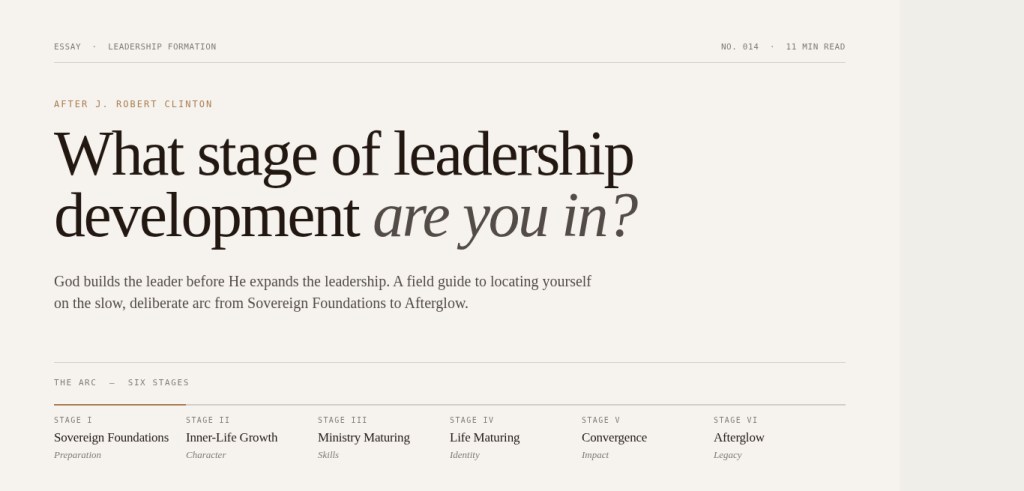
  • “What Stage of Leadership Development Are You In?”

    I want to ask you a question that might be more unsettling than it sounds.

    Are you frustrated with where you are in your leadership right now?

    Maybe you feel like you should be further along. Maybe you’ve been in the same role for years and something in you is quietly wondering if this is it. Maybe you’re in a season that feels like subtraction — less influence, less visibility, more obscurity — and you’re not sure if it’s preparation or punishment.

    Before you answer that question, let me introduce you to a man named J. Robert Clinton.

    Clinton was a long-time professor at Fuller Theological Seminary who spent decades doing something unusual: he studied the leadership development of hundreds of Christian leaders across history — A.W. Tozer, Watchman Nee, Dawson Trottman, and many others — and he looked for patterns. What he found changed the way I think about my own leadership journey, and I believe it might do the same for you.

    His central claim? Leadership is not primarily about skills, positions, or strategies. It is about a process. A God-designed, often slow, frequently uncomfortable, deeply intentional process that takes a lifetime.

    And that process, he argued, moves through six recognisable stages.


    Before We Begin: The Most Important Sentence Clinton Ever Wrote

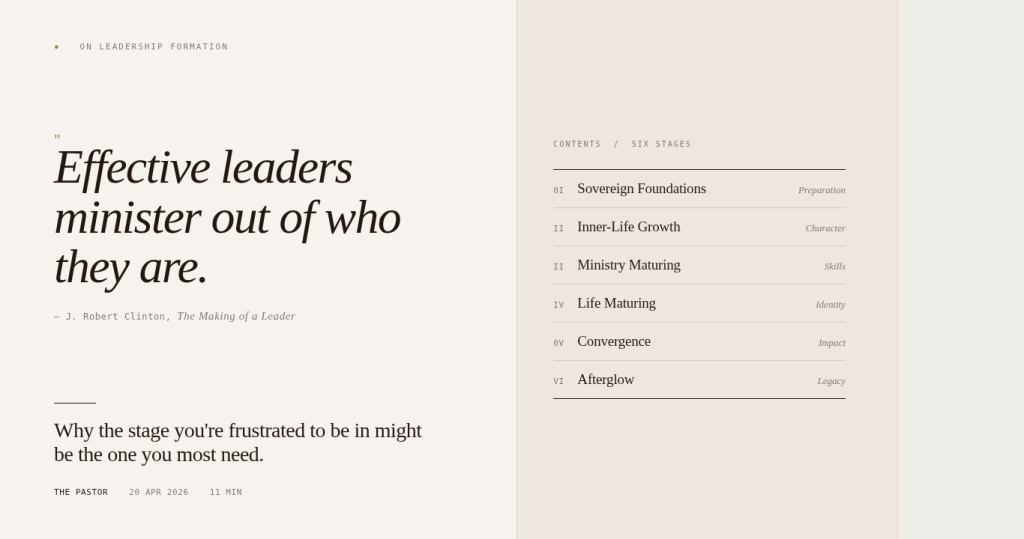
    Here it is: “Effective leaders minister out of who they are.”

    Everything else flows from that. The whole point of Clinton’s research is that God is less interested in what you’re producing right now than in who you’re becoming. That reframe alone — if you’ll let it settle — changes the entire way you interpret your current season.

    Now, the six stages.


    Stage 1: Sovereign Foundations

    This is the stage you didn’t choose and can’t control.

    It includes everything that shaped you before you were consciously leading anything: your family background, your cultural context, your early spiritual exposure, the experiences — good and painful — that formed your personality and your instincts. God is laying a foundation in you that you won’t fully understand until much later.

    Moses spent forty years in Pharaoh’s palace and another forty in the wilderness before he led a single person out of Egypt. David was shaped as a shepherd — alone, unknown, defending sheep — long before he wore a crown. Paul’s training as a Pharisee, which must have felt like an embarrassing detour after his conversion, became the very platform from which he engaged the intellectual world of the first century.

    Your story is not a distraction from your calling. It is part of it.


    Stage 2: Inner-Life Growth

    This is where God’s primary concern shifts inward.

    You’re learning to pray. You’re learning obedience. You may have early mentors, early spiritual formation, early glimpses of what God has placed in you. But more than anything, you’re being tested — integrity tests, obedience tests, moments where you have to decide whether you’ll do the right thing when no one is watching and nothing is on the line.

    Clinton’s research showed that the lessons not learned in this stage simply repeat. God is patient and persistent. If the issue is pride, He’ll keep putting you in situations that expose it until you deal with it. If the issue is a tendency to cut corners, or to perform for an audience, or to draw identity from results — it will come around again.

    This stage is often invisible to everyone around you. That’s the point.


    Stage 3: Ministry Maturing

    Now you’re doing things. Leading teams, preaching, serving, running projects, experimenting with your gifts. This stage is often exciting and messy in equal measure. You’re discovering what you’re good at, but also where your edges are. You’re learning how to lead people, and people are showing you exactly where your character still needs work.

    Here’s what Clinton says is the critical insight about the first three stages combined, and it’s the thing that most emerging leaders completely miss:

    In stages one, two, and three, God is working primarily in the leader — not through them.

    Many of us spend these years evaluating our productivity, measuring our outputs, anxious about what we’re producing. Meanwhile, God is quietly evaluating something else entirely: our character. He wants to teach us that we can only minister out of what we are. Skills can be borrowed. Character cannot.


    Stage 4: Life Maturing

    Something begins to shift in this stage. Ministry and character start to deepen together. You begin to understand not just what you can do, but what you were made for. Calling becomes clearer. You start to work through people rather than just alongside them. Communion with God — not ministry success — becomes your deepest source of life.

    Clinton describes a key transition in this stage: leaders move from doing ministry to leading ministry. It’s the shift from being the person who does everything to being the person who shapes everything. And it requires a kind of letting go that doesn’t come naturally to driven people.

    The Apostle Paul captures the spirit of this stage well. By the time he writes Philippians from a prison cell, he’s not anxious. He’s not striving. He writes, “I have learned, in whatever state I am, to be content” (Philippians 4:11). That word learned is significant. Contentment is not a personality type. It is a hard-won formation.


    Stage 5: Convergence

    This is where it gets provocative.

    Convergence is the stage where God aligns everything — your calling, your giftedness, your experience, your character, your opportunity — and you step into the role you were uniquely designed for. Maximum fruitfulness. Maximum effectiveness. Doing exactly what God made you to do, at the right time, with the right authority.

    Clinton studied this stage extensively. His conclusion was sobering: very few leaders actually get here.

    Many stall in Ministry Maturing, forever busy but never quite focused. Others never push through the discomfort of Life Maturing. Some derail through character failure. Others are limited by their own poor self-awareness — they’ve never done the hard work of understanding what they’re actually called to.

    Think of Nehemiah, arriving in Jerusalem with a singular clarity of assignment. Think of Moses at the burning bush, eighty years in the making. Think of Paul writing his epistles — not grasping for influence, but operating out of a settled sense of call.

    Convergence is possible. But it is not inevitable.


    Stage 6: Afterglow

    For the few who reach it, this final stage is not retirement — it is multiplication. Leaders in this stage exert broad, indirect influence through the networks they’ve built, the leaders they’ve mentored, the wisdom they’ve accumulated. The focus shifts from leading movements to multiplying leaders. The fruit of a life faithfully lived.

    Paul to Timothy: “What you have heard from me in the presence of many witnesses entrust to faithful people who will be able to teach others also.” (2 Timothy 2:2). Four generations of leadership in one sentence.


    So — What Stage Are You In?

    Here’s a simple grid that might help you locate yourself:

    Clinton’s research is ultimately a gift — not because it gives you a ladder to climb, but because it gives you permission to be exactly where you are. The obscure season is not wasted. The painful test is not random. The delay you’re frustrated by is not a mistake.

    God builds the leader before He expands the leadership.

    The question isn’t whether you’re where you wish you were. The question is: what is God teaching you in this stage?

    That question, taken seriously, is what separates leaders who reach convergence from those who spend their whole lives in preparation for something they never quite step into.

    Don’t be in such a hurry to get to the next stage that you miss what this one is for.


    J. Robert Clinton’s The Making of a Leader is one of the most important books I’ve read on leadership development. If you’re investing in emerging leaders — or trying to understand your own journey — it’s essential reading.

  • What Got Us Here Will Get Us There

    You’ve heard it said: What got you here won’t get you there.

    It’s one of those phrases that gets repeated in leadership circles until it loses its edges. And there’s truth in it. There are seasons that demand course corrections. Moments when we have to shed old patterns and learn new ways of thinking and leading. Nobody reaches a new level by insisting nothing needs to change.

    But here’s what I’ve been sitting with: there are also things that were put into our lives — convictions, patterns, principles, practices — that if we stay faithful to them, will get us to where God wants us to go. Not everything that brought us here needs to be left behind.

    Which brings me to what I want to talk about.

    Think about something that was given to you. Not bought. Not earned. Handed over by someone who loved you.

    Maybe it was your grandfather’s watch — worn and scratched, but it still ticks. Or your grandmother’s recipe, her handwriting on a card slightly faded, folded and unfolded so many times the creases are nearly worn through. Or a piece of furniture with a story attached: This was your great-great-aunt’s, brought over from Ireland.

    What makes those things valuable? It isn’t novelty. Nobody says, “This watch is amazing — it’s brand new.” What makes them valuable is provenance. Proven worth. The fact that it survived. The fact that it was trusted to you.

    The Christian faith is exactly that kind of inheritance.

    Not something we invented. Not something every generation gets to redesign from scratch. Something handed to us — carefully, at great cost — by people who sometimes died to make sure it arrived intact.


    The Pressure to Revise Everything

    We live in a world that treats faith like a streaming service. Constantly updating. Algorithmically adjusted to what you prefer. Curated to your tastes. If you don’t like this version, there’s a new one loading.

    And the pressure doesn’t always come from outside the church. Progressive voices say: Orthodoxy is just power dressed up as truth. Pragmatic voices say: What matters is what works, not what’s always been believed. Therapeutic voices say: As long as people feel accepted, does doctrine really matter?

    I want to take those voices seriously, because they’re not always entirely wrong. There have been times when the church clung to tradition out of fear rather than faith — when what was called “orthodoxy” was actually just the dead weight of preference.

    So let me give you a distinction that I think cuts through the confusion.

    Jaroslav Pelikan, the great church historian, put it like this:

    “Tradition is the living faith of the dead. Traditionalism is the dead faith of the living. And, I suppose I should add, it is traditionalism that gives tradition such a bad name.”

    Read that again slowly. Tradition — the living faith of the dead. Traditionalism — the dead faith of the living.

    We are not traditionalists. We are not clinging to forms out of familiarity, protecting our comfort zones, resisting the Spirit’s movement because we’re afraid. But we are orthodox. We believe that what has been entrusted to the church is not ours to rewrite. We receive it. We guard it. We live it forward.


    Jude’s Urgent Letter

    Jude is one of the shortest books in the New Testament — 25 verses, easy to skip. But don’t let its size fool you. This is one of the most direct, urgent, uncompromising letters in the entire canon.

    Jude had a letter planned. He was ready to write about the joy of salvation. Then something happened — false teachers had crept into the community, twisting grace into licence, distorting the very character of Jesus. Jude couldn’t ignore it.

    So he picks up his pen and writes a different letter. A rallying cry. And right at the heart of it — verse 3 — is one of the most important statements in the entire New Testament:

    “Dear friends, although I was very eager to write to you about the salvation we share, I felt compelled to write and urge you to contend for the faith that was once for all entrusted to God’s holy people.” — Jude 1:3

    Three words matter enormously here.

    Once for all. The Greek is ephapax — done, settled, complete. Not provisional. Not ongoing. Not subject to further revision. The foundation is fixed.

    Entrusted. This is inheritance language. Gift language. The faith wasn’t discovered — it was delivered. It came from outside us, through the apostles, through eyewitness testimony, through the movement of the Spirit across history. We received something we didn’t build. Something many gave their lives to protect.

    Contend. The Greek word carries the image of a wrestler straining for position, a soldier holding ground. Jude isn’t inviting gentle reflection. He’s calling for courageous, active engagement. As John Piper once wrote: “There is a body of doctrine worth contending for. There is truth worth dying for. That is hard for our relativistic culture to understand.”


    The Baton We’re Carrying

    Think about a relay race.

    When a runner receives the baton, their one job is to carry it faithfully to the next person. They didn’t design it. They didn’t choose its shape or weight. Their job isn’t to redesign it on the way round the track. Their job is to run well and hand it over intact.

    That’s us.

    We are somewhere in the middle of a very long relay. The apostles ran first. The church fathers ran. The reformers ran. The missionaries ran. The martyrs who died in Roman arenas and African fields and Asian prisons — they ran. And they handed it to us.

    The question isn’t: What do we want the faith to be?

    The question is: Are we carrying it well?

    This faith has a name. In the second century, as the church faced pressure from false teachers pulling it in every direction, ordinary believers began reciting together:

    I believe in God, the Father Almighty, Creator of heaven and earth. I believe in Jesus Christ, His only Son, our Lord…

    The Apostles’ Creed. Not a piece of liturgical furniture. A battle cry. A statement of non-negotiables. A summary of the faith once for all delivered to the saints. People kneeled in Roman arenas, given the choice to renounce or die, and recited these words. That is what has been passed to us.


    Scripture: Our Compass, Not Our Weather Vane

    Paul wrote to Timothy: “All Scripture is God-breathed and is useful for teaching, rebuking, correcting and training in righteousness.” (2 Timothy 3:16–17)

    Here’s an image that helps me. You’re navigating somewhere new. You could use a compass — always pointing north, steady, reliable. Or a weather vane — spinning with every shift in the wind, pointing wherever the current blows.

    Culture is a weather vane. Understanding culture matters enormously. But it cannot be our compass. Scripture is our compass.

    One of the great temptations of every era — including ours — is to use the parts of Scripture we like and quietly ignore the parts that make us uncomfortable. The moment we start editing the Bible based on what the culture finds palatable, we’ve stopped navigating by compass. We’re spinning with the weather vane.

    Erwin McManus puts it simply: “The Bible is not an antiquated text. The Scriptures are the text that will lead us into the future.”

    What got us here will get us there.


    A Living Inheritance, Not a Museum Piece

    Here’s where I want to finish.

    Look at the fruit.

    The faith delivered through the apostles has, over two thousand years, abolished child sacrifice, abolished gladiatorial combat, created the first hospitals, founded universities, given dignity to the poor, given freedom to enslaved people, carried hope into every continent on earth. This is not a perfect record — the church has failed and sinned and we must own that honestly. But the fruit of genuine, rooted orthodoxy across history is undeniable.

    Luke 7:35: “Wisdom is proved right by all her children.”

    Two thousand years of children. That’s the evidence.

    John Stott wrote that the Christian is not someone who has found a new truth, but someone who has found the Truth — and that Truth is a Person. The faith we guard is not a philosophical system. It is the story of Jesus Christ, the same yesterday, today, and for ever.

    The changelessness of Jesus is not the problem in a changing world. It is the solution.

    We are not revisionists who rewrite the faith because it feels archaic or offends us. We are orthodox believers with a fully alive faith that has been transforming lives for two thousand years. A faith that got us here — and will get us there.


    How to Respond

    Three anchors to return to this week.

    Anchor in Scripture — not as a rulebook, but as the living Word. Read it. Wrestle with it. Let it correct you. Let it be your compass when the culture is telling you to spin.

    Anchor in the Creed — not as empty recitation, but as joyful declaration. Speak it aloud this week and mean it. This is the deposit. This is what people died for.

    Anchor in community — the faith was not delivered to isolated individuals. It was delivered to God’s holy people. Your small group, your church, the people around you — this is where you work it out together.

    We carry the deposit. We carry the baton. We stand on the shoulders of the apostles.

    The question for each of us is simply this: Will we carry it well?

  • Why “Fake It ‘Til You Make It” Is Not a Sustainable Leadership Strategy

    There is a piece of advice that gets handed around in business circles like wisdom. You have heard it. You may have even lived by it. Fake it ’til you make it. The idea is straightforward enough: project confidence before you have the competence. Build the brand before you have the product. Market the promise before you can fulfil it.

    In the startup world, this became something close to doctrine. Create the identity first — the logo, the aesthetic, the story — then build the actual thing to match. For some, it worked. For many more, it collapsed the moment reality caught up with the projection. The gap between image and substance has a way of closing. And when it does, it rarely closes in your favour.

    What concerns me more than its presence in business is where this thinking has quietly settled in the church. We have leaders who have mastered the language of vision and calling, who can project authority and prophetic weight, but whose inner life — their character, their formation, their depth — has not yet caught up with the platform they are standing on. And sometimes, perhaps without fully realising it, we have dressed up “fake it ’til you make it” in spiritual clothing and called it prophetic.

    The Problem with Brand-First Leadership

    Modern strategy in business is essentially this: establish who you want to be perceived as, then work backwards. Build the audience before you build the product. Sell the dream before you can deliver it. There is a certain logic to it in the commercial world, where branding and demand-generation serve real purposes. But leadership — real leadership — does not work that way. Because leadership is not primarily about perception. It is about trust. And trust is not built through clever positioning. It is built through proven character over time.

    When leaders build a platform that exceeds their character, one of two things happens. Either the weight of the platform eventually exposes what is missing underneath, or the leader spends an exhausting and ultimately unsustainable amount of energy managing the gap. Neither is a good outcome. The first is a crisis. The second is a slow collapse dressed up as ministry.

    When “Prophetic” Becomes a Cover Story

    Here is where it gets uncomfortable for those of us in church leadership.

    There is a version of “fake it ’til you make it” that has found a home in charismatic and evangelical ministry culture. It goes something like this: a leader feels called to something significant — a church, a movement, a platform, a ministry. The calling feels real. The vision is compelling. And so, instead of submitting to a formation process, they simply declare it. They speak it into existence. They present the vision as though it is already accomplished. They lead with the language of what will be as though it already is, without the substance, the character, or the track record to underwrite the claim.

    Now — to be clear — there is something genuinely prophetic in the church. Speaking faith-filled vision, declaring what God has promised, stepping out before you can fully see: these are all legitimate expressions of faith-based leadership. The problem is not prophetic vision. The problem is using prophetic language as a substitute for formation. It is claiming a future that you have not yet been shaped to carry.

    The biblical prophets were not people who simply made bold declarations. They were people who had been through something. Isaiah encountered the holiness of God and was undone before he was sent. Jeremiah was told he was known before he was formed, but he still walked decades of painful ministry before the words carried weight. Moses spent forty years in the desert before God spoke from a burning bush. The declaration came after the formation, not instead of it.

    The Sequence That Changes Everything

    One of the most clarifying frameworks I have encountered in leadership development comes from the work of Robert Clinton, whose research into hundreds of biblical and historical leaders revealed a pattern that runs entirely counter to the brand-first approach.

    Clinton observed that God consistently develops leaders in a specific sequence: Know → Be → Do.

    First, the leader comes to know — knowledge, revelation, theological depth. Then, before they are sent to do, God insists on the being stage. The shaping of character. The formation of the inner life. The tests of integrity and obedience. Only then does effective action flow naturally from who the person has become.

    The world, and unfortunately much of contemporary ministry culture, tends to run this sequence in reverse: Do → Be → Know. Get busy. Figure out who you are later. Learn on the job. But Clinton’s research found something sobering: the leaders who skipped or rushed the formation stage — the being stage — were the ones most likely to experience catastrophic failure later, often at the point of their greatest influence.

    His conclusion was direct: skill grows faster than character. And when that gap opens up wide enough, it becomes a chasm.

    David’s Forgotten Formula

    There is a verse in Psalm 78 that quietly holds one of the most important leadership principles in Scripture. It describes David’s leadership of Israel in just twelve words:

    “He shepherded them with integrity of heart; with skilful hands he led them.” — Psalm 78:72

    Notice the order. Integrity of heart first. Skilful hands second. Character before competency. Being before doing.

    David was not without flaws — scripture does not pretend otherwise. But the thing that made his leadership sustainable, the thing that earned him the designation of “a man after God’s own heart,” was not his strategic brilliance or his military success. It was the formation of his inner life. Years of obscurity, tending sheep, writing psalms in the wilderness, running for his life. By the time David took the throne, the throne was not bigger than the man sitting in it.

    That is the test worth applying to any leader, including yourself: Is the person bigger than the platform, or is the platform bigger than the person? When the platform outgrows the person, the whole thing becomes unstable.

    Formation Is Not a Delay — It Is the Process

    Here is the reframe that changes everything: the formation process is not what happens before your ministry begins. It isyour ministry beginning. The years of testing, character development, hidden faithfulness, and unglamorous preparation are not delays in God’s plan for your leadership. They are the plan.

    Joseph did not become a leader in spite of the pit, the false accusation, and the prison. He became a leader through them. Each test — and Clinton would call them exactly that, integrity checks — was shaping something in him that no amount of positional authority could manufacture. By the time Pharaoh placed the signet ring on his finger, Joseph’s character was ready to carry what his calling required.

    The question worth sitting with is this: Have I been shaped by what I have been through, or have I simply survived it and moved on?

    A More Sustainable Path

    So what does the alternative actually look like? It looks like:

    Pursuing depth before scale. Before you expand the platform, ask whether your inner life can sustain the weight of it. Formation is not a one-time event. It is an ongoing commitment to knowing yourself, being honest about your gaps, and submitting to the people and processes that develop you.

    Treating character as infrastructure. In the same way that a building needs foundations proportional to the floors it will carry, your leadership capacity must be proportional to your character. Mac Lake frames it simply: character and competency must develop together, not sequentially. Every skill you build should be matched by a corresponding character quality.

    Letting your track record do the talking. Authentic authority is not declared — it is recognised. You do not need to announce what you carry if you actually carry it. The leaders whose words land with weight are the ones who have earned that weight through a life people can read.

    Embracing the hiddenness. Some of the most critical leadership formation happens in seasons that feel invisible, unrecognised, and slow. Resist the cultural pressure — and the church pressure — to shortcut your way to influence. The seasons that feel like waiting are often the seasons that are doing the most work.

    The Gap Always Closes

    Here is the uncomfortable truth about fake it ’til you make it: the gap between image and substance always closes eventually. Either you do the work of formation and your character catches up to your calling — or reality catches up to you. Leadership built on projected confidence without genuine substance does not simply plateau. It collapses. And when it does, it takes people with it.

    The church deserves leaders who are not merely impressive but trustworthy. Leaders whose public face matches their private life. Leaders who have been through enough that their words carry the weight of lived experience, not just well-crafted vision.

    Character is the infrastructure that platform runs on. Build that first. Build it slowly. Build it honestly.

    The rest will follow.

  • You Can’t Change the Season — But You Can Change the Level

    I was talking recently with a group of church leaders, and I asked them to share a frustration they were carrying in ministry right now. What came back was striking — not because the frustrations were unusual, but because they were almost identical across people in completely different contexts.

    Flat momentum. A team that feels tired. A vision that feels stuck. The sense that you’re doing all the right things, but something just isn’t moving. One leader put it perfectly: “I feel like I’m running hard but going nowhere.”

    I’ve been there. Jeannie and I have pastored Ikon Church for thirty-eight years. Over that time we’ve had mountain tops and valleys, seasons of extraordinary growth and seasons of grinding it out. And the thing I’ve learned — the thing I wish someone had told me earlier — is this:

    Life is experienced in seasons. But it’s lived on levels.

    That distinction changed how I lead.


    The Writer of Ecclesiastes Saw It First

    The Teacher in Ecclesiastes opens chapter three with one of the most quoted passages in the Bible:

    “There is a time for everything, and a season for every activity under the heavens: a time to be born and a time to die, a time to plant and a time to uproot…” — Ecclesiastes 3:1-2

    Most people read this as a poem about acceptance. And there is acceptance in it — an acknowledgement that certain rhythms of life are beyond our control. But what the Teacher is really doing is more demanding than that. He isn’t counselling resignation. He is calling us to wisdom: the wisdom to recognise which season you’re in, to stop fighting what you cannot change, and to ask the better question — how do I lead and live well in the season I’m actually in?

    Because here’s the truth: you can’t control the seasons. But you can control the level at which you live within them.

    Seasons cycle. Levels ascend.

    The Apostle Paul captures this in 2 Corinthians 3:18 — “we are being transformed into his image from glory to glory.” Note the movement. Not from glory to hardship to glory. From glory to glory. The transformation is always upward. Seasons come and go they go up and down. But levels? Levels are intended to go in one direction.


    1. Seasons Are Inevitable — Levels Are Intentional

    In leadership as in life, seasons come whether you want them or not. I’ve been in momentum seasons — where everything you touch seems to turn to gold. I’ve been in seasons where I couldn’t catch a break. Seasons where everyone seemed to love what we were doing. Seasons where it felt like half the church had quietly drifted. Seasons of opposition, seasons of joy, seasons of genuine grief.

    You can’t vote on which one arrives next.

    But here’s what I’ve learned: within every one of those seasons, there is a level available to you that you have not yet occupied. The building might be the same. The city might be the same. The faces might be the same. But you don’t have to lead from the same level.

    Seasons happen to you. Levels happen in you.

    That’s not just motivational language. It’s a theological claim. Two pastors can be in the same city, the same economy, serving the same demographic — and one is leading at a fundamentally different level. Not because their circumstances are different, but because they are different. They’ve grown beyond the limits of the season.

    Proverbs 15:24 puts it simply: “The way of life winds upward for the wise.” Upward. The wise don’t plateau. They ascend. Not because their seasons are easier, but because they refuse to let their season set their ceiling.


    2. Frustration Is Not Just Agitating — It’s Educating

    So how do you know when it’s time for a new level?

    Frustration.

    I know that’s not the answer you were hoping for. But stick with me.

    Every great leader I know faces seasons of deep frustration. And the instinct — every time — is to try to fix the season. To change the strategy. To hire someone new. To launch something different. Anything to make the frustration go away.

    But often, the frustration is not a problem to fix. It’s an invitation to a new level.

    When the systems that used to work doesn’t work anymore — that’s not just a systems problem. When the way you led last year no longer inspires your team — that’s not just a culture problem. When the strategy that brought growth now feels stale — that’s not just a strategy problem. God may be using every one of those frustrations to say the same thing he said to Israel at the foot of the mountain:

    “You have stayed long enough at this mountain… See, I have given you this land. Go in and take possession.” — Deuteronomy 1:6, 8

    You have stayed long enough. That’s not a rebuke. It’s a release. God is not frustrated with you — he’s frustrated for you. He can see what’s possible on the other side of a new level, and he will not let you settle for the current one.

    Exodus 23:30 adds a patient, important word: “Little by little I will drive them out before you, until you have increased enough to take possession of the land.” Notice that word — until. The process of going level to level is the very thing that increases your capacity for what comes next. The frustration isn’t wasted. It’s formational.

    Ask yourself honestly: What’s frustrating me right now? Don’t just vent about it. Study it. Something in there is trying to tell you something.


    3. It Takes Maturity to Admit “This Level Isn’t Working”

    This is where most leaders get stuck.

    It takes real humility — and a certain kind of courage — to look at what used to work and say out loud: “It’s not working anymore.” To admit that the approach that built this team last year might not build it this year. That the system you put in place three years ago is no longer fit for purpose. That what got you here will not get you there.

    Leaders evolve or they erode. There isn’t a middle option.

    Paul’s language in Philippians 3 is instructive here. He doesn’t say he’s arrived. He says he is pressing on — and crucially, he names what makes that possible:

    “Forgetting what is behind and straining toward what is ahead, I press on toward the goal to win the prize for which God has called me heavenward in Christ Jesus.” — Philippians 3:13-14

    Forgetting what is behind. You can’t move to the next level while clinging to the last one. You cannot be offended when God shows you the deficiency of your current level. You cannot get defensive when he says, “There’s more — but it requires a different version of you.”

    The most freeing statement I’ve learned to make is this: I don’t want to hold on to anything that’s holding me back.

    That applies to attitudes, habits, systems, default modes of leadership — anything. If it’s holding you back, it has to go.


    4. From Surviving to Supernatural Leadership

    There are two storms in the Gospels that I find myself returning to.

    In the first, the disciples are in a boat, terrified, while Jesus is asleep. They wake him in panic. He calms the wind and waves. What strikes me is not the miracle — it’s the level. Jesus could sleep through what caused panic in everyone else. He wasn’t unaware of the storm. He was operating at a different level within it.

    In the second, Jesus walks on the water toward the terrified disciples. What they feared most became the ground he stood on.

    What Jesus did literally, we are invited to do metaphorically. Leaders at a new level walk on what other people drown in. They bring calm into crisis. They carry faith into fear. They lead with clarity in the very circumstances that cause others to freeze.

    That’s not leadership skill. That’s supernatural leadership. And it is available to you — not when your season changes, but when you decide to lead at a new level within the season you’re already in.


    Three Questions to Sit With This Week

    You don’t need a new season. You need a new level. Here’s where to start:

    First — what season am I actually in? Not the one you wish you were in. The real one. Name it honestly. You can’t navigate a season you won’t acknowledge.

    Second — what frustration is God using to invite me higher? Don’t just manage the frustration. Listen to it. What is it telling you about where you’ve been camped too long?

    Third — what am I holding onto that’s holding me back? An attitude. A system. A default. A posture. Something. Name it. And decide today that you don’t want to hold on to anything that’s holding you back.

    Your season may not change. But you don’t have to lead from the same level.


    What season are you navigating right now — and what might God be inviting you into? Leave a comment below.

  • If it’s not a Spiritual Gift it’s a Spiritual Discipline

    I have to be honest with you.

    I don’t have the gift of hospitality.

    I know that’s a strange confession for a pastor to make. But it’s true. If you knock on my door unannounced, I will welcome you. I’ll make you a cup of tea. I’ll be warm, I’ll be kind, I’ll be genuinely glad to see you. But I will not experience profound spiritual joy. That’s not me being rude — that’s me being honest.

    Some people absolutely light up when someone shows up at their door. They don’t just cope with it; they thrive on it. Their home is always ready, their kettle is always on, and you can practically feel the love radiating through the door before it even opens. For them, hospitality isn’t an effort. It’s a gift.

    For me, it’s a discipline.

    And that distinction — simple as it sounds — has changed everything about how I understand the Christian life.

    The Line That Changes Everything

    Here it is, as plainly as I can say it:

    If it’s not a spiritual gift, it’s a spiritual discipline.

    That’s it. That’s the insight. But don’t let the simplicity fool you — there’s enormous freedom buried in that sentence.

    The New Testament gives us multiple lists of spiritual gifts. From Romans 12, 1 Corinthians 12, Ephesians 4, and 1 Peter 4, we have somewhere around 20 gifts, and there are more — teaching, prophecy, encouragement, mercy, giving, healing, administration, hospitality, apostleship, and more. The apostle Paul tells us that every believer has received at least one. Peter goes on to say:

    “Each of you should use whatever gift you have received to serve others, as faithful stewards of God’s grace in its various forms.” — 1 Peter 4:10

    Not might have received. Not could receive if you try hard enough. Have received. It’s done. The Spirit distributes them as he sees fit: “All these are the work of one and the same Spirit, and he distributes them to each one, just as he determines.” (1 Corinthians 12:11)

    But here’s what we rarely talk about: most of us don’t have most of the gifts. And we were never supposed to.

    The Pressure We Put on Ourselves

    One of the quiet burdens many Christians carry is the pressure to be good at everything the Bible calls us to. We’re all called to give generously. We’re all called to have faith. We’re all called to show mercy, to encourage one another, to welcome the stranger. So when we find those things hard, we assume something’s wrong with us.

    The person sitting next to you in church who weeps every time someone shares a struggle — who runs toward pain rather than away from it, who always seems to know exactly what to say to the broken-hearted — they have the gift of mercy. When they show compassion, the Spirit of God is actively at work through them. It flows supernaturally. It costs them very little.

    For others of us — and I’m putting my hand up here — showing that level of compassion takes real effort. Not because we don’t care. Not because we’re spiritually immature. But because mercy isn’t our gift. For us, being merciful is a discipline we have to choose, a muscle we have to intentionally exercise.

    And that is perfectly fine.

    The distinction frees us from a subtle but crushing form of comparison. You stop asking “why can’t I be more like them?” and start asking “what has God actually given me, and how do I grow in what He hasn’t?”

    Gifts Are Supernatural; Disciplines Are Intentional

    A spiritual gift, when it’s operating, has a quality of ease and fruitfulness to it that goes beyond natural ability. It produces joy. It produces results that surprise even the person using it. When a person with the gift of encouragement speaks into your life, something shifts — not because they’re naturally clever with words, but because the Holy Spirit is working through a vessel that’s been fitted for it.

    Jesus himself modelled this. Though fully God, he chose not to cling to the advantages of his divinity. He did ministry as a human being, dependent on the Spirit — led by the Spirit, filled by the Spirit, empowered by the Spirit. “The Son can do nothing by himself; he can do only what he sees his Father doing.” (John 5:19)

    He is our model. And the gifts of the Spirit are the same means by which God has chosen to continue the ministry of Jesus through his church.

    But a spiritual discipline is different. A discipline is a practice we build into our lives — not because it flows naturally, but because Christlikeness requires it. I may not have the gift of mercy, but I am called to be merciful. I may not have the gift of giving, but I am called to be generous, tithe and contribute. I may not have the gift of faith at the level someone else carries it, but I am called to trust God.

    So I practise.

    I practise mercy by putting myself in situations where I have to choose it. I practise generosity by giving even when I don’t feel the supernatural pull to do so. I practise faith by speaking God’s promises out loud when my feelings tell a different story.

    Paul says it clearly: “Follow the way of love and eagerly desire gifts of the Spirit.” (1 Corinthians 14:1) There’s room to desire more. There’s room to grow. But the foundation is this: know what you’ve been given, and build the rest into your life with intention.

    Why This Matters for How You See Others

    When my three sons were younger, I noticed they each had entirely different strengths.

    Same family. Entirely different gifts.

    If I’d pushed each of them to be more like the others, I’d have crushed what was unique about them. What they needed wasn’t to be rounded off into a homogenous version of “the ideal person.” They needed space to discover and develop what they actually had.

    The church is no different. Paul’s picture in 1 Corinthians 12 is a body — and a body doesn’t need every part to do every function. It needs each part to do its function well. When the part that sees tries to do the work of the part that hears, you don’t get a better body. You get a confused one.

    So when you see someone whose mercy flows effortlessly, don’t envy them. Celebrate them. They’re filling a gap that you were never designed to fill. And find your gap — the one that only you can fill.

    What to Do With This

    Two things.

    First, discover your gifts. Pay attention to where you experience joy and ease in serving others, where things seem to work supernaturally, where people confirm that God is using you in a particular way. Ask God to show you. As Paul wrote to the Corinthians: “We have not received the spirit of the world, but the Spirit who is from God, so that we may understand what God has graciously given us.” (1 Corinthians 2:12) You have been given something. The Spirit wants to help you understand what it is.

    Second, name your disciplines. Look honestly at the things you’re not naturally gifted in but are still called to as a follower of Jesus. Don’t be ashamed of them. Build them into your life with intention. The Spirit will meet you in the discipline just as he meets others in the gift.

    You are not a half-finished version of the person in the next row. You are a gift machine — naturally gifted, shaped by experience, and supernaturally equipped to do the specific part of God’s work that only you can do.

    But the parts that aren’t gifts? Don’t abandon them. Discipline them.

    That’s not a lesser way to live the Christian life. That’s maturity.


    This post is drawn from Empowered: Discovering and Developing Your Spiritual Gifts by Paul Benger. Available on Amazon.

  • The Gifts That Make People Nervous

    From the series: Empowered — Discovering and Developing Your Spiritual Gifts

    Let me name the elephant in the room.

    When most Christians hear the phrase “spiritual gifts,” they’re broadly fine — until the conversation gets to the gifts that involve healing, miracles, prophecy and tongues. That’s when the room shifts. Eyes drop. People who were engaged a moment ago become suddenly cautious.

    And honestly? I understand that. These are the gifts that carry the most baggage. They are the gifts most associated with manipulation, exaggeration, and theatrical performance. They are the gifts most likely to have caused someone pain, embarrassment, or disillusionment. And they are the gifts most likely to be dismissed by serious, thoughtful Christians who have decided that the safest response is to simply leave them alone.

    But I want to suggest that leaving them alone is not the answer. And the reason I think that is not because I am naive about the problems, but precisely because I am not.

    Two Equally Bad Responses

    Here is the pattern I observe. When it comes to these gifts — faith, healing, miracles, tongues, prophecy — Christians tend to fall into one of two camps.

    The first camp marginalises them. These gifts get quietly shelved, perhaps with a theological framework that says they ceased with the apostles, or simply with a practical assumption that they’re not really for ordinary people in ordinary churches. The result is a Christianity that is decent and sincere, but largely explained by natural means. There’s nothing happening that strictly requires God to be real.

    The second camp sensationalises them. These gifts get amplified, performed, and made central to the identity of a community. Healings are claimed loudly. Experiences are elevated. People who don’t receive what they expected are sometimes made to feel that their faith was insufficient. The result is a Christianity that is spectacular but fragile — and often harmful to people who were already vulnerable.

    Neither response is faithful to the New Testament. And in Empowered, I spend a significant amount of time arguing for a third way.

    What If There’s a Third Way?

    The book of Acts opens with a remarkable phrase. Luke says he wrote his gospel about all that Jesus “began” to do and to teach (Acts 1:1). That word “began” carries immeasurable weight. It suggests that what Jesus started during His earthly ministry was never meant to conclude with His ascension. It was designed to continue — through His followers, empowered by the same Spirit.

    Jesus healed the sick, raised the dead, cast out demons, and multiplied bread to feed thousands. These were not peripheral features of His ministry that we should feel free to leave behind. They were signs of the kingdom’s arrival — visible demonstrations that God was breaking into the broken world with power and love. And His commission to His followers was clear: “Heal the sick, raise the dead, cleanse those who have leprosy, drive out demons” (Matthew 10:8). This was not a suggestion. It was a command, placed alongside preaching and baptism as an essential expression of kingdom ministry.

    The early church took this seriously. Luke records it as though it were ordinary. People were healed. Situations were transformed. Items of clothing carried healing from Paul to the sick (Acts 19:12) — and Luke narrates this without apparent embarrassment. For the first Christians, God’s supernatural work through His people was not an extraordinary exception. It was the expected expression of the kingdom continuing through a Spirit-empowered community.

    The Wonderful Tension

    So how do we navigate this faithfully, without falling into either dismissal or excess?

    The theologian Gordon Fee, whose work on Paul and the Holy Spirit is among the most rigorous scholarship in this field, gives us a genuinely helpful frame. He describes the church as living within what he calls a “wonderful tension” between two realities — heaven and earth. We are a community of people who live on the earth, in a broken world where suffering persists and prayers are sometimes not answered the way we hoped. But we are also a community that has already tasted the powers of the age to come, that carries the Spirit who raised Jesus from the dead, and that is called to demonstrate the kingdom’s reality in the present.

    Fee’s insight is that this tension, when held well, is not a problem to be solved — it is the normal posture of the Spirit-filled church. If you pull the tension too tight — claiming too much, too fast, demanding results, treating healing as a guaranteed transaction — you end up in dangerous territory. You create an environment where the vulnerable are manipulated and the doubtful are shamed. You make faith into a performance.

    But if you let the tension go too slack — settling for a Christianity that expects nothing supernatural, that treats the power gifts as historical curiosities — the church’s witness falls flat. You end up representing a God whose power is entirely in the past tense.

    The third way holds both. We expect God to move supernaturally because that is who He is and what He has promised. And we hold that expectation with humility, because we do not control Him, we cannot predict His timing, and we will not always understand His purposes.

    Learning to Step Out

    John Wimber, the founder of the Vineyard movement and one of the most thoughtful practitioners of healing ministry in recent church history, had a phrase he returned to repeatedly: “Faith is spelled R-I-S-K.”

    What he meant was this: every time you pray for someone to be healed, you are stepping into uncertainty. You don’t know what God will do. You don’t know how He will respond. And there is always the possibility that nothing visible will happen — that you’ll pray with genuine faith and the person will leave unchanged. That is a genuinely uncomfortable place to stand.

    But Wimber’s argument was that this risk is worth taking. Because something always happens when we pray in faith — it just might not be what we expected. Sometimes the healing is gradual rather than instantaneous. Sometimes it is emotional or spiritual rather than physical. Sometimes the most powerful thing is simply that a person who felt abandoned by God experienced the love and care of people who were willing to stop and pray. That is not nothing. That is, in fact, everything.

    Wimber also said something that I find myself coming back to often: “We don’t seek God’s power, we seek His presence. His power and everything else we need is always found in His presence.” That reordering matters enormously. When the power gifts become about performance, about results, about spiritual credibility — they have already gone wrong. When they remain rooted in love for the person in front of you and trust in the God you are bringing them to, they remain faithful.

    The Gift of Tongues

    Of all the gifts, tongues is perhaps the one that provokes the most uncertainty. It is the gift most likely to make thoughtful Christians feel distinctly awkward.

    But consider its biblical framing. Luke traces its origin back to Pentecost — and before that, to Babel. At Babel, humanity’s arrogant attempt at unity through power resulted in the scattering of language and the fracturing of community (Genesis 11). At Pentecost, the Spirit reverses that fracturing. People from every nation hear the gospel in their own language. What divided humanity is being undone. The gift of tongues, in its origins, is a sign of the Spirit’s power to cross the boundaries that separate us.

    Paul, in 1 Corinthians 14, addresses its use in corporate worship with remarkable pastoral care. He doesn’t dismiss it — he regulates it, because he wants the church to be built up. Tongues with interpretation can function as a message from God to the congregation. Personal tongues is a form of prayer in which the Spirit intercedes beyond what words can express (Romans 8:26). These are not fringe experiences reserved for a spiritually elite few. They are gifts of grace, given by the same Spirit who distributes all the others, for the building up of the body and the deepening of the individual’s relationship with God.

    Where I Land

    In the appendix of Empowered, my wife Jeannie tells a story about a period of physical healing in my own life — something that happened after a trip to Rwanda in 2017 that I can only account for by the power of God. I include it not to prove a point, but because I think honesty requires it. I am not arguing for the power gifts from a theoretical distance. I am arguing for them because I have experienced what happens when God’s people hold the wonderful tension well — expectant but humble, bold but not manipulative, willing to step out in faith without demanding a particular outcome.

    The gifts that make people nervous are not gifts to be avoided. They are gifts to be approached carefully, biblically, and with a community around you that can help you discern, test, and develop what the Spirit is doing.

    The question is not whether these gifts are real. The New Testament evidence and the witness of the global church make a compelling case that they are. The question is whether we will engage them faithfully — neither dismissing what God has given nor using it for ends He never intended.

    My invitation is this: don’t settle for a Christianity that explains itself entirely by natural means. And don’t pursue spiritual experience as an end in itself. Seek His presence. Do it with others. Hold the tension well. And be open to what God might do in and through a community that is genuinely available to Him.


    Paul Benger is the lead pastor of Ikon Church and the author of Empowered: Discovering and Developing Your Spiritual Gifts. Find the book here: https://www.amazon.co.uk/s?k=empowered+paul+benger

  • Three Kinds of Gifts — and Why Your Church Needs All of Them

    From the series: Empowered — Discovering and Developing Your Spiritual Gifts

    There’s a pattern I’ve noticed in churches over the years. You walk through the door, spend a few weeks in the services, and fairly quickly you start to sense what the community values most. For some churches it’s the teaching — careful, expository, scholarly. For others it’s the atmosphere — the worship, the spontaneous prayer, the expectation of something supernatural happening. For others still it’s the community — the warmth, the hospitality, the sense that people here genuinely care for one another.

    None of those emphases is wrong. But each on its own is incomplete.

    In the book of Corinthians, Paul paints a picture of a church where spiritual gifts operate in extraordinary diversity. There are gifts of teaching, prophecy, healing, administration, mercy, tongues, helps, faith, and more. Far from trying to organise these into a tidy hierarchy, Paul insists they are all expressions of the same Spirit, distributed with intention, and necessary to the health of the whole.

    The theologian Robert J. Clinton, whose work I draw on heavily in Empowered, helps us see these gifts in three distinct clusters. Understanding these three clusters — and recognising which ones your church leans into most — may be one of the most important things you can do for your community’s health.

    The Three Clusters

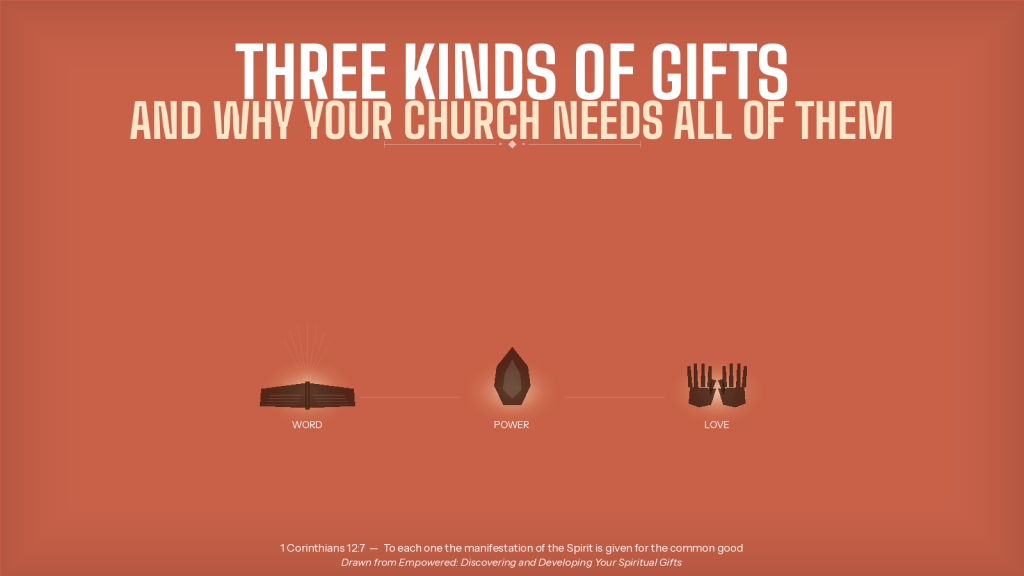
    Word gifts are the gifts that clarify God’s nature and truth. They include teaching, prophecy, encouragement, evangelism, shepherding, and apostleship. These gifts deal in revelation — bringing God’s truth into the room and making it accessible, applicable, and life-changing. A church rich in word gifts tends to produce theologically grounded disciples who know what they believe and why.

    Love gifts are the gifts that reveal God’s heart. They include administration, helps, mercy, giving, and hospitality. These are often the least celebrated and most undervalued gifts in the church — and yet they are, as I describe in the book, the connective tissue that holds everything else together. Without them, even the most powerful sermon or miraculous healing loses its impact. They are the soil in which every other gift takes root.

    Power gifts are the gifts that demonstrate God’s presence. They include faith, healing, miracles, tongues, and interpretation. These gifts operate in the realm of the supernatural — they are visible signs that the kingdom of God is not merely a theological concept but a present, active reality. They point beyond what is humanly explicable and say: God is in the room.

    The Problem of the Lopsided Church

    Here is what I observe again and again: most churches lean heavily into one of these clusters and neglect the others. You end up with what I call “word churches,” “power churches,” and “love churches.”

    Word churches are excellent at doctrine and preaching. They produce biblically literate congregations. But they can become cold — intellectually rigorous without being relationally warm or spiritually alive. The gifts of mercy and healing rarely feature. People learn a great deal but don’t always encounter God.

    Power churches are spiritually electric. Things happen. There is expectation in the room. But without the grounding of word gifts, spiritual experience can become unmoored from Scripture — and without the love gifts, the vulnerable and broken can sometimes fall through the cracks in the rush towards the spectacular.

    Love churches are warm, inclusive, and deeply pastoral. They create communities where people feel seen and cared for. But without word gifts, they can drift from theological clarity. Without power gifts, the supernatural work of the Spirit can feel quietly absent — nice people doing nice things, with little that would require God to be real.

    The New Testament vision is all three clusters operating together. As I put it in the book: a church that is doctrinally sound, supernaturally empowered, and practically loving gives the watching world a complete picture of Jesus. They see His truth proclaimed clearly, His power demonstrated tangibly, and His love expressed practically. That three-dimensional witness is what makes the church compelling rather than irrelevant.

    Why Every Gift Matters

    One of the most striking things in Paul’s teaching is how deliberately he refuses to create a hierarchy of spiritual significance.

    Paul lists administration alongside apostleship (1 Corinthians 12:28). Let that sit for a moment. The gift of steering a church well — managing its systems, coordinating its people, creating the structures that allow mission to happen — Paul places it in the same sentence as the gift of pioneering new ground for the gospel. They are not in competition. They are equally essential.

    The Greek word for administration is kubernēsis — a word that means helmsman. It’s the person who steers the ship towards its destination. Not the person who owns the ship. Not the person who draws the map. The one who reads the wind, manages the crew, and makes a thousand daily decisions that keep everything on course. Without them, the ship drifts.

    Similarly, the gift of helps — the person who sees what needs doing and quietly does it before anyone else has noticed — sits alongside miracles in Paul’s list (1 Corinthians 12:28). The person who makes sure the room is set up, who checks in on the speaker before they preach, who arrives early and leaves late, who notices the detail everyone else walked past — that person is operating by the same Spirit who raises the dead.

    This is not flattery. It is theology. The same Spirit who empowers the evangelist also empowers the administrator. The same divine energy that flows through miraculous healings also flows through acts of hospitality and mercy.

    Paul goes further. In 1 Corinthians 12:22-25, he insists that the parts of the body that seem weaker are indispensable, and that the parts we think of as less honourable are to be treated with special honour. God intentionally structures it this way — so that there is no division in the body, but that its parts should have equal concern for each other.

    What Does Your Church Need More Of?

    There is a question worth sitting with honestly: which cluster does your church most undervalue?

    If you are in a word church, you may need to create more space for the power gifts — not as a performance, but as a sincere expectation that God moves supernaturally among His people. You may also need to ask whether the love gifts are sufficiently honoured — whether the person serving coffee is celebrated as genuinely as the person preaching.

    If you are in a power church, you may need to deepen your roots in Scripture and theological formation. Supernatural experience without doctrinal grounding can drift in dangerous directions. You may also need to examine whether compassion for the ordinary, ongoing needs of people — grief, loneliness, financial hardship, mental health — is as prioritised as the dramatic.

    If you are in a love church, you may need to ask whether you are expecting too little of God. Whether a culture of warmth and care has inadvertently replaced an expectation of the Spirit’s power. Whether theological depth has been sacrificed on the altar of accessibility.

    A Vision for the Whole

    Jon Tyson puts it well: “We need the tension of difference to be the beauty of unity.” The gifts are not given to a body that all looks and operates the same. They are given to a body of remarkable diversity, where every member brings something that the others cannot supply.

    The administrator makes space for the healer to operate. The one with the gift of mercy creates the relational safety in which prophecy can be received. The teacher grounds the community in truth so that spiritual experience can be tested and kept healthy. The giver releases resources that make hospitality possible on a scale that would otherwise be impossible.

    Each cluster needs the others. A healthy church is not one that has perfected a single expression — it is one that makes room for all three, values each equally, and keeps asking the question: what is missing here, and who among us carries the gift to supply it?

    Spiritual gifts are not given for personal fulfilment or individual advancement. They are given for the common good (1 Corinthians 12:7). Every gift, however unspectacular it may seem, is a grace given to the whole community. And every community that truly wants to represent Jesus to the world will need the word gifts that make Him known, the love gifts that make Him feel near, and the power gifts that make Him undeniable.

    The question is not: which gifts do we prefer? The question is: are we making space for all of them?


    Paul Benger is the lead pastor of Ikon Church and the author of Empowered: Discovering and Developing Your Spiritual Gifts. Find the book here: https://www.amazon.co.uk/s?k=empowered+paul+benger

    Also my new book SAINTS OUT NOW

  • Your Gifts Won’t Survive Without Community

    From the series: Empowered — Discovering and Developing Your Spiritual Gifts


    Sarah sat nervously at the edge of the prayer circle. Three months into this church, she still felt like an outsider looking in — quiet by nature, uncertain of her place, more likely to slip out unnoticed than to step into anything. When the pastor asked if anyone would pray for a family facing a medical crisis, something stirred in her she couldn’t explain. Before she’d fully decided to speak, words were already forming. She prayed. And when she finished, the room was still.

    Afterwards, a church leader found her. “You have a gift of prayer,” he said simply. “Specifically intercession. We need that here.”

    Sarah didn’t know but she had carried it for years, because the gift had never had a context in which to emerge. It needed a room, a need, a community gathered around a shared burden. Without those things, it would have remained exactly where it was — dormant, unnamed, unused.

    This is not an unusual story. It is, in fact, the normal way that spiritual gifts work.


    Gifts Are Not Private Property

    There is a particular cultural assumption about spiritual gifts that the New Testament consistently resists — the idea that they are personal possessions, individual endowments to be explored in private and deployed at will. The language we use tends to reinforce this: my gifts, discovering my gifts, what I have been given.

    But Paul’s framing in 1 Corinthians 12 is stubbornly communal. The gifts are not given to individuals for individual benefit. “To each one the manifestation of the Spirit is given for the common good” (1 Corinthians 12:7). The common good. Not your good, not your ministry, not your platform — the good of the body. The body is the whole point.

    Gordon Fee, whose scholarship on the Spirit in Paul’s letters is excellent, makes this explicit: “God is not simply saving diverse individuals and preparing them for heaven; rather He is creating a people for His name, among whom God can dwell and who in their life together will reproduce God’s life and character.”

    A gift exercised outside of community is not functioning as Paul describes. At best it is incomplete. At worst, as the charismatic world has discovered to its cost, it can become something dangerous — unchecked, unaccountable, shaped more by an audience’s response than by the community’s discernment.

    The gifts are covenantal, not personal. They belong to the body, entrusted to individuals for the body’s sake.


    We Are Part of an Unfinished Story

    Luke begins the book of Acts with a telling phrase: “In my former book, Theophilus, I wrote about all that Jesus began to do and to teach” (Acts 1:1). That word — began — carries immeasurable weight. Luke is telling Theophilus, and us, that the Gospels are not the conclusion. They are the introduction. What Jesus started, he continues through his Church, empowered by the same Spirit.

    Acts itself ends with the same open-ended logic. There is no neat resolution, no closing summary, no “The End.” Paul is in Rome, “proclaiming the kingdom of God and teaching about the Lord Jesus Christ with all boldness and without hindrance” (Acts 28:31) — and the narrative simply stops. Because the story hasn’t finished.

    It is still unfolding. In your city. In your church. In the gifts that are operating, dormant, or just beginning to surface in the people around you.

    This is what it means to be the Church — not admirers of a completed historical project, but active participants in Christ’s ongoing work. The gifts aren’t accessories for the especially devout. They are the means by which that work continues. And they are discovered, developed, and deployed not in isolation, but in the community that carries the story forward together.


    Temple and Table — The Two Rhythms That Change Everything

    The early church in Jerusalem had a simple rhythm captured in a single verse: “Every day they continued to meet together in the temple courts. They broke bread in their homes and ate together with glad and sincere hearts” (Acts 2:46).

    Temple and table. These two spaces created the ecosystem in which spiritual gifts flourished in the first century, and they remain the essential rhythms for gift development today.

    The temple represents the gathered community — corporate worship, teaching, prayer, and shared encounter with God. It is where the prophetic word finds a platform, where teaching gifts are exercised in public, where leadership is tested and recognised. It is where the community witnesses the Spirit moving across the broader body. Acts 4 gives us a striking picture of what can happen when the temple experience is taken seriously: “the place where they were meeting was shaken. And they were all filled with the Holy Spirit and spoke the word of God boldly” (Acts 4:31). That was not an individual experience. It was a communal one. The boldness that followed flowed from their unity in prayer, not from private spiritual practice.

    The table represents something different but equally essential — the intimate, unhurried rhythms of shared life. Small groups, shared meals, embracing new people, the kind of relationships where people are truly known rather than merely noticed. It is around these tables, metaphorical and literal, that the quieter gifts find space to emerge: mercy, encouragement, wisdom, helps, administration. It is where a reserved woman in a home group discovers she has the gift of intercession when someone she loves needs prayer. It is where a tradesman discovers he has the gift of teaching when teenagers start leaning in.

    Neither rhythm is sufficient alone. Temple without table becomes a performance — impressive, even inspiring, but ultimately hollow, because there is no intimacy to root it. Table without temple becomes comfortable fellowship without direction, warm and relational but slowly drifting from the mission that gives community its purpose.

    Both are the work of the Spirit. Both are the soil where gifts grow. The question is not which to choose — it is how to cultivate both with intention.


    The Modern Problem: Together, But Alone

    Sociologist Robert Putnam coined the phrase “bowling alone” to describe a troubling shift in American culture: people were ten pin bowling more than ever, but bowling league membership was plummeting. More activity, less community. Physically present, relationally absent.

    The Church has not been spared this cultural current. We have become skilled at creating shared experiences — gatherings, events, services, conferences — whilst remaining strangers to one another. We cherish our individuality and our personal spiritual journey. We want the inspiration of corporate worship without the accountability of intimate fellowship. We want the affirmation that comes from exercising gifts in public without the correction that comes from people who know us well.

    But biblical Christianity knows nothing of isolated discipleship. The very concept would have been foreign to the early church. Faith was inherently communal, gifts were inherently relational, and growth was inherently corporate. You cannot develop a gift of mercy without people to show mercy to. You cannot discover a gift of encouragement without relationships deep enough to require it. You cannot test a prophetic gift without a community of discernment around you.

    The individualisation of faith does not just impoverish the community — it actively damages the individual. It eliminates the relational context in which many gifts are discovered in the first place. It removes the accountability that keeps gifts healthy and properly directed. And it eliminates the feedback loop — encouragement, gentle correction, increasing responsibility — through which gifts actually mature.

    A prophetic gift without the testing of mature community can veer easily into pride or error. A teaching gift without relationship becomes dry and impersonal. Leadership detached from mutual submission grows controlling. We need each other not just for warmth, but for the very formation that makes our gifts safe and life-giving to those around us.


    When Gifts Come Alive

    Three stories from Chapter 4 of Empowered stay with me because they each illustrate how unpredictably and how specifically community creates the conditions for gifts to emerge.

    Liz was quiet by nature. She attended her home group more out of obligation than enthusiasm, preferring to listen rather than speak. When a fellow member mentioned an upcoming cancer surgery, the group prayed — and Liz found words flowing through her with unusual clarity, boldness, and faith. The prayer carried a spiritual authority everyone in the room could sense. Over the following months, people began asking specifically for her prayers. Eventually her pastor invited her to lead the church’s prayer ministry. Over the years, she witnessed God perform miracles in response to those prayers. Her gift had been present for years. It emerged in community, in a specific moment of shared need, and it never would have been discovered in isolation.

    James was a tradesman with no formal education. When his church asked him to help with youth ministry, he protested — “I’m not a teacher. I barely finished school myself.” But at a weekend retreat, he found himself explaining theological concepts to teenagers using analogies from his construction work. A concrete foundation as a metaphor for building faith in Christ. Scaffolding as spiritual support. The teenagers leaned in. Five years later, he leads the church’s mentoring programme, helping young men navigate faith and life with the same practical wisdom that first surfaced at that retreat. His gift would have remained dormant without the community that pushed him into service before he felt ready.

    Maya was eighteen. A youth leader noticed that when someone in the group was excluded or struggling, Maya would appear with words that restored confidence and reminded people of their worth in God’s eyes. She had an uncanny ability to see past people’s facades to their true potential. After observing the pattern for several months, the youth pastor pulled her aside and explained what she had been doing — the gift of encouragement (Romans 12:8). With that understanding, what had been an intuitive response became an intentional ministry. Maya began mentoring younger girls and eventually developed a peer support network that transformed the youth group’s culture.

    In each case, the gift didn’t announce itself through a spiritual gifts inventory or a private revelation. It emerged through relationship, within the ebb and flow of shared life, often when nobody was looking for it. Gifts are discovered not in assessment moments but in the messy, beautiful reality of people serving together.


    Gifts Need Accountability, Not Just Encouragement

    There is a dimension to community’s role in gift development that we tend to underemphasise because it is less comfortable: community doesn’t just affirm gifts — it also corrects and constrains them.

    Paul’s extended teaching on spiritual gifts in 1 Corinthians 12–14 is not primarily about discovery or even deployment. It is about order. The gifts are to be exercised under authority, submitted to communal discernment, evaluated by those with wisdom. Two or three prophets speak; the others weigh carefully what is said (1 Corinthians 14:29). Everything is done in a fitting and orderly way (14:40).

    This structure is not bureaucratic interference with the Spirit’s freedom. It is the protection that allows the gifts to be genuinely trusted. When gifts operate outside of this structure — when a minister or individual insists their gift speaks for itself and requires no testing — the community is not protected, and the gift itself becomes vulnerable to distortion.

    The most powerful expressions of spiritual gifts — reconciliation, peacemaking, pastoral care through seasons of genuine hardship — often emerge precisely in the difficult places of community, when relationships have been tested, when conflict has been navigated, when the cost of commitment has been paid. Gifts don’t flourish in transient, consumer relationships. They flourish in covenant ones.


    Practising Temple and Table Today

    The rhythms of Acts 2 remain as vital as they were in the first century, though they take different shapes. For those wanting to engage them more intentionally, three postures are worth cultivating.

    Join a ministry team. Serving alongside others in a shared task is one of the most reliable environments for gift discovery — because it combines the inspiration of shared mission with the intimacy of working relationships. The worship team member who discovers a pastoral gift while praying with fellow musicians. The children’s ministry helper who uncovers teaching abilities they never imagined. The hospitality volunteer who realises they have a gift for administration as they coordinate events. The context does the work that a spiritual gifts questionnaire cannot.

    Participate actively in a small group — the key word being actively. Simply attending is not enough. Gifts emerge through engagement: sharing prayer requests, offering to help with practical needs, contributing to discussions, taking on small responsibilities. The safe space of table fellowship is where the quieter gifts — mercy, encouragement, wisdom, helps — have room to breathe and be named.

    Invite honest feedback from trusted people. Most of us are poor judges of our own spiritual gifts. We either dismiss obvious gifts as “just being helpful” or assume we have gifts we don’t actually possess. Ask people who know you well what they observe in you. Their perspective reveals what we cannot see in ourselves. This requires humility — the willingness to receive both affirmation and gentle correction. But it is one of the most significant gifts that community can offer.


    The Soil Cannot Be Replaced

    The opening of Acts tells us that Jesus began his work. The closing tells us it is still unfolding. Somewhere between those two bookends is your story — and the story of the people around you, each carrying something the body needs, each requiring the soil of community to discover it, develop it, and offer it for the common good.

    Spiritual gifts do not thrive in private. They were never designed to. They are planted in you for the sake of others, and they grow through the friction and grace and shared life of belonging to a community that is trying, together, to embody the kingdom of God.

    Your gift needs your community. And your community needs your gift.

    The soil cannot be replaced. But it can be cultivated. And the harvest, when it comes, belongs to everyone.


    This post is drawn from Empowered: Discovering and Developing Your Spiritual Gifts by Paul Benger. Available on Amazon.