• When the Spectacular Blinds Us — Sensationalism, Accountability, and the Gifts of the Spirit

    A reflection on charismatic culture, pastoral responsibility, and the cost of elevating gifting above character


    There is a particular kind of silence that has caused immeasurable damage to the charismatic and Pentecostal church. It is not the silence of ignorance. It is the silence of people who suspected something was wrong, who perhaps even knew something was wrong, and who said nothing — because the gift was too impressive, the ministry too large, the atmosphere too electric to risk disrupting.

    That silence has a name. It is the fruit of sensationalism. And it is costing us dearly.


    The Hunger That Became a Vulnerability

    The desire for the supernatural is not in itself a problem. It is, in many ways, a sign of theological health. A church that has given up expecting God to move, to heal, to speak, to break in — that church has, in some meaningful sense, stopped believing the New Testament.

    But hunger, when it becomes desperation, stops being discerning.

    When we need the spectacular — when the measure of a gathering’s success is whether something unusual happened, when a minister’s authority is proportional to the drama of their revelations, when the atmosphere of awe becomes the primary currency of spiritual credibility — we have created the precise conditions in which deception flourishes and accountability collapses.

    The apostle Paul saw this tendency clearly in Corinth. A church dazzled by the more spectacular gifts, ranking members by what they could perform, measuring spiritual maturity by what could be demonstrated. His corrective in 1 Corinthians 12–14 is not to suppress the gifts. It is to reorder the priorities. “Eagerly desire gifts,” he writes — but the whole argument of chapter 13 insists that gifts without love are not just incomplete; they are nothing. “If I have the gift of prophecy and can fathom all mysteries and all knowledge… but do not have love, I am nothing” (1 Corinthians 13:2).

    The Corinthian mistake was not that they valued the gifts. It was that they valued them above everything else. We have inherited that mistake.


    What the Evidence Now Shows

    Two cases, separated by decades but united by the same structural failure, deserve our honest attention.

    Paul Cain was one of the most celebrated prophetic voices in the charismatic world of the late twentieth century. Associated with the Kansas City prophets and admired across the movement, he was known for the apparent precision and power of his prophetic ministry. Leaders of significant standing built credibility by association with him. His gifting was, by all accounts of those close to him, remarkable.

    In 2004, three of those leaders — Rick Joyner, Mike Bickle, and Jack Deere — publicly disclosed that Cain had been living a long-term pattern of homosexual behaviour and serious alcoholism. These were not rumours. They were confirmed, including by Cain himself, who issued a public apology and sought counselling.

    What is most instructive about this case is not the sin itself — Scripture is clear that every person, however gifted, is a fallen human being in need of grace. What is most instructive is the admission that followed. Jack Deere, one of the three who finally acted, said this:

    “We all have preached that you never put gifting over character — but that is what we did for Paul. We would have fired anyone else. The reason we didn’t is because of his gifting.”

    That sentence is worth reading more than once.

    Shawn Bolz has been a prominent prophetic voice in contemporary charismatic Christianity, widely known for delivering what appeared to be precise, supernaturally sourced personal prophecies — naming details about people’s lives with striking specificity. In early 2025, Christian content creator Mike Winger released an extensive exposé detailing two categories of serious concern: that Bolz had been mining social media to source information presented as divine revelation, and that multiple credible witnesses had alleged non-consensual sexual misconduct against people in his ministry context.

    Bethel Church, with which Bolz had been associated, released a public statement acknowledging that credible allegations of sexual misconduct had been brought to their attention as early as 2019. They apologised for their failure to act with appropriate urgency. Their statement effectively confirmed that a culture of protection — for the gifting, for the ministry, for the atmosphere — had taken precedence over the protection of people.

    Bolz subsequently stepped back from public ministry.

    These are not isolated aberrations. They are symptoms of a culture.


    The Structural Problem

    When a prophetic or miraculous gift becomes the primary basis for a minister’s platform and authority, a dangerous dynamic takes root: the gift becomes too valuable to jeopardise. Raising concerns about character, behaviour, or accountability is experienced — consciously or not — as a threat to something precious. Better to manage quietly. Better to wait and see. Better to let the ministry continue than to risk losing what God is doing.

    This is precisely how predatory behaviour survives in gifted environments. The gift provides cover. The atmosphere generates loyalty. The sensational creates a kind of communal investment — we’ve seen things here, we’ve experienced things here — that makes it costly to speak.

    Paul’s framework in 1 Corinthians 14 is deliberately anti-spectacular. “Everything should be done in a fitting and orderly way” (14:40). The gifts are to be tested, weighed, and evaluated. “Two or three prophets should speak, and the others should weigh carefully what is said” (14:29). The Greek word there — diakrinō — means to distinguish, to discern, to judge carefully. Paul is not calling for the suspension of prophetic ministry. He is insisting that prophetic ministry without communal discernment and testing is not biblical prophecy. It is performance.

    John is equally direct: “Do not believe every spirit, but test the spirits to see whether they are from God, because many false prophets have gone out into the world” (1 John 4:1). Testing is not cynicism. It is obedience. A culture that treats the testing of prophetic claims as somehow offensive to the Spirit has got things exactly backwards.


    The Shepherd’s Responsibility

    Ezekiel 34 is one of the most searching passages in the Hebrew scriptures. God’s indictment of Israel’s shepherds is not primarily that they were wicked. It is that they failed to protect: “You have not strengthened the weak or healed the sick or bound up the injured. You have not brought back the strays or searched for the lost. You have ruled them harshly and brutally” (Ezekiel 34:4).

    The shepherd’s first responsibility is to the flock — not to the ministry, not to the atmosphere, not to the reputation of the house. When leaders choose the protection of gifted individuals over the protection of vulnerable people, they have inverted the shepherd’s calling. They are, in Ezekiel’s terms, feeding themselves rather than feeding the sheep.

    Jesus himself, in Matthew 7, gives us the most uncomfortable test of all for those operating in the prophetic and miraculous: “Many will say to me on that day, ‘Lord, Lord, did we not prophesy in your name and in your name drive out demons and in your name perform many miracles?’ Then I will tell them plainly, ‘I never knew you.’” (Matthew 7:22-23).

    Gifts can operate without intimacy. Miracles can happen without holiness. The supernatural is not always a reliable guide to the character of the person through whom it flows. Jesus knew this. He taught it. We have, far too often, forgotten it.


    What Mature Charismatic Practice Actually Looks Like

    None of this is an argument against the gifts. It is an argument for their proper stewardship.

    A genuinely mature charismatic culture holds several things together that sensationalism tears apart:

    Gift and character are inseparable. The New Testament consistently connects empowerment by the Spirit with the formation of Christlike character. The fruit of the Spirit (Galatians 5:22-23) and the gifts of the Spirit are not two separate tracks. A sustained gap between what someone demonstrates in public ministry and how they live in private is not a spiritual mystery to be tolerated. It is a warning sign to be taken seriously.

    Testing is an act of love, not suspicion. When Paul commands the weighing of prophecy, he is protecting the gift as much as guarding the community. False prophecy, unchecked, discredits genuine revelation. Abuse, unaddressed, destroys the trust that ministry requires. Communities that test, correct, and — when necessary — act are communities where the gifts can flourish safely.

    Platform is not a substitute for accountability. One of the most dangerous features of the contemporary charismatic landscape is the way platform insulates individuals from the ordinary structures of community accountability. When a minister’s primary relationships are with audiences rather than with elders, mentors, and peers who can speak honestly into their lives, the conditions for unchecked behaviour are already in place. Jack Deere’s confession — “we would have fired anyone else” — is a confession about the corrupting effect of platform on judgement.

    Protecting people is always primary. When credible allegations arise, the first question cannot be “what will this do to the ministry?” It must be “are people safe?” The Bethel situation is instructive not because Bethel is uniquely culpable, but because the pattern of delayed action in the face of credible evidence is recognisable across the charismatic world. The flock comes first. Always.


    A Word About Grace

    This post is not written to fuel cynicism about the charismatic church, nor to suggest that the gifts of the Spirit are too dangerous to pursue. The opposite is true. It is precisely because the gifts are so important, so genuinely needed, so central to the mission of the church, that their misuse and the culture that enables it must be addressed honestly.

    Paul Cain was, by the testimony of those who knew him, genuinely gifted. That does not diminish what he did, nor excuse those who should have acted sooner. Shawn Bolz’s situation involves allegations, some of which remain contested; what is not contested is that Bethel held credible information for years and chose protection of ministry over protection of people.

    Both men are, like all of us, people for whom Christ died. The call to accountability and the call to grace are not in competition. We can hold both. What we cannot do is allow grace to become a reason for inaction when people are being harmed.

    The charismatic church has extraordinary gifts. It also has structural vulnerabilities that sensationalism creates and protects. Naming that honestly — without condemning the tradition, without abandoning the gifts — is not a failure of faith. It is an expression of it.

    The Spirit who gives the gifts is also the Spirit of truth. He is not threatened by scrutiny. He is, in fact, the one who invites it.


    “For the Spirit God gave us does not make us timid, but gives us power, love and self-discipline.” — 2 Timothy 1:7
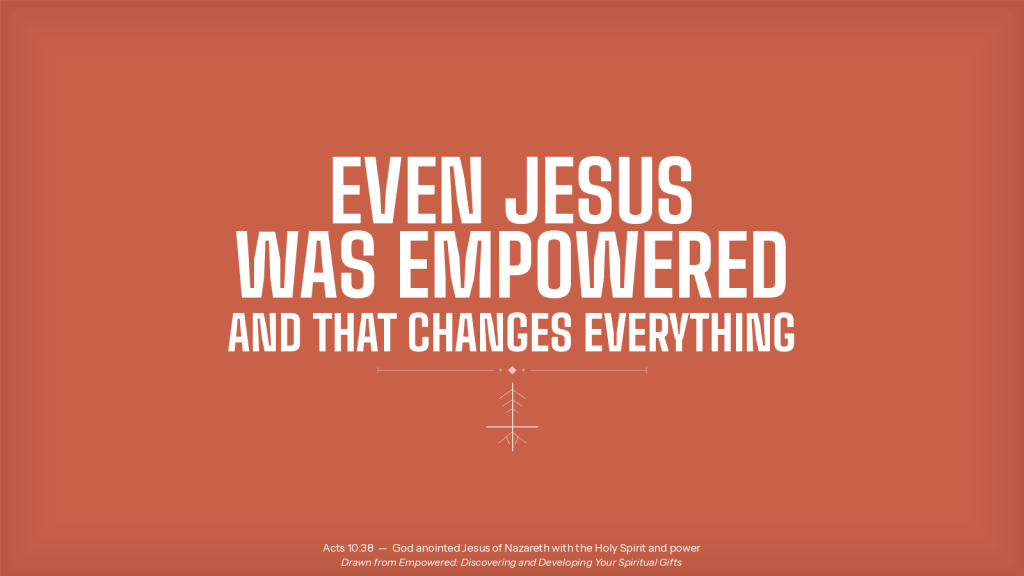

  • Even Jesus was Empowered – and that changes everything 

    From the series: Empowered — Discovering and Developing Your Spiritual Gifts


    There is a theological assumption so deeply embedded in the way we think about Jesus that most of us have never stopped to question it. It goes something like this: Jesus healed people because he was God. Jesus taught with authority because he was divine. Jesus cast out demons and raised the dead because he had access to divine power that we simply don’t.

    It sounds reverent. It sounds orthodox. And it lets us off the hook entirely.

    But it isn’t what the New Testament actually teaches.


    The Assumption We Need to Lose

    The Gospels are unanimous on this point: Jesus did not conduct his earthly ministry by drawing on his divine nature independently of the Father and the Spirit. He operated as a Spirit-empowered human being — fully submitted, fully dependent, fully anointed — showing us what Spirit-filled humanity actually looks like.

    This is not a radical claim. It is the explicit claim of the New Testament itself.

    Jon Thompson, in his landmark work Convergence, puts it with arresting clarity:

    “Jesus did not rely on His divinity to do ministry. Instead, He laid aside divine prerogative and showed us what it means to walk in the power of the Holy Spirit… He is the model of a truly spiritual life.”

    Sit with that for a moment. Jesus is not primarily our Saviour who did what we could never do. He is also our model who did what we are being invited to do. The incarnation is not just rescue — it is demonstration. Jesus lived as he lived in order to show us how to live.


    What Kenosis Actually Means

    The theological term for what Thompson is describing is kenosis, drawn from Philippians 2:6-7 — Paul’s breathtaking summary of the incarnation:

    “Who, being in very nature God, did not consider equality with God something to be used to his own advantage; rather, he made himself nothing by taking the very nature of a servant, being made in human likeness.”

    Kenosis does not mean that Jesus stopped being God. It does not mean his divine nature was inactive or absent. It means that in his incarnate ministry, Jesus voluntarily chose not to operate from independent divine prerogative. He set aside the unilateral use of his divine attributes and stepped fully into the limitations and dependencies of human existence.

    N.T. Wright, in Jesus and the Victory of God, frames this with characteristic precision:

    “Jesus believed himself called to do and be what, in Israel’s scriptures, YHWH had promised to do and be. But he would do this not by being a distant, detached deity, but by becoming human and accomplishing this task as the Spirit-anointed Messiah.”

    This is the extraordinary claim at the heart of the Gospels. The one who is fully God chose to accomplish his mission as the Spirit-anointed Messiah — which means his ministry is not a category entirely its own. It is the model for ours.


    The Gospels Won’t Let Us Miss This

    The Gospel writers are not subtle about this. Luke, in particular, goes out of his way to show us the Spirit’s role in every phase of Jesus’ life and ministry.

    At his baptism: “The Holy Spirit descended on him in bodily form like a dove” (Luke 3:22).

    In the wilderness: “Jesus, full of the Holy Spirit, left the Jordan and was led by the Spirit into the wilderness” (Luke 4:1).

    At the launch of his public ministry: “Jesus returned to Galilee in the power of the Spirit” (Luke 4:14).

    At his inaugural sermon in Nazareth: “The Spirit of the Lord is on me, because he has anointed me to proclaim good news to the poor” (Luke 4:18).

    This is not incidental detail. Luke is making a theological argument: the entirety of Jesus’ ministry — his teaching, his miracles, his compassion, his confrontations — flowed from his anointing by the Spirit.

    Matthew confirms it: “If it is by the Spirit of God that I drive out demons, then the kingdom of God has come upon you” (Matthew 12:28). Jesus himself traces his power not to his divine nature but to the Spirit.

    John’s Gospel deepens the theological frame. Jesus says: “The words I say to you I do not speak on my own authority. Rather, it is the Father, living in me, who is doing his work” (John 14:10). And earlier: “For the one whom God has sent speaks the words of God, for God gives the Spirit without limit” (John 3:34).

    Jesus ministered from a position of total dependence and unlimited anointing. Not divine bypass — divine dependence.


    Three Streams, Held Together

    Jon Thompson argues that Jesus embodied what he calls “convergence” — the perfect integration of three essential streams of Christian life and ministry that we almost always pull apart:

    Word — He taught the Scriptures with authority and truth. His teaching wasn’t performance; it emerged from deep immersion in Israel’s story and the Father’s revelation.

    Spirit — He operated in the gifts and power of the Holy Spirit. Healing, deliverance, prophecy, miracles — these were not departures from his normal ministry; they were the normal expression of it.

    Sacrament — He lived in deep communion with the Father through the spiritual practices that shaped his inner life: solitude, prayer, fasting, worship. “Very early in the morning, whilst it was still dark, Jesus got up, left the house and went off to a solitary place, where he prayed” (Mark 1:35).

    These three streams flowed together in Jesus without contradiction or competition. He did not choose between biblical depth and spiritual power. He did not trade communion with the Father for effective ministry. He held all three — because all three belonged together.

    Thompson’s diagnosis of the contemporary church is sobering: most churches lean heavily into one or two streams whilst neglecting the third. Some prize biblical teaching but are suspicious of spiritual power. Others pursue supernatural experience but have shallow scriptural roots. Still others emphasise liturgy and sacramental practice but lack both depth and power. Jesus held all three. He is the model.


    From Intimacy to Ministry

    Here is the most important thing that Chapter 3 of Empowered draws out — and it is the thing most likely to be missed in our rush to do something with our gifts.

    Jesus’ authority came not from platform. It came from intimacy.

    Jon Tyson, in Beautiful Resistance, captures what made Jesus different:

    “Jesus resisted the pull of hurry, fame, and power, staying anchored in the Father’s love and the Spirit’s leading. That’s why his authority had weight — it came from intimacy, not from platform.”

    The hours in Gethsemane. The forty days in the wilderness. The pre-dawn retreats to solitary places. These were not interruptions to Jesus’ ministry — they were the source of it. Everything that flowed outward into healing and teaching and transformation had its origin in what was cultivated inward in the Father’s presence.

    John Mark Comer names the implication plainly: “Jesus’ life is not just something to admire, it’s something to imitate. His way of life is the template for human flourishing.”

    Cambridge theologian Sarah Coakley adds a crucial clarification about what this means for spiritual authority:

    “The Spirit’s work in us, as in Christ, is not about the assertion of power, but about the transformation that comes through vulnerable openness to God. True spiritual authority emerges not from grasping after divine prerogatives, but from the kenotic pattern of self-offering that Jesus modelled.”

    This is the correction our age desperately needs. We have confused anointing with gifting, platform with authority, confidence with power. Jesus shows us a different way entirely: authority grows from surrender, power flows from dependence, gifts are most alive when they are rooted in love.

    Curtis Thompson frames the contrast sharply: “We grow into the likeness of Christ not through anxiety or performance, but through the joyful awareness of the Father’s presence and the Spirit’s work in us.”

    Our gifts were never meant to be managed or performed. They were meant to be released — from a place of rest in the Father’s love, carried by the Spirit’s anointing, offered in the kenotic posture of self-giving that Jesus modelled from first to last.


    What Jesus Models for Us

    If Jesus is the model — not merely the exception — then his life becomes a set of concrete invitations.

    He models radical dependence on the Father: “The Son can do nothing by himself; he can do only what he sees his Father doing” (John 5:19). Jesus did not operate from accumulated spiritual capital. He lived moment by moment in attentive response to the Father. That dependence is not a limitation we should outgrow. It is the posture we are being invited into.

    He models empowerment by the Spirit: “God anointed Jesus of Nazareth with the Holy Spirit and power, and he went around doing good and healing all who were under the power of the devil” (Acts 10:38). The Spirit is not a supplement to our natural gifts. He is the source of our supernatural ones. The anointing Jesus carried is the same anointing he has poured out on his people.

    He models the integration of disciplines and gifts: The one who healed the sick and raised the dead also rose before dawn to pray in solitude. The disciplines were not what earned the gifts — they were what kept the channel clear. Prayer, rest, Scripture, fasting, Sabbath, community — these are not alternatives to Spirit-empowered ministry; they are its foundation.


    Our Call to Follow

    Following Jesus into this Spirit-empowered life means reshaping not just what we do but how we approach it.

    It means practising humility — understanding ourselves as vessels, not sources. Our gifts are not competencies we have achieved. They are graces we have received. The moment we begin to take credit for what the Spirit is doing through us, we have already begun to lose it.

    It means embracing dependence — genuinely needing the Spirit’s presence and power, not just hoping for it. This is not passive resignation. It is the active, daily discipline of asking, seeking, opening ourselves to be filled. “We require daily filling by the Spirit” is not a pious sentiment. It is a practical reality.

    It means adopting Jesus’ rhythms — prayer, solitude, Sabbath, worship, generosity — not as religious duties but as the practices that create the conditions in which the Spirit can work most freely. Pentecostal theologian Amos Yong reminds us of the global scope of this:

    “The Spirit’s gifts are not limited by culture, race, or social status. When we follow Jesus’ model of Spirit-dependence, we discover that God’s power works through the most unlikely people in the most unexpected places. The Spirit blows where it wills, empowering the global church for mission.”

    And it means living in community — because spiritual gifts are discerned, tested, and developed within the fellowship of the body, not in isolated self-assessment.

    Dallas Willard’s definition of discipleship is worth returning to here: “Discipleship is the process of becoming who Jesus would be if he were you.” This is not a call to clone Jesus’ personality or replicate his specific actions. It is a call to embody his character and his approach to ministry — dependent, Spirit-filled, rooted in intimacy, given for others — in the unique context and calling that is yours.


    The Promise That Makes It Real

    Jesus’ resurrection didn’t just vindicate him. It opened the door.

    After his resurrection, he appeared to his disciples and said: “As the Father has sent me, I am sending you.” And with that he breathed on them and said: “Receive the Holy Spirit” (John 20:21-22).

    The commissioning is not accidental. It follows the pattern exactly. He was sent as the Spirit-anointed Messiah. He now sends his people — and he breathes the same Spirit into them. Paul makes the connection explicit in Romans 8:11: the same power that raised Christ from the dead now lives in everyone who belongs to him.

    This is not wishful thinking. It is the explicit promise of Jesus himself.

    The question is not whether you have access to what Jesus had. The question is whether you will follow his model — the dependence, the intimacy, the surrender, the rhythms — that allowed what he had to flow.

    Because what Jesus modelled was not the exception to human life. It was the possibility of it.


    This post is drawn from Empowered: Discovering and Developing Your Spiritual Gifts by Paul Benger. Available on Amazon.

  • You’re Not Meant to Watch from the Sidelines

    From the series: Empowered — Discovering and Developing Your Spiritual Gifts


    There’s a particular kind of frustration that settles into a church over time. It’s not the frustration of conflict or crisis. It’s quieter than that. It’s the frustration of watching the same small group of people carry everything — Sunday after Sunday, meeting after meeting — while the majority of the congregation does what congregations have been trained to do: show up, receive, and go home.

    We call it attendance. But God has a different word for it.


    The Spectator Problem

    Jesus didn’t die to fill seats. He died to raise up a people — a body, as Paul describes it, with every part functioning, every member contributing, every gift deployed for the common good.

    And yet somewhere along the way, the church absorbed the logic of the performance economy: a few gifted professionals on stage, a large audience benefiting from their talent, and a clear but unspoken division between those who serve and those who are served.

    This isn’t a new problem. Paul was already addressing it in Corinth. The Corinthian church was fascinated by the more spectacular gifts — tongues, prophecy, miracles — and those who didn’t have those gifts drew a quiet conclusion: this must not be for me. Paul’s response in 1 Corinthians 12 is both a rebuke and an invitation. He doesn’t lower the expectation. He raises it. He insists that every single member of the body has been given a gift. Not as a possibility. As a fact.

    “To each one the manifestation of the Spirit is given for the common good.” — 1 Corinthians 12:7

    Each one. Not each especially anointed one. Not each ordained one. Not each extroverted, stage-ready one. Each. One.

    Watchman Nee said it bluntly: “The church loses immeasurably when its members refuse to exercise their gifts.” The losses aren’t theoretical. They’re people — people who never discover what they carry, communities that never benefit from what God placed in them, missions that stall because the workers are watching from the stands.

    The spectator problem isn’t a personality problem. It’s a theology problem. And the solution isn’t a better volunteering system. It’s a recovered theology of gifts.


    The Spirit Decides, We Participate

    Here is one of the most liberating and most misunderstood truths about spiritual gifts: you didn’t choose yours.

    “All these are the work of one and the same Spirit, and he distributes them to each one, just as he determines.” — 1 Corinthians 12:11

    The word Paul uses here is boulētai — he wills, he determines, he chooses. The distribution of gifts is a sovereign act of the Spirit. This means you are not responsible for manufacturing your gifts, and you are not in competition with anyone else for theirs. The Spirit has already decided.

    But — and this is where the invitation comes in — sovereignty doesn’t eliminate participation. Paul’s language throughout 1 Corinthians 12–14 is active. He says pursue (14:1), desire earnestly (14:39), seek to excel (14:12). The Spirit decides what you carry. You decide what you do with it.

    John Wimber used to say that faith is spelled R-I-S-K. There is no such thing as passive gift use. Gifts are exercised, developed, offered, and refined through practice. They atrophy through neglect. The question is never just “what has the Spirit given me?” It’s always also: “what am I doing with what I’ve been given?”

    This dynamic — sovereignty and participation, divine initiative and human response — is the rhythm of the whole Christian life. We don’t earn grace, but we do respond to it. We don’t manufacture the fruit of the Spirit, but we do cultivate it. We don’t generate the gifts, but we do exercise them.

    You are not a passive recipient. You are a participant in the mission of the Spirit.


    Three Kinds of Gifts

    Before we can discern our spiritual gifts, it helps to understand that not every God-given capacity is the same kind of thing. There are at least three categories of gifts worth distinguishing.

    Natural Gifts are the capacities you were born with — the aptitudes, temperaments, and tendencies that were present before you ever thought about ministry. Some people are natural communicators. Others have an instinctive ability to read a room, organise complexity, or care for someone in distress. These are not accidents. They are woven into you by your Creator. As Psalm 139 reminds us, you were knitted together with intention.

    Acquired or Developed Gifts are the skills built over time through practice, discipline, and experience. Malcolm Gladwell’s observation that mastery often requires around ten thousand hours of deliberate practice captures something real: competency is cultivated. A musician, a carpenter, a counsellor — each has invested themselves in their craft. These developed capacities are also gifts. They represent stewardship of time and talent, and they are every bit as much a part of God’s equipping as anything else.

    Spiritual Gifts are distinct from both of the above, though they can overlap with them. A spiritual gift is a God-given, Spirit-empowered capacity for ministry and mission — given specifically to build up the body of Christ and advance the kingdom of God. The key difference is not the activity itself but the source and the effect. Spiritual gifts are expressed in dependency on the Spirit, and they produce results that exceed what natural talent or acquired skill alone could account for.

    These three categories aren’t in competition. The Spirit often takes what is natural in us and supernaturally amplifies it for his purposes. And he sometimes gives gifts that bear no relationship at all to our personality or background — because the Spirit is sovereign, and the body needs what it needs.

    Robert J. Clinton’s work on spiritual formation is helpful here: gifts emerge through a lifetime of response to God, not in a single dramatic moment. The question is not “have I had a spiritual gifts experience?” but “what is consistently bearing fruit in my life and in others?”


    We Don’t All Have the Same Gifts

    The diversity of gifts is not a problem to be managed. It’s a design to be celebrated.

    Paul’s body metaphor in 1 Corinthians 12 is not just poetic — it’s instructive. A body with every part doing the same thing is not a body. It’s a tumour. Healthy bodies are marked by differentiation: eyes and ears and hands and feet, each doing what only they can do, all of it coordinated by the head.

    Jon Tyson puts it this way: “We need the tension of difference to be the beauty of unity.” Different gifts, different temperaments, different streams. The church that values every gift — not just the visible and celebrated ones — is the church that is most fully itself.

    This has practical implications for how we structure church life. Churches tend to over-resource the gifts that serve their particular culture and under-resource the gifts that challenge or complement it. A Word-centred church may unconsciously marginalise those with gifts of mercy, healing, or administration. A Power-centred church may struggle to honour the quiet teacher or the faithful servant. A Love-centred church may neglect prophetic sharpness.

    The healthy body needs all three streams. Word — teaching, prophecy, wisdom. Power — healing, miracles, faith. Love — mercy, service, hospitality, giving. When one stream dominates and the others are marginalised, the body limps.


    Are Some Gifts Just Things We Should All Do?

    It’s a fair question. If the New Testament calls all believers to evangelise, to give generously, to show mercy — then in what sense is evangelism or giving or mercy a spiritual gift at all?

    The answer lies in a distinction: if it’s not a spiritual gift for you, it’s a spiritual discipline.

    All of us are called to love our neighbours. Some people carry a supernatural grace for it — they walk into a hospital ward and the atmosphere shifts. What is effort for most is effortless for them, not because they’re better but because the Spirit has equipped them specifically for it. For the rest of us, we’re invited to practise it as a discipline — not because we’re let off the hook, but because maturity is formed in the doing.

    The gifts don’t excuse the rest of the body from the call. They model what the Spirit can do when he works through us. They inspire us. They set the pace.


    Four Tests to Discern Your Gifts

    So how do you actually work out what your gifts are? Chapter 2 of Empowered offers four tests — not as a formula, but as a framework for discernment.

    1. The Pattern Test

    What keeps happening? Where do you consistently see fruit — not occasionally, but repeatedly, across different contexts and seasons?

    The Spirit tends to be consistent. If people regularly come to you for counsel and leave changed, that’s a pattern. If things seem to get more organised when you’re involved, that’s a pattern. If you’ve noticed that when you pray for people a particular kind of breakthrough seems to follow, that’s a pattern. You’re not looking for one peak experience. You’re looking for a groove worn by repeated movement of the Spirit.

    Gordon Fee observes that gifts are confirmed over time, in community, through fruit. The Pattern Test is simply paying attention to what the Spirit is already doing.

    2. The Holy Discontent Test

    What frustrates you when it’s missing?

    This is one of the more counterintuitive tests, because we don’t usually think of frustration as spiritually significant. But there’s a kind of holy discontent that is actually the signature of a gift — a God-given intolerance for a particular kind of brokenness or gap.

    The person with a gift of mercy is not mildly bothered by suffering — they’re devastated by it, compelled by it, unable to walk past it. The person with a gift of leadership doesn’t just notice when a team is directionless — something in them rises up and won’t rest until order is restored. The person gifted in teaching doesn’t just wish people understood the Bible better — they’re almost indignant when truth is mishandled.

    Pay attention to what troubles you in a way that moves you to act. That frustration may be the Spirit’s fingerprint on you.

    3. The Joy Test

    Where do you feel most alive when you’re serving?

    Not most comfortable. Not most appreciated. Most alive — that sense of rightness, of doing what you were made to do, of the Spirit moving through you in a way that is both energising and larger than you.

    There is a specific kind of joy that comes from operating in your gifts. It’s different from the satisfaction of a task completed or the relief of a job done. It’s more like how athletes describe being in the zone — effort that doesn’t feel like effort, flow that doesn’t feel forced.

    This doesn’t mean gifts are always easy. A prophet who delivers difficult truth doesn’t find it comfortable. A leader navigating a hard season isn’t breezing through it. But underneath the difficulty there is a settled sense of this is what I’m here for. That’s the Joy Test. Pay attention to it.

    4. The Desire Test

    What do you long to do?

    This test is the most personal and, for many people, the most surprising. We’ve been trained to be suspicious of our desires — to assume that what we want is probably what God doesn’t want. But Psalm 37:4 tells us that when we delight in God, he gives us the desires of our heart. That’s not a promise about getting what you want. It’s a promise about transformation — that as we align with God, our desires begin to align with his purposes.

    The longing to intercede, to teach, to lead, to create, to serve, to heal — these desires, when surrendered and tested, often turn out to be the Spirit’s invitation. Not every desire is a gift. But every spiritual gift tends to come with desire. The desire is part of the gift.


    Gifts Are Discerned in Community

    One more thing needs to be said: you cannot reliably discern your own gifts in isolation. Spiritual gifts are not private possessions — they are given for the common good (1 Corinthians 12:7), and they are recognised in community.

    Gordon Fee puts it directly: “The gifts are not merely personal possessions; they are for the common good, to be discerned and affirmed in community.”

    This is why the role of leaders and community is not peripheral to gift discernment — it’s essential. The community sees what you cannot always see in yourself. A faithful leader will name what they observe, confirm what they see emerging, and create space for gifts to be tested and developed. You need people around you who are honest enough to speak, wise enough to observe, and committed enough to walk with you over time.

    If no one has ever named a gift in you, find people who will. If you’ve never asked the community around you what they observe in you, ask. Gifts flourish in the light of community, not in the dark of self-assessment alone.


    You Were Not Made to Watch

    Tyler Staton makes a point worth our attention: spiritual gifts don’t belong only in the church building. They operate in the boardroom, the kitchen, the classroom, the hospital, the school playground, and the neighbourhood street. The Spirit did not equip you for Sunday mornings only. He equipped you for your whole life.

    You carry something the world around you needs. Not in a platform sense. In a body-of-Christ sense — you are a member, and every member matters.

    The spectator life is not a comfortable alternative to full engagement. It is a slow diminishment. The gifts that are not exercised don’t disappear — they wait. And the body that misses what you carry doesn’t compensate — it limps.

    You were given a gift by a sovereign Spirit who distributes as he wills, placed into a body that needs what you carry, called into a mission that won’t be fully accomplished without your participation.

    You were not made to watch from the sidelines.


    This post is drawn from Empowered: Discovering and Developing Your Spiritual Gifts by Paul Benger. Available on Amazon.

  • Why Spiritual Gifts Aren’t Optional

    There’s a quiet assumption running through much of the Western church that goes something like this: spiritual gifts are for a certain kind of Christian. The upfront ones. The confident ones. The ones who seem to have a direct line to heaven. The rest of us? We just serve on the welcome team, give our tithe, and hope for the best.

    But that assumption isn’t just unhelpful — it’s unbiblical.

    In my book Empowered, I set out to challenge this idea head-on. Because the New Testament doesn’t present spiritual gifts as an optional add-on for the enthusiastic few. It presents them as the standard equipment for every follower of Jesus. And if we’ve lost sight of that, it’s worth asking why — and what it’s costing us.

    The Gift That Comes With the Giver

    Let’s start with what spiritual gifts actually are. At the simplest level, they are God-given abilities, distributed by the Holy Spirit, that empower us to serve others and advance God’s kingdom. They are not natural talents. They are not personality traits. They are not proof of spiritual maturity. They are something else entirely — supernatural tools God provides to accomplish what we cannot do on our own.

    The apostle Paul puts it plainly in 1 Corinthians 12:4–7. There are different kinds of gifts, but the same Spirit distributes them. Different kinds of service, but the same Lord. And then comes the line that should stop us in our tracks: “Now to each one the manifestation of the Spirit is given for the common good.”

    Each one. Not some. Not the elite. Each one.

    Gordon Fee, in his landmark work God’s Empowering Presence, describes the Holy Spirit as the personal, empowering presence of God among His people. That’s a beautiful and theologically rich way to understand what’s happening when we talk about spiritual gifts. They aren’t abstract “things” we carry around in our pockets — they are expressions of God’s living presence in us.

    Why So Many Have Given Up

    If spiritual gifts are for everyone, why have so many believers quietly walked away from them?

    The reasons are more layered than we often admit. Some people have grown disillusioned or confused. They don’t understand what the gifts are, and so they’ve never pursued them. Others have witnessed gifts being abused — used for personal gain, control, or manipulation — and that left a bad taste. For others, spiritual gifts just seem “weird” or out of place in our rational, post-enlightenment world.

    And then there’s a subtler issue: many believers feel excluded. They see gifts being exercised on public platforms by high-profile leaders and quietly wonder, Do my gifts matter too?

    All of these are real barriers. And they deserve honest answers, not dismissal.

    But here’s what’s crucial: the New Testament response to misuse is never disuse — it’s right use. Paul spends an entire chapter (1 Corinthians 14) teaching the church how to use spiritual gifts properly, so they build up and encourage the body of Christ. And in 1 Corinthians 13, he reminds us that love must be the foundation for every spiritual gift. The answer to abuse isn’t abandonment. It’s maturity.

    Jesus Is the Model

    One of the most important theological foundations for spiritual gifts is often overlooked: Jesus himself modelled a life empowered by the Holy Spirit.

    Though he was fully God, Philippians 2:6–7 tells us he chose not to exploit that equality with God for his own advantage. Instead, he lived as a fully human man, dependent on the Spirit to fulfil his mission on earth. From his baptism — when the Holy Spirit descended on him — to his ministry in the wilderness and beyond, Jesus shows us what it means to live in the power of the Spirit. He was continually filled by the Spirit, led by the Spirit, and empowered to perform miracles, heal the sick, and preach the good news of the Kingdom.

    And then he made an extraordinary promise. In John 14:12, Jesus told his followers that whoever believes in him will do the works he has been doing — and even greater things. His ministry wasn’t meant to end with him. He empowered every believer through the Holy Spirit to continue his work.

    If Jesus himself operated through the power of the Spirit, how much more do we need to?

    Everyone Gets to Play

    John Wimber, one of the great pioneers of renewal, was passionate about moving the gifts out of the hands of a few leaders and into the lives of ordinary believers. His famous phrase captures it perfectly: everyone gets to play. The Holy Spirit, Wimber argued, is an equal-opportunity employer. The gifts aren’t reserved for pastors, preachers, and platform personalities. They belong to the whole body.

    Roger Stronstad, in his work on Luke’s charismatic theology, makes a similar case — that the Spirit doesn’t just anoint individuals here and there, but empowers the entire body to speak, serve, and demonstrate God’s kingdom. And Yonggi Cho, who led the largest church in the world in Seoul, South Korea, believed that releasing spiritual gifts into small groups was one of the key reasons for their explosive growth. When everyone is empowered, the whole church flourishes.

    This is the picture the New Testament paints of normal church life. Not a performance by a few gifted leaders, but a community where every member knows their gifting and uses it to serve.

    Faith: The Key to Activation

    Here’s a tension we need to sit with: God gives the gifts, but we activate them by faith. Romans 12:6 tells us that we have different gifts according to the grace given to us — and if your gift is prophesying, then prophesy in accordance with your faith.

    Gifts don’t automatically operate just because we have them. We have to step out in faith, frequently in weakness and uncertainty. That’s uncomfortable. It’s messy. It involves risk and the very real possibility of getting it wrong.

    Robert J. Clinton, in Unlocking Your Giftedness, teaches that discovering and developing your gifts involves testing, feedback, and risk. You can’t figure out your gifts in a vacuum — you discover them in the messy, beautiful process of trying, failing, learning, and growing.

    As Wimber famously said: faith is spelled R-I-S-K.

    What’s at Stake

    So why does this matter? Why not just let sleeping gifts lie?

    Because without the gifts, the church is merely human. With them, it becomes a living temple of the Holy Spirit. Spiritual gifts build up the church. They reveal God’s presence. They empower mission — healing, prophecy, evangelism, acts of mercy that extend God’s kingdom in the world. They unite and diversify the body. As Paul writes in 1 Corinthians 12:27, “Now you are the body of Christ, and each one of you is a part of it.”

    Gordon Fee puts it powerfully: the church is a community of the Spirit, in-dwelt and gifted by the Spirit, as the present expression of the people of God.

    That’s the kind of church I want to be part of. A community where spiritual gifts aren’t treated as optional extras for the super-spiritual, but as the normal, expected, beautiful way that Jesus continues to minister through his people today.

    They are for you — not just pastors, not just extroverts, not just “special” Christians. They are God’s empowering presence made visible. They are signs that Jesus is alive and active in his people. And they are tools for mission, love, and transformation.

    The only question is whether we’ll have the faith to step into what God has already placed inside us.


    This post is drawn from the Introduction and Chapter 1 of Empowered: Discovering and Developing Your Spiritual Gifts by Paul Benger.

  • The Enemy is After Your Confidence

    A while back I came across a statistic that stopped me in my tracks. A leadership conference speaker mentioned that seven out of ten pastors in America were looking for other work. When I dug into the research myself — Barna Group, Lifeway — I couldn’t find that exact figure, but what I did find was arguably more alarming.

    Leaders reporting that they felt less resilient than before. Pastors describing a sense of being ghosted — not by strangers, but by the very people they had given their lives to serve. Budgets under pressure. No real time off. A creeping, quiet discouragement that had settled in like damp in an old building. And then there’s the thing nobody says out loud: there is an Enemy, and leaders are a giant target.

    I want to talk about something we don’t address often enough: confidence.

    The writer of Hebrews doesn’t mince his words:

    “So do not throw away your confidence; it will be richly rewarded. You need to persevere so that when you have done the will of God, you will receive what he has promised.” — Hebrews 10:35-36

    The word translated “confidence” here is the Greek παρρησία (parrēsia), and it carries far more meaning than our English word suggests. In classical Athens, παρρησία was a civic term with sharp political edges — the right and obligation of a free citizen to speak openly and boldly in the public assembly, even at personal cost. To possess παρρησία was to have standing. To lose it was to lose your voice.

    The writer of Hebrews reaches for this loaded word deliberately, and crucially he has already used it once in the same chapter: in 10:19, παρρησία describes the bold access to God himself — the right to enter the Most Holy Place — that the blood of Jesus has thrown open to every believer. These two uses form an intentional literary bracket around the whole passage.

    What you must not throw away is not self-belief, not optimism, not willpower. It is the Christ-won, blood-purchased right to approach God directly.

    That changes everything about how we read the warning. And notice the verb: ἀποβάλητε — “throw away” — is active and deliberate. This isn’t a confidence that slowly erodes. It’s a confidence that gets handed over.

    I’ve come to believe there’s a direct attack on the confidence of leaders right now. And when we lose confidence, we make predictable trades: comfort over care, control over courage, caution over conviction. We downsize our vision. We lose perspective. We survive instead of lead.

    There’s a moment in the Gospels I keep returning to. Immediately after Jesus’ baptism — that extraordinary moment where heaven opens, the Spirit descends, and the Father speaks — the very next verse says he was led into the wilderness to be tempted by the devil. From the heights of absolute confidence to the testing ground of absolute pressure.

    And what does Satan target? Twice he opens with the same phrase: “If you are the Son of God…”

    This is not just an attack on Jesus’ identity. It is an attack on his confidence. And Matthew 4 gives us three anchors — three unshakeable sources of confidence — that Jesus draws on to defeat every assault.

    NT Wright notes that Matthew frames the entire scene as a deliberate echo of Israel’s forty years in the wilderness — Jesus is the true Israel, facing and defeating the same tests that Israel repeatedly failed. Every one of his three responses is drawn from Deuteronomy 6–8, the chapters immediately following Israel’s great confession: Hear, O Israel, the Lord our God, the Lord is one. And the Greek word translated “if” (εἰ) in “if you are the Son of God” is better understood as “since” — this is a first-class conditional. Satan isn’t questioning the declaration the Father just made at the Jordan; he is using it as a lever. The question was never are you the Son of God? It was: will you be the kind of Son God intends — or the kind the world expects?


    1. Our Confidence Comes from God’s Word

    Jesus has been fasting forty days. He’s hungry, isolated, and by any measurable standard, not looking like the Son of God. Satan senses the moment and presses in: “If you are the Son of God, tell these stones to become bread.”

    The real temptation wasn’t food. It was this: do you still believe what God said about you when the evidence is pointing the other way? Because at the Jordan, the Father had said, “You are my Son, whom I love; with you I am well pleased.” And now, alone and starving in the desert, that voice felt a long way away.

    I know that feeling. In November 2017 I woke up one Thursday evening and noticed the left side of my face was dropping. By Friday I was in hospital. Scans confirmed it wasn’t a stroke — it was Bell’s Palsy, and I had it at the most severe level possible.

    I preached at Ikon Church that Sunday. I didn’t mention it in the first service — people thought I was having a stroke right there in the pulpit. In the 9:15 service, I told the congregation what had happened. And during the worship that morning, I laid hands on my own face and prayed.

    Two things happened. First, I felt a clear rebuke to carry on as normal — not to step aside, not to hide. And then a verse arrived in my mind, from the story of a man with a withered hand who comes to Jesus for healing:

    “Then Jesus said to the man, ‘Stretch out your hand.’ And he stretched it out, and it was restored as whole as the other.” — Matthew 12:13

    As whole as the other. I knew God was telling me: this side of your face will be restored just like the other. I held onto that. I kept preaching — including at a friend’s church in the north-east, which was, I’ll be honest with you, not my finest hour.

    In less than two weeks, my face was completely restored. When I went back to the consultant six weeks later, he told me this was a miracle. With that level of Bell’s Palsy, full recovery is rare. This particular consultant — who I served alongside on a board of trustees — used that exact word.

    Every single person around me in those weeks had a story of someone who never fully recovered. My mum, my aunty, my uncle. The voices of discouragement were real, and they were kindly meant. But I had to learn to say — and I mean really say it, in the middle of the night with my hands on my face — just like the other.

    That trust is powerful. Somebody needs it today. Whatever the bad report, whatever the voice of criticism or fear or discouragement — you can believe what God has said.

    I hear what you’re saying. But I believe God.

    Our confidence comes from God’s word.


    2. Our Confidence Comes from Our Conviction That God Is Good

    In the second temptation, Satan tries a different angle. He quotes scripture back at Jesus. “If you’re going to trust the Word of God, here’s a verse for you — throw yourself down, and the angels will catch you.” You can almost hear the smirk.

    But Jesus isn’t rattled. He quotes back: “Do not put the Lord your God to the test.”

    What Jesus is really saying is this: I don’t need to test God to prove that God is for me. His word is enough. My circumstances do not change who God is.

    This is the subtler, deeper attack. It’s the same one Satan ran on Adam and Eve in the garden: “Did God really say? God is holding out on you. There’s more for you if you reject him.” You may have heard a version of that voice yourself. You’d be happier in a different role. This leadership is too hard. God just wants to take from you.

    And here’s the challenge: this kind of trust is relational, not transactional. Thousands of people followed Jesus, watched him perform miracles, some were even sitting at a meal with him and Lazarus after the resurrection — and still walked away. Because if trust is transactional, you need another transaction to keep going. But if trust is relational, it is anchored in the character of God, not the circumstances of your life.

    Job said it devastatingly: “Even though he slay me, yet will I trust him.”

    My bad report doesn’t change who God is. My dark season doesn’t change who God is. Nothing changes who God is.

    I am convinced that God is good. I am convinced he’s got more for me. I am convinced that the best is yet to come. I am convinced he is all-powerful, all-knowing, and all-loving, and that life in all its fullness is found in Jesus Christ.

    That conviction is not wishful thinking — it is an act of courageous faith. And it is one of the most powerful sources of confidence available to any leader.

    Our confidence comes from our conviction that God is good.


    3. Our Confidence Comes from Our Worship

    The third temptation is the most naked. Satan drops the pretence: “Bow down and worship me, and all the kingdoms of the world are yours.”

    Anton LaVey, the founder of the Church of Satan, once said: “We don’t worship Satan. We worship ourselves.” Whether he knew it or not, he had articulated exactly what Satan was after — not just from Jesus, but from all of us.

    Jesus’ answer is unequivocal: “Away from me, Satan! For it is written: Worship the Lord your God, and serve him only.”

    The principle is this: where your confidence comes from determines where it will run out. If you worship yourself, your confidence will run to the edge of your ability and no further. If you worship your intellect, it will one day be found lacking. If you worship position or celebrity or wealth, it will never be enough. If you worship comfort, you will never be satisfied.

    But when you worship the God who is infinite, all-knowing, all-loving, and all-powerful — that reservoir of confidence never runs dry. With God there is no shortage of vision, no shortage of wisdom, no shortage of purpose, no shortage of solutions. The ships of wisdom are still sailing.

    Notice what Jesus says: worship the Lord your God, and serve him only. Worship is not primarily the songs you sing — it is the one you live for. And the focus of your worship will become the source of your confidence.

    Someone once said they would die for Jesus. A friend replied: “Good news — he wants you to live for him first.”

    Our confidence comes from our worship.


    Don’t Throw It Away

    The writer of Hebrews says it plainly: “Do not throw away your confidence.” That verb — throw away — implies an act of will. Confidence can be surrendered. It can be handed over, not just stolen.

    The Enemy knows that. He knew it when he came to Jesus in the wilderness. He knows it when he comes to you.

    You are better with confidence. You lead better, you love better, you give better, you see further. And you are needed — right now, in this moment, in the church and the world you’re trying to build.

    So: go back to God’s word and let it speak. Choose, today, to be convinced that God is good regardless of the evidence to the contrary. And examine the focus of your worship — because whatever sits at the centre of your life will shape the level of your confidence.

    The Enemy is after your confidence. But it is not his to take.


    What’s your “but” today? What is the thing you need to believe God for in the face of discouragement? I’d love to hear from you in the comments below.

  • How to be Happy

    Harvard confirms what the Bible already knows.

    Everyone wants to be happy. That’s not controversial. The question isn’t whether we want it — it’s whether we know how to find it.

    Arthur C. Brooks is a Harvard professor, bestselling author, and one of the world’s leading researchers on human happiness. He teaches the most oversubscribed elective at Harvard Business School — a course called “Leadership and Happiness” — and has spent years distilling decades of social science, neuroscience, and longitudinal research into a remarkably clear picture of what makes human beings flourish. His conclusions are fascinating. They’re also deeply familiar — because the Bible got there first.

    The Four Idols

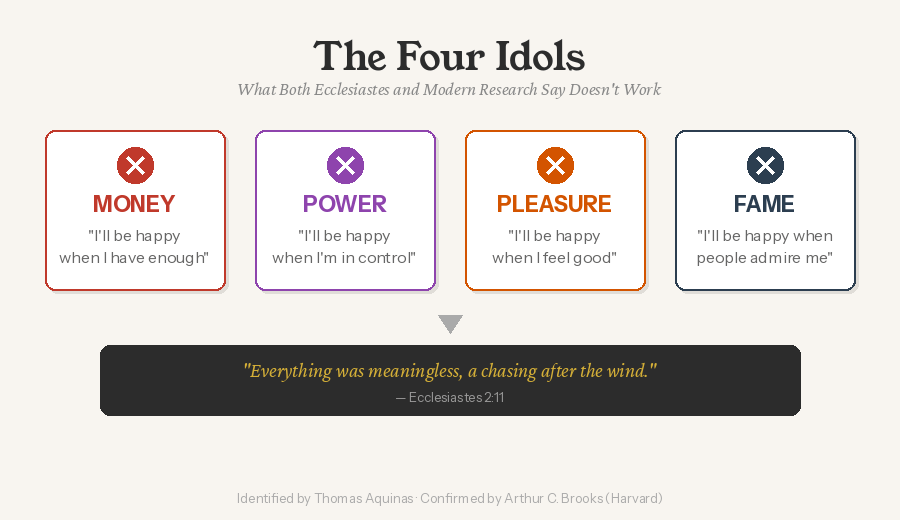
    Brooks argues that most people pursue happiness through what he calls the four “idols”: money, power, pleasure, and fame. These pursuits, he says, are not inherently bad, but they become toxic when we treat them as ultimate goals. They promise fulfilment and deliver diminishing returns. The more you chase them, the less they satisfy.

    Three thousand years before Brooks arrived at that conclusion, the Teacher in Ecclesiastes ran the same experiment. He tried everything — wealth, projects, pleasure, prestige — and delivered his verdict: “Everything was meaningless, a chasing after the wind” (Ecclesiastes 2:11). Tim Keller put it memorably: an idol is whatever you look to for things that only God can give. The tragedy isn’t that we want too much. It’s that we’re settling for too little — and calling it ambition.

    Brooks and the Bible are reading from the same page. The idols don’t deliver. They never have.

    The Three Macronutrients

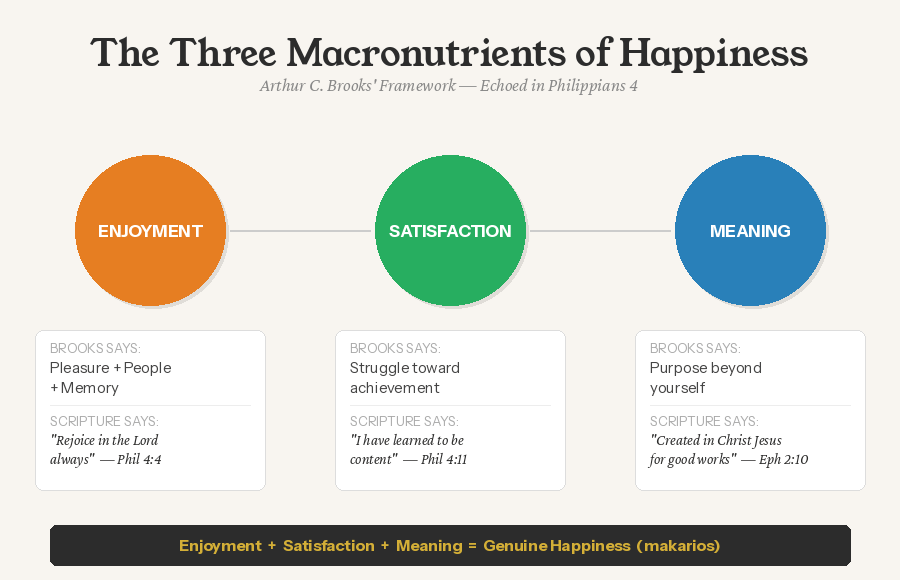
    Brooks describes happiness not as a feeling but as a practice — something built from what he calls “the three macronutrients”: enjoyment, satisfaction, and meaning.

    Enjoyment isn’t the same as pleasure. Pleasure consumed alone becomes addictive and hollow. Enjoyment, Brooks says, is pleasure combined with people and memory. It’s shared. Satisfaction isn’t comfort — it’s the reward that comes after struggle, the deep sense of having done something hard and done it well. And meaning is the big one: the “why” of your life, the sense that your existence serves a purpose beyond yourself. Brooks says we are living through a “meaning crisis” — people increasingly can’t answer the most basic questions about why they’re alive or what they would give their life for. Scripture has always had an answer. Ephesians 2:10 says we are God’s poiema — his crafted work, created in Christ Jesus for good works he prepared in advance. You are not an accident searching for a reason. You have a purpose — and it was set in place before you arrived.

    Notice what Paul writes from a Roman prison cell in Philippians 4: “I have learned to be content whatever the circumstances. I know what it is to be in need, and I know what it is to have plenty. I have learned the secret of being content in any and every situation” (Philippians 4:11–12). Two things stand out. First, Paul says he learned it. Contentment is a practice — exactly as Brooks describes. Second, Paul had none of the four idols. No wealth, no power, no comfort, no reputation. And yet he writes what may be the most joyful letter in the entire New Testament.

    Brooks says happiness is a direction, not a destination — a process of becoming incrementally happier through better habits and deeper self-understanding. Paul would agree. He practised it. He cultivated it. And he found it in the last place the world would look.

    The Four Pillars

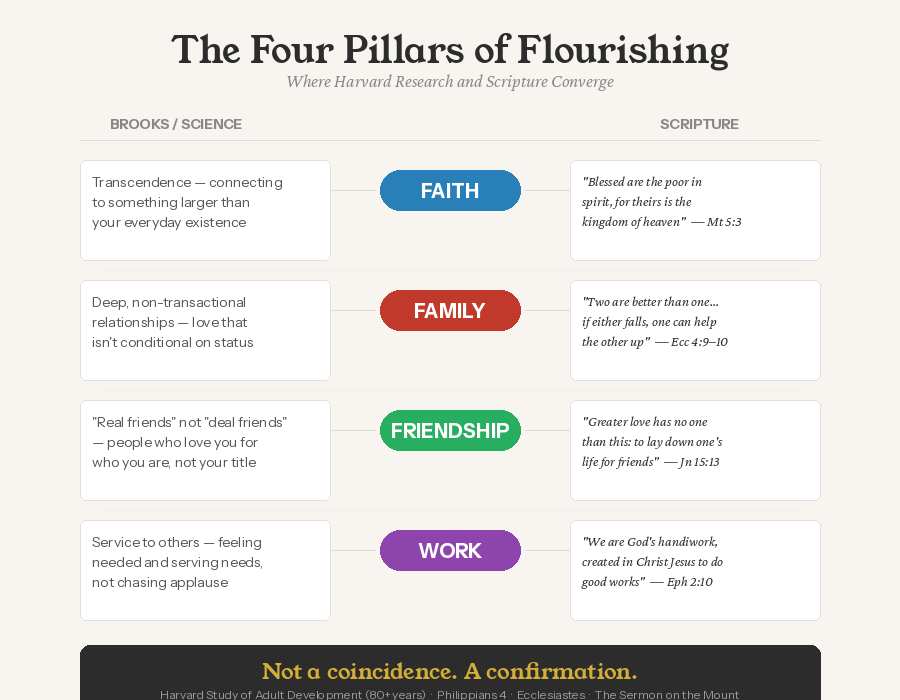
    This is where Brooks’ work becomes truly striking. After years of research, he identifies four pillars that consistently appear in the lives of the happiest people: faith, family, friendship, and meaningful work. He’s explicit that these aren’t optional extras — they are the architecture of a flourishing life.

    Faith, Brooks says, is about transcendence — connecting to something larger than your everyday existence. Family and friendship are about deep, non-transactional relationships. He draws a sharp distinction between “deal friends” and “real friends.” Deal friends are utilitarian — they care about your job title and what you can do for them. Real friends, like family, love you for who you are. And meaningful work is about service — feeling needed and serving the needs of others.

    The Harvard Study of Adult Development — the longest longitudinal study on human wellbeing, tracking hundreds of people over more than 80 years — arrived at the same conclusion: the single greatest predictor of long-term happiness is the quality of a person’s relationships.

    Now open your Bible. Genesis declares that it is not good for man to be alone. Ecclesiastes says two are better than one, because if either falls, the other can help them up (4:9–10). Jesus says the greatest love is to lay down your life for your friends (John 15:13). Paul tells the Colossians to work at everything with all their heart, as working for the Lord (3:23). And as Ephesians 2:10 reveals, we are God’s poiema — his crafted work, created for good works he prepared in advance.

    Faith. Family. Friendship. Meaningful work. Brooks arrived at these four pillars through decades of empirical research. Scripture has been proclaiming them since Moses.

    The Convergence

    Brooks himself closes many of his lectures with a line that sounds like it could come straight from a pulpit: “The world says use people, love things, and you are the centre of everything. But the right formula is to love people, use things, and worship the divine.”

    This is not a coincidence. It’s a confirmation. The most rigorous modern research on human flourishing — after thousands of subjects, decades of data, and billions of dollars in funding — keeps arriving at the same place the Bible has always been.

    God didn’t design you for the endless pursuit of more. He designed you to flourish through trust, through love, through purpose, through belonging. The world’s happiness strategy is to get more, achieve more, experience more. God’s happiness strategy is to love more, trust more, give more, belong more.

    Paul — chained, stripped of every idol, writing by lamplight in a Roman cell — puts it like this: “I can do all this through him who gives me strength” (Philippians 4:13). His contentment wasn’t dependent on his circumstances. It was dependent on his connection — to Christ, to community, to calling.

    That same contentment is available to you. Not when the circumstances change. Now.

    The scientists are catching up. The Bible has been waiting.

  • Here Comes the Team Again part 6

    Sent, Not Self-Sent

    Paul was sent, he didn’t commission himself.

    That’s worth sitting with for a moment, because it challenges an image many of us carry without realising it — Paul the maverick, the lone genius, answering to no one but God. The reality is far more interesting. Paul was the most sent person in the New Testament. And being sent meant being connected and accountable — not in a way that restricted him, but in a way that grounded him.

    Throughout this series we’ve explored how apostolic teams formed, how they were led, how they fractured, and who was on them. But none of it holds together unless we ask the prior question: who sent them, and to whom did they answer? Because if there’s one thing the New Testament makes clear, it’s that apostolic ministry was never a solo act. It was sent, supported, and accountable — and Paul wouldn’t have wanted it any other way.

    Sent From Somewhere

    We explored the Antioch commissioning in detail earlier in this series, so I won’t retrace the whole story. But it’s worth noticing one detail we didn’t dwell on then.

    “From Attalia they sailed back to Antioch, where they had been committed to the grace of God for the work they had now completed. On arriving there, they gathered the church together and reported all that God had done through them and how he had opened a door of faith to the Gentiles” (Acts 14:26-27).

    After the entire first missionary journey — Cyprus, Pisidian Antioch, Iconium, Lystra, Derbe, stoning, miracles, churches planted across Asia Minor — Paul and Barnabas didn’t simply move on to the next project. They went home.

    They gathered the church together. Not the elders privately. The whole community. And they reported — the Greek is anēngeilon, a full declaration, a giving of account. This isn’t a casual update. This is the apostolic team returning to its sending community and saying: here’s what happened, here’s what God did, here’s where we are.

    Luke frames the journey as a defined assignment: “the work they had now completed.” Paul and Barnabas understood themselves as operating under a commission, not a blank cheque. They had been sent from somewhere, and they went back to somewhere. That rhythm of sending and returning, commissioning and reporting, is woven into the fabric of apostolic ministry from the very beginning.

    Submitting to the Wider Body

    If the Antioch return shows Paul’s accountability to a local sending community, the Jerusalem Council of Acts 15 reveals something broader — his willingness to submit to the wider body of Christ on matters he could easily have settled himself.

    The issue was sharp. Men from Judea were teaching that Gentile converts must be circumcised to be saved (Acts 15:1). Paul knew they were wrong. He had the theological clarity, the apostolic authority, and the missionary track record to make a unilateral ruling. But instead, “Paul and Barnabas were appointed, along with some other believers, to go up to Jerusalem to see the apostles and elders about this question” (Acts 15:2).

    That’s a remarkable act of humility from someone who knew he was right.

    N.T. Wright has observed that for Paul, the unity of the church across the Jewish-Gentile divide was not a secondary concern but a direct implication of the gospel. If God had created one new humanity in Christ, then the church’s visible unity mattered — not as politics, but as theology. When Paul went to Jerusalem, he wasn’t just seeking tactical approval. He was practising what he preached.

    And notice how the Council worked. Peter spoke from experience (Acts 15:7-11). Paul and Barnabas reported what God had done (15:12). James offered a theological framework from the prophets (15:13-21). The decision emerged from the community: “It seemed good to the Holy Spirit and to us” (15:28). This is corporate discernment — leaders from different contexts listening to the Spirit together and arriving at a shared conclusion. No single voice dominated. No one pulled rank. The gospel was too important for that.

    The Collection: Solidarity in Action

    If the Jerusalem Council demonstrates theological accountability, Paul’s collection for Jerusalem demonstrates something even more concrete — sacrificial solidarity across the network.

    Paul spent years organising a substantial financial gift from his Gentile churches to the impoverished Jewish believers in Jerusalem. He references it across multiple letters (1 Corinthians 16:1-4; 2 Corinthians 8-9; Romans 15:25-27; Galatians 2:10). This wasn’t a quick whip-round. It was a carefully coordinated, cross-cultural project that Paul poured apostolic energy into for the better part of a decade.

    Why? Because for Paul, the collection was koinōnia — fellowship made tangible. Partnership in the gospel. Romans 15:27 makes the logic beautifully clear: “If the Gentiles have shared in the Jews’ spiritual blessings, they owe it to the Jews to share with them their material blessings.” The spiritual blessing flowed from Jerusalem outward. The material generosity flowed from the nations back. One family. One table. One economy of grace.

    Wright has argued that the collection represented Paul’s most visible embodiment of the “one new humanity” theology of Ephesians 2. It wasn’t charity. It was covenant solidarity — Gentile churches acknowledging their debt to the Jewish roots of their faith, and Jewish believers receiving living proof that the Gentile mission was real.

    What strikes me most is the accountability Paul built into the process. He didn’t control the funds personally. He arranged for church-appointed representatives to accompany the gift (2 Corinthians 8:18-21). He insisted that giving be voluntary (2 Corinthians 9:7). And he took the collection to Jerusalem in person, despite knowing that danger awaited him there (Romans 15:30-31), because he understood that the integrity of the project depended on personal presence, not delegated management.

    This is what relational connection between churches looks like when it has substance. Not just shared branding or an annual conference. Real sacrifice for churches you didn’t plant, among people you may never meet, because you share a gospel that makes you family.

    Something Deeper Than Structure

    Now, I want to be careful here. God has used all kinds of structures throughout church history — denominations, independent churches, networks, movements, and combinations of all four. I’ve seen beautiful accountability within traditional denominations and I’ve seen remarkable fruitfulness from leaders who’ve ploughed a fairly independent furrow. God is generous, and He doesn’t limit Himself to one model.

    But when I read Paul, I see something that goes deeper than any of these structures. I see what I’d call apostolic network participation — a web of relational accountability that is richer than affiliation and more organic than bureaucracy.

    Think about what Paul actually had. A sending church that commissioned him and expected him back. A relationship with the Jerusalem apostles built on mutual recognition and honest disagreement. A network of churches connected through shared workers, shared letters, and shared financial sacrifice. Co-workers like Timothy and Titus who functioned as apostolic delegates across multiple churches. And the collection — binding Gentile and Jewish believers together in ways that cost them something.

    Gordon Fee consistently emphasised that Paul’s vision of the body of Christ was never purely local — it was inherently connectional. The Spirit who distributed gifts within a congregation was the same Spirit binding congregations together across geography and culture. For Paul, belonging to Christ meant belonging to each other, and that belonging had practical, visible, costly expression.

    What I find compelling about Paul’s model isn’t that it provides a template we can photocopy. It’s that it reveals a heartbeat. The heartbeat says: we are better together. The heartbeat says: my calling is not my private possession. The heartbeat says: the community that sends me has the right to speak into my life, and I welcome that, because the mission is too important and I am too human to carry it alone.

    The Gift of Being Sent

    Here’s what I’ve come to believe. The deepest form of accountability isn’t structural — it’s relational. It’s not about reporting lines or governance documents, though those have their place. It’s about the kind of relationships where people know you well enough to ask hard questions, love you enough to tell you the truth, and are invested enough in your calling to hold you to it when things get difficult.

    Paul had that. He had it in Antioch, in Jerusalem, in the network of co-workers who travelled with him, and in the churches that prayed for him and gave sacrificially to a cause he championed. He wasn’t accountable because someone made him be. He was accountable because he understood that apostolic ministry, like every spiritual gift, is given for the body, not for the individual.

    In Empowered, I explore how gifts are never private possessions — they’re always given for the building up of others. The same is true of apostolic calling itself. It thrives in community. It’s confirmed in community. And it stays healthy in community. The moment a calling becomes a personal franchise, something essential has been lost.

    Paul sailed back to Antioch. He went up to Jerusalem. He organised the collection. He appointed delegates he didn’t control. He submitted to outcomes he didn’t determine. And he did all of this while leading the most dynamic missionary movement the world had ever seen.

    Being sent didn’t limit him. It liberated him.

    A Series in Six Parts

    Across these six posts, we’ve watched Paul build something extraordinary. Teams that were diverse in gift, ethnicity, and gender. Leadership that was clear but cruciform. Formation processes rooted in community discernment. Honest reckoning with conflict and failure. Women integrated at every level of ministry. And accountability structures that were relational before they were institutional.

    The picture that emerges is not a blueprint to be imposed. It’s a vision to be pursued — prayerfully, humbly, in the communities where God has placed us. And the heart of that vision is this: apostolic ministry was never meant to be carried alone. It is sent, supported, and sustained within a network of relationships thick enough to hold both the mission and the people who carry it.

    The church doesn’t need more lone voices. It needs more communities brave enough to commission, generous enough to release, and loving enough to stay connected.

    Sent, not self-sent. That’s the invitation.

  • Here Comes the Team Again part 5

    The Women on Paul’s Team

    Open Romans 16 and start counting.

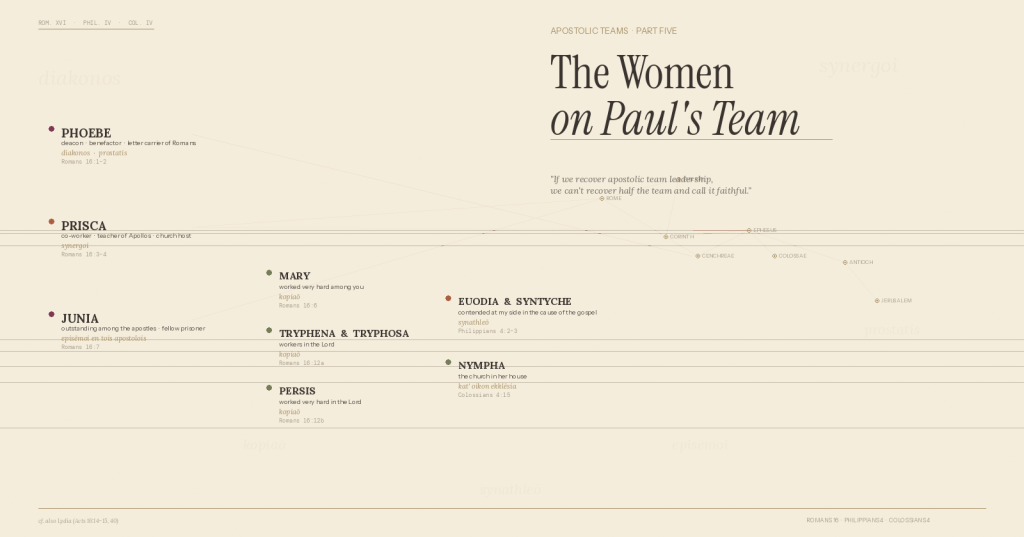
    Of the twenty-six-plus individuals Paul greets by name, at least nine are women. Not wives mentioned in passing. Not silent supporters. Women Paul names with the same language of ministry, labour, and partnership that he uses for his male co-workers. Women he calls deacons, co-workers, and apostles.

    This isn’t a post about the modern debate over women in ministry. It’s something simpler and, I think, more powerful than that. It’s a post about what Paul actually did. Because when you look at the evidence — not through the lens of later church debates, but through the lens of what Paul wrote with his own hand — you find women everywhere on his team. And he wasn’t embarrassed about it. He was pleased with it.

    Phoebe: The Woman Who Carried Romans

    Paul opens his greetings in Romans 16 with a commendation — and the first person he commends is a woman.

    “I commend to you our sister Phoebe, a deacon of the church in Cenchreae. I ask you to receive her in the Lord in a way worthy of his people and to give her any help she may need from you, for she has been the benefactor of many people, including me” (Romans 16:1-2).

    Three things to notice. First, Paul calls Phoebe diakonos — deacon. Not diakonissa, the later feminine form invented to soften the title, but the same word Paul uses elsewhere for male leaders including himself (1 Corinthians 3:5, 2 Corinthians 6:4). Douglas Moo, in his NICNT Romans commentary, and N.T. Wright both argue that the addition of the phrase “of the church in Cenchreae” strongly suggests an official leadership role, not merely a general description of service.

    Second, Paul calls her prostatis — a word variously translated as “benefactor,” “patron,” or “helper.” In the Greco-Roman world, a prostatis was a person of means and influence who provided resources, legal protection, and social support. Paul says Phoebe was a prostatis to “many people, including me.” Paul — the apostle — acknowledges that this woman had supported and benefited him.

    Third, and perhaps most significant: there is an overwhelming scholarly consensus that Phoebe was the letter carrier of Romans. Paul’s commendation follows the standard form of an ancient letter of recommendation — introducing a trusted emissary to the recipients. Wright argues that in the ancient world, the person who delivered a letter was typically the one who read it aloud and answered questions about it. If that’s correct, then Phoebe — a woman — was the first person to publicly read and explain the most theologically significant letter Paul ever wrote. As Scot McKnight and others have noted, that effectively makes Phoebe the first commentator on Romans.

    Paul entrusted a woman with the delivery, reading, and initial interpretation of his masterwork. That tells us everything we need to know about what Paul thought women were capable of.

    Prisca: Named Before Her Husband

    “Greet Prisca and Aquila, my co-workers in Christ Jesus. They risked their lives for me. Not only I but all the churches of the Gentiles are grateful to them” (Romans 16:3-4).

    Paul calls Prisca (Priscilla) and Aquila synergoi — the same “co-workers” language he uses for Timothy, Titus, and other key team members. But notice the order. In four of the six New Testament references to this couple, Prisca is named first — here in Romans 16, and in Acts 18:18, Acts 18:26, and 2 Timothy 4:19. In a culture where the husband’s name conventionally came first, reversing the order almost certainly signals that Prisca was the more prominent partner in ministry.

    Acts 18:26 gives us a concrete example. When the eloquent Apollos arrived in Ephesus preaching with incomplete understanding, it was Prisca and Aquila who “took him aside and explained to him the way of God more adequately.” A woman, alongside her husband, correcting and instructing a gifted male teacher. And Luke, far from hiding this, names her first in the account.

    Paul says they “risked their lives” for him — language that suggests imprisonment or mortal danger. Prisca wasn’t a background supporter. She was a frontline co-worker who put her life on the line for the apostolic mission and whose home served as the meeting place for the church in multiple cities (Romans 16:5, 1 Corinthians 16:19).

    Junia: Outstanding Among the Apostles

    We’ve already encountered Junia in an earlier post in this series and I’ve written blogs about her before, but she belongs at the heart of this one too.

    “Greet Andronicus and Junia, my fellow Jews who have been in prison with me. They are outstanding among the apostles, and they were in Christ before I was” (Romans 16:7).

    The scholarly consensus is now decisive: Junia was a woman. No one in the history of the church interpreted the name as masculine until the thirteenth century. John Chrysostom, writing in the fourth century, had no hesitation — he celebrated the wisdom of “this woman” who was “deemed worthy of the title of apostle.” The masculine “Junias” has no attestation anywhere in the ancient world. As Scot McKnight puts it in Junia Is Not Alone, the creation of Junias was effectively a sex change performed on the text by editors who couldn’t accept that a woman could be an apostle.

    McKnight goes further. If Junia was an apostle — and Paul says she was outstanding among them — then, as McKnight writes, “she was in essence a Christ-experiencing, Christ-representing, church-establishing, probably miracle-working, missionizing woman who preached the gospel and taught the church.” That’s not a marginal role. That’s apostolic ministry at its fullest.

    Moo confirms the grammar: the Greek episēmoi en tois apostolois means “outstanding among the apostles,” not merely “well known to the apostles.” Wright and Dunn read it the same way. Junia wasn’t simply known by apostles — she was one of them.

    And she’d been in prison with Paul. The word synaichmalōtos — “fellow prisoner” — is one Paul uses only three times, for people who shared his chains for the gospel. Junia had suffered for the mission. She had paid the price. And Paul honoured her publicly for it.

    The Workers and Contenders

    Junia, Phoebe, and Prisca are the most prominent women on Paul’s team, but they are far from alone.

    In Romans 16 alone, Paul greets Mary “who worked very hard for you” (v.6) — the verb kopiaō is the same word Paul uses for his own apostolic labour in 1 Corinthians 15:10 and Galatians 4:11. He greets Tryphena and Tryphosa, “those women who work hard in the Lord” (v.12), using kopiaō again. He greets Persis, “the beloved, who has worked very hard in the Lord” (v.12). He greets Julia and the mother of Rufus (v.13, 15). These aren’t decorative mentions. Paul is using his strongest language of ministerial labour for these women.

    In Philippians, Paul writes: “I plead with Euodia and I plead with Syntyche to be of the same mind in the Lord… these women have contended at my side in the cause of the gospel, along with Clement and the rest of my co-workers” (Philippians 4:2-3). The verb is synathleō — “to contend together,” “to fight alongside.” It’s athletic, combative language. Euodia and Syntyche didn’t just help Paul — they fought beside him in the gospel. And Paul lists them alongside his male co-workers without distinction.

    In Colossians 4:15, Paul sends greetings to “Nympha and the church in her house” — a woman who hosted and presumably led a house church. In Acts 16, Lydia — a dealer in purple cloth — responds to Paul’s preaching in Philippi, is baptised with her household, and her home becomes the base for the Philippian church (Acts 16:14-15, 40). The first European convert and the first European church host was a woman.

    What the Evidence Demands

    Let me be clear about what I’m not doing in this post. I’m not trying to resolve the broader theological debate about women’s roles in the church. Trusted scholars I respect — Wright, Fee, Moo, McKnight — land in different places on some of those questions. What I am doing is letting the evidence of Paul’s actual practice speak for itself.

    And when it speaks, it says this: Paul’s apostolic teams included women at every level. Women who were deacons. Women who were co-workers. Women who were apostles. Women who carried letters, hosted churches, taught gifted men, contended in the gospel, risked their lives, went to prison, and worked so hard that Paul used the same language for their labour that he used for his own.

    In Empowered, I argue that the Spirit distributes gifts “to each one, just as he determines” (1 Corinthians 12:11) — not according to gender, age, or social status. What we see in Paul’s practice is exactly what that theology would predict. If the Spirit gives gifts without regard to gender, then the teams built on those gifts will naturally include women exercising the full range of their callings.

    Paul wasn’t a modern egalitarian operating with twenty-first-century categories. He was a first-century Jewish apostle operating in a patriarchal culture. And yet his teams were more gender-diverse than many church leadership teams today. That should give us pause.

    Scot McKnight titled his study of Junia Junia Is Not Alone. He’s right. She wasn’t alone. She had Phoebe beside her, and Prisca, and Mary, and Tryphena, and Tryphosa, and Persis, and Euodia, and Syntyche, and Nympha, and Lydia. Paul saw what the Spirit had placed in each of them, and he gave them room to flourish.

    If we’re serious about recovering apostolic team leadership, we can’t recover half the team and call it faithful.

  • Here Comes the Team Again part 4

    When Teams Break

    If apostolic teams were only ever a story of triumph, we’d have reason to be suspicious. The New Testament is too honest for that.

    The previous posts in this series have painted a picture of something remarkable — Paul’s divinely commissioned, gift-diverse, Spirit-formed teams achieving extraordinary things across the Roman Empire. All of that is true. But it’s not the whole truth. Because Paul’s teams also fractured, faltered, and fell apart. People left. Friendships ruptured. Trust was broken. And the greatest missionary partnership in the early church ended not with a commissioning service but with a blazing row.

    If we’re going to recover genuine apostolic team leadership, we need to be honest about what happens when teams break. Because they will.

    The Sharp Disagreement

    “Barnabas wanted to take John, also called Mark, with them, but Paul did not think it wise to take him, because he had deserted them in Pamphylia and had not continued with them in the work. They had such a sharp disagreement that they parted company” (Acts 15:37-39).

    Let those words land. This is Paul and Barnabas — the original apostolic team. The pair commissioned together by the Holy Spirit at Antioch (Acts 13:2). The men who’d been stoned, chased out of cities, and worshipped as gods side by side. They had history. They had fruit. They had a divine mandate. And they couldn’t resolve a disagreement about a young man called Mark.

    The Greek word Luke uses is paroxysmos — a violent irritation, a paroxysm. It’s the word we’d use for a seizure or an explosion. This wasn’t a measured discussion that ended in a polite agreement to differ. This was a rupture.

    And notice what caused it. Not theology. Not moral failure. Personnel. Barnabas wanted to give his cousin Mark a second chance after Mark had abandoned the first missionary journey at Perga (Acts 13:13). Paul refused. He’d been burned once and wasn’t willing to risk the mission on someone who’d already walked away.

    Both men had a case. Paul was protecting the mission. Barnabas was protecting a person. Paul saw the desertion and drew a line. Barnabas saw the potential and extended grace. This is the kind of disagreement that destroys teams precisely because both sides are partially right.

    What’s remarkable is what Luke doesn’t say. He doesn’t tell us who was right. He doesn’t resolve the tension for us. He just reports the rupture and moves on. Barnabas took Mark and sailed for Cyprus. Paul chose Silas and went to Syria and Cilicia. The one team became two. The mission continued — but the partnership was over.

    The Antioch Confrontation

    If the Barnabas split was painful, the Antioch incident was dangerous.

    “When Cephas came to Antioch, I opposed him to his face, because he stood condemned. For before certain men came from James, he used to eat with the Gentiles. But when they arrived, he began to draw back and separate himself from the Gentiles because he was afraid of those who belonged to the circumcision group. The other Jews joined him in his hypocrisy, so that by their hypocrisy even Barnabas was led astray” (Galatians 2:11-13).

    Peter — the rock, the leader of the Twelve — caved to social pressure and withdrew from eating with Gentile believers. This wasn’t a private wobble. It was a public capitulation that threatened to undo the gospel itself. If Jewish and Gentile believers couldn’t eat together, the unity of the body was a fiction. And the damage cascaded: “even Barnabas was led astray.”

    That phrase should stop us. Barnabas — the man who’d championed the Gentile mission from the beginning, who’d seen the grace of God in Antioch and was glad (Acts 11:23) — was pulled into the hypocrisy by the gravitational force of Peter’s example. If Barnabas could be swept along, anyone could.

    Paul confronted Peter publicly. “I opposed him to his face.” This is team conflict at its most acute — one apostle publicly rebuking another because the gospel was at stake. Paul didn’t take Peter aside for a quiet word. The offence was public, so the correction had to be public. The integrity of the mission demanded it.

    N.T. Wright argues that this confrontation reveals how seriously Paul took the social implications of the gospel. The table fellowship of Jewish and Gentile believers wasn’t a secondary issue — it was the living proof that God had created one new humanity in Christ. When Peter withdrew, he wasn’t just being socially cautious. He was denying in practice what the gospel declared in principle.

    Demas Loved This World

    If the Barnabas split was a fracture between friends and the Antioch confrontation was a fight for the gospel, the departure of Demas was something quieter and sadder — a slow drift that ended in desertion.

    “Demas, because he loved this world, has deserted me and has gone to Thessalonica” (2 Timothy 4:10).

    One sentence. No argument recorded, no dramatic confrontation. Just a man who had once been listed among Paul’s “fellow workers” (Philemon 24), who had sent greetings alongside Luke to the Colossian church (Colossians 4:14), and who now, when the cost of association with Paul became too high, walked away.

    Paul writes this from a Roman prison, likely facing execution. The timing makes the betrayal sharper. This isn’t Demas disagreeing with Paul’s theology or strategy. It’s Demas choosing comfort over costly loyalty. He “loved this present world” — the now age, as the Greek puts it — more than the age to come.

    And he wasn’t alone in leaving. Paul continues: “Crescens has gone to Galatia, Titus to Dalmatia. Only Luke is with me” (2 Timothy 4:11). Some of these departures were legitimate ministry assignments. But the overall picture is devastating. The great apostolic team leader, near the end of his life, is almost alone. The team that had once stretched across the Mediterranean had thinned to a physician who refused to leave.

    Mark’s Redemption

    But here’s where the story turns

    In the same letter where Paul records Demas’s desertion, he writes to Timothy: “Get Mark and bring him with you, because he is helpful to me in my ministry” (2 Timothy 4:11).

    Mark. The same John Mark whose desertion at Perga had caused the rupture between Paul and Barnabas. The man Paul had refused to trust with a second chance. Now, years later, Paul doesn’t just tolerate Mark — he specifically requests him. He calls him euchrestos — “useful,” “profitable,” “helpful.” The man who’d once been written off as a liability had become, in Paul’s estimation, essential.

    What happened in the intervening years? Luke doesn’t tell us directly, but the evidence points to Barnabas. After the split with Paul, Barnabas took Mark to Cyprus and invested in him. The encourager did what encouragers do — he saw the potential that Paul couldn’t see in that moment, and he refused to give up on it. By the time Paul writes Colossians, Mark is with him in Rome and Paul instructs the Colossians to welcome him (Colossians 4:10). By the time he writes 2 Timothy, Mark is someone Paul actively wants by his side.

    The team broke. But the person who caused the break was ultimately restored. And the man who refused to give him a second chance eventually changed his mind. That’s not a failure of apostolic leadership — that’s the gospel working its way through the mess of human relationships.

    What the Fractures Reveal

    So what do we do with all this? Let me suggest four things that the breaking of Paul’s teams reveals.

    First, team conflict is not evidence that the mission has failed. The Paul-Barnabas split was agonising, but it produced two missionary teams instead of one. Barnabas continued fruitful ministry. Paul continued fruitful ministry. And Mark — the cause of the rupture — was restored. God’s purposes are not derailed by human disagreements, even sharp ones. The mission is always bigger than the team.

    Second, there are times when confrontation is an act of faithfulness, not a failure of relationship. Paul’s rebuke of Peter at Antioch was not a personality clash. It was a defence of the gospel. When the integrity of the mission is at stake — when people are being excluded, when the truth is being compromised, when leaders are acting out of fear rather than conviction — someone has to speak. As I explored in the previous post, someone has to lead. And sometimes leading means opposing a friend to their face.

    Third, not everyone finishes the race. Demas is a sobering reminder that proximity to Paul was no guarantee of perseverance. You could work alongside the greatest apostolic leader in history and still choose the comforts of the present world over the costliness of the mission. Teams will lose people — not always through conflict, but sometimes through the quiet erosion of commitment that comes when the cost outweighs the desire. As I write in Empowered, gifts don’t automatically operate just because we have them — we activate them by faith, and we can also let them grow dormant through neglect.

    Fourth, and most importantly, broken teams are not beyond redemption. Mark’s story is the heart of this post. The deserter became the helper. The man who walked away became the man Paul specifically requested. This didn’t happen overnight — it took years, and it took Barnabas’s willingness to invest in someone Paul had given up on. But it happened. And if it happened for Mark, it can happen in any team where people are willing to extend the same grace they themselves have received.

    The Honest Church

    Here’s the prophetic edge. We live in a church culture that is often terrible at handling team fractures. We either pretend they don’t happen — projecting an image of seamless unity that fools no one — or we catastrophise them, treating every disagreement as a scandal and every departure as a betrayal.

    Paul’s letters model something better. He’s ruthlessly honest. He names names — Peter, Demas, Alexander the metalworker who “did me a great deal of harm” (2 Timothy 4:14). He doesn’t pretend that apostolic teams are immune to conflict. But he also doesn’t let the fractures define the story. The very letter that records Demas’s desertion also records Mark’s restoration. The same apostle who split from Barnabas later speaks of him with warmth (1 Corinthians 9:6).

    Teams break. People leave. Friendships fracture under the weight of disagreement, pressure, and the ordinary failings of human beings trying to do extraordinary things. That’s not a reason to stop building teams. It’s a reason to build them with honesty, with grace, and with the kind of cruciform love that can survive the fractures — and sometimes redeem them.

    Mark’s story proves it. The team that breaks is not necessarily the team that’s finished.

    https://www.amazon.co.uk/s?k=empowered+paul+benger&crid=2LQ9BFCRDBLDJ&sprefix=%2Caps%2C291&ref=nb_sb_ss_recent_1_0_recent

  • Here Comes the Team Again part 3

    How Apostolic Teams Form

    Nobody applied for a job on Paul’s team. There was no recruitment drive, no interview process, no job description circulated around the churches of Asia Minor. And yet Paul assembled one of the most effective missionary teams in history.

    How?

    The answer matters because it challenges almost every assumption we bring to team-building in the church today. We default to hiring, headhunting, and networking — borrowing models from the corporate world and baptising them with prayer. But when you trace how Paul’s teams actually came together, you find something far more organic, far more Spirit-led, and far more rooted in community than anything a staffing consultant would recommend.

    The Antioch Moment

    It starts in a room in Antioch, around AD 48.

    “In the church at Antioch there were prophets and teachers: Barnabas, Simeon called Niger, Lucius of Cyrene, Manaen (who had been brought up with Herod the tetrarch) and Saul. While they were worshipping the Lord and fasting, the Holy Spirit said, ‘Set apart for me Barnabas and Saul for the work to which I have called them.’ So after they had fasted and prayed, they placed their hands on them and sent them off” (Acts 13:1-3).

    Before we rush past this, pause and notice what’s happening.

    Five leaders are named. Look at the diversity. Barnabas — a Levite from Cyprus, the “son of encouragement” who’d already been sent from Jerusalem to investigate the Antioch church and had the wisdom to see it was genuine (Acts 11:22-24). Simeon called Niger — the name Niger is Latin for “black,” almost certainly indicating African heritage. N.T. Wright notes that how ancient people thought about race in the Roman world was vastly different from recent centuries in the West, but Simeon’s name likely signals that people from Africa were already receiving the gospel and serving in leadership. Lucius from Cyrene in modern-day Libya — possibly one of those who heard the disciples speaking in their own language at Pentecost (Acts 2:10). Manaen, who grew up alongside Herod Antipas — a man raised in the corridors of political power who somehow ended up in the church. And Saul of Tarsus — Pharisee turned apostle, the most unlikely of the five.

    This is not a team built around a single personality or gift cluster. It’s ethnically diverse, culturally diverse, socially diverse. It spans the spectrum from African diaspora to Roman aristocracy to rabbinic training. And the text tells us they were “prophets and teachers” — not one or the other, but both gift streams represented in the same leadership group.

    Now notice the context. They aren’t strategising. They aren’t planning a mission trip on a whiteboard. They are worshipping and fasting. The Spirit speaks into a community that is already gathered, already seeking, already submitted. The commissioning doesn’t come from a visionary leader’s plan — it comes from communal discernment in the presence of God.

    This is how the first missionary team formed. Not through recruitment. Through revelation — received in community.

    In Empowered, I explore how the early church operated in two rhythms: temple and table. The gathered worship and the intimate fellowship. Gifts were discovered at the table and deployed from the temple. Antioch embodies both. These five men had been doing life together, teaching together, worshipping together — maybe for years. And out of that shared life, the Spirit identified who should go.

    There’s something else worth noting. The Antioch church sent two of its five named leaders. They didn’t hoard their best people. They released them. That’s an act of extraordinary faith — and it tells us something about the kind of community that produces apostolic teams. It’s a community that holds its leaders with open hands.

    Barnabas Saw Paul Before Paul Saw Himself

    The Antioch moment doesn’t emerge from nowhere. There’s a backstory, and it begins with one man’s ability to see potential.

    After Paul’s conversion, the Jerusalem church wanted nothing to do with him. Understandably. The man who had been dragging believers to prison was now claiming to be one of them. It was Barnabas who took the risk — who brought Paul to the apostles and vouched for him (Acts 9:27). Later, when the Jerusalem church sent Barnabas to investigate the growing Gentile church in Antioch, he saw the need and knew exactly who could help. He travelled to Tarsus — a significant journey — specifically to find Paul and bring him to Antioch (Acts 11:25-26).

    Paul didn’t seek out a role. He was in Tarsus, apparently waiting. Barnabas went and got him because Barnabas could see what Paul carried. For an entire year they taught together in Antioch, side by side, before the Spirit commissioned them for the road.

    This is team formation through discernment, not recruitment. Barnabas wasn’t filling a vacancy. He was recognising a calling. And notice the humility involved — Barnabas brought in someone whose gifts would eventually surpass his own. By Acts 13:13, Luke starts writing “Paul and his companions” where he’d previously written “Barnabas and Saul.” Barnabas recruited the man who would outgrow him. That takes a security in God that most leaders never find.

    Paul Spotted Timothy in the Wreckage

    If Antioch shows us team formation through community discernment, Lystra shows us something different — team formation through encounter.

    Paul arrives in Lystra on his second missionary journey. The last time he was there, the crowd had first tried to worship him as Hermes, then stoned him and left him for dead (Acts 14:8-19). He comes back anyway. And in that town — scarred by violence — he finds Timothy.

    “Paul came to Derbe and then to Lystra, where a disciple named Timothy lived, whose mother was Jewish and a believer but whose father was a Greek. The brothers and sisters at Lystra and Iconium spoke highly of him. Paul wanted Timothy to go with him” (Acts 16:1-3).

    Three things stand out. First, Timothy was already a disciple — formed in faith by his mother Eunice and grandmother Lois (2 Timothy 1:5), shaped by Scripture “from childhood” (2 Timothy 3:15). The community had already done its work before Paul arrived. Second, the local believers endorsed him — “the brothers and sisters at Lystra and Iconium spoke highly of him.” Paul didn’t make a unilateral decision. He consulted the people who knew Timothy best. Third, there’s a prophetic dimension. Paul later reminds Timothy of “the prophecies once made about you” (1 Timothy 1:18) and the gift given “through prophecy when the body of elders laid their hands on you” (1 Timothy 4:14). Timothy’s commissioning, like Paul’s own at Antioch, involved prophetic recognition within community.

    Timothy was probably a teenager or young man when Paul was stoned in his town on the first visit. He would have seen it — or at least heard every detail. He knew exactly what signing up for Paul’s team meant. This wasn’t a career opportunity. It was an invitation to suffer.

    And yet Paul saw something in this young, half-Jewish, uncircumcised believer from a backwater town that made him say: this is the one I want. That’s the same genius for seeing gifts that we explored in the previous post — but now we see it operating at the point of team formation, not just team deployment.

    Providential Encounters on the Road

    Not every team member was recruited. Some were found.

    Aquila and Priscilla appear in Acts 18 because they’d been expelled from Rome by Claudius’s edict and happened to land in Corinth — where Paul happened to arrive. They shared the same trade, tentmaking, so Paul stayed and worked with them. A providential convergence of geography, economics, and calling. They became two of Paul’s most significant co-workers — teaching Apollos, hosting churches, risking their lives for Paul (Romans 16:3-4).

    Luke appears in the narrative almost without introduction. In Acts 16:10, the text suddenly shifts from “they” to “we” — Luke has joined the team at Troas. No explanation, no recruitment scene. He’s simply there, and from that point he’s part of the story. The physician who would write both the Gospel of Luke and Acts — arguably the most significant historian of the early church — joined Paul’s team through what appears to be a quiet, providential meeting.

    Silas was different again. After the sharp disagreement with Barnabas over John Mark, Paul “chose Silas and left, commended by the believers to the grace of the Lord” (Acts 15:40). Silas had come to Antioch as a delegate from the Jerusalem Council — a prophet in his own right (Acts 15:32) and a Roman citizen. Paul chose him deliberately, but the believers at Antioch endorsed the decision through prayer and commendation. Again, the pattern: individual discernment confirmed by community recognition.

    What the Pattern Reveals

    When you stand back and look at how Paul’s teams formed, no single model emerges. That’s the point. The Spirit doesn’t work to a formula. But there are consistent threads.

    Every team member was already being formed before Paul found them. Timothy had been shaped by Scripture from childhood. Aquila and Priscilla were already believers with established gifts. Silas was already a recognised prophet. Luke was already a researcher, cataloguing the Jesus movement.

    Paul didn’t create people from scratch — he recognised what the Spirit had already been doing in their lives and drew them into the mission. As I argue in Empowered, gifts are discovered in community before they’re deployed in mission. Paul’s genius was spotting people whose gifts had already taken root — and giving them a context in which to flourish.

    Community confirmation was non-negotiable. The Antioch Five were commissioned through corporate worship and fasting. Timothy was endorsed by the believers in Lystra and Iconium. Silas was commended by the Antioch church. Even Timothy’s prophetic calling was recognised “when the body of elders laid their hands on you.” Paul didn’t operate as a lone scout signing up individuals. The community always had a voice.

    The team was shaped by the road, not just by the plan. Aquila and Priscilla were found because of a Roman imperial edict. Luke appeared at Troas during a journey that the Spirit had repeatedly redirected — Paul had been “kept by the Holy Spirit from preaching the word in the province of Asia” and “the Spirit of Jesus would not allow them” to enter Bithynia (Acts 16:6-7). The team that entered Europe was assembled partly through divine roadblocks. God’s “no” to one plan created the “yes” that brought the right people together.

    And the cost was always clear. Timothy had watched Paul get stoned. Silas would be beaten and jailed in Philippi. Aquila and Priscilla “risked their lives” for Paul. Nobody joined this team under the illusion that it was a platform for personal advancement. They joined because they recognised the mandate, believed in the mission, and were willing to pay the price.

    A Word for Today

    Modern church teams are often assembled the way corporations build departments — job descriptions, interviews, salary negotiations, skills assessments. There’s nothing inherently wrong with any of those tools. But if they become the primary mechanism for building a team, something vital is lost.

    Paul’s teams were forged in worship, confirmed in community, tested on the road, and refined through suffering. The people who joined him weren’t hired for their competence — though they were competent. They were recognised for their calling. And there’s a world of difference between the two.

    The Antioch model asks uncomfortable questions of the modern church. Are our communities the kind of places where the Spirit can speak and be heard? Are we worshipping and fasting together — or just planning and strategising? Do we have the faith to release our best leaders rather than hoarding them? Are we looking for people whose gifts have already taken root in community — or are we just scanning CVs?

    Paul’s teams didn’t form in a boardroom. They formed in the presence of God, on dusty roads, in the aftermath of stoning, around the workbench of a tentmaker, and at tables where diverse believers broke bread together.

    That’s where apostolic teams still form. If we have eyes to see.