• This post was first shared on Jamesclear.com

    There is a interesting story about how Pablo Picasso, the famous Spanish artist, developed the ability to produce remarkable work in just minutes.

    As the story goes, Picasso was walking though the market one day when a woman spotted him. She stopped the artist, pulled out a piece of paper and said, “Mr. Picasso, I am a fan of your work. Please, could you do a little drawing for me?”

    Picasso smiled and quickly drew a small, but beautiful piece of art on the paper. Then, he handed the paper back to her saying, “That will be one million dollars.”

    “But Mr. Picasso,” the woman said. “It only took you thirty seconds to draw this little masterpiece.”

    “My good woman,” Picasso said, “It took me thirty years to draw that masterpiece in thirty seconds.” [1]

    Picasso isn’t the only brilliant creative who worked for decades to master his craft. His journey is typical of many creative geniuses. Even people of considerable talent rarely produce incredible work before decades of practice.

    Let’s talk about why that is, and even more important, how you can reveal your own creative genius.

    The Age of Most Nobel Prize Winners

    A recent study tracked the ages of Nobel Prize winners, great inventors, and scientists. As you can see in the graph below, the researchers found that most groundbreaking work peaked during the late thirties — at least a full decade into any individual career. Even in the fields of science and math, creative breakthroughs often require ten years or more or work. [2]
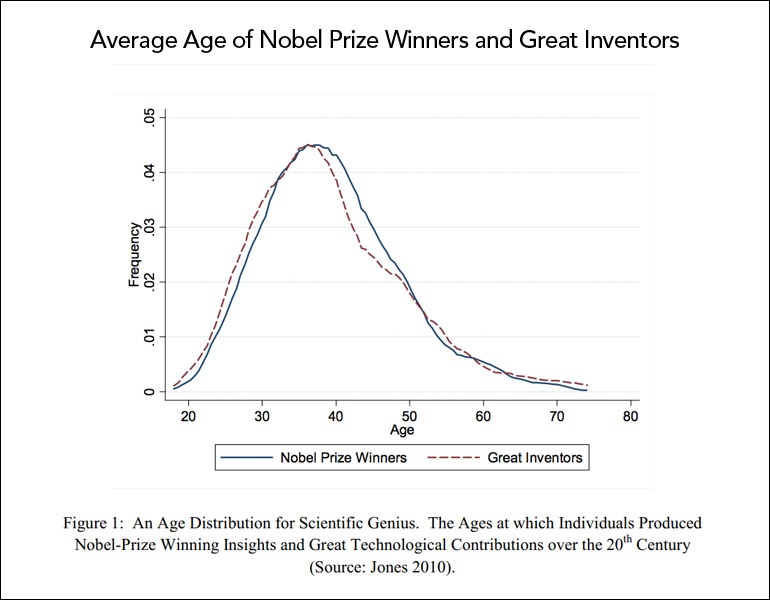
    Image

    These findings match the work done by previous researchers as well.

    For example, a study conducted at Carnegie Mellon University by cognitive psychology professor John Hayes found that out of 500 famous musical pieces, nearly all of them were created after year 10 of the composer’s career. In later studies, Hayes found similar patterns with poets and painters. He began referring to this period hard work and little recognition as the “ten years of silence.”

    Whether you are a composer or a scientist, creativity is not a quality you are born with or without. It is something that is discovered, honed, and improved through real work.

    Which brings us to an important question: How can you do your best work and discover your hidden creative genius?

    Permission to Create Junk

    People tend to look at successful writers, writers who are getting books published and maybe even doing well financially, and think that they sit down at their desks every morning feeling like a million dollars, feeling great about who they are and how much talent they have and what a great story they have to tell; that they take a few deep breaths, push back their sleeves, roll their necks a few times to get all the cricks out, and dive in, typing fully formed passages as fast as a court reporter. But this is just fantasy of the uninitiated. I know some very great writers, writers you love who write beautifully and have made a great deal of money, and not one of them sits down routinely feeling wildly enthusiastic and confident. Not one of them writes elegant first drafts… For me and most other writers I know, writing is not rapturous. If fact, the only way I can get anything written at all is to write really, really bad first drafts.
    —Anne Lamott, Bird by Bird

    In any creative endeavor you have to give yourself permission to create junk. There is no way around it. Sometimes you have to write 4 terrible pages just to discover that you wrote one good sentence in the second paragraph of the third page.

    Creating something useful and compelling is like being a gold miner. You have to sift through pounds of dirt and rock and silt just to find a speck of gold in the middle of it all. Bits and pieces of genius will find their way to you, if you give yourself permission to let the muse flow.

    Create on a Schedule

    Inspiration is for amateurs. The rest of us just show up and get to work.
    —Chuck Close

    Amateurs create when they feel inspired. Professionals create on a schedule.

    No single act will uncover more creative genius than forcing yourself to create consistently. Practicing your craft over and over is the only way to become decent at it. The person who sits around theorizing about what a best-selling book looks like will never write it. Meanwhile, the writer who shows up every day and puts their butt in the chair and their hands on the keyboard — they are learning how to do the work.

    Ira Glass is the host of the popular radio show This American Life, which is broadcast to 1.7 million listeners each week. This is the advice Glass gives to anyone looking to interesting, creative work: “The most important thing you can do is do a lot of work. Do a huge volume of work. Put yourself on a deadline so that every week or every month you know you’re going to finish one story. It is only by going through a volume of work that … the work you’re making will be as good as your ambitions.”

    If you want to do your best creative work, then don’t leave it up to choice. Don’t wake up in the morning and think, “I hope I feel inspired to create something today.” You need to take the decision-making out of it. Set a schedule for your work. Genius arrives when you show up enough times to get the average ideas out of the way.

    Finish Something

    Steven Pressfield’s most famous work, The Legend of Bagger Vance, was a best-selling novel that became a major motion picture starring Matt Damon, Will Smith, and Charlize Theron. But if you ask Pressfield, he will say that his most important book was one that you never heard of: the first book he finished.

    Here’s how Pressfield describes finishing his first novel…

    I never did find a buyer for the book. Or the next one, either. It was ten years before I got the first check for something I had written and ten more before a novel, The Legend of Bagger Vance, was actually published. But that moment when I first hit the keys to spell out THE END was so epochal. I remember rolling the last page out and adding it to the stack that was the finished manuscript. Nobody knew I was done. Nobody cared. But I knew. I felt like a dragon I’d been fighting all my life had just dropped dead at my feet and gasped out its last sulfuric breath.” [3]

    Finish something. Anything. Stop researching, planning, and preparing to do the work and just do the work. It doesn’t matter how good or how bad it is. You don’t need to set the world on fire with your first try. You just need to prove to yourself that you have what it takes to produce something.

    There are no artists, athletes, entrepreneurs, or scientists who became great by half-finishing their work. Stop debating what you should make and just make something.

    Practice Self-Compassion

    When I write, I feel like an armless legless man with a crayon in my mouth.
    —Kurt Vonnegut

    Everyone struggles to create great art. Even great artists.

    Anyone who creates something on a consistent basis will begin to judge their own work. I write new articles every Monday and Thursday. After sticking to that publishing schedule for three months, I began to judge everything I created. I was convinced that I had gone through every decent idea I had available. My most popular article came 8 months later.

    It is natural to judge your work. It is natural to feel disappointed that your creation isn’t as wonderful as you hoped it would be, or that you’re not getting any better at your craft. But the key is to not let your discontent prevent you from continuing to do the work.

    You have to practice enough self-compassion to not let self-judgement take over. Sure, you care about your work, but don’t get so serious about it that you can’t laugh off your mistakes and continue to produce the thing you love. Don’t let judgment prevent delivery.

    Share Your Work

    When it comes to ideas, most people overestimate the risk of piracy, and underestimate the price of obscurity.
    —Mike Trap

    Share your work publicly. It will hold you accountable to creating your best work. It will provide feedback for doing better work. And when you see others connect with what you create, it will inspire you and make you care more.

    Sometime sharing your work means you have to deal with haters and critics. But more often than not, the only thing that happens is that you rally the people who believe the same things you believe, are excited about the same things you are excited about, or who support the work that you believe in — who wouldn’t want that? [4]

    The world needs people who put creative work out into the world. What seems simple to you is often brilliant to someone else. But you’ll never know that unless you choose to share.

    How to Find Your Creative Genius

    Finding your creative genius is easy: do the work, finish something, get feedback, find ways to improve, show up again tomorrow. Repeat for ten years. Or twenty. Or thirty.

    Inspiration only reveals itself after perspiration.

    Sources:
    1. I couldn’t find the original source for this Picasso story and I’m not sure if it’s true. The point remains just as strong and compelling either way, but if you know the original source please share.

    2. Working paper from the National Bureau of Economic Research, which can be read here.

    3. Quote from The War of Art. You’ll also notice that it took Pressfield nearly 20 years before he published The Legend of Bagger Vance. He put in his ten years of silence, just like every other great artist.

    4. If you look for it, you will also find a huge hidden benefit of sharing your work publicly: the gut reaction. Whenever you share something with someone else — a business idea, an article you wrote, a painting, a picture — there will be a split second when they first process your work that you get their true response. In my experience, you will either have genuine excitement (which is an indication that you are onto something good) or any other emotion (which is an indication that it’s average at best).


  • “Build a great experience, customers tell each other about that. Word of mouth is very powerful.”-Jeff Bezos, CEO Amazon.com

    If you attended a party where the host snarled at you, reluctantly offered you a drink, looked past you to greet someone deemed more important and basically couldn’t wait until you left–chances are you would as soon as you could.

    Unfortunately, that’s the experience many of us receive today. We’re not treated as a valued customer–a guest–to be respected. Rather, we’re a nuisance to be endured–we’re the blaring car alarm when they’re trying to sleep. In the business world, customer service has become a dirty phrase.

    In my experience companies too focused on new business risk ignoring, alienating, and then losing the clients and business they already have. Customers that are taken for granted soon leave, and business suffers.

    Here are five key rules I’ve noticed that help

    1. Use the Right Term.

    First, don’t call people clients, or even customers. It’s much better to refer to them as “guests,” and we are their host. We should always happy to see them and strive to make their time with each of us a great experience.

    2. Anticipate Needs.

    A great waiter knows when to refill your glass or bring the bill, just as a great company anticipates what their guests need, often before they know it themselves.

    3. Give Respect.

    It costs nothing to be courteous, but you can pay dearly if you aren’t.

    4. Treat Everyone like a VIP.

    “There’s only one boss,” Sam Walton once said, “the customer. He can fire everybody from the chairman on down simply by spending his money elsewhere.”

    5. Show immediate Action and Solutions, Not Blame.

    Sometimes things mess up, but apologies, which matter, mean nothing if they aren’t followed by action. Well done is better than well said.

    In short, providing great guest experience isn’t its own department. It’s everybody’s job.

    Adapted from an article by Eric Schiffer

  • I turn 50 in a few weeks, and there’s nothing I can do about it. In a culture that celebrates youth, it’s easy to believe the only key to impact is to be young.

    sundial

    Just as we can misspend our youth, it’s just as easy to blow your decades past age 40/50.

    What Does Age Predict?

    Your best years as a leader should be somewhere between 45 and 75. Maybe even longer. Dallas Willard, who died in 2013 at age 75, contributed as much in his last two decades as in his first five decades. When Dr. Willard passed away, I was saddened because he was a voice I wanted to hear from for years to come. 

    Nobody worries that Tim Keller or John Piper are over 60 or that Andy Stanley is over 50.

    In fact, their stage of life might be the very reason they add so much value to so many people. Consider this: all three of these leaders are having a huge impact on people under 35.

    As these leaders (and many others) show us, growing older does not necessarily mean growing irrelevant. In fact, you have the unique opportunity to reflect on years of learning and living and contribute in a way you simply couldn’t when you were in your 20s or 30s. Strangely, most leaders are a little insecure about growing older, as though being under 40 is the key to effectiveness as a leader.

    Here’s my plan for the next few decades to be my best yet.

    1. I’m Going To Re-Fire My Imagination

    I have this inner conviction, it’s a strong inner conviction, that we are creators and therefore our goal is to create.

    I believe we should imagine a better future, whether that’s in our Churches, our families, our careers or our personal lives and then give ourselves to create that future.

    We are the only species on the planet with this capability. My goal is to continue, at least for a little while yet, to be the sharpest, most creative, most adventurous leader within the organisations I lead.

    2. I’m Going To Stay Current

    If you think it’s cool to say “I don’t do social media”, “call me, don’t text me” or “seriously, who cares what you ate for lunch?”, the funeral director is standing by.

    I’m amazed at how many leaders dismiss social media and the technological changes around us as irrelevant fads. Really? Look, how you spend your personal time is up to you, but for the sake of the organisation you lead, at least understand what the trends are and try to get current with them. (PS. Your kids might even text you when they go to uni.)

    3. I’m Going To Learn From Younger Leaders

    Yes, it’s easy to spot mistakes in younger leaders a mile away. But usually that’s because you’ve made them yourself and a couple decades allows you to connect the dots quickly. But if you’re not learning from younger leaders, you’re missing out. Not only do they bring energy and passion to the table, but they bring perspective into a culture older leaders struggle to understand. They’re also reading authors and listening to music you’ve never heard of and see things you’re struggling to perceive.

    4. I’m Going To Keep The Main Thing The Main Thing

    For me that is summed up in the Mission of our Church, Christian Life Church

    Building relevant contemporary Churches, Reaching People with the message of Jesus and Equipping them to live successful Christian lives

    At the heart of that is creating a Church environment and experience that reaches people who as yet don’t know Jesus.

    5. I’m Not Going To Cling Stubbornly To The Changes I’ve Introduced

    If you’ve been a leader for a decade or more, you’ve probably engineered some huge changes. The temptation is to hang on to those changes forever.

    You may even be leading today because you didn’t like the organisation you were a part of 20 years ago and you desperately wanted change.

    Holding to the changes you introduced years ago is a quick path to obscurity for an older leader.

    6. I Am Going To Set The Next Generation Up To Win

    clc sun pm


    The most successful leaders are the leaders who make other people successful. Surely your leadership should reflect that, especially in your best years. I’m not going to hang on too long.

    Don’t worry, I’m not planning to retire but one day it will be time to follow a leader who has followed me.

    This, I believe, will be my greatest joy!

    7. I’m Going To Continue The Journey Of Discovery

    My growth as a leader as been facilitated by the willingness to travel, to connect with new people, new groups and experiences. I read more today than I ever have and I read more widely today than I ever have.

    I’m not going to stop. In fact I think I might ramp it all up a notch.

    That’s my plan, what’s yours?

    Please like, repost or leave a comment.

  • Daniel Coyle on Achieving Mastery

    Daniel Coyle is the author of some of the best books on getting better at anything: The Talent Code and The Little Book of Talent.

    Dan knows that the “10,000 hour rule” is nice, (it takes 10,000 hours to become great at something) but you need to align your effort with the way your brain was designed to learn.

    image

    Hours are vital but you can get to mastery faster — much faster — by practicing the right way.

    So how can you and I do that? Here are seven steps experts use:

    1) Be uncomfortable

    You learn best when you’re reaching. “Flow” is great. But flow is not the best way to learn. You want to be stretched to the edge of your ability. It needs to be hard. That’s how your brain grows.

    Here’s Dan:

    We learn when we’re in our discomfort zone. When you’re struggling, that’s when you’re getting smarter. The more time you spend there, the faster you learn. It’s better to spend a very, very high quality ten minutes, or even ten seconds, than it is to spend a mediocre hour. You want to practice where you are on the edge of your ability, reaching over and over again, making mistakes, failing, realizing those mistakes and reaching again.


    2) Stop reading. Start doing.

    Keep the “Rule of Two-Thirds” in mind. Spend only one third of your time studying. The other two-thirds of your time you want to be doing the activity. Practicing. Testing yourself. Get your nose out of that book. Avoid the classroom. Whatever it is you want to be the best at, be doing it. The closer your practice is to the real thing, the faster you learn.

    Here’s Dan:

    Our brains evolved to learn by doing things, not by hearing about them. This is one of the reasons that, for a lot of skills, it’s much better to spend about two thirds of your time testing yourself on it rather than absorbing it. There’s a rule of two thirds. If you want to, say, memorize a passage, it’s better to spend 30 percent of your time reading it, and the other 70 percent of your time testing yourself on that knowledge..

    3) The sweet spot

    You want to be successful 60 to 80 percent of the time when training. That’s the sweet spot for improvement. When learning is too hard, we quit. When it’s too easy… well, we quit then too. Always be upping the challenge to stay in that 60 to 80 percent zone.

    Here’s Dan:

    You don’t want to be succeeding 40 percent of the time. That’s flailing around. You don’t want to be succeeding 95 percent of the time. That’s too easy. You want to constantly be toggling, adjusting the environment so that you’re succeeding 60 to 80 percent of the time.


    4) Commit to the long term

    Asking someone “How long are you going to be doing this?” was the best predictor of how skilled that person would end up being. Merely committing to the long haul had huge effects.

    Here’s Dan:

    The question that ended up being the most predictive of skill was “How long are you going to be doing this?” Commitment was the difference maker. The people who combined commitment with a little bit of practice, their skills went off the charts.

    Commit to the long haul. Don’t give up. Even works for mice:

    5) Find a role model

    Watching the best people work is one of the most powerful things you can do. It’s motivating, inspiring and it’s how you were built to learn. Study the best to be the best.

    Here’s Dan:

    When we stare at someone we want to become and we have a really clear idea of where we want to be, it unlocks a tremendous amount of energy. We’re social creatures, and when we get the idea that we want to join some enchanted circle up above us, that is what really lights up motivation. “Look, they did it. I can do it.” It sounds very basic, but spending time staring at the best can be one of the most powerful things you do.

    6) Naps are steroids for your brain

    Napping isn’t for the lazy. It’s one of the habits of the most successful people in any field. Sleep is essential to learning. Naps are a tool that will make you the best.

    Here’s Dan:

    Napping is a high performance activity. If you looked into the habits of highly successful people you would see a lot of naps, a lot of recovery. It’s sort of our brains’ janitorial service. It helps us clean out the stuff we don’t want. It also helps us work on ideas while we’re asleep. Top performers use sleep as a tool.


    7) Keep a notebook

    Eminem keeps a journal. Peyton Manning keeps a journal. Top performers track their progress, set goals, reflect, and learn from their mistakes.

    Here’s Dan:

    Most people who are taking an ownership role in their talent development use this magical tool called a notebook. Keep a performance journal. If you want to get better, you need a map, and that journal is that map. You can write down what you did today, what you tried to do, where you made mistakes. It’s a place to reflect. It’s a place to capture information. It’s a place to be able to track your progress. It’s one of the most underused yet powerful tools that I could imagine anybody using.

    If you only remember two words From this…Dan says the two key words are “Reach” and “Stare.”

    Reach: Always push yourself to the edge of your ability.
    Stare: Look at those better than you and emulate them.

    Here’s Dan:

    I would say, “Reach. Get out on the edge of your ability. Get into your discomfort zone and reach past that.” And I would say, “Stare. Find somebody you want to be in two years, three years, five years, and stare at that person. See what they’re doing. See exactly what they’re doing, and steal that. Steal from them.”

    Sum up

    Sadly, you weren’t born an expert.

    But you can become one with practice and time. Start now. You’ll be amazed at what you can achieve:


  • In the March edition of Inc. magazine, Leigh Buchanan interviews Stanford professors Robert Sutton and Huggy Rao about the practices of companies who successfully grow and scale.  You can read the interview HERE. I found their insights quite applicable for some of the things that are needed for churches to grow.

    starbucks-1940x900_34124

    While this is obviously not an exhastive list, the following are 6 Practices Of Growing Churches gleaned from the article:

    1. Growing Churches Focus On Church Health More Than Church Growth 

    Intuitive church leaders know attendance and budget only tell a portion of the story.  Rick Warren introduced us to the concept of church health.  Rick reminded us healthy things grow.  Therefore, focus on church health. Brian Houston from Hillsong Church constantly talks about this in leadership forums. I have personally heard him say this over and over again.

     Rao points out, “When people think of growth, usually they think of anatomy.  How big are the limbs?  But the real thing is physiology.  Is stuff circulating well – the blood and the oxygen?  Even if your anatomy is very developed, your physiology can be bad.”

    2. Growing Churches Demand Excellence 

    Growing churches know the level of excellence must keep pace with the level of numerical growth.  Sutton says,

    “Companies grow well and scale badly when they focus on running up the numbers but not the quality.”

    The law of entropy: Anything left to itself will deteriorate. Everything needs attention.

    3. Growing Churches Are Vigilant About Their Mission, Vision And Core Values 

    As the company grew to over 13,000 stores, Howard Schultz acknowledged the “watering down of the Starbucks experience.”  In contrast, Sutton notes Facebook employees are “internalized in a very deep way what is sacred and taboo at Facebook.  They are not  going to take their eyes off that mindset ball.”  Shawn Lovejoy, Lead Pastor of Mountain Lake Church, says, “You must be mean about the vision.”

    This is the opposite to Marshall Goldsmith’s “what got you here won’t get you there.”

    What got you “here,” after all, includes shared convictions, inviolable standards, even small experiential details like the sound of coffee grinding. Sacrifice those, and you may never get to “there”–or to any “there” that’s a worthwhile destination.

    4. Growing Churches Stop Doing Unproductive Ministries 

    When is the last time you brought about a necessary ending to an unproductive ministry?  When is the last time you killed a golden calf?  Rao notes,

    “If you are getting big, before you add a new meeting, figure out which meeting you can kill.  Before you put in a new rule, see which rule you can kill.”  

    This is simply good stewardship.  Rao goes on,

    “Subtraction is very important because in an overloaded organisation, when you subtract, it is giving a gift.”  

    chapel

    5. Growing Churches Identify And Spotlight Their Most Fruitful People

    Cascading is a term that used when someone in your church is already doing something right.  Effective church leaders identify and release staff and volunteers who cascade and create positive catalytic activity.  These “catalysts” will grow your ministry and make your life easier.  They free you up to focus on only what you can do as a senior leader.  

    Kaaren Hanson, Vice President of Software Design company Intuit, sums it up well when she says,

    ”The way you know you’ve succeeded is to ask yourself, ‘If I stopped putting energy into this, would it continue to go well?’”

    6. Growing Churches Not Only Embrace Change, They Foster It

    Warren said in his Ted Talk,

    “When the speed of change around an organisation is faster than the speed of change within the organisation, the organisation becomes irrelevant.”  

    I spend some time working with Churches who feel like they are stuck. Sometimes these Churches have been the avant garde ones from 20-30 years ago but today they feel stuck. Fast growing churches understand change is their constant companion.  Rao concludes,

     ”With fast growth, the rate of change is phenomenal.”

    Sutton asks a final question, “In the end you have to ask:

    ‘Are we happy living in the world we’ve built?”‘

    If not change it…

  • This blog post is from Cole Nesmith, I really enjoyed it…

    CHRISTIANS ARE PRETTY GOOD AT SELF DEPRECATING.

    We value it as some sort of symbol for holiness. I suppose the idea is taken from the likes of Paul who makes statements about his suffering being gainful. But we take these words of a man living boldly in the face of persecution and distort them to be a prescription for how we should live. We misunderstand Paul’s ability to find life despite his hellish circumstances and, instead, view painful circumstances as a virtue.

    But you and I live in a relatively peaceful and painless world in relation to the lives of Paul and the other New Testament martyrs. And so, in the void of actual persecution, we begin to falsely persecute ourselves through self-deprication and manufactured flagellation. But,

    Self-deprication is not holy. It demeans the creative work of God.

    Every time you or I say “Eh, I’m nothing,” we discount the powerful work of God in creating humanity in his own image and giving us thoughts, dreams, hopes and passions. To declare one’s self as nothing is to deny the image of God within us. When we deprecate self, we deprecate God. We call God a liar and tell him that his declaration of “it is very good” was – in fact – very wrong.

    And often, the concept of individual nothingness is followed by identifying statements like “I’m just a filthy sinner.” And – we find in statements like these – that we not only neglect the image of God within. We actually deny the redemptive work of Jesus.

    Viewing self as nothing negates the saving work of Christ on the cross.

    We know that – in Christ – we are no longer slaves but sons. We are not under the yoke of the slavery of sin and death. Rather, we have been set free from the law of sin and death. We are not lowly sinners. We are purified, holy, perfect and blameless. We have been made heirs to the promise of the kingdom of heaven on earth.
    Not only has Christ redeemed the life of the individual, he has commissioned us into being ambassadors of reconciliation to all the universe. We have not only been saved FROM the curse of sin. We have been saved TO a life beyond what we could have ever asked for. Thus,

    Stepping into Christ causes one to value his life all the more. 

    The truth is, If it was all about God, you wouldn’t be here. But you are. 

    God has chosen to create you. He knew you in your mother’s womb. He knows the hairs on your head, and he calls you valuable. He calls you son. He calls you daughter. He calls you friend. And not only has he chosen to create you, he’s chosen to commission you. He’s entrusted the keys to heaven to you and has empowered you with the Holy Spirit to unleash heaven on earth. That doesn’t mean turning off your brain and heart only to become a dreamless, idealess robot.

    God wants you to have original thought. He wants you to have creative ideas. He wants to accomplish his agenda in tandem with you. 

    Your dreams, gifts, talents and passions aren’t in conflict with the mission of God. Rather, he wants to highlight and elevate the gifts He’s placed inside you as he’s unfolding his plans with you. He hasn’t given you the ability to have dreams and creative thought only to set you on a course of passionless angst for the duration of your days.
    No. He was intentional in crafting you with certain abilities and experiences so that you might step into accomplishing that which only you can accomplish the way only you can accomplish it. You are not replaceable.

    No one can do what you’ve been created to do. No one can play the role you’ve been created to play. You have a unique purpose, and God is pleased to have you contribute your uniqueness to the canvas of the universe. That’s the nature of co-labouring.

    Co-labouring with Christ means valuing your unique contribution and stewarding it well. 

    It’s time we stop telling God that we’re nothing and begin aligning ourselves with how he sees us and who he says we are. It’s time we shift our view from lowly sinner to redeemed heir. God so longs to reignite the spirit of dreaming within us. His plans are unfolding, and he’s given us the opportunity to uniquely contribute to that process of redemption and reconciliation.

    The simple fact that you are here means you have a purpose. God’s pursuit for you shows that you’re valuable.Christ’s sacrifice for you says that you’re worth something.

    Open your hands. Live surrendered. Be willing to do anything and go anywhere at any moment. But don’t mistake that posture for the idea that God has asked you to stop dreaming. Instead, dream all the more, and watch in amazement as God expands those dreams to become more than you could have ever imagined.

  • Last monday I posted on 8 Reasons Most Churches Are Below 200. It drew lots of interest and comments from all around the world. One of the main reasons for posting was to raise the leadership awareness that as Churches grow our leadership style changes and grows too.

    Tim Keller says, “Every church has a culture that goes with its size and which must be accepted.”

    At different stages of growth and development within a Church the culture shifts and that is often seen in the changes that happen within the way the church is led. The acceptance of these shifts so often determines whether a church can successfully transition to another size.  So… today I thought I might mention 7 of those changes:

    1. You move from managing workers, to leading managers, to leading leaders:

    As a church grows it requires leaders to represent and lead various constituencies within the church. Leaders begin to be empowered by the church’s board/senior leaders to make decisions and plans for their sphere. Leaders are now not chosen because of their length of involvement or personality but on the basis of skill and giftedness too.

    2. Focus shifts from a survival-in-the-present mode to a success-in-the-future mode.

    Vision begins to drive the agenda more intentionally and powerfully. Whereas in the past the leadership team was consistently focussed upon the day to day running of the Church it is now focussed on creating a healthy environment that can deliver the future vision. Other leaders are required to pick up the day to day essentials.

    3. Expectations move from informal to formal:

    Churches often begin relatively unstructured but for a wide variety of reasons this changes as Churches grow. Some of the changes may include the establishing of boards, changing the Church’s legal status, modifying the leadership structure etc.. Good structure is both safeguarding and releasing. Structure creates culture…

    4. You move from making decisions by general consensus to a handful of people making decisions.

    This point is linked with 3 above and in my observations has been one of the most difficult changes for people to grasp. Growth requires a faster pace. However we have to have safeguards included and so getting this right becomes very important. Failure to do so can lead to a lot of frustration.

    Empowerment is the key issue here. The staff team has to be empowered, key volunteers have to be empowered. One of my observations is that some leaders think they are empowering people by delegating tasks but that is just work distribution. True empowerment happens when responsibility is given to those being empowered.

    5. People’s roles move from general responsibility to specialised responsibility.

    As a Church begins and at a certain size people take on several areas of responsibility and often function as generalists. If the Pareto Principle is right then at this stage the 20% is just a few people and the few people end up working across several areas of Church life. As the Church grows individuals begin to specialise in areas where their gifts lie and the Church begins to discover the possibility and benefit of people serving and focusing on their strengths.

    6. The senior leaders shift their focus from being primarily caregivers to making sure people are being cared for by raising up leaders.

    Leadership development becomes the most important task of Senior Leaders and training people in how to care for one another is essential. This does not mean that the Senior Leader(s) care less for the people but that they realise they will need an effective and efficient team to be able to care well for everyone as the Church grows.

    Leaders and leadership are mission critical and any senior leader knows that their number one task is to ensure there is no lack of resources in this area.

    7. The senior leader shifts from working in the organisation to working on the organisation.

    The Senior Leaders role becomes increasingly focussed as the Church grows. They realised they cannot do everything or even everything that they used to do but that their priorities lie in ensuring the Church has a clear mission, vision and strategy. Their focus becomes about ensuring the progress is in line with the organisations values and that the culture being established is one that is desired.

    The leader becomes preoccupied with getting the right people in the right places.

    For further reading I thoroughly recommend this article by Tim Keller on Leadership And Church Size Dynamics


    twitter: @paulbenger
    facebook: facebook.com/paulbenger
    church: lifechurch.org.uk

  • I have adapted what follows from an article I read called How To Manage Your online Persona. I have included the authors names at the bottom as much of the material comes from them. There’s no doubt about it, this matters more than it did one year ago and in one years time it will matter even more and so I thought it worth some thought.

    Thanks to the overwhelming influence of the internet, everybody in 2014 is now growing up in the public eye. It’s such a seismic change that it’s hard to believe that this is still a relatively recent phenomenon–YouTube is only 9 years old, while Facebook just celebrated its 10th anniversary.

    Facebook marked their anniversary in a way that really brought home this point. The social-networking giant surprised all its long-time users with special personalized Facebook videos, which captured the high points of users’ Facebook posts over the years.

    Whether you gave the move a thumbs up or thumbs down, there’s no denying that watching your own Facebook film makes you keenly aware that people who barely know you are now able to track your life as closely as you do–and make their own conclusions about you as a result.

    When we watch celebrities grow up on the public stage, we inevitably end up making lasting judgments about them as people. Justin Timberlake ends up being admired for his class, professionalism, and talent, while Justin Bieber is condemned for his public rudeness and repeated run-ins with the law. Those long-term verdicts are very hard to shake.

    That can’t help but be a huge issue when it comes to your own persona. Through Facebook, Twitter, LinkedIn, and other online sites, it’s not just friends and family that are able to track your highs and lows over the years. Current and potential professional power players also have access to your life story, just as if you were one of the Justins. And some even demand that you perform online at a certain level if you want to be a part of their organizations; one company actually advertised for salespeople who had a Klout score above 35!

    As The New Yorker put it in their 2013 article, “You Are What You Tweet.”

    The article suggests that what we present online is presumed to meaningfully represent who we are. So when we post baby pictures on Facebook, we’re presenting ourselves as proud parents. And when we flaunt our extravagant vacation photos, we’re attesting to the value we place in luxury.

    So, how do you make sure you’re more Timberlake than Bieber? How do you create a timeline that draws an audience and impresses potential clients? Here are a few important tips to take on board whenever you’re posting online:

    Make Social Media A Must

    For those of you who believe you don’t need a strong online presence to be successful, we’d like to quote Tom Peters, the man who coined the term “personal branding.” Peters wrote in 2004,

    “When I first wrote about [personal branding] in the summer of 1997, it was cool. But now it’s necessary. Ain’t no choice, bro.”

    Even though he said that before social media had really made its mark, it’s now truer than ever.

    A recent study shows that 78% of those who did business through social media outperformed those who didn’t.

    When you’re trying to build your network or close a sale, there is no question that people will look to Google, as well as social media sites, to find out if you’re trustworthy and have a good reputation. That’s why you always need to keep your awards, accomplishments, and current activities up-to-date across the board.

    Be More than a Marketer

    In movies and scripted TV shows, the main character’s backstory will make all the difference as to whether or not viewers like what they’re watching. For instance, Walter White was a murderous drug dealer on the hit show Breaking Bad. We never would have engaged with him if he hadn’t been diagnosed with terminal cancer on the very first episode and began his criminal efforts to provide for his family.

    So what’s your backstory? Do you regularly post photos and videos of your family activities? Do you talk about your interests and your passions? Would someone “like” your Facebook movie? Hopefully, the answer to all those questions is “yes.” Strive to be more than your business in your virtual life–because people get people, and if they get you, they’ll probably buy from you.

    Stand Out and Stand Tall

    Think about the people you like to track on social media. Now go one step further and think about why you like to check out their posts and statuses. Is it because they’re funny? Are they always doing interesting things? Do they consistently share important information that you feel is useful? Do you relate to them somehow? The odds are it’s a combination of a few of the factors.

    With all that in mind, seek ways to showcase your personality as well as your expertise in unique and engaging ways that will attract social media users. Find ways to do something daily that your followers can look forward to. For example, one of our clients posts an outrageous photo on Facebook every morning and relates it back to his business. It’s easy to do–and it always draws a crowd.

    Participate and Pitch in

    Finally, remember that it’s called social media–in other words, this isn’t supposed to be a one-way conversation with you talking and everybody else listening.To really improve your social media engagement levels, you need to listen to others and contribute to conversations when you have something to offer, whether it’s just a witty remark or a substantive contribution that demonstrates your expertise.

    The more you connect, the more people will engage with you. Their friends will, in turn, be exposed to your influence and possibly become one of your followers as well.

    In 2014, your social media activities should be as much of a daily business must as answering important emails or returning calls.

    JW Dicks (@jwdicks) and Nick Nanton (@nicknanton) are best-selling authors who consult for small- and medium-size businesses on how to build their business through personality-driven marketing, personal-brand positioning, guaranteed media, and mining hidden business assets. 

  • church attendance

    While social media, and even traditional media, are still preoccupied with megachurches and multisite churches, the reality is that most churches in North America & Britain are quite small. The Barna group pegs the average Protestant church size in America at 89 adults, in the UK average attendance is 84 (inc children see chart at bottom of post). Sixty percent of protestant churches have less than 100 adults in attendance. Only 2 percent have over 1000 adults attending.

    Please understand, there’s nothing wrong with being a small church. I just know that almost every small church leader I speak to wants his or her church to  grow.

    So why is it that most churches never break the 200 attendance mark?

    They organise, behave, lead and manage like a small organisation.

    There’s a world of difference between how you organise a corner store and how you organise a larger supermarket. In a corner store, Mom and Pop run everything. Want to talk to the CEO? She’s stocking shelves. Want to see the Director of Marketing? He’s at the cash register. Mom and Pop do everything, and they organise their business to stay small. Which is fine if you’re Mom and Pop and you don’t want to grow.

    But you can’t run a supermarket that way. You organise differently. You govern differently. There’s a produce manager, and people who only stock shelves. There’s a floor manager, shift manager, general manager and so much more. So what’s the translation to church world?

    Here are eight reasons why churches who want to grow end up staying small:

    1. The Pastor is the Primary Caregiver.

    Honestly, if you just push past this one issue, you will have made a ton of progress. When the pastor has to visit every sick person, do every wedding and  funeral, and make regular house calls, he or she becomes incapable of doing other things. That model just doesn’t scale. If you’re good at it, you’ll grow the church to 200 people and then disappoint people when you can’t get to every event any more. Or you’ll just burn out. It creates false expectations and so many people get hurt in the process.

    The answer, by the way, is to teach people to care for each other in groups.

    2. The Leaders Lack a Strategy. 

    Many churches today are clear on mission and vision. What many lack is a widely shared and agreed upon strategy. Your vision and mission answers the why and what of your organisation. Your strategy answers how. And how is critical. Spend time working through your strategy. Be clear on how you will accomplish your mission and don’t rest until the mission, vision and strategy reside in every single volunteer and leader.

    At Christian Life Church our Mission is Clear:

    Building relevant contemporary churches
    Reaching people with the message of Jesus
    Equipping them to live successful Christian lives

    3. True Leaders aren’t Leading. 

    In every church, there are people who hold the position of leadership and then there are people who are truly leaders (who may not hold any position in your church). Release people who hold titles, but aren’t advancing the mission, and hand the job over to real leaders. Look for people who have a track record of handling responsibility in other areas of life and give them the job of leading the church into the future with you.

    When you actually have leaders leading, it will make a huge difference.

    4. Volunteers are Unempowered

    Sure, small churches may not have the budget to hire other staff, but you have people. Once you have identified true leaders, and once you’re clear on your mission, vision and strategy, you need to release people to accomplish them. Try to do it all yourself and you will burn out, leave or simply be ineffective.  Empower volunteers around an aligned strategy and you will likely begin to see progress.

    5. The Management Team Micromanages. 

    If you need permission every time you need to buy paper towels or repaint an office, you have a governance issue. Most boards or management teams who micromanage do so because that’s where most people simply default. You need a board who guards the mission and vision and empowers the team to accomplish it and then gets out of the way.

    6. Too Many Meetings. 

    I know churches with 50 people in attendance. Who have a bunch of elders and the church leadership is in evening meetings two to three times a week. Why on earth would a church that small need to meet that often?

    If you’re going to meet, meet on purpose for the future. Use meetings for vision and reorganisation. Free up your time so you and your team can accomplish something significant.

    7. Too Many Events and Programmes that Lead Nowhere. 

    Activity does not equal accomplishment. Just because you’re busy doesn’t mean you’re being effective. If you check into most small churches, there are a lot of programs that accomplish little and lead nowhere. Stop them. Yes, people will be mad. Even have the courage to cut some good programs. Good is the enemy of great. Then go out and do a few great things.

    8. The Pastor Suffers from a Desire to Please Everybody.

    Many pastors I know are people-pleasers by nature. Go see a counselor. Get on your knees. Do whatever you need to do to get over the fear of disappointing people. Courageous leadership is like courageous parenting. Don’t do what your kids want you to do; do what you believe is best for them in the end. Eventually, many of them will thank you.

    UK Church Attendance:

    The number of churches by denomination with the average size of their congregation are as follows:

      • There are 16,247 Anglican churches in England, with an average congregation size of 54.
      • 5,999 Methodist churches with an average congregation size of 48.
      • 3,656 R. Catholic churches – average congregation 244
      • 2,386 Baptist churches – average congregation 107
      • 2,281 independent churches – average congregation 84
      • 2,227 Pentecostal churches – average congregation 129
      • 1,470 URC churches – average congregation 48
      • 1,307 ‘new’ churches – average congregation 140
      • 317 Orthodox churches – average congregation 81
      • and 1,611 churches of other descriptions with an average congregation of 63.

    Adapted from a post on careynieuwhof.com

  • coach

    I think the leadership world knows that coaching is in. When it comes to developing and empowering leaders nothing is has powerful as a great coach who knows their craft.

    One of the biggest mistakes we make when it comes to coaching is our mental model. We think that coaching means me (the expert) telling you (because of my vast experience) how to do something. That isn’t coaching. It might be teaching, training or instruction but it isn’t coaching.

    When It Comes to Coaching Relationship Is The Key:

    I’ll try to develop this point in other posts at a later date. Relationships are built via conversation and interaction. That is true also of a coaching relationship. So here are 5 Questions that I have called:

    The Coaching Conversation

    1. How Are You Doing? Now Listen…
    2. What Are You Celebrating, Where Are You Winning? Now Listen…
    3. What Challenges Are You Facing? Now Listen…
    4. What Are You Doing About Your Challenges? Now Listen and don’t be tempted to fix it for them. Hard I know but essential.
    5. How Can I Help? Now Listen…

    Remember Coaching is About Them.

    It’s about their development and to develop people need more than just cognitive or practical theory we need emotional, imaginational buy-in and the only way that is possible is to give opportunity for the imagination of people to light up. Trust me, try this conversation it will help…