• image

    The leader sets the bar for the organization.

    If you are a leader of an organization then you have the awesome responsibility of establishing the parameters by which your organization will be successful.

    Now, as I feel the need in every post like this, Jesus sets the bar. Period. He is our standard. But, it would be foolish to ignore the fact that God allows people to lead, even in the church. And, as Christian leaders, we set the bar in our church for many of the things that happen in the church.

    A mentor of mine always says, “Everything rises and falls on leadership”. He didn’t make up the saying, but he’s learned in his 70+ years experience how true a statement it is. Are you leading with the idea that you are setting the bar for the people you are trying to lead?

    Here are 7 ways the leader sets the bar:

    Vision casting

    The God-given vision to the people is primarily communicated by the senior leader. Others will only take it as serious as you do. Keeping it ever before the people primarily is in your hands.

    Character

    The moral value of the church and staff follows closely behind its senior leadership. Our example is Jesus, and none of us fully live out that standard, but the quality of the church’s character — in every major area of life — will mirror closely to the depth of the leader’s character.

    Team spirit

    If the leader isn’t a cheerleader for the team, they’ll seldom be any cheerleaders on the team. Energy and enthusiasm is often directly proportional to the attitude of the leader.

    Generosity

    No church — and no organization for that matter — will be more generous than that of its most senior leadership. There may be individuals who are generous, but as a whole people follow the example of leadership in this area as much or more than any other.

    Completing goals and objectives

    The leader doesn’t complete all the tasks — and shouldn’t — but ultimately the leader sets the bar on whether goals and objectives are met. Complacency prevails where the leader doesn’t set measurable progress as a value and ensure systems are in place to meet them.

    Creativity

    The leader doesn’t have to be the most creative person — seldom is — but the team will be no more creative than the leader allows. A leader that stifles idea generation puts a lid on creativity and eventually curtails growth and change.

    Pace

    The speed of change and the speed of work on a team is set by the leader. If the leader moves too slow — so moves the team. If the leader moves too fast — the team will do likewise.

    Team members will seldom outperform the bar their leader sets for them. Consequently, and why this is so important a discussion, an organization will normally cease to grow beyond the bar of the leader.

    This post came from ronedmondson.com
  • I’m a busy person. I interact with busy people all the time. Chances are, you’re a busy person (which is why you’re not even reading this introduction…you’re already skimming my four points below). Busyness is just in the air in our society. Not many of us like it, but few of us have managed to escape it. Busyness isn’t just uncomfortable; it can be dangerous.

    There are few things as potentially damaging. Blaise Pascal once noted, busyness sends more people to hell than unbelief.

    Here’s the thing. I DO like being busy. I’m not sure I agree with yer man Blaise. In fact, I would go so far as to say we are meant to be busy, meant to be productive, designed to be fruitful. I do however think that we are not meant to be overwhelmed by busyness. Our lives should have a full but easy and simple rhythm that allows us to live on purpose, achieving much and at the same time fully enjoying life. Here are four things that will help us

    Sleep

    Psalm 127:2 says, “It is in vain that you rise up early and go late to rest, eating the bread of anxious toil; for he gives to his beloved sleep.”

    “Sleep,” a friend of mine once said, “is an act of faith.”

    It is not your busyness that indicates closeness to God, but your ability to rest in the midst of a restless culture. Many times, our inability to sleep comes from the myth that we need to hold everything together. We need to learn that while we are sleeping, God is at work.

    A lack of sleep doesn’t just lead to physical problems; it quickly fosters a spirit of cynicism that ruins our spiritual life. It’s no good burning the candle at both ends if it sours our view of God, deprives us of our joy, and ends our life prematurely. It’s no good burning the candle and being crabbie with the kids. They deserve the best of us. Someone once said, “Sometimes the most holy thing you can do is to just take a nap.”

    Refuse to worry about tomorrow.

    This one comes directly from Jesus:

    “Therefore, do not worry about tomorrow, for tomorrow will worry about itself.” (Matt. 6:34, NIV). I used to find this verse a little odd. “

    Tomorrow is worrying about itself, Jesus? Well, that’s exactly what I was worried about!” But what Jesus is saying is that he’ll be with us tomorrow just like he’s with us today. The Israelites in the wilderness were only given manna for one day, to teach them that God would provide for their tomorrows. And he’s still trying to teach us the same lesson.

    Create some margin.

    You’ve heard of the “big rocks” and “sand” metaphor. Fill a jar with rocks and the sand will fill in to the cracks. Start with the sand and you’ll never be able to fit the rocks in, too. It’s a simple metaphor, but it’s still an insightful one: prioritize the “big rocks” of your life, and allow yourself margin for the “sand.”

    Stress and busyness in our lives can come from doing too many things. But often they are the result of leaving no margin between the various items on our calendar. Rhythm and margin are essential to maintaining our sanity. To summarise: ensure that you have time for the “big rocks” of your life, and keep the peripheral items peripheral. You need to take control of your calendar, because if you don’t, someone will take control of it for you.

    Here’s a tip I learned from The Storyline Productivity Schedule that I thoroughly recommend. Don’t do emails first thing each day, because if you do you are on someone else’s schedule and not yours

    Observe the Sabbath Rhythm.

    Now let’s be clear, I don’t mean let’s become Jewish, but let’s keep the pattern of rest and recreation (re creation). That’s why I love Sundays. We can be absent from work, be re-created physically through rest and be re-created spiritually through Worship and Submission to the Word of God and be re-created emotionally through the community of family and church. I have tried to practice something I heard Rick Warren say on this subject some years ago.

    Divert Daily, Withdraw Weekly and Abandon Annually

    Adapted from a post by JD GREEAR

  • On Easter Sunday 20.4.14 we are launching a brand new sermon series called:

    40 Days That Changed Everything

    It’s about the 40 days between the Resurrection and the Ascension of Jesus. For 5 weeks we will be looking into the post-resurrection appearances and how Jesus’ teaching and interaction with the disciples literally changed everything.

    After his suffering, he showed himself to these men and gave MANY convincing proofs that he was alive. He appeared to them over a period of forty days and spoke to them about the Kingdom of God – Acts 1:3-4

    These 40 days have proved to be world changing and over the last 2000 years their impact has changed the lives of billions of people. I’m certain as you join this conversation your life will also be changed by the fact that Jesus is Alive.

    We look forward to seeing you. Sundays 9:15 | 10:45 | 6:30 (except Easter Day 10:45 | 6:30 only)

    Christian Life Church
    Britannia Road (Storforth Lane)
    Chesterfield
    S43 3QD

    01246 768677

  • This Sunday a visitor to Church asked me this question.

    How come this church is so alive and vibrant? I visit so many Churches were there’s no life, there are no young people, why is this church so different?

    I’m not sure I answered the question very well., after all, I think it needs a long answer and not a three minute foyer chat. It did make me think a little though and reflect on the fact that relevance is part of our mission statement, stated here. Building RELEVANT contemporary Churches, reaching people with the message of Jesus and equipping them to live successful Christian lives.

    Then earlier today I read this from Great Leaders Serve on exactly the same subject and I thought I’d share it with you.

    I had two experiences Saturday that reminded me of a little discussed responsibility of leaders – maintain relevance.

    We must not only work to stay relevant ourselves, we must help the brands and organizations we serve maintain relevance in a changing world.

    I stopped by our local Honey Baked Ham store to pick up some smoked turkey for sandwiches. When I arrived, I noticed three employees and no customers. I made a comment about the long line the last time I visited. The man behind the counter said, “It must have been during the holidays.” Then he went on to say, “However the holidays weren’t really that busy either.” When I asked why, he said, “Our customers are dying, and young people don’t eat with us.” Wow!

    Image

    Within 10 minutes, I was on the phone with my wife talking about what I might pick up for lunch. She suggested a fantastic local restaurant; I thought it was a great idea. However, I couldn’t go there – they don’t take credit cards — bizarre behavior in 2014. Since I had neither cash nor check, I went somewhere else.

    I don’t know if you think these stories are connected or not. They are for me. Both raise questions of relevance. The first is certainly infinitely harder to solve than the second – to challenge and change the eating habits of a generation is not the same as making the decision to accept credit cards. However, the leadership in both these businesses needs to crack the relevance code or get left behind.

    Brands and organizations that stand the test of time do many things well. Chief among them, they maintain relevance. How do they do it? It’s complicated. Here are a few of the essential ingredients.

    Leadership.

    Are you surprised? Brands and organizations don’t drift towards relevance, they drift towards irrelevance. Leaders put relevance on the agenda and lead the charge.

    Listening.

    I don’t know how any organization can stay relevant without listening. Proactive, intentional, systematic, active listening is required. Customers, vendors, competitors and the industry can provide clues to relevance if we’re really listening.

    Learning.

    I love the idea that learning hasn’t taken place until behavior changes. If we listen well and don’t act on what we’ve heard, have we really learned anything? I say we haven’t.

    Courage.

    If we listen well and discover something we need to change to gain relevance and aren’t willing to change it, we’ve learned nothing, nor have we made any progress. To make the changes needed to maintain relevance will require courage – the courage to break with tradition, the courage to try something new, the courage to take a risk.

    I’m not sure when I’ll go back to the Honey Baked Ham store – I hope they’ll still be there at Thanksgiving.

  • Finding Your Muse,
    5 Ways to Fuel Your Creativity

    Creativity is a governing force in humanity – a function of the mind. It is, at its essence, your outward expression of an inward thought or emotion. YOU ARE CREATIVE.

    This means that there are two hindrances that can limit your creativity: an internal barrier that limits your imagination and inspiration, and an external barrier that limits your expression or presentation of your creativity.

    muse

    Finding your source of inspiration (or “muse”) is the doorway to your creativity. This seems like an obvious factor, but I am constantly surprised in how few people can specifically say what inspires them. I have been surprised at how I might stumble over that question myself.

    Your muse (inspiration) can be found in nature, in people, in books, in music, in a memory, or in a particular situation. When you find it, you don’t have to wait for those moments of inspiration to come around, you can activate your creativity on demand.

    Search out and take note of anything that makes you say, “I want to do that!” “What if?” or “I have an idea!”.

    What’s your source?
    Here are 5 ways to FUEL your Creativity:

    1. Surround Yourself With Excellence

    I have discovered my most favorite music by not just listening to talented musicians, but by finding out who they listen to. Without fail, good artists observe great artists, and great artists observe extraordinary artists.

    You should always study and surround yourself with things and people you consider to be great. This builds in you a template of quality and standard of excellence that can take your creativity forward.

    There is absolutely nothing wrong with studying and even copying aspects of the greats of your industry. As Pablo Picasso once said, “Good artists copy, great artists steal.” While I agree with Picasso, it goes without saying that you should steal their methods and not their products.

    2. Just Create

    What was the factor that changed Edgar Allen Poe from a depressing houseguest to an inspirational figure? He wrote. “If you do not use your creativity you will not improve your creativity.” Try something original, and try something new, put yourself in positions that require creativity, and practice your art continuously.


    (Image Source: Stephen Wiltshire)

    This is where creativity flourishes or dies. When you first start off, your end result is rarely your desired result. This is okay and absolutely normal. For every great painting you see in an art gallery, there are a dozen sketches, rough drafts, and discarded concepts that you don’t see.

    Every single one of history’s most creative heroes, from Da Vinci to Edison, started off with a failed attempt. What sets them apart is that they worked until their finished product finally matched their mental image.

    3. Cross Creative Borders

    Have you ever noticed that people get nearly all of their inspiration from a few select victories in life? The athlete uses sports metaphors and principles to build a great company. The soldier uses military principals to raise a family. The biologist uses the principles of nature to improve their photography.

    Use your confidence in one area and apply it to a something new – you will find that both skill and creativity are transferable to any new challenge.

    4. Limit Amusement

    Your creative source is known as your “muse”. This is an ancient Greek word meaning to be absorbed in thought or inspired. Amusement is the absence of thought or inspiration.

    While being amused can be healthy in small doses, over saturating yourself with it can be detrimental to your creativity. Use things like television or movies as ways to expand your imagination – not replace it.

    Television for example, requires little creativity or thought. If you don’t believe me, find someone watching TV and observe their facial expressions. Most of the time you will find that their eyes are open and their mind is off. This is because most shows do the imagining for you. Again, this can be a good thing, so long as you use it as a creative trigger rather than an imagination killer.

    A fantastic way to exercise your creativity is to use literature, audiobooks, or good storytelling songs as a form of entertainment. Since there is generally no imagery to go along with the story, it forces you to use your imagination – something desperately needed in a graphic-filled world.

    5. Ignore The Scoffers

    Creativity must be expressed. However, this leaves the artist in a vulnerable state, open to scrutiny and judgment. In business athletics, the arts, and in life in general you will come across those discouraging critics who feel that they can build themselves up by pushing you down (you yourself may even be your own worst critic).

    Keep yourself open to suggestion and improvement from those who have your best interest at heart, but refuse to give any space in your mind to a spiteful comment.

    Ignore the scoffers, or better yet, use their negativity as motivation. Every great creative figure has had critics say they were inadequate, but history doesn’t remember the reviews, it remembers innovation, inspiration, imagination, and creativity.

    Adapted from a post by hongkiat.com

  • Image

    This past Sunday we had Ps Kirk Bowman from The Rock Church in North Carolina with us. After making sure he was settled into his hotel I reflected on why I love having visiting speakers. Here’s my top 10.

    1. We Immediately Get Along: Despite my introversion in regards to first-time meetings, once the introductions are over and we being to talk, we usually get along. There’s an affinity, we understand each others world’s and this helps to fast track the developing relationship.

    2. There’s A Unique Work Of The Spirit Going On Within Their Lives: Paul in Ephesians talks of the “manifold wisdom of God” (3:10) and I always love seeing this at work through different lives and ministries. Although we work in the same fields and face the same issues, joys and challenges there’s a unique grace, a unique calling a unique work of the Spirit going on in every person. If you’re open you can receive from that work and it can benefit you greatly.

    3. The People Fall In Love With Them: I have a friend called Duane White and he has this incredible saying, “I love it when my friends meet my friends.” I love it when the church meets my friends. I find our church has such a generous spirit that they usually fall in love with them and as a result I often hear, “When is ______ coming back?” I don’t feel threatened by that, why would I? I’m encouraged by it. I’m encouraged that the people in Church have discovered a new relationship and want to receive more from it.

    4. Their Ministry Raises Expectation: A spirit of faith is the rocket fuel for living a successful christian life and that more than anything is what I want for our church. I want our people to know that God is for them and I want them to be aspirational in life, service and ministry. I have found over the years that there’s an impartation that can happen as we receive from our guests.

    5. It’s An Opportunity For Generosity: Every time we have guests it’s an opportunity for us to serve them well, to bless them and then bless the ministry they are involved in. It’s a chance for the church as a whole to live out this value of being a generous people.

    6. You Get Some New Ideas: Pastors are not lazy people. Usually, they’ve got a plan, a strategy, something they are working on, a way in which they feel God is leading them. Many Pastors though are blinkered. In my experience, many are still trying to reinvent the wheel. I’m not. If you’ve got a good idea that works for us, that fits our style, our culture and philosophy as a church, I’m stealing it! Unashamedly. Kirk had some great ideas around leadership development that might well get a run out at Christian Life Church sometime and who knows where else…

    7. People Are Interesting And Energising: The thought of meeting people for the first time fills me with dread. I don’t why, it just does, but the minute I’ve met them I’m energised, I’m having fun and I’m interested because people are interesting, their story is usually compelling and that gives us energy.

    8. There’s Exposure To A Bigger World: Think about it. Guests are involved in things you are not, they know people you do not, they are doing things you are not and sometimes they are doing things that you’d like to. Just these few facts show how we gain exposure to a world beyond our own and that can only be good for us. It means we are not confined to our world but through friendship and connection we get to live in and enjoy a world much larger and our horizon is thereby lifted.

    9. It’s An Opportunity To Finally Move The Magazines: For me, this could have been number 1. Kirk used an illustration in one of his messages how we can be blind to things we have been meaning to fix. He talked about the pile of papers/magazines that we put to one side with the intention of clearing them away but we forget, then we overlook them and then we don’t see them. As he was speaking I am thinking of all the things I’m noticing in our church building that we should have fixed but we’re overlooking. I wouldn’t have noticed had Kirk not been with us. The job list gets produced Monday… 🙂

    10. They Give An Objective Third-Person Viewpoint: During their visit you will usually talk about your church’s vision and plans. It’s in those conversation that their observations are given and prove really helpful. I think I’ve been saved from many mistakes as well as been encouraged to stretch as a result of hearing someone else give a view or share their experience in a particular area. This is invaluable.

    Paul

  • Here it is late March, and lots of folks haven’t yet gotten around to doing their personal planning for 2014 – despite all good intentions. The start of a new year is our trigger to consider new goals, and to take into consideration the wealth of advice out there for how to keep them. If you haven’t yet come up with your own goals by this time, it may seem like you might as well wait until next year and try again. But don’t get sidetracked by the early year hype – right now is always a good time to plan. And for those out there who hate to plan, it can even be (dare I say) fun if you play by your own rules.

    We know that what gets imagined, written down, and described is more likely to get done. A person can say I want to grow my business, but if they can think through the types of activities they want to do, the amount of revenue they need to bring in, and their ultimate clients then they are more likely to succeed. It’s a virtuous cycle because planning focusses your attention.

    Many times we don’t want to plan because it’s hard work to come up with the answers to such big questions. It’s hard to take time from our routines to figure out what kind of work we really want to do or what will make us happy.

    Any planning is better than no planning at all. You can plan for a period of two months or two years. You can write it in a formal document or scratch it out on a napkin. Do it your way; just do something. Use what you know about yourself, and you can find a way to plan that works for you.  Here are some suggestions that might inspire you to get started.

    Use a guide/coach
    This isn’t necessarily a person, although you’re sure to find plenty of advisors out there.
    But even simpler is to find a tool or system that asks the big questions for you. There’s planning ideas and software available via the internet.

    Go someplace that makes you happy. Location matters.
    Find a place you like to go, and head there to do your planning.  This could be a hotel, the coast, a coffee shop or your patio. Feeling happy and at ease might be just what you need to give you that extra push to make the time. Plus, positive, relaxed surroundings help us think more expansively.

    It’s almost impossible to do any thinking work at your desk, so if that’s where you’re parked to plan it’s going to be heavy lifting. Treat planning as a gift to yourself, and use your environment to your benefit.

    Create an environment where you can focus.
    Experts say that concretely planning how to achieve a goal, rather than vaguely considering it, works because it helps us to focus.  How important is focus when it comes to accomplishing what you want?  According to psychologist and bestselling author Dan Goleman, it’s vital. “While the link between attention and excellence remains hidden most of the time,” he writes, “it ripples through almost everything we seek to accomplish.”

    Goleman’s latest book, Focus: The Hidden Driver of Excellence, says it all.  By setting aside time to plan how we’re going to achieve our goals, we can visualize and strategize, which will make them that much more tangible and attainable.

    Be specific.
    It’s easy to plan squishy goals like “I’m going to get in shape this year,” but by not being specific, we’re planning for failure. Nutritional author Dr. Josh Axe shows the difference in a compelling example here.

    Whether it’s about weight or exercise or a major business venture – any goal written down in specific terms is more likely to be achieved. However, you don’t have to go over the top on details. As Peter Bregman discusses in Harvard Business Review, setting areas of focus rather than time-bound goals can be an effective strategy.

    Give yourself an A to start.
    Benjamin Zander, renowned conductor of the Boston Philharmonic, talks about the importance of starting by giving everyone an A. What he means is that we will be our most creative and risk-taking if we stop worrying about being successful, and focus on our contribution. If we already assume we’re great, what’s possible then?

    In planning, assume you’re doing it perfectly. Your goals are just right for you. Whenever, and however, it’s still the right way to go. By taking the pressure off goal setting as a big ticket, must-do, January 1 endeavour, we allow ourselves to benefit from it all year long. 


    Adapted from an article on Forbes.com

  • This last Sunday we had our Vision Sunday across all of our services. The atmosphere was electric as we celebrated all that God has done in Christian Life Church in 2013. As we looked towards the year ahead, 2014, I explained that we have an overarching mission that guides everything we do. This mission, we believe, is our articulation of the work of the Holy Spirit amongst us. Here’s our mission statement:

    “Building relevant contemporary Churches, reaching people with the message of Jesus and equipping them to live successful Christian Lives.”

    This mission: Building, Reaching, Equipping guides everything we do. It’s the work of the Spirit, its our true north, our evaluation plumb line, but on its own it’s incomplete. “The river of mission requires the banks of vision.” as Amanda White, one of our Church family put it after one of the services. Vision is the detail that keeps the mission on course to its final destination.

    We have all seen that when a river bursts its banks the result is devastation. I have observed many churches with great dreams and mission ideas (often called vision), but also observed how many have not seen these accomplished, often because there was no process, no step by step movement, no incremental tweaks.Image

    At Christian Life Church our mission doesn’t change but the riverbanks of vision are changing constantly to help us achieve greater effectiveness. Each year our Vision is simply the focus for the following 12 months and what will be the specific steps taken to keep the mission on track.

  • Salvation is a community forming event

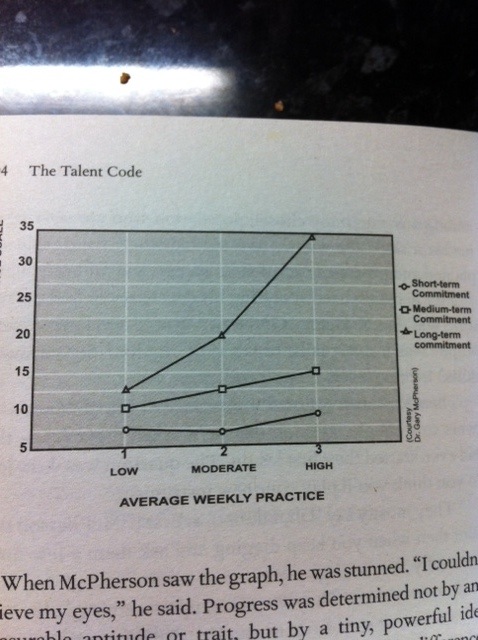
  • This graph shows the correlation between the hours of practice that Children were putting in to learn a musical instrument after they had answered the following question. “How long do you see yourself playing your musical instrument for?” The options were, this school year (short-term commitment), throughout school years (medium-term commitment) or for the rest of my life (Long-term commitment).

    Then their average hours of weekly practice were recorded. 20 minutes per week (low), 45 minutes per week (medium), and 90 minutes per week (high). Children who saw themselves playing their musical instrument for life were 4 times more likely to practice at a high level than those who only thought they would play for the current school year.

    Their vision of doing something for life motivated them to work harder at perfecting the skill.

    20120303-183919.jpg

    What vision is driving you to grow personally?