I want to ask you a question that might be more unsettling than it sounds.
Are you frustrated with where you are in your leadership right now?
Maybe you feel like you should be further along. Maybe you’ve been in the same role for years and something in you is quietly wondering if this is it. Maybe you’re in a season that feels like subtraction — less influence, less visibility, more obscurity — and you’re not sure if it’s preparation or punishment.
Before you answer that question, let me introduce you to a man named J. Robert Clinton.
Clinton was a long-time professor at Fuller Theological Seminary who spent decades doing something unusual: he studied the leadership development of hundreds of Christian leaders across history — A.W. Tozer, Watchman Nee, Dawson Trottman, and many others — and he looked for patterns. What he found changed the way I think about my own leadership journey, and I believe it might do the same for you.
His central claim? Leadership is not primarily about skills, positions, or strategies. It is about a process. A God-designed, often slow, frequently uncomfortable, deeply intentional process that takes a lifetime.
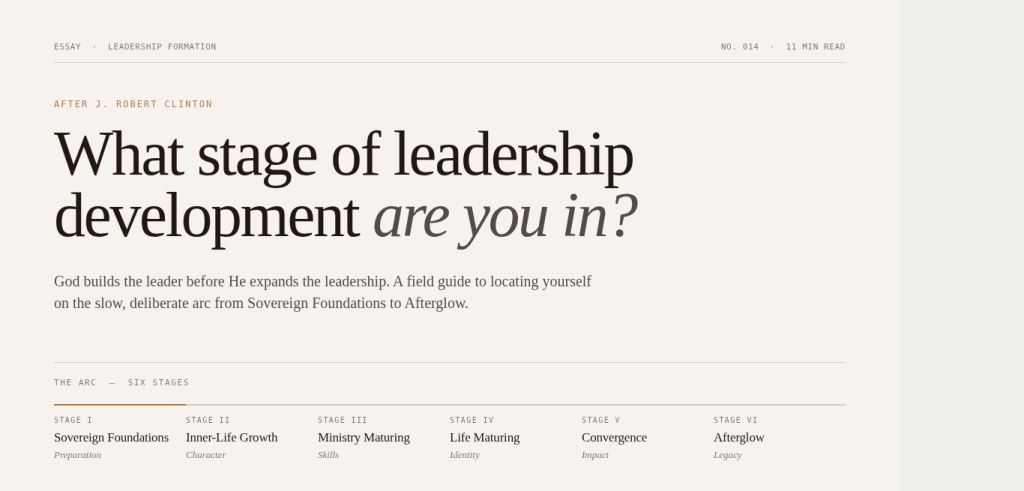
And that process, he argued, moves through six recognisable stages.
Before We Begin: The Most Important Sentence Clinton Ever Wrote
Here it is: “Effective leaders minister out of who they are.”
Everything else flows from that. The whole point of Clinton’s research is that God is less interested in what you’re producing right now than in who you’re becoming. That reframe alone — if you’ll let it settle — changes the entire way you interpret your current season.
Now, the six stages.
Stage 1: Sovereign Foundations
This is the stage you didn’t choose and can’t control.
It includes everything that shaped you before you were consciously leading anything: your family background, your cultural context, your early spiritual exposure, the experiences — good and painful — that formed your personality and your instincts. God is laying a foundation in you that you won’t fully understand until much later.
Moses spent forty years in Pharaoh’s palace and another forty in the wilderness before he led a single person out of Egypt. David was shaped as a shepherd — alone, unknown, defending sheep — long before he wore a crown. Paul’s training as a Pharisee, which must have felt like an embarrassing detour after his conversion, became the very platform from which he engaged the intellectual world of the first century.
Your story is not a distraction from your calling. It is part of it.
Stage 2: Inner-Life Growth
This is where God’s primary concern shifts inward.
You’re learning to pray. You’re learning obedience. You may have early mentors, early spiritual formation, early glimpses of what God has placed in you. But more than anything, you’re being tested — integrity tests, obedience tests, moments where you have to decide whether you’ll do the right thing when no one is watching and nothing is on the line.
Clinton’s research showed that the lessons not learned in this stage simply repeat. God is patient and persistent. If the issue is pride, He’ll keep putting you in situations that expose it until you deal with it. If the issue is a tendency to cut corners, or to perform for an audience, or to draw identity from results — it will come around again.
This stage is often invisible to everyone around you. That’s the point.
Stage 3: Ministry Maturing
Now you’re doing things. Leading teams, preaching, serving, running projects, experimenting with your gifts. This stage is often exciting and messy in equal measure. You’re discovering what you’re good at, but also where your edges are. You’re learning how to lead people, and people are showing you exactly where your character still needs work.
Here’s what Clinton says is the critical insight about the first three stages combined, and it’s the thing that most emerging leaders completely miss:
In stages one, two, and three, God is working primarily in the leader — not through them.
Many of us spend these years evaluating our productivity, measuring our outputs, anxious about what we’re producing. Meanwhile, God is quietly evaluating something else entirely: our character. He wants to teach us that we can only minister out of what we are. Skills can be borrowed. Character cannot.
Stage 4: Life Maturing
Something begins to shift in this stage. Ministry and character start to deepen together. You begin to understand not just what you can do, but what you were made for. Calling becomes clearer. You start to work through people rather than just alongside them. Communion with God — not ministry success — becomes your deepest source of life.
Clinton describes a key transition in this stage: leaders move from doing ministry to leading ministry. It’s the shift from being the person who does everything to being the person who shapes everything. And it requires a kind of letting go that doesn’t come naturally to driven people.
The Apostle Paul captures the spirit of this stage well. By the time he writes Philippians from a prison cell, he’s not anxious. He’s not striving. He writes, “I have learned, in whatever state I am, to be content” (Philippians 4:11). That word learned is significant. Contentment is not a personality type. It is a hard-won formation.
Stage 5: Convergence
This is where it gets provocative.
Convergence is the stage where God aligns everything — your calling, your giftedness, your experience, your character, your opportunity — and you step into the role you were uniquely designed for. Maximum fruitfulness. Maximum effectiveness. Doing exactly what God made you to do, at the right time, with the right authority.
Clinton studied this stage extensively. His conclusion was sobering: very few leaders actually get here.
Many stall in Ministry Maturing, forever busy but never quite focused. Others never push through the discomfort of Life Maturing. Some derail through character failure. Others are limited by their own poor self-awareness — they’ve never done the hard work of understanding what they’re actually called to.
Think of Nehemiah, arriving in Jerusalem with a singular clarity of assignment. Think of Moses at the burning bush, eighty years in the making. Think of Paul writing his epistles — not grasping for influence, but operating out of a settled sense of call.
Convergence is possible. But it is not inevitable.
Stage 6: Afterglow
For the few who reach it, this final stage is not retirement — it is multiplication. Leaders in this stage exert broad, indirect influence through the networks they’ve built, the leaders they’ve mentored, the wisdom they’ve accumulated. The focus shifts from leading movements to multiplying leaders. The fruit of a life faithfully lived.
Paul to Timothy: “What you have heard from me in the presence of many witnesses entrust to faithful people who will be able to teach others also.” (2 Timothy 2:2). Four generations of leadership in one sentence.
So — What Stage Are You In?
Here’s a simple grid that might help you locate yourself:
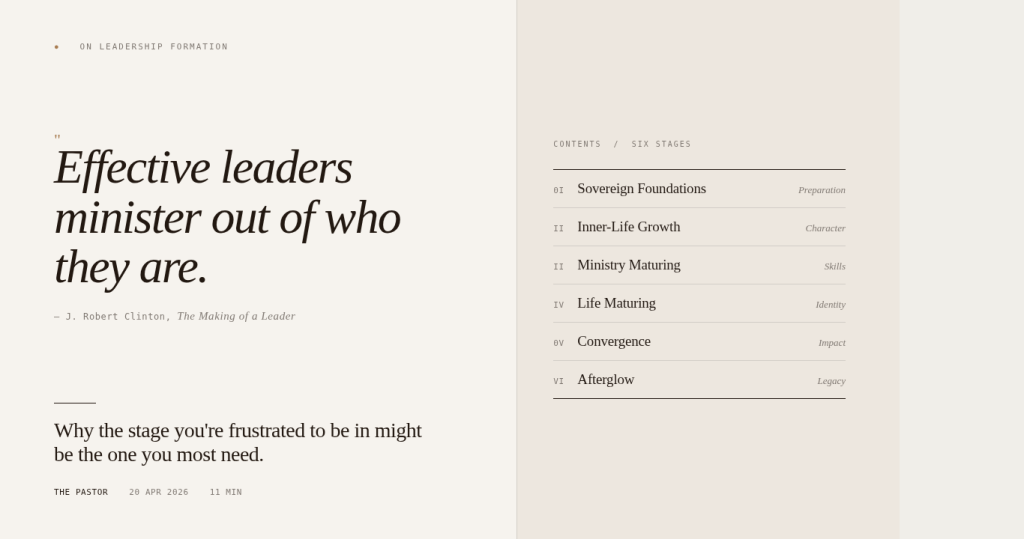
Clinton’s research is ultimately a gift — not because it gives you a ladder to climb, but because it gives you permission to be exactly where you are. The obscure season is not wasted. The painful test is not random. The delay you’re frustrated by is not a mistake.
God builds the leader before He expands the leadership.
The question isn’t whether you’re where you wish you were. The question is: what is God teaching you in this stage?
That question, taken seriously, is what separates leaders who reach convergence from those who spend their whole lives in preparation for something they never quite step into.
Don’t be in such a hurry to get to the next stage that you miss what this one is for.
J. Robert Clinton’s The Making of a Leader is one of the most important books I’ve read on leadership development. If you’re investing in emerging leaders — or trying to understand your own journey — it’s essential reading.


Leave a Reply