• The Top Four Things That Derail Leaders

    Here are the top 4 things that Derail leaders: (adapted from a book by perry noble)

    1. FEAR OF MAN (See Proverbs 29:25)

    “fear of man will prove to be a snare”

    It is IMPOSSIBLE to please everyone (Galatians 1:10)! We know we are dealing with “fear of man” issues when we:

    ● Feel the need to respond every time someone attacks
    ● Get our “major insight” from @ replies and Facebook comments
    ● Allow the comments we receive (usually online, or second hand) to dictate our mood
    ● Prepare a sermon and ask, “Is this going to make people feel comfortable”

    2. FAILURE TO ASK FOR HELP

    The difference between an Amateur and a Professional is… an amateur resents coaching a professional pays for it.

    One of the biggest mistakes a leader can make is to assume that being a leader means you must have all of the answers—and when you don’t have the answers then make something up.

    Being a leader means surrounding yourself with people who know what you do not know and then creating an environment where they are free to say what needs to be said.

    3. FEAR OF MAKING THE WRONG DECISION

    If you haven’t meased up at some point, then you’re not leading well. Leaders take risks, and with some risks come reward while others provide us with an “educational experience.”

    The tragedy in making a wrong decision isn’t actually in making the wrong decision but rather in the unwillingness to admit a decision was wrong and then do what it takes to make it right.

    4. COMPARISON

    I cannot tell you the number of times I have personally been paralysed as a leader because I would look at someone else and think, “I will never be as good as them; why should I even try?”

    I honestly think this is one of the main weapons the enemy uses in his arsenal of WMD’s! (Weapons of mass destruction)

    We should always learn from other leaders, but we must never allow the measure of our success as a leader to be based on how the Lord chooses to bless other people.

  • 10 Warning Signs of A Leadership Crash

    We’ve all seen the breaking news headlines. It’s yet another leader who’s crashed and burned with a financial scandal, an affair, or a struggle with addiction.

    The leader’s family is wrecked. The organization blows up. Millions of dollars are lost in the brand’s tarnished reputation. Everything falls to pieces.

    And these scandals happen so frequently to our political and corporate leaders that we tend to assume they’re the inevitable result of pressure or some character flaw.

    IMG_0294Former Pastor Dr. Stephen Mansfield specializes in helping companies get back on track after their leaders falter. And over the years, he’s seen the same risk factors for leadership crashes crop up again and again. These aren’t the kind of warning signs you might immediately think of. But when you hear them, they make complete sense. And they’re powerful.

    I’m convinced what Stephen shares here will save some lives.

    Even if you feel like you’re on sure footing today, take this list to heart and share it with your colleagues. It can help you stay healthy and well balanced as you grow in leadership.

    Warning Sign #1: Being Out of Season

    Ever made a commitment with your spouse that you’d only stay at a job for, say, 12 months — only to find, two years later, you still haven’t moved on?

    Then you know what it’s like to be “out of season.”

    It’s the first sign of a leadership crash, which Stephen describes as that feeling where “you know that you’re not where you’re supposed to be.”

    Stephen says it’s dangerous because

    “you’re not going to be doing [your job] well. You’re going to start pushing. You’re going to start stressing. You’re going to start medicating. You’re going to try to fix it.”

    And “fixing it” usually makes it worse. Your “fix” for the financial situation you’ve gotten yourself into ends up as tax fraud. Your “fix” for that marital strain is an affair with a colleague.

    In those moments, Stephen says, we must take a hard but necessary step:

    “Stop whatever you’re doing. Do whatever you have to do to stop the daily pushing on something that’s out of season.”

    To go back to the example of overstaying your commitment at a job: Go to your spouse and say, “I know I said I’d stay 12 months and I realize it’s been two years. I know it needs to end. Let’s talk about it.” It’s going to feel scary. But if you’re out of season now, that means there’s different, better situation out there where you’ll be “in season.”

    Warning Sign #2: Choosing Isolation

    The second sign of a leadership crash is isolating yourself.

    Now, we’re not talking about pursuing solitude. All my fellow introverts know there’s nothing wrong with taking a little time to yourself to recharge.

    The idea of isolation goes deeper. When you isolate yourself, you’re continually cutting yourself off from feedback from those who know and love you.

    When you isolate yourself, you’re continually cutting yourself off from feedback from those who know and love you. It’s a natural inclination when we’re hiding something, because we think people will figure out whatever our dirty secret is.

    What do you do? In Stephen’s words, you

    “find your best friend, sit them down, and say, ‘I’ve screwed up.’”

    Better yet, surround yourself with people who aren’t afraid to stand up to you in the first place. These are the kind of people who can call you on your bull and challenge you when they see you trying to distance yourself.

    Warning Sign #3: Defining Episodes of Bitterness

    If you’re scanning this post, stop and read this point. As Stephen says, for most leaders who have a crisis,

    “this is the defining issue almost more than anything on this list.”

    Every single one of us is vulnerable to bitterness. Nobody gets through life without a trauma of some kind. A romantic relationship that went sour. A parent who walked out. A cruel bully back in school.

    “The question,” Stephen says, “is whether we surrender our souls to it.”

    “Never succumb to the temptation of bitterness.” – Martin Luther King, Jr.

    Part of Stephen’s work in these leadership crashes is to figure out what happened. And in every scenario, he sees a leader who held onto some kind of bitterness or wound, allowing it to cycle and re-cycle in his or her soul.

    Until we resolve those issues of bitterness and recognize when they rear their ugly heads, they can creep in and fuel our actions.

    We’ve got to resolve those issues of bitterness or else they’ll come back and leave us vulnerable in ways we may not expect.

    Warning Sign #4: Evading Confrontation

    When we evade small moments of confrontation, we set ourselves up for a large-scale disaster.

    “If we don’t have small healthy confrontations and explosions,” Stephen explains, “we’re going to have the great big, huge ones that blow up our lives.”

    What does that look like in everyday life?

    It’s a quick correction you give your assistant. It’s a small word of advice to your child. It’s a short conversation with your spouse about something amiss you noticed.

    These small, regular confrontations help us fine tune what’s going on in our relationships. Without them, our frustrations mount and we end up with a big explosion.

    Some small examples from Stephen include:

    “Hey, that blog post doesn’t make any sense.”
    “Hey, you’re being silly.”
    “You were a little harsh the other day in that meeting. What’s going on?”

    As a leader, it’s your job to invite this kind of feedback. Ask people to confront you. In fact, Stephen even writes it into the job descriptions at his company.

    Warning Sign #5: Losing Trusted Friendships

    One of the first questions Stephen asks when he consults with an organization is “What’s the recent history with the leader’s friendships?”

    Why? Because, as he sees it,

    “Friendships always reflect the state of the soul and the state of the individual. And when it comes to crashes, we’re always talking about the soul.”

    Friendships always reflect the state of the soul and the state of the individual.
    In almost every circumstance where there’s a leadership crisis, there’s some kind of dysfunction or fall-out with a leader’s closest friendships.

    It goes right along with choosing isolation and evading confrontation, doesn’t it? To protect yourself from a crash, prioritize your friendships.

    Warning Sign #6: Forgetting Fun

    “Most people,” according to Stephen, “are living in overly scripted lives.”

    IMG_0295We spend our days barreling through our to-do lists, working out, finishing projects, helping out with the kids’ homework, getting the oil changed in the car, whatever — and we simply forget to have fun.

    If you’ve found that your favorite trips, hobbies, and diversions have faded away, pay attention to that.

    High achievers tend to trivialize fun because they feel like it’s expendable on a list full of other seemingly more pressing tasks.

    High achievers tend to trivialize fun because they feel like it’s expendable on a list full of other seemingly more pressing tasks. But fun is critical to our happiness because, according to Stephen,

    “fun is where you find yourself again. It’s where the creative energy, the imagination, the fun and the frolic comes from. It’s where rest for a certain part of your soul happens.”

    So fight for the fun in your life. Embrace it as a healthy part of life and leadership.

    Warning Sign #7: Perpetuating an Artificial Image

    IMG_0296These days, everybody self-brands and self-projects an image. We carefully stage our Instagram posts and set up Google alerts for our names. It’s crazy.

    In leadership, sometimes we build or gain a “brand” that’s larger than reality. And living under the pressure of that false branding is exhausting.

    As a result, Stephen points out,

    “a lot of these crashes are about people blowing up a world they don’t want to live in anymore.”

    After awhile, you feel like you can’t confess that artificial image. Nor can you live up to it. So you destroy it — with an affair or too many drinks or embezzlement or whatever the crisis is. It may be subconscious, but it’s the only way out that some people can see.

    Warning Sign #8: Serving the Schedule

    I just have to quote Stephen here because I think so many of us can relate to this one, especially if we lead a business or division:

    “We all look down at our iPhones and go, ‘I’ve got seventeen meetings today. What are any of them about? How did this get scheduled?’ When we lose the purpose for the schedule, but we’re just going through the schedule, that’s when numbness sets in. That’s when resentment sets in. That’s when a deadness of soul sets in, and always, that leads to these crashes.”

    In other words, you look at your day and can’t see the larger, strategic purpose behind it.


    Warning Sign #9: Building a Third World

    This is one of those “soft signs” you might not think of at first. But it’s so obvious once you hear it.

    One sign of a crisis is building a “third world” outside of your home and your office. For many, it’s a bar. An apartment in the city. A casino. Stephen says it’s the place we’ve created “so we can avoid the discomfort and the unhappiness of home and work.”

    The truth is, success changes you. And often times, leaders let themselves be changed without bringing their spouses and families along for the ride. As a result, they feel misunderstood at home, and that’s what drives them to create this third world where they can indulge their vices or simply be someone else.

    If you’re married, Stephen’s advice for you is to “stay in a position where you value the input of [your] spouse.” When your spouse understands your world, you’re much less vulnerable to go build another one.

    Warning Sign #10: Losing the Poetry

    What does it mean to “lose the poetry?”

    Stephen recounts a movie called Broadcast News in which the main character, who’s a news producer, gets up and sees if the day’s news can still make her cry. One morning, it doesn’t.

    That’s losing the poetry.

    Whatever your role, you got into it for a reason. You believed in something. You were passionate about a subject. You wanted to improve people’s lives. When you lose sight of that reason, when you lose the heart of what you’re doing, that’s losing the poetry. And when that happens, you’re inviting destruction to come in instead.

    What captured your heart in the first place? What lit you up and propelled you to want to achieve success in your field? Stephen says, quite simply, “Hang onto that. Keep it central.”

    So how can we build sustainable lives as leaders and protect ourselves from these kinds of crashes? Here’s Stephen’s advice:

    Keep it simple. That’s the main thing. What’s simple? Simple is you stay with the marriage you had. Simple is you spend time with your kids. Simple is that you’re constantly improving. Simple is you believe in what your people are doing. You believe in them, and you inspire them. [That] pretty much captures the majority of the reason people fail and the majority of the reason people are successful.

    Remember this stuff isn’t just important so that you don’t have a miserable life experience. It’s important because people are watching your story, and they’re learning from it.

  • Could Your Disadvantage Be Working In Your Favour?

    At the start of the 20th Century, Alfred Adler suggested the counterintuitive Theory of Compensation. His thesis was that disadvantages can often work to our advantage because they develop within us attitudes, strengths and abilities that would otherwise not appear. His theory was that as we compensate for those disadvantages we discover our greatest gifts.

    Adler studied Art students and discovered that 70% of those he observed had some form of optivcal anomaly. He cited Mozart and Beethoven as two among a number of history’s great composers who had degenerative traces in their ears.

    IMG_0291More current writers such as Malcolm Gladwell and Matthew Syed of spoken of similar findings. Ethiopia continually produces world class long distance runners and it has been clearly documented that a large part of the reason for this is what we might term their ‘disadvantaged environment.’

    Due to the poverty they experience reducing the lack of travel options open to them and then the environmental conditions of the region, people run a lot and develop breathing patterns and capacities to do so.

    Some years ago it was discovered that British number one table tennis player Desmond Douglas had the fastest reactions of all professional table tennis players at that time. The reason? As he was learning the game the only place he could practice, which he did for thousands of hours was a garage. The confined space of that garage meant he developed super fast reactions in order to get back balls that were hit at pace towards him.

    In these examples and many others success was achieved not in spite of the disadvantage but because of it.

    David and Goliath

    When David requests to take on the Philistine Champion Goliath in one of the Bible’s most famous stories everything we think leads us to believe he’s at a disadvantage. His weaponry is not as technical, he has no armour, in fact he is unable to wear armour, it’s just too heavy for him. He’s a teenager, Goliath is a seasoned champion, he’s a shepherd and a lunch carrier for his brothers, Goliath is a champion.

    But David has one thing in his favour, something he never thought of has being in his favour. He had the lonely task of remote shepherding in dangerous places. This experience and I am sure the fear of wild animals had meant he was an expert sling shot.

    He was never going to need to engage Goliath. Goliath would be dead well before he got anywhere near to David. David’s disadvantage was the reason he was successful against the giant because it developed in him the very skills and qualities he would need.

    So often the things that we perceive as disadvantages we. try to change.

    What if, the circumstances we are trying to change are the very circumstances God is using to change us?

    I love what the Apostle Paul says in 2 Corinthians 4:17

    For our light and momentary troubles are achieving for us an eternal glory that far outweighs them all.

    I know that in the midst of trouble or carrying a ‘disadvantage’ it can be hard to see, but God is sovereign and God is good! Even if he didn’t send it, he will use it.

  • The Image Of God

    At the start of the story is the tantalising phrase in Genesis 1,

    “God created man in his own image: In the image of God he created him.”

    Of course, it does not occur in a vacuum. It is the climax of the entire creation narrative. The Earth, which was formless and empty (verse 1), was first given shape and was then filled: with good things, initially vegetation and then animal life.

    Verse 26,

    “Then God said, ‘Let us make man in our image, in our likeness, and let them rule over the fish of the sea and the birds of the air, over the livestock, over all the earth and over all the creatures that move along the ground. So God created man in his own image, both male and female he created them.”

    Two points of reference

    In trying to understand what is implied here, I take it that there are two points of reference. Firstly, the Image of God marks us out from all other living creatures, which by implication are not made in the Image of God. Genetically, we may be almost identical to our nearest animal relative, the Chimpanzee, but spiritually we are poles apart. So we will gain insight into understanding what the Image of God means, if we explore the differences between mankind and the rest of the animal kingdom.

    The second point of reference is of course God himself, so we will also understand the meaning of being made in his image if we explore what he has revealed of himself – in nature, in scripture and most especially in Jesus Christ.

    The image of God in man therefore distinguishes us from all other animals on the one hand and shows our family resemblance to God on the other. I take it that the words ‘image’ and ‘likeness’ amount to the same thing. They are not referring to different categories but are intended to emphasise & clarify the central idea.

    This process leads us to focus on 6 distinctive characteristics of humanity. Firstly, we are…

    1) Creative

    Animals are wonderfully uncreative. They do not change the world they live in. The creativity we observe in them is instinctive. So birds build their nests but every year it has the same design. They never think to build on an extension, create a loft conversion or develop their skills. They just do the same old instinctive thing.

    God on the other hand has been creative beyond anything we can comprehend. Both science and the Bible testify that the entire universe came into existence – out of nothing! Our knowledge of the expanding universe traces everything that exists, including time and space, back to an unimaginably small ‘singularity’ which came into existence from nothing. A humanist put to me recently that we have a straight choice – to believe in an eternal universe that has always existed or an eternal God who created a finite universe. He was wrong. We do not have that choice.

    The idea that the universe is an eternal static entity died in 1929 when Hubble observed the Red Shift – a Doppler effect in light from distant galaxies – which demonstrated that the universe is expanding.  We haven’t always had the universe. It began – apparently out of nothing, some 13-15 billion years ago.

    Now human creativity is of a different order from God’s, not least because we lack his astonishing power, intelligence and artistry. But nonetheless, we have original, creative ideas.

    2) Intelligent

    The mind that lies behind the creation is reflected, albeit in small measure, in our capacity for understanding and rational thought. The psalmist wrote, “Do not be like the horse and mule which have no understanding but must be controlled by bit and bridle” (Ps 32:8–9). Human intelligence is unlike anything found in the animal kingdom. We ponder the meaning of our existence, the significance of our actions and the prospects of our destiny. Unlike animals, man is a thinker and capable of being instructed and growing in understanding.

    Some religious beliefs which are anti-intellectual and belittle our need to study and learn, have failed to see the wonder of who we are. Approaches to evangelism which diminish the proper place of argument and persuasion diminish the humanity of the people we would reach. The extraordinary Mind behind the Universe has given us minds to enquire, to reason and, as Kepler put it, “To think God’s thoughts after him”. So the apostle Paul urges that we should be “transformed by the renewing of our minds” to discern the will of God (Romans 12:2).

    But as the creation itself defies atheistic understanding, so too, human intelligence and self-consciousness also defies secular analysis. Peter S Williams’ book, I Wish I Could Believe in meaning is full of good things that are essential to the subject at hand.

    He quotes Jerry Fodor, a leading philosopher of the mind saying,

    ‘Nobody has the slightest idea how anything material could be conscious. Nobody even knows what it would be like to have the slightest idea about how anything material could be conscious.’

    He quotes another authority, Ned Block as writing,

    “We have nothing worthy of being called a research programme, nor are there any substantive proposals about how to go about starting one” (p 322).
    Researchers are stumped by the very thing that drives them – they cannot understand their own understanding.

    Philosopher J. Bubziszewski recalls the dilemma of self-understanding he experienced as an atheist:

    My mind, I supposed, was nothing more than the activity of my brain, my brain nothing more than a computational device. Of course, we do not experience ourselves as machines, but I told myself that we are machines under a double curse – the illusion of being more than machines and the desire for the illusion to be true. How a machine could suffer such things as desires and illusions deeply troubled me. In fact, all the phenomena of consciousness troubled me. I was troubled by the redness of red, the deliberateness of choice, the preciousness of my loves, the sense I sometimes had of exerting my will against an inclination – I was even troubled by the experience of being troubled. I knew that I could not fit these things inside the theory that I was a machine, and I knew that the intuition that I was more than a machine made a better fit with reality. To get around this fact, I told myself that a machine is something that I know, whereas a soul is something that I do not know – conveniently forgetting that I experience myself, unlike machines, directly…In a sense, I thought I did not exist.

    Eventually, Budziszewski came to a realisation,

    “I had reached my conclusions not because of the data but in spite of it.”

    3) Aesthetic

    IMG_0114Thirdly then, our capacity to appreciate beauty. Genesis 2:9, “The Lord God made all kinds of trees grow out of the ground – trees that were pleasing to the eye.” God is not only the great artist who made a beautiful creation but has made us in his image so that we can appreciate beauty.

    One of the best things in life is finding yourself with a view that just takes your breath away. It amazes me that those views are all around us all of the time.

    4) Moral

    Fourthly, we are moral. The creator God, the mind behind the universe, was the artist who designed a beautiful world and created mankind who could understand his moral character & purposes. Animals suffer from fear but as far as we can tell, they have no natural sense of guilt or awareness of good and evil choices. Yet our daily lives are dominated by such awareness.

    Human conscience is a major aspect of our humanity. We battle with evil within ourselves and witness it in others. We long for the good but find all too often that the good that we would do we don’t do, while the evil we know we should not do – we end up doing. Paul’s description of this dilemma in Romans 7 struck me with great force when I first read it in my late teens.

    The world is like that. Morality fits the facts and points us to an ultimate, absolute moral being. Yet without God, morality is merely an arbitrary code of mutually agreed manners for diners at the human lunch club, of no more significance than agreeing that we should not blow our noses at the table.

    5) Relational

    If we want to understand what people in general believe to be of central importance in their lives, we have only to read novels or watch Soap Operas. The dominant theme of human existence, reflected in stories the world over, is about relationships. In a word, Love.

    We may be confused as to what love is; we may reduce it to intense emotions or sexual functioning. We may keep love entrapped within the limits of the nuclear family. But life and love go together so closely that the breakdown of relationships is the single biggest cause of people wanting to commit suicide. We know in our souls that we were not made to live in isolation.

    “No man is an island.”

    But where does love come from? How do we discover what it is? Where are the deepest descriptions of it? Has the world found any better exposition of the meaning of love than in the life, teaching and passion of Jesus? No it has not; and Jesus was emphatic that loving our neighbour was the second commandment about love, not the first. As Augustine so powerfully expressed it:

    “You created us for yourself, O God, and our hearts will not rest until they find their rest in you.”

    We are made for healthy relationship with God, Self, Others & Culture.

    6) Spiritual

    So man is incurably religious. Until the 20th century, every culture in human history has been dominated by belief in a God or gods. In the last century, atheism was imposed upon much of the world – across China, the Soviet Union and much of Europe. The overthrow of Communism and Nazism has led those oppressed people to return to their religious heritage. In the free world, where the demands of Christian belief have been cast aside by post-modernity, we have seen the enormous rise of superstitions such as astrology, spiritism and magical charms. We are Spiritual.

    Jesus the ultimate image-bearer

    All these themes then challenge our humanity and ask us if we are really alive? Are we creative, thinking, artistic, moral, relational beings, who hunger after God? Are we growing on all fronts? Are we well-balanced individuals, giving proper attention to each area?

    Now an image is but a reflection of the original. Sometimes the image may be hazy and distorted. But it does not exist on its own. Beyond the image is the reality. The Image of God in us not only helps us to see who we really are, but also reveals God to us. But we are not left searching through a haze to find hints and images of the One who made us.

    Here’s the good news: the one in whose image we are made, has come among us and revealed himself.

    “No-one has ever seen God, but God the only Son, who is at the Father’s side, he has made him known” (John 1:18).

    Paul wrote:

    ‘[Jesus] is the image of the invisible God, the firstborn over all creation. For by him all things were created…For God was pleased to have all his fullness dwell in him…’ (Colossians 1:15–19)

    It is therefore not a coincidence that these major themes are themselves the best evidences for God. The argument from Creation, from Intelligence, from Beauty, from Morality, from Love, from our intrinsic Hunger for God and of course from the person of Jesus himself in his teaching, deeds, character, claims, death and resurrection are the major lines of argument for the existence of God.

    Check out the series we recently did in Church called IKON for more on this…

  • The Paradox of Flourishing

    Here at Christian Life Church (soon to be IKON CHURCH) our Vision Statement is simple. HUMAN FLOURISHING: people doing well in every area of life. We believe that if we are successful in our work this will be the result.

    In his latest book, Strong and Weak: Embracing a Life of Love, Risk and True Flourishing, Andy Crouch examines what it means to flourish as a human being, he writes.

    “What are we meant to be? We are meant to flourish—not just to survive, but to thrive; not just to exist, but to explore and expand.”

    img_0009In order to actually embody that answer, Crouch believes we have to grasp the underlying “paradox of flourishing.” “Flourishing comes from being both strong and weak,” he writes, requiring us to “embrace both authority and vulnerability, both capacity and frailty – even, at least in this broken world, both life and death.”
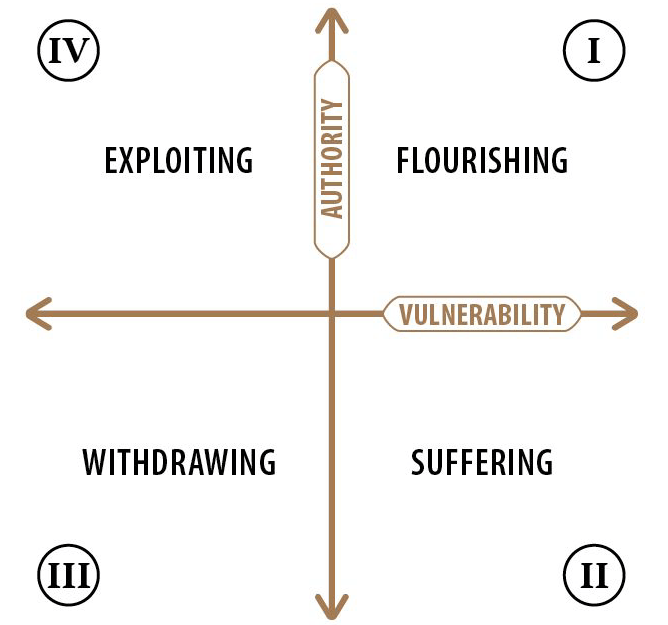
    In truth, most of us tend to elevate one to the detriment of the other, relishing in abuse of power or pursuit of poverty.

    Yet as humans created in the image of God, and as citizens of an upside-down Kingdom, we are called to embrace and combine each together. Such is the path to real life and abundance, both in the now and not yet.

    To understand such a paradox, Crouch argues, we have to reexamine our definitions of authority and vulnerability. Using a 2×2 chart (see below) to demonstrate his point, Crouch explains that, when rightly ordered and properly understood, its a mixture that paves the way to an abundant life.

    IMG_0281When we think about authority, for example, we can often fall into traps of exploitation or withdrawal. Rightly understood,

    Godly authority is something quite different: “the capacity for meaningful action.”

    When you have authority, what you do, or do not do, makes a meaningful difference in the world around you…This authority, uniquely ours as the image bearers of God, is a gift in every way. It does not come from our own autonomous selves—it is given by Another. And it is good. The sorrow of the whole human story is not that we have authority, it is the way we have misused and neglected authority. Our drive for authority – our sense of frustration when we are denied it, or our sense of grief when we lose it – comes from its fundamental goodness.

    So authority is meant to characterize every image bearer – even the most vulnerable. As infants, long before we could provide for ourselves in any way, we learned that we were capable of meaningful action. We emerged from the womb and instinctively sought to recognize a human face. We learned that others would give meaning to our cries.

    When we think about vulnerability, on the other hand, we often fall into traps of glorified suffering or (again) withdrawal. A pursuit of vulnerability is not one that idolizes weakness as a good in itself, but one that values “exposure to meaningful risk.”

    The vulnerability that leads to flourishing requires risk, which is the possibility of loss – the chance that when we act, we will lose something we value. Risk, like life, is always about probabilities, never about certainties. To risk is to open ourselves up to the chance that something will go wrong, that something will be taken from us – without knowing for sure whether that loss will come to pass or not.

    To be vulnerable is to be exposed to the possibility of loss – and not just loss of things or possessions, but loss of our own sense of self. Vulnerable at root means woundable – and any wound deeper than the most superficial scratch injures and limits not just our bodies but our very sense of self. Wounded, we are forced to become careful, tender, tentative in the way we move in the world, if we can still move on our own at all. To be vulnerable is to open oneself up to the possibility – though not the certainty – that the result of our action in the world will be a wound, something lost, potentially never to be gained again.

    When we combine each of these together, we’re reminded of the upside-down economics of the Kintron, and it yields plenty of implications for our personal lives. But in telling us something about the needs and dreams of the human person, such a framework offers plenty of hints for how we ought to structure and imagine our society:

    The same psalmist who celebrated human dominion over the creatures also was capable of looking up into the heavens and grasping what they meant for the significance, or insignificance, of our small and transitory lives…I have come to believe that the image of God is not just evident in our authority over creation – it is also evident in our vulnerability in the midst of creation. The psalm speaks of authority and vulnerability in the same breath – because this is what it means to bear the image of God…

    When authority and vulnerability are combined, you find true flourishing. Not just the flourishing of the gifted or affluent, but the needy and limited as well…

    In the end, this is what love longs to be: capable of meaningful action in the life of the beloved, so committed to the beloved that everything meaningful is at risk.

    So how do we structure a society or communities of faith that cultivate the conditions for such flourishing, keeping the underlying paradox in mind? How do we foster institutions of culture and government that recognize human capacity and create room for “meaningful action”? How do we embrace “exposure to risk” as a value, also using our power, authority, and dominion to protect and nurture and disciple the most vulnerable?

    “If we want flourishing, this is what we will have to learn,” Crouch concludes. “What we will have to unlearn, and be saved from, are our failures of authority, vulnerability or both.”

  • Fasting is Becoming Big Business

    BY DANA G. SMITH
    15.03.17
    A friend of mine recently tried the 5:2 Diet—in which you consume 500 calories two days per week but eat normally the other five days. “It sucked,” she says. “I didn’t feel any mental clarity, I felt weak and confused. It was also awkward socially because you can’t really do anything on those days. You just want to go to sleep and have the day be over.”

    But it probably made her healthier. While many diet or body-hacking fads are backed by dubious science at best (see coconut oil pulling), the trend of fasting to improve mental capacity and increase longevity—not to mention lose weight—is grounded in legitimate and fascinating scientific principles. The benefits of intermittent fasting or extreme calorie restriction range from improved insulin sensitivity to reduced inflammation to the growth of new brain cells.

    Fasting is reported to shrink cancerous tumors, delay aging, and stave off the chronic diseases that accompany it, including heart disease, diabetes, and possibly even dementia.

    But fasting is also really really hard. Even aging researcher and fasting expert Eric Verdin admitted that calorie restriction can be challenging and disruptive to domestic life.

    “I never felt better than when I was on it, but it takes a lot of discipline, especially when you’re busy at work,” says Verdin, who is president and CEO of the Buck Institute for Research on Aging. “It’s also totally asocial. Everything is dictated by the diet. Living with a family and saying no to dinner is hard.”

    Fortunately, as with any hot trend, companies have sprung up to make fasting easier or even unnecessary. And it’s becoming big business. Hundreds of diet and recipe books targeting everyone from beginners to body builders are available on Amazon. There’s even a subset of fasting literature aimed at devout Christians.

    The first calorie-restriction meal delivery service also launched last year. Developed by gerontologist Valter Longo at the University of Southern California, the ProLon Fasting Mimicking Diet offers you five days’ worth of soups, teas, and bars totaling 800 daily calories for just $299.

  • THEOLOGY: Two Trees in the Garden

    Have you ever noticed that in the Genesis story of creation there’s a prominent role given to two trees? We have the Tree of the Knowledge of Good and Evil alongside the Tree of Life, both located in the centre of the Garden. (Genesis 2:9; 3:3)

    The Tree of Life

    This tree was God’s provision to meet our needs and to share his life endlessly

    The Tree of the Knowledge of Good and Evil

    This was God’s prohibition against humans overstepping our proper authority and domain. A recognition, that although we have been given authority there is a boundary to how far that authority can reach and be exercised. A realisation that all authority comes from God and therefore is submitted to God, we are meant to exercise our authority under God’s authority.  Therefore:

    To have authority one should be under authority

    IMG_0276No Trespassing

    As part of this scene God places a “No Trespassing” sign on the Tree of the Knowledge of Good and Evil. Here we are to acknowledge that we are not God and that there are some things that God will keep for himself. By the way, the reason that he does this is our good.

    In God’s plan only he would know good and evil. As creator he has the right to define what is good and what is evil and he knew that if we were to share that right things would become very different, as indeed they did and have.

    For God, the defining of good and evil corresponds to whether something is aligned with his will and purpose.

    The Vandalism of Shalom

    We call this state in the Garden ‘Shalom’ – perfect peace. When humans decided that we wanted to be like God, we wanted to know all that God knew (impossible) and we wanted to judge like God alone can judge, rather than leading to life and loving relationship our actions lead to death. Shalom was shattered.

    Sin according to the Genesis account is the transgression of the proper boundary. We are not satisfied being God-like in our capacity to love; we also want to become God-like in our capacity to judge. – Greg Boyd

    “Do not judge.” Said, Jesus and this was the reason for the “no trespassing” sign on this tree.

    When we judge we lose our capacity to love. We cannot like God balance these two things called love and judgement because our judging becomes critical assessments made from our finite and often biased perspectives.

    Adam and Eve put themselves at the centre of everything rather than just receiving the life at the centre which God had provided for them. They overstepped.

    Let God have what is his and what he wants, because true life flows in that place.

  • What Did Jesus Mean When He Said, “DO NOT JUDGE?”

    Nine out of Ten 20 somethings say that Christians are Judgemental

    What did Jesus mean when he said, “Judge not, and you will not be judged.” It’s one of the most commonly quoted verses from the bible (Luke 6:37). Many of us, and not merely politicians, invoke the verse as a first defense when accused of wrong. It is also a favorite stone thrown by those outside the church to accuse Christians of hypocrisy.

    In 2007 a book was published called UnChristian: What a New Generation Really Thinks about Christianity. It’s based on research done among non-Christian 20-somethings. One of their core findings was that nearly nine out of ten young people view Christians as “judgmental.” And given the prohibition against judging issued by Jesus, this would mean most people view Christians as hypocrites.

    Given these findings, it’s pretty important that both Christians and non-Christians understand what Jesus means when he says “judge not.”

    The key is recognizing that the word judge can be used in two different ways in the New Testament.

    Sometimes judge is used to mean “judge between things,” to differentiate, or discern. In this case we judge between right and wrong, good and evil, righteous and unrighteous.

    But this kind of judging-the act of discernment-is not what Jesus is forbidding. In fact throughout the Bible we are commanded to discern. In the same chapter of Luke 6 and in the very same discourse as the famous “judge not” statement, Jesus talks about having the discernment to see the difference between good people and evil people (Luke 6:43-45). He compares them to trees. Good trees, he says, produce good fruit and bad trees produce bad fruit. The call to differentiate good from evil is to judge, to discern, correctly.

    This is often what get’s Christians into hot water in our uber-tolerant and increasingly diverse culture. When a Christian labels something as “wrong” or “evil” they are often pounced upon as being judgmental and out of step with Jesus. Sometimes this is the case, as I will discuss below, but very often the accusation is the result of a culture that no longer understands the difference between discernment and condemnation.

    F.F. Bruce, a New Testament scholar, explains the linguistic dilemma this way:

    “Judgment is an ambiguous word, in Greek as in English: it may mean exercising a proper discernment, or it may mean sitting in judgment on people (or even condemning them).”

    It is this second definition, to condemn, that Jesus forbids and he makes that clear when the whole sentence in Luke 6 is read: “Judge not, and you will not be judged; condemn not, and you will not be condemned.” Jesus is saying the same thing in two ways-a common rabbinical device at the time.

    He’s calling us to not condemn people, to not pass final judgment and declare them irretrievably guilty.

    This is an incredibly important idea if you understand the context in which Jesus was speaking. The entire culture of his day was predicated on the notion that some people were acceptable and others were not. And the way you defined yourself, your identity and place in the world, was by comparing and contrasting yourself with others.

    So, for example, at that time Jews saw themselves as inherently better or more acceptable to God then non-Jews. They commonly referred to gentiles (non-Jews) as “dogs.” And many Romans had equally dismissive views of the Jews. And these judgments continued even within the each community. Rich people were seen as more blessed and acceptable to God than poor people. The healthy were seen as righteous, and those with diseases or disabilities were judged to be sinners receiving their due.

    This is the judgment that Jesus says is absolutely wrong.

    When we judge/condemn someone we are declaring that they have no value; no worth-that they do not matter to us or God. And we do this as a means of elevating ourselves. The more people pushed below us, the higher in value we must be. Greg Boyd captures the problem of judging really well. He says:

    “You can’t love and judge at the same time,” because “It’s impossible to ascribe unsurpassable worth to others when you’re using others to ascribe worth to yourself.”

    This is the problem Jesus is addressing-the idea that our worth requires someone else’s condemnation.

    Of course this wasn’t just a problem in 1st century Judea. Consider what Martin Luther King Jr. said in one of his sermons. He describes why segregation (a form of exclusion and judgment) is so wrong:

    Segregation is not only inconvenient-that isn’t what makes it wrong. Segregation is not only sociologically untenable-that isn’t what makes it wrong. Segregation is not only politically and economically unsound-that is not what makes it wrong. Ultimately, segregation is morally wrong and sinful. … “It’s wrong because it substitutes an ‘I-It’ relationship for the ‘I-Thou’ relationship and relegates persons to the status of things.
    Judgment causes us to see the other not as a person, but as a thing-as less human and therefore less valuable. And once we do that to a person, or a group of people, it opens the door to all kinds of terrible evil-segregation, injustice, abuse, even genocide. Jesus is warning us about excluding anyone, or seeing ourselves or our group as inherently better than any other. We may disagree and discern another person or group to be wrong-but when that discernment causes us to value another person or group less, then we’ve crossed the line into judgment, condemnation, and exclusion.

    Obviously there are, and always will be, people and groups that we disagree with theologically, socially, or politically. But we seem to cross that line between discernment and judgment so easily today. In present political rhetoric, or in descriptions of other faiths and nationalities, we quickly devalue or write off “those people” as less valuable. We exclude them from the status that we feel privileged alone to occupy.

    This seems to be the accepted posture on many political television and radio programs. Sometimes these talk show hosts speak about “liberals” as if they’re demonic. Of course many liberal blogs caricature conservatives in equally disturbing ways. If you have strong political views, that’s just fine. Defend your views, disagree with others, engage on the level of ideas-but when we start to condemn those who disagree with our politics, when we see them as intrinsically interferer, we enter dangerous and decidedly unchristian territory.

    When we see other people as wrong, not just about what they believe, but in their core identity as people-then it’s easy to convince ourselves that we don’t have to love them; we don’t have to serve them; we don’t have to respect them. This exclusion and condemnation of others fuels so much of what’s broken in our world today. It’s what convinces one group to kill another; or one person to abuse another.

    But Jesus says, not so with you. Not among my people. The Christian is never to judge, never condemn, never exclude, never to see anyone as without value or dignity-even the person we disagree with most. To quote Greg Boyd again,

    “The Christian’s job is to agree with God that every person you meet was worth Jesus dying for.”

    We cannot ascribe that kind of value and dignity to a person and condemn them as worthless at the same time. It’s just not possible.

    There is no THEM and US just US…

  • Approval is Overrated

    You don’t get better if you are only trying to prove how good you already are.

    Part of me doesn’t like feedback, be honest, neither does part of you.  “Feedback is the breakfast of champions,” sounds great until someone gives you feedback, critical feedback. Even that word, ‘critical’, send shivers doesn’t it. The word however, along with the practice is not necessarily negative, but can be, when given and received correctly, the catalyst for growth and improvement.

    The following is an article about a writer called  Katrina Costoula who experimented with stand up comedy and in the process discovered. APPROVAL IS OVERRATED. It’s packed with great insights that will be well worth your time.

    _________

    Three years ago I called a stand-up comedy instructor to sign up for one of his classes. “I do not like being on stage, and I am not funny,” I said. “Do you think I can still take the class?” Thankfully, he said yes.

    In every lesson, I would stand up in front of my classmates and share my jokes. Feedback was instantaneous: They would either laugh or they wouldn’t. If they laughed, I’d keep the joke for the final showcase performance. If they didn’t, I’d scrap it. I was thankful for this feedback. I didn’t want to embarrass myself at the showcase.

    Most jokes I wrote didn’t make the cut. But by the end of the 10-week program, I had a five-minute set of solid jokes.

    A lot of people look for feedback in their hobbies, but they seek only approval at their jobs.

    I was asked to be the closing act. And to my delight, the audience laughed! A lot. I took the set to open-mic nights, and it was received just as warmly—not bad for someone who’d never heard the words “you are funny” directed at her in her entire life.

    In comedy, I didn’t want to prove I was good. In fact, I knew I was not good. My goal was to learn to get better.

    I’ve noticed that a lot of people look for feedback in their hobbies, but they seek only approval at their jobs. Could it be that companies themselves make it difficult to learn, and push people to look for approval instead of improvement?

    HOW COMPANIES DISCOURAGE LEARNING

    There was no way I could create a good comedy set without feedback. You can never really know if your own jokes are funny. The only way to find that out is to test them in front of an audience. Professional comedians test their jokes in small gigs before they go on a big stage. Done right, feedback can be as useful at work.

    586a795a-a1a7-4777-a029-ac950d0cc6ae-3856-00000e448de606d0_tmp

    It often isn’t. In most workplaces feedback is part of performance reviews. Everyone hates performance reviews. One recent report estimated that 22% of employees would actually call in sick to avoid facing an appraisal.

    What’s more, other researchers suggest that more than half of a given performance rating doesn’t even have to do with the person being evaluated—it hinges on the traits of the person doing the evaluating. If this sounds intuitively right, it’s something that companies themselves are beginning to affirm. In the past few years, major employers have abandoned the annual review. PwC discontinued annual reviews for all 200,000-plus employees as early as 2013. Deloitte, Accenture, and KPMG followed suit.

    One of the troubles with the traditional performance review—linked as it is with raises, promotions, and training opportunities—is that you need to prove you’re already good to be rewarded. So that’s the mind-set with which many of us approach feedback in these experiences. We look for approval and validation, knowing that negative feedback can be used against us, rather than help us grow.

    One of the troubles with the traditional performance review . . . is that you need to prove you’re already good to be rewarded.
    As a result, a lot of us get triggered into a fixed, defensive approach to our work. We hesitate to take the risks that creativity and innovation depend on. Failure doesn’t look good, so we hide our mistakes and become subtly more antagonistic—trying to find ways to win over the “judges,” rather than experiment with methods to improve our work.

    Stanford researcher Carol Dweck has argued that passion for learning, rather than hunger for approval, is where true success is born and sustained.

    Just scrapping performance reviews doesn’t change the fact that the approval of a few people is directly linked to your livelihood. Even with that particular ritual gone, many of us don’t automatically embrace what Dweck has long called the “growth mind-set” that’s needed to truly learn.

    Is there a better way to kick this addiction to approval? How do you keep learning, rather than just trying to show your employer and the world how good you already are?

    APPROVAL SHOULDN’T BE YOUR DRIVING FORCE

    Sometimes, self-promotion really is necessary—like when you need to land your next job, client, or funding, for example. By all means, try to get your bosses on your side. Just don’t let their approval drive you in the process. Here are some reasons why, which stand-up comedy helped me come to terms with:

    It will reduce your risk-taking. To have an impact and improve, you need to get yourself out there. Stand on that stage. Write that article. Cold-call or -email that person. There’s no learning without doing—or without making yourself vulnerable to other people’s judgment in the process. The more interesting work you do, the more haters you will have. Don’t let that stop you.

    It will diminish the pleasure you take in your work. One of the reasons we enjoy our hobbies so much is that we do them for ourselves. Because we want to. Because we enjoy it. We don’t care so much what people think. Wouldn’t it be great to find the same pleasure at work? Choose the projects you enjoy and give them your authentic self. Get into flow and forget others’ opinions.

    The more interesting work you do, the more haters you will have. Don’t let that stop you.

    Approval can be a misleading measure of success. We believe we’ve made it when we get accepted to a great college or graduate program. When we land a job at a prestigious company. When we close a funding round. When we get a promotion. These achievements are just a stamp of approval. They don’t necessarily represent impact or value added. Did we improve people’s lives? Did we build something useful? What’s worse is that our need for recognition is insatiable. We can never have enough.

    In the new economy, the approval of a few gatekeepers becomes less and less necessary.You can self-publish if you’re a writer, freelance if you have the skills, and crowdfund if you have the ideas. The market decides. You can never predict the market’s reaction to your work. You can only focus on honing your craft and putting your best work out there.

    HOW TO EMBRACE FEEDBACK

    Isn’t the pursuit of approval a basic human need, you might ask? The answer is yes. When we’re children, we learn to seek our parents’ approval as a means of survival. That’s why, as adults, negative feedback can trigger us into fight-or-flight mode.

    But however ingrained it may be, that reaction isn’t universal or unchangeable; it often depends on the context. I was surprised by how painless it was to get feedback in comedy, contrary to feedback at work. What makes learning a hobby easier? If you can put your finger on that, you may be able to better embrace feedback in other areas of your life, too.

    These are a few steps you can try:

    Don’t put all your eggs in the job basket. I cherished feedback in comedy because I didn’t see myself as a comedian. The stakes were low. You need to lower the stakes at work to be able to approach it with a learning attitude. If your sense of self-worth (and income) come just from your job, failure and criticism will hurt a lot. Develop your life outside of work—including other streams of income. You’re not just a marketer. You’re perhaps also a parent, a friend, a cook, and a basketball player.

    Adopt an eternal-novice attitude.

    There’s no shame in being a rookie in a new hobby. Try to separate the quality of your output from your identity. Don’t say to yourself, “I am a good marketer.” Say, “I am a marketer who loves the job and keeps getting better at it.” See the difference? Most people overestimate their skills.If you believe you’re already good, you stop learning. And even if you were good in the first place, you can soon become obsolete.

    Strengthen your relationships. You need some people in your life who accept you regardless of the success of your professional endeavors—people who won’t love you any less if you don’t get that promotion or job offer. Surround yourself with them, and you won’t be looking to fulfill your deepest emotional needs through your work, as though your life depends on it. You can embrace your career with a little more playfulness. You’ll welcome feedback just as you do in your hobbies.

    Accept it if it helps you improve, and discard it if not. It isn’t about proving to the world how good you are. It’s about getting better all the time. Have fun. Have a laugh—preferably with others.

    Caterina Kostoula is an executive coach and a global business leader at Google.

  • The Shack is not as heretical as some think.

    The following is a post from Orthodox theologian and author Brad Jersak (PhD).

    HERESY HUNTERS ARE AT IT AGAIN

    Paul Young’s bestseller finally hits the big screen on March 3. That’s news—great news—as I’ll explain shortly.

    What’s not news is how the so-called ‘discernment ministries’ (a euphemism for heresy-hunters) have begun yelping. They’re recycling ‘ye olde’ objections but, typically, barking up the wrong tree.

    The charge of ‘heresy’ is serious, so it ought to be taken seriously, especially by those wielding it. But as an Orthodox theologian, I confess that its sloppy use as a pejorative, grates on my doctrinal nerves.

    For example, the outcry against Young’s creative portrayal of God’s ‘Threeness’ or his imaging the invisible God as a black woman betrays a crass literalism that the author obviously never intended.

    RUBLEV’S TRINITY AND MODERN MISOGYNY

    Russian painter Andrei Rublev’s famous icon of the Trinity (15th c.) would seem to break the same rules as The Shack, where Abram and Sarai’s three angelic guests were eventually identified with Father, Son and Holy Spirit—one God depicted as three persons. Yet in Eastern iconography, the Father is elsewhere never depicted because the visible image of God is reserved for Jesus Christ alone.

    So how is it, I ask, that Rublev’s icon isn’t tossed onto the book-burning stacks along with The Shack? No doubt it would have been if Orthodox believers were incapable of using limited human expressions (words or pictures) for the divine mysteries.

    Those who miss a point so obvious should recuse themselves from the doctrinal judgement seat and perhaps read John of Damascus’ Exact Exposition of Orthodox Doctrine before rendering further verdicts.

    But isn’t it odd that we should have no such eruption when God is rendered in art or literature as a towering white King? Or a great roaring lion? Or a lowly shepherd? Yes, these are biblical metaphors (only) … as is Jesus’ parabolic description of God the woman, urgently scouring her home for the lost coin.

    I’m obligated to ask the question: is the actual shock of The Shack not rooted in racism and misogyny?

    The Father can be a lion, a lamb, a shepherd or a king, but not a black woman or a native American man? The Spirit can be a dove, a fire or a gust of wind, but not an ethereal Asian woman (the Hebrew pronouns for ‘Spirit’ notwithstanding)?

    UNVEILING THE ‘VIOLENT GOD’ HERESY

    But if we must speak of heresy, The Shack ‘goes there.’ It addresses and debunks the actual heresy that depicts God as an angry, wrathful and violent deity. We might consult the great Church Fathers for their verdict. After all, they gave us the doctrines of the Trinity, the full deity of Jesus Christ and the personhood of the Holy Spirit. They composed the ancient creeds and penned an abundance of still-in-print works Against Heresy. What do they say?

    We have space for one example.

    St. John Cassian, in Institutes 8.4, concedes that speaking of God using anthropomorphisms (attributing human traits to God) is necessary because of our limited perspective and language. But he warns us not to literalize anthropomorphisms or we create an idol. Specifically, speaking of God as if he were actually ‘angry,’ Cassian says,

    … these things cannot without horrible sacrilege be literally understood of him who is declared by the authority of Holy Scripture to be invisible, ineffable, incomprehensible, inestimable, simple, and uncomposite, the disturbance of anger (not to mention wrath) cannot be attributed to that immutable nature without monstrous blasphemy.

    So, says Cassian, St. John the Damascene, St. Antony the Great, Athanasius and the great company of Christianity’s founding theologians. And yes, Paul Young as well.

    It’s true: Scripture uses the language of ‘wrath,’ but where do we get the idea that God actually reacts in violence and vengeance? Cassian explains that God’s anger is in the eye of the beholder: “With whatever mildness and gentleness of spirit it [God’s corrective judgement] may be carried out, this is nonetheless considered high wrath and the cruelest anger by those who are to be deservedly punished” (Inst. 8.4.3).

    In other words, when humanity rebels, sinpunishes us, grace corrects us, but the fearfuland guilty project their fears onto God as ‘wrath’ and retribution. He can’t lift a finger without being libeled as a punisher.

    This is why, even today, a Christianity of repressed moralism identifies with an angry God but find The Shack’s Papa unfamiliar and offensive.

    THE SHACK AS ANTI-VENOM FOR RELIGIOUS POISONED VIEWERS

    And this is the front line of the spiritual battle ensuing in a theatre near you on March 3. The Shack wades headlong into the fray, exposing the heresy and idolatry of god the retributive punisher with the one true God who speaks and acts exactly like Christ! The God of The Shack fails to live down to our militaristic, violent, vengeful, patriarchal expectations and theological presumptions.

    Well, that kind of behavior got Jesus crucified, so we shouldn’t be surprised if it gets Young’s movie a few haters.

    And this is precisely why The Shack is so important right now. It unveils toxic representations of God as an emperor with no clothes. And it displaces them with the cruciform God of the Gospels—the self-giving, radically forgiving, co-suffering God of love revealed in Christ.

    In a year when the Sanhedrin in America were guilty of campaigning for a crueler, condemning and more exclusive deity, The Shack movie will be a welcome anti-venom for religion-poisoned viewers who come to behold the face of Love and say, “If God were like that, I’d give him one more chance.”
    Brad Jersak (PhD) is an Orthodox theologian and editor in chief of CWR (Christianity Without the Religion) Magazine. He explores these themes in his book, A More Christlike God: A More Beautiful Gospel.