• How to Find Your Creative Genius

    As the story goes, Picasso was walking though the market one day when a woman spotted him. She stopped the artist, pulled out a piece of paper and said, “Mr. Picasso, I am a fan of your work. Please, could you do a little drawing for me?”

    Picasso smiled and quickly drew a small, but beautiful piece of art on the paper. Then, he handed the paper back to her saying, “That will be one million dollars.”

    “But Mr. Picasso,” the woman said. “It only took you thirty seconds to draw this little masterpiece.”

    “My good woman,” Picasso said, “It took me thirty years to draw that masterpiece in thirty seconds.”

    Picasso isn’t the only brilliant creative who worked for decades to master his craft. His journey is typical of many creative geniuses. Even people of considerable talent rarely produce incredible work before decades of practice.

    Let’s talk about why that is, and even more important, how you can reveal your own creative genius.

    The Age of Most Nobel Prize Winners
    image

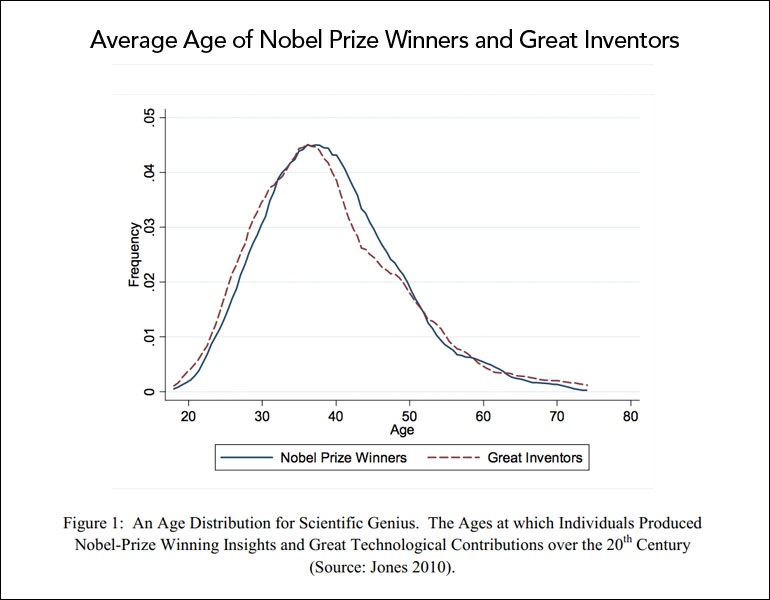
    A recent study tracked the ages of Nobel Prize winners, great inventors, and scientists. As you can see in the graph below, the researchers found that most groundbreaking work peaked during the late thirties — at least a full decade into any individual career. Even in the fields of science and math, creative breakthroughs often require ten years or more or work.

    These findings match the work done by previous researchers as well.

    For example, a study conducted at Carnegie Mellon University by cognitive psychology professor John Hayes found that out of 500 famous musical pieces, nearly all of them were created after year 10 of the composer’s career. In later studies, Hayes found similar patterns with poets and painters. He began referring to this period hard work and little recognition as the “ten years of silence.”

    Whether you are a composer or a scientist, creativity is not a quality you are born with or without. It is something that is discovered, honed, and improved through real work.

    Which brings us to an important question: How can you do your best work and discover your hidden creative genius?

    Permission to Create Junk

    PEOPLE TEND TO LOOK AT SUCCESSFUL WRITERS, WRITERS WHO ARE GETTING BOOKS PUBLISHED AND MAYBE EVEN DOING WELL FINANCIALLY, AND THINK THAT THEY SIT DOWN AT THEIR DESKS EVERY MORNING FEELING LIKE A MILLION DOLLARS, FEELING GREAT ABOUT WHO THEY ARE AND HOW MUCH TALENT THEY HAVE AND WHAT A GREAT STORY THEY HAVE TO TELL; THAT THEY TAKE A FEW DEEP BREATHS, PUSH BACK THEIR SLEEVES, ROLL THEIR NECKS A FEW TIMES TO GET ALL THE CRICKS OUT, AND DIVE IN, TYPING FULLY FORMED PASSAGES AS FAST AS A COURT REPORTER. BUT THIS IS JUST FANTASY OF THE UNINITIATED. I KNOW SOME VERY GREAT WRITERS, WRITERS YOU LOVE WHO WRITE BEAUTIFULLY AND HAVE MADE A GREAT DEAL OF MONEY, AND NOT ONE OF THEM SITS DOWN ROUTINELY FEELING WILDLY ENTHUSIASTIC AND CONFIDENT. NOT ONE OF THEM WRITES ELEGANT FIRST DRAFTS… FOR ME AND MOST OTHER WRITERS I KNOW, WRITING IS NOT RAPTUROUS. IF FACT, THE ONLY WAY I CAN GET ANYTHING WRITTEN AT ALL IS TO WRITE REALLY, REALLY BAD FIRST DRAFTS.
    —ANNE LAMOTT, BIRD BY BIRD

    In any creative endeavor you have to give yourself permission to create junk. There is no way around it. Sometimes you have to write 4 terrible pages just to discover that you wrote one good sentence in the second paragraph of the third page.

    Creating something useful and compelling is like being a gold miner. You have to sift through pounds of dirt and rock and silt just to find a speck of gold in the middle of it all. Bits and pieces of genius will find their way to you, if you give yourself permission to let the muse flow.

    Create on a Schedule

    INSPIRATION IS FOR AMATEURS. THE REST OF US JUST SHOW UP AND GET TO WORK.
    —CHUCK CLOSE

    Amateurs create when they feel inspired. Professionals create on a schedule.

    No single act will uncover more creative genius than forcing yourself to create consistently. Practicing your craft over and over is the only way to become decent at it. The person who sits around theorizing about what a best-selling book looks like will never write it. Meanwhile, the writer who shows up every day and puts their butt in the chair and their hands on the keyboard — they are learning how to do the work.

    Ira Glass is the host of the popular radio show This American Life, which is broadcast to 1.7 million listeners each week. This is the advice Glass gives to anyone looking to interesting, creative work: “The most important thing you can do is do a lot of work. Do a huge volume of work. Put yourself on a deadline so that every week or every month you know you’re going to finish one story. It is only by going through a volume of work that … the work you’re making will be as good as your ambitions.”

    If you want to do your best creative work, then don’t leave it up to choice. Don’t wake up in the morning and think, “I hope I feel inspired to create something today.” You need to take the decision-making out of it. Set a schedule for your work. Genius arrives when you show up enough times to get the average ideas out of the way.

    Finish Something

    Steven Pressfield’s most famous work, The Legend of Bagger Vance, was a best-selling novel that became a major motion picture starring Matt Damon, Will Smith, and Charlize Theron. But if you ask Pressfield, he will say that his most important book was one that you never heard of: the first book he finished.

    Here’s how Pressfield describes finishing his first novel…

    I NEVER DID FIND A BUYER FOR THE BOOK. OR THE NEXT ONE, EITHER. IT WAS TEN YEARS BEFORE I GOT THE FIRST CHECK FOR SOMETHING I HAD WRITTEN AND TEN MORE BEFORE A NOVEL, THE LEGEND OF BAGGER VANCE, WAS ACTUALLY PUBLISHED. BUT THAT MOMENT WHEN I FIRST HIT THE KEYS TO SPELL OUT THE END WAS SO EPOCHAL. I REMEMBER ROLLING THE LAST PAGE OUT AND ADDING IT TO THE STACK THAT WAS THE FINISHED MANUSCRIPT. NOBODY KNEW I WAS DONE. NOBODY CARED. BUT I KNEW. I FELT LIKE A DRAGON I’D BEEN FIGHTING ALL MY LIFE HAD JUST DROPPED DEAD AT MY FEET AND GASPED OUT ITS LAST SULFURIC BREATH.” [3]

    Finish something. Anything. Stop researching, planning, and preparing to do the work and just do the work. It doesn’t matter how good or how bad it is. You don’t need to set the world on fire with your first try. You just need to prove to yourself that you have what it takes to produce something.

    There are no artists, athletes, entrepreneurs, or scientists who became great by half-finishing their work. Stop debating what you should make and just make something.

    Practice Self-Compassion

    WHEN I WRITE, I FEEL LIKE AN ARMLESS LEGLESS MAN WITH A CRAYON IN MY MOUTH.
    —KURT VONNEGUT

    Everyone struggles to create great art. Even great artists.

    Anyone who creates something on a consistent basis will begin to judge their own work. I write new articles every Monday and Thursday. After sticking to that publishing schedule for three months, I began to judge everything I created. I was convinced that I had gone through every decent idea I had available. My most popular article came 8 months later.

    It is natural to judge your work. It is natural to feel disappointed that your creation isn’t as wonderful as you hoped it would be, or that you’re not getting any better at your craft. But the key is to not let your discontent prevent you from continuing to do the work.

    You have to practice enough self-compassion to not let self-judgement take over. Sure, you care about your work, but don’t get so serious about it that you can’t laugh off your mistakes and continue to produce the thing you love. Don’t let judgment prevent delivery.

    Share Your Work

    WHEN IT COMES TO IDEAS, MOST PEOPLE OVERESTIMATE THE RISK OF PIRACY, AND UNDERESTIMATE THE PRICE OF OBSCURITY.
    —MIKE TRAP

    Share your work publicly. It will hold you accountable to creating your best work. It will provide feedback for doing better work. And when you see others connect with what you create, it will inspire you and make you care more.

    Sometime sharing your work means you have to deal with haters and critics. But more often than not, the only thing that happens is that you rally the people who believe the same things you believe, are excited about the same things you are excited about, or who support the work that you believe in — who wouldn’t want that? [4]

    The world needs people who put creative work out into the world. What seems simple to you is often brilliant to someone else. But you’ll never know that unless you choose to share.

    How to Find Your Creative Genius

    Finding your creative genius is easy: do the work, finish something, get feedback, find ways to improve, show up again tomorrow. Repeat for ten years. Or twenty. Or thirty.

    Inspiration only reveals itself after perspiration.

  • Encouragement – why and how you should give it.

    There’s plenty of books, websites, and leadership resources that talk about the importance of encouragement. As Goethe said in 1768,

    “Instruction does much, but encouragement everything.”

    The following example comes from Phil Cooke who is a media producer, speaker and writer.

    Some time ago, our team was called into a major, national media ministry because they were struggling with a declining response to their television program. For years, their financial support had dropped, and it had been nearly a decade since they’d been in the black. They had simply not adjusted to a changing culture, and needed a wakeup call on how the digital revolution had changed the world.

    It took months of hard work and consulting with the ministry, but in less than a year – and after nearly a decade in the red – we helped them turn things around. Obviously it was a team effort between us and their in-house media, donor development, and leadership teams that ensured the ministry would continue to impact the world.

    At a meeting shortly after, I made it a point to congratulate the ministry team, and tell them what a great job they had done. I followed up with personal emails to encourage them that they were now on the right track, and it had been a wonderful experience working with them.

    Time went by and our Cooke Pictures team went on to other projects.

    Then, unexpectedly at Christmas a couple of years later, I received a Christmas card with a note from a leader on their donor development team. Here’s an short excerpt from that note:

    “I wanted to thank you in writing for an email you sent to me congratulating our team for helping turn the revenue from the ministry’s long downturn. You were the only person who acknowledged this accomplishment, of which you played a vital part. Our entire team was grateful for your kind words and observations. You added an exclamation on my many years of service! I will always be grateful that God allowed our paths to cross.”

    Think about that. At a major, national media ministry, I was apparently “The only person who acknowledged this accomplishment.” It meant enough that years later, she sent me a note.

    so

    Leaders: When was the last time you congratulated your team? When was the last time you noticed great work? It’s not just an emotional touchy-feely thing. A study by Bersin revealed that companies that “excel at employee recognition” are 12 times more likely to enjoy strong business results.

    It’s time to be grateful for the people around you at every level. Take some time today to “tour the factory floor” and tell people how much they are appreciated. Believe me, I don’t need research to tell me that it makes a difference.

    Be Specific: A few years ago my good friend Dave Gilpin spoke about how praise is often blunt whilst criticism is sharp and more effective. His revelation was that criticism is sharp and effective because it is usually specific. When people want to criticise a pastor they say things like, “Your preaching isn’t deep enough.” Whilst when they feel encouraged and that a message has really helped them they might say, “Good message, Pastor.” Dave, encouraged his listeners to always try to be specific with praise so that it would be sharper and carry greater impact.

    Leaders:  Think about how you can give some specific encouragement to your team this week. Don’t just thank them be specific. Use phrases like:

    “I love it when…”
    “You are so good at…”
    “When you do….”

    Finally:
    Hebrews 10:25 “…Encourage one another daily – and all the more as you see the day approaching.”

    1 Thessalonians 5:11 “Therefore encourage one another and build each other up, just as in fact you are doing.”


  • Martin Luther King on Flourishing

    Dr. Martin Luther King, Jr. Is a person whose memory is often presented in a kind of secularised version. It would be no exaggeration to say that Dr. King is presented as one of the heroic crusaders for “truth, justice, and the American way,” with the civil rights movement in view as the specific focus.

    This version of events neglects or omits that King never would have been involved in this struggle that cost him his life if he wasn’t “Reverend” Dr. Martin Luther King.

    He would not have continued to pursue the cause of justice if he did not believe God was with him. His Christian commitment was central to his practice of public faith.

    Second, the complicated aspects of King’s life provide yet another opportunity to consider how to evaluate great causes led by flawed people.

    Though some debate exists around whether King had moral failures, it presents a conundrum many of us face: what do we do when our heroes are imperfect? How do we evaluate their public deeds?

    One of the best things we can do when faced with such questions is to seize the opportunity to examine our own motives when evaluating public figures.

    It is easy to condemn those who are not “on our team” and use their failings as a reason to discredit their public actions, while simultaneously finding it easier to make a separation between the failures and grand projects of “our kind of people.”

    A better path is to recognize that ever since Genesis 3, humans have come with a label that says “prone to breakage,” and to recognize that even the best leaders (i.e., all those not named Jesus) have weaknesses, blind spots, and, in some cases, tremendous flaws in character.

    While recognizing this truth, we can also look at what they have done in spite of their brokenness and do our best to evaluate their public actions on their merits.

    Finally, this evaluation of the public actions of heroic figures can prompt us to take a look at our own hopes for society.

    In 1964, Dr. King gave a speech at Drew University entitled “The American Dream.” It includes these words regarding the Declaration of Independence:

    Now one of the first things we notice about this dream is an amazing universalism. It does not say some men, it says all men. It does not say all white men, but it says all men which includes black men. It doesn’t say all Protestants, but it says all men which includes Catholics. It doesn’t say all Gentiles, it says all men which includes Jews. And that is something else at the center of the American Dream, which is one of the distinguishing points, one of the things that distinguishes it from other forms of government, particularly totalitarian systems.

    King continues, saying:

    It [the Declaration] says that each individual has certain basic rights that are neither derived from nor conferred by the state. They are gifts from the hands of the Almighty God. Very seldom if ever in the history of the world has a socio-political document expressed in such profound, eloquent and unequivocal language the dignity and the worth of human personality.

    Dr. King took language foundational to the essence of the country and held it up as a mirror, urging Americans to live up to its ideals.

    Even those critical of the ways King and others wished to bring about changes in society can ask themselves, “What are my hopes for all of the citizens of our country?”

    If Christians believe that the nations in which  live have, at their core, a view of human flourishing emerging from rights bestowed by God and fundamental dignity rooted in human beings as divine image bearers, how do we consider the myriad ways for this vision to become reality?

    For readers of this blog, perhaps a more specific question is, “How do Christians lead the way in helping all humans flourish in every sphere of life?”

    Dr. King was a man compelled by Christian belief. He was imperfect, but also a model of hope in action. America has a national holiday in his honour that can be the occasion for us to become people who model hope by pursuing strategies for flourishing with great vision and creativity.

    If we do so, what will our legacy be decades from now?

  • 5 Reasons We Reject Our Own

    The gospel accounts of Mark, Luke and John record incidents of Jesus and his ministry being rejected in his home town of Nazareth. When we read these accounts we sadly discover that this meant the people of Nazareth were unable to receive everything that Jesus had for them, even though in Luke’s account the people seem to be asking Jesus to, “Do here in your hometown what we have heard you did in Capernaum.”

    I think in our churches today it is imperative that we have a culture of raising and releasing our own and not rejecting our own. The rest of this post considers five reasons and the roots that they stem from those reasons that cause us to reject our own, rather than release them.

    The accounts in the gospels can be found in these passages:
    Mark 6:1-6
    Luke 4:23-30
    John 7:1-3 (note verse 5)

    1. FAMILIARITY

    “Isn’t that the carpenter?” “Aren’t these his brothers?” Brothers, by the way, that at this point did not believe in Jesus themselves. The hometown crowd knew Mary and the scandal surrounding the first born, they also knew Jesus’ brothers, James, Joseph, Simon and Judas and his sisters who are unnamed. Their questions reveal a common trait. This person cannot be special, we know him.

    The root of this problem is JUDGEMENT. Our judgement of people and their circumstances prevents us from receiving from them when we should recognise that each and everyone of us are broken vessels and any use that we have to God is by his grace.

    2. THE TALL POPPY SYNDROME

    This is the human tendency to cut down a person who seems to be getting ahead. A peer whose profile is increasing or whose skill is developing, whose work or character is getting them noticed. This trait is very evident in British culture, just take a look at some of our reporting media, looking for any opportunity to dish the dirt as we say. Of course, it is us, the public, that fuel that because it sells.

    The root of this problem is ENVY.

    3. OUR OWN INSECURITIES

    Not dissimilar to the tall poppy syndrome our own insecurities can cause us to be really negative about people in our world and therefore be slow to praise and empower.

    The root of this problem is FEAR. We wonder, fearfully wonder, will there be a place for me?

    4. OUR PRECONCEPTIONS

    Jesus faced rejection at different times for all kinds of reasons but imagine facing rejection for healing a man who had been paralysed for 38 years. The reason for the rejection, you did it on the sabbath. Our views, our preconceptions can mean that we are not open to new things, to things that are done differently than we’ve previously known or experienced.

    The root of this problem is RELIGION, and it is far more widespread than we think.

    5. NEPOTISTIC ACCUSATIONS

    Our failure to praise and raise our own, or from within can come because we fear that people will accuse us of providing jobs for the boys. They will question our motives and therefore, even when our motives are pure we draw back because we fear the accusation.

    The root of this problem is THE FEAR OF PEOPLE. We need to remember that God said to  Jeremiah, “Do not be afraid of them for I am with you.” Jeremiah 1:8

    In Conclusion

    My hope is that in all our churches and organisations we will raise, praise, equip and empower our own more than ever before to be the very best that they can be and take what God has begun in and through us to a whole new level.

  • 4 Ways To Lead Well – With or Without the Title

    In recent years much has been said about not needing the title “leader” to be a leader. You don’t have to be the “Director” or “Manager” or whatever that title is at your organisation to lead. Just because you aren’t a “leader” on the org chart doesn’t mean you can’t lead in your role, that’s the idea. That said you may well be the leader on the org chart and these thoughts apply equally to you

    Being a leader in today’s workspace has a lot more to do with the relationships people have with you and the trust you’re given by your superiors and peers alike. Here are four things that earn big leadership and trust points as you continue to grow as a leader and continue to be trusted as a leader in your role:

    1. Do what you say you’re going to do, when you say you’re going to do it.

    This one seems simple, but you’d be surprised how jarring this is for some people. One of the key elements of leading is being someone that people can trust. Not trust in an “I know something you don’t know” kind of way, but be someone that can be trusted to follow through. If you come through on everything you say you will, people are going to recognise it. It may not be right away, but over time you’ll become a “go-to person” when important projects, decisions, etc. come down the line. If you’re crushing it in the everyday tasks, your peers and leaders will notice and trust that you’re a person who keeps their word.

    2. Live the culture.

    Part of your leader’s role is to set the tone for the organisation. They work hard to come up with a mission, values, vision, whatever you want to call it, and then they implement that culture in the organisation. If you want to grow as a leader, hop on board. As you lean in to and live the culture that’s being created, you’ll grow into an ambassador for the exemplary employee, volunteer and team member. Culture is created for the benefit of the organisation, those it serves and the team, so if you lead the way in owning that culture, everyone around you will benefit and follow your lead.

    3. Fill the gaps.

    Part of leading is finding ways to improve your organisation. That doesn’t just need to come from the top, down, though. Save your leader some stress by going ahead and filling those gaps. Be a gap filler. Don’t go around bragging about how great you are because you went above and beyond to cover a glaring hole, though. Filling gaps for the recognition isn’t leading; it’s sucking up. Lead your team by making it the best it can be. Make yourself an integral and go-to member of the team that leads the way in making things happen.

    4. Ask

    This is one of the easiest and most difficult ways to lead. By simply asking your leader what you can do to lead from your current spot, you show a lot of courage and responsibility that comes with being a leader. However, be prepared that everything you hear may not be what you want to hear. What you hear might require more effort or difficult conversation. But all of that is part of being a leader. Sometimes you’ll ask how you can grow as a leader, and you’ll find out about some blind spots that you didn’t know you had. Sometimes you’ll find out that you aren’t doing as great of a job at following through as you thought. That’s ok, though. Because you asked, you now know and can show your leadership by owning your shortcomings and starting to correct them. Leaders can’t be above reproach, and when you admit that, you begin to truly lead yourself as well as those around you.

    Step out today from the pack and be a leader, title or not.

  • Fujimura – Art Inspired by Faith

    Decades before Makoto (“Mako”) Fujimura became America’s most successful evangelical fine artist — and even longer before he advised Martin Scorsese on the director’s new movie, Silence — an unplanned turn down a darkened museum hall in Tokyo defined his artistic calling.

    Awaiting him there were dozens of fumi-e, bronze and wooden tiles bearing an image of Jesus or the Virgin Mary.

    During Japan’s 250-year persecution of its Christians, magistrates forced suspected believers to trample the images or face torture and death. Yet Japanese Christianity was never eliminated, and Fujimura, who encountered the images just after his own conversion, saw in their “deeply scarred mystery” a skewed testimony and a personal touchstone.

    “Everything I’ve done has stemmed from that,” he said.

    Today, Fujimura is the most successful serious artist of openly evangelical faith in the U.S., and probably in the world. His larger paintings sell for up to $400,000 and defy the secular art establishment’s unspoken commandment: Thou shalt not reward an artist who claims explicit Christian inspiration.

    img_0102
    Artist Makoto Fujimura.
    Photo courtesy of Andrew H. Kim

    At the same time, his ravishing semiabstract canvases and his work as a writer and administrator have eroded the corresponding prejudice among evangelicals: Thou shalt not trust modern art.

    Says fellow artist and sometime collaborator Bruce Herman, “He’s a kind of household name; if people think of contemporary artists who are Christians they immediately think of Mako.”

    Most recently, the fumi-e have led Fujimura into a kind of partnership with Scorsese.

    The “trampling blocks” are pivotal in Scorsese’s new movie, Silence. Fujimura is credited on the film as a “special adviser” and has written a kind of companion book about Shusaku Endo, the author of the 1966 novel from which the movie is adapted.

    The association — Scorsese calls Fujimura a “remarkable artist and writer”— may gain Fujimura enough nonevangelical recognition to attain an elusive goal: street cred — not just as an artist, but one of faith — among non-Christians.

    A personal touchstone:

    “In grade school I used to play baseball on the beach at Kamakura,” Fujimura said recently over buckwheat tea. “That was one of the places where they lined up Christians to step on the fumi-e.”

    A youthful 56, he wears a cowled wool sweater and cuffed-up jeans, either for style or because rain has turned his bucolic property near Princeton, N.J., into a small swamp.

    His family is distinguished and haunted. One grandmother died in the Allied firebombing of Tokyo; one grandfather, then No. 2 in Japan’s wartime education ministry, toured the horrors of Hiroshima a week after it became the original ground zero.

    Mako was born in Boston while his scientist father was doing postdoctoral work with the linguist and activist Noam Chomsky. Fujimura attended middle school, high school and college in the U.S. and then returned to Tokyo for a crucial six years. It was there that he mastered the traditional Japanese nihonga tradition, in which pigments made from pulverized semiprecious stones refract seemingly infinitely, and merged it with a New York-style abstraction to create a unique look.

    He experienced his Christian conversion in Tokyo through American Protestant missionaries. And his encounter with the fumi-e provided his underlying themes: beauty, death, faith and resilience. In 1992 he became the youngest artist ever to have work acquired by Tokyo’s Museum of Contemporary Art.

    His success stateside was less meteoric. In the ’90s, his paintings sold quietly — and since they do not include obvious symbols, most buyers were unaware of the role of Christianity in their inspiration. He became a leader in a movement to reconcile evangelicals to contemporary art, but it was small.

    “We were like the Hubble Telescope, sending out these almost futile messages in hopes that someone could hear them,” he said.

    img_0207
    Makoto Fujimura’s “Grace Remains” is 73 cm x 91 cm, mineral pigments and gold on Kumohada paper, 2016.

    Exclusively represented by Artrue International, to be exhibited by Waterfall Mansions, New York City, in May-June 2017. Photo courtesy of Alyson Lecroy.

    His sometimes dark concerns ran up against what Greg Wolfe, editor of the religion-and-arts journal Image and an early champion, calls an evangelical resistance to “the idea of grace working through fallen things.”

    Yet that idea took on tragic national resonance in 2001. Fujimura’s young family lived in downtown Manhattan, three blocks from what, one bright morning, became the new Ground Zero. Amid the smoke and mourning after 9/11, he co-founded Tribeca Temporary, a collective for talented but traumatized displaced artists. The act of vision and generosity enhanced his career. Grateful art-world players touted him; the White House appointed him to the National Council on the Arts; he gained a wider evangelical audience for his vision of God amid “the ever-expanding ground zeros of the world.”

    His work was distinctive and ambitious: from the raw orange flame climbing against a riverine background in “Ghost,” done shortly after 9/11, to a series reflecting the prose of Dante and T.S. Eliot, collaborations with musicians and other painters, and breathtaking modernist grids of gold leaf, another Japanese nihonga staple.

    James Elkins, an influential critic at the Art Institute of Chicago, described Fujimura as pioneering “a new kind of art, about hope, healing, redemption, refuge, while maintaining visual sophistication and intellectual integrity.”

    Among conservative Christians, says Wolfe, “Mako became a kind of a good pied piper, leading people into greater ease of dialogue with the contemporary art world.”

    In 2010, Crossway Books became the first major evangelical publisher to release an edition of the four Christian Gospels with abstract illustrations, done by Fujimura. In 2015, he was named director of the Brehm Center for Worship, Theology and the Arts, a buzzing hub of the powerhouse Fuller Theological Seminary.

    There are still dissatisfactions. Fujimura is well-known in Asia but his art remains unrepresented in most major American museums and unreviewed in key publications such as The New York Times. Elkins maintains that were it not for Fujimura’s outspoken Christianity he would belong to the international art elite along with luminaries such as Germany’s Gerhard Richter.

    The Scorsese connection may help. In 2013 one of the producers of Silence who knew of Fujimura’s fascination with Endo’s novel suggested he write an accompanying book.

    At first Fujimura worried that the film might be “a culture wars project.”

    But the script impressed him, and a 90-minute meeting with Scorsese convinced him of the director’s intellectual enthusiasm as well as earnestness — “you know when something is a deep calling.”

    Because the film was delayed, “Silence and Beauty” came out half a year earlier. In addition to taking on Endo’s novel, it is a meditation on Fujimura’s own art, and a provocative speculation on the impact upon Japan of its suppression of Christianity.

    His involvement may help the film among evangelical elites who were scandalized by Scorsese’s 1988 film The Last Temptation of Christ and who might otherwise have shunned the Catholicism or dark subject matter of “Silence.”

    In an online review in the evangelical magazine Christianity Today, Brett McCracken wrote: “Silence is not just about mission. The film itself is missional,” extremely high praise. An adjacent ad is for Fujimura’s book.

    As twilight fell, Fujimura excused himself to talk to some students at nearby Princeton University.

    “I’ve never wanted to be an art star,” he said. “The God of the Bible is an artist, perhaps the only true artist.”

    He will admit, however, to being pleased that more of his buyers “understand the totality of who I am — not only a contemporary artist working in nihonga, but that the art is connected to the divine.”

  • The 3 Main Ingredients for Happiness

    According to studies cited in Timothy D Wilsons book ReDirect-Changing the stories we live by, there are three ingredients that contribute more than anything else to human happiness. I have commented on all three below and how all three are connected to a healthy life of faith.

    1. MEANING:

    Finding meaning. The better we understand and explain events that happen to us, especially the negative ones, the faster and fuller we recover from them. I think that this is one of the reasons that certain studies have shown that people of faith are usually happier, it is because they can find meaning or purpose in the midst of their experiences. This is powerful because the experience itself is not the end of an event, good will come from it. There’s redemption and justice to look forward to.

    One of the most popular scriptures that Christians will turn to for this is Romans 8:28 which says,

    For we know in all things God works for the good of those who love him, those who are called according to his purpose

    As humans our core narratives are derived from culture, parents, traditions and our religion. It’s why for several weeks following 911 in America churches were full. People were once again drawing on their core narratives. “In God we Trust” perhaps…

    Meaning helps us to feel special and underlines our core beliefs. Again the scriptures drip with this conclusion. In the Bible, we are called, chosen, loved, found and rescued. Although we don’t always know how to articulate or describe these things, a healthy reading of scripture should leave any person with no doubt that they are special in the eyes of God.

    Here’s a surprising scripture that reveals that to us:

    Suddenly a great company of angels appeared saying, “Glory to God in the highest, peace on earth to men on whom his favour rest.” Luke 2:13-14

    Yes, this is what the angels said to the shepherds announcing the birth of Jesus, but did you notice how it speaks of us? “Peace to men, on whom his FAVOUR rests.” God favours us! Now I have to say I didn’t always think that’s what God thought of me , of us, but years of reading the scriptures have utterly convinced me. Meaning forged from events and circumstances and derived from the knowledge of God’s view contributes hugely to human well being and happiness, so it seems.

    2. HOPE HAS REAL POWER:

    Knowing that we have some control over things, knowing that we can change has proven to be a huge motivator and contributes greatly to our happiness. As Humans we have this incredible ability to decide today to make tomorrow different and we know that we can do it. Unlike other mammals who are just going to act instinctively, we can act intentionally. For example, a baboon is just going to baboon all day long, a beaver will not have woken this morning and declared, “No more dams, I’m done with dams, from now on I’m building bridges.” No, the beaver will once again build its dams.

    This vision, this hope is proven to have real power. People who tap into this have shown themselves to be healthier, less depressed and more optimistic. Now don’t be confused about optimism, it isn’t just thinking good thoughts as opposed to negative ones. Optimism is behaving in an optimistic way. behaving in a way that says, “There is hope.” “Things can get better.” etc.. Optimists confront problems, they don’t shy away from them, they plan better and persist longer because they believe obstacles can be overcome. They have an adaptive, healthy way of coping.

    Once again the scriptures are full of these themes of hope and faith. The Christian life is defined, of course,  as a life of faith. Think of Hebrews 11:1

    Now faith is the substance of things hoped for the evidence of things not seen

    A life of faith, rather than leaving one frustrated, contributes to the state of happiness.

    Also the sense of control that we mentioned earlier is something the scriptures teach us has been gifted to us by God. In Genesis 1:26 God says,

    Let us make man in our image and let them rule…

    That word rule here doesn’t mean to dictate and command but to steward, care, lovingly control, tend. I love the way that Andy Crouch in his book Culture Making says it,

    Humans are meant to make something of this world

    When we accept that gift of control, that sense of we can do something about things, we tend to grow happier.

    3. PURPOSE

    We all know that at some point in life we ask the question why? Why am I here, is there a purpose? Nothing answers this question better than the Bible’s story. In the Bible’s story despite the fact that God is so great, good, does brilliant things, comes in the person of Jesus and does for us what we cannot do for ourselves he (God) does not set himself up as the hero.

    We are the hero. It is all done for us. When we read the first few chapters Genesis for example, God is not describing how he made the world but why he made the world. He made it for us. A place for us to thrive and flourish. A place for us to grow and develop. A place to discover. Anyone who has heard me preach in recent years as probably heard me say something like, “We were always meant to make clothes, Ferrari’s, Harley Davidsons, Hotels (because they are much better than tents) etc..” The point I have been making is this, God provided everything for us to thrive and our purpose was and is to make something great that would reflect his goodness.

    Our reflecting his goodness was meant to involve our relationships with God, others, ourselves and our world. It was meant to pull on every bit of creativity, care and love that God had placed within is. And we were meant to do it in community. This is still our purpose today. It is seen so clearly in many parts of scripture but let me turn to the calling of Abraham in Genesis chapter 12 and verse 2.

    I will make you into a great nation and I will bless you. I will make your name great and you will be a blessing.

    Did you see that? “You will be a blessing.” At the heart of faith is this sense that God will bless me, yes, but the reason is so that I, along with others, can fulfil the purpose of blessing others and caring for this world.

    BE HAPPY!

  • Prominent Biblical Scholars On Women in Leadership

    This article first appeared at http://newlife.id.au/prominent-biblical-scholars-on-women-in-ministry/

    Some Christians think that only people who have a “loose approach to scripture” can believe that women should be leaders and teachers in the church. I strongly doubt that any evangelical Christian would regard these scholars and theologians as having a loose approach to scripture, and yet each of them believes that appropriately gifted women should be leaders and teachers in the church. Here is a sample of various statements made by these prominent scholars (some of whom are now deceased.)

    F.F. Bruce (1910-1990)

    F.F. Bruce was the Rylands Professor of Biblical Criticism and Exegesis at the University of Manchester, and belonged to the Open Brethren.

    “An appeal to first principles in our application of the New Testament might demand the recognition that when the Spirit, in his sovereign good pleasure, bestows varying gifts on individual believers, these gifts are intended to be exercised for the well-being of the whole church. If he manifestly withheld the gifts of teaching or leadership from Christian women, then we should accept that as evidence of his will (1 Cor. 12:11). But experience shows that he bestows these and other gifts, with ‘undistinguishing regard’, on men and women alike―not on all women, of course, nor yet on all men. That being so, it is unsatisfactory to rest with a halfway house in this issue of women’s ministry, where they are allowed to pray and prophesy, but not to teach or lead.”
    F.F. Bruce, “Women in the Church: A Biblical Survey,” Christian Brethren Review 33 (1982) pp.7-14. (Source)

    Gordon D. Fee (b. 1934)

    Professor Emeritus of New Testament at Regent College, ordained in the Assemblies of God

    “It seems a sad commentary on the church and on its understanding of the Holy Spirit that “official” leadership and ministry is allowed to come from only one half of the community of faith. The New Testament evidence is that the Holy Spirit is gender inclusive, gifting both men and women, and thus potentially setting the whole body free for all the parts to minister and in various ways to give leadership to the others. Thus my issue in the end is not a feminist agenda—an advocacy of women in ministry. Rather, it is a Spirit agenda, a plea for the releasing of the Spirit from our strictures and structures so that the church might minister to itself and to the world more effectively.”
    “The Priority of Spirit Gifting for Church Ministry”, Discovering Biblical Equality Complementarity without Hierarchy. Ronald W. Pierce, Rebecca Merrill Groothuis, Gordon D. Fee (eds) (IVP Academic, 2012) p.254.

    Craig S. Keener (b. 1960)

    Professor of New Testament at Asbury Theological Seminary, ordained in an African-American Baptist church but serves in settings with a range of traditions.

    ” . . . we Pentecostals and charismatics affirm that the minister’s authority is inherent in the minister’s calling and ministry of the Word, not the minister’s person. In this case, gender should be irrelevant as a consideration for ministry–for us as it was for Paul. . . . Today we should affirm those whom God calls, whether male or female, and encourage them in faithfully learning God’s Word. We need to affirm all potential laborers, both men and women, for the abundant harvest fields.”
    Was Paul For or Against Women in Ministry?, Enrichment Journal, Spring 2001. (Source)

    I. Howard Marshall (1934-2015)

    Professor Emeritus of New Testament Exegesis at the University of Aberdeen, belongs to the Evangelical Methodist Church

    “Much anguish is felt by women whose God-given talents have been denied expression. This is due to the inability of complementarians to provide any coherent and persuasive reasons for denying women these [ministry] positions in church—women are asked to accept a scriptural command simply because it is God’s will even if they cannot understand why it is so. . . . [And it is due to] the arbitrariness of the way in which the ruling is put into effect, with all the going beyond what Scripture actually says and the casuistry that is employed regarding the limits of what women may and may not do.”
    Comments made at a panel discussion at the Evangelical Theological Society 2010 meeting. (Source)

    Leon Morris (1914-2006)

    New Testament scholar, ordained Anglican minister. In his commentary on Paul’s letter to the Romans, Morris stated that

    “Phoebe is certainly called a deacon” in Romans 16:1; and Junia along with Andronicus (mentioned in Romans 16:7) were “outstanding among the apostles which might mean that the apostles held them in high esteem or that they were apostles, and notable apostles at that.” Morris adds, “The former understanding seems less likely . . .” The Epistle to the Romans (Grand Rapids: Eerdmans, 1988) p.529 & 534. Morris also wrote essays advocating for women in ministry, and he welcomed women at Ridley Theological College, Melbourne, where he was Principal from 1964 until his retirement in 1976.

    John Stott (1921-2011)

    Anglican minister, theologian, one of the principal authors of the Lausanne Covenant in 1974

    “If God endows women with spiritual gifts (which he does), and thereby calls them to exercise their gifts for the common good (which he does), the Church must recognize God’s gifts and calling, must make appropriate spheres of service available to women, and should ‘ordain’ (that is commission and authorize) them to exercise their God-given ministry, at best in team situations. Our Christian doctrines of Creation and Redemption tell us that God wants his gifted people to be fulfilled, not frustrated, and his church to be enriched by their service.”
    J.R.W Stott, Issues facing Christianity Today (Basingstoke: Marshalls, 1984) p.254.

    Ben Witherington III (b. 1951)

    Professor of New Testament Interpretation at Asbury Theological Seminary, ordained Methodist pastor

    “We need to keep steadily in mind that what determines or should determine the leadership structures in the church is not gender but rather gifts and graces of the Holy Spirit. The family of faith is not identical with the physical family, and gender is no determinant of roles in it. Gender of course does affect some roles in the Christian family, but that is irrelevant when it comes to the discussion of the leadership structure of the church. This is why we should not be surprised to find even in Paul’s letters examples of women teachers, evangelist, prophetesses, deacons, and apostles. Paul is not one who is interested in baptizing the existing fallen patriarchal order and calling it good. One of the tell tale signs of Paul’s views on such matters can be seen in what he says about baptism— it is not a gender specific sign that we have for the new covenant unlike the one for the old covenant, and Paul adds that in Christ there is no ‘male and female’ just as there is no Jew or Gentile, slave or free. The implications of this are enormous. The change in the covenant sign signals the change in the nature of the covenant when it comes to men and women.”
    Why Arguments against Women in Ministry aren’t Biblical, on Dr Witherington’s website The Bible and Culture here.

    N.T. Wright (b. 1948)

    New Testament scholar, Anglican Bishop of Durham (2003-2010)

    “It is the women who come first to the tomb, who are the first to see the risen Jesus, and are the first to be entrusted with the news that he has been raised from the dead. This is of incalculable significance. Mary Magdalene and the others are the apostles to the apostles. We should not be surprised that Paul calls a woman named Junia an apostle in Romans 16.7. If an apostle is a witness to the resurrection, there were women who deserved that title before any of the men. . . . Nor is this promotion of women a totally new thing with the resurrection. As in so many other ways, what happened then picked up hints and pinpoints from earlier in Jesus’ public career. I think in particular of the woman who anointed Jesus (without here going in to the question of who it was and whether it happened more than once); as some have pointed out, this was a priestly action which Jesus accepted as such.”
    “Women’s Service in the Church: The Biblical Basis”, a conference paper for the Symposium, Men, Women and the Church, St John’s College, Durham, September 4 2004. (Source)

    Many More . . .

    Numerous other evangelical scholars also believe that the Bible, correctly interpreted, does not restrict gifted women from any ministry function or position. There are too many to mention them all, but here are just a few: Kenneth Bailey, Gilbert Bilezikian, Michael Bird, R.T. France, Richard Hays, Kevin Giles, Joel B. Green, Stanley Grenz, David Instone-Brewer, Walter Kaiser, John R. Kohlenberger III, Richard N. Longenecker, Scot McKnight, Roger Nicole, Roger E. Olson, Philip Barton Payne, Howard Snyder, John Stackhouse, etc. (I have deliberately chosen to mention only male scholars to avoid the accusation of women being self-serving.)

    Finally, a quotation from

    Dallas Willard (1935-2013),

    “It is not the rights of women to occupy `official’ ministerial roles, nor their equality to men in those roles, that set the terms of their service to God and their neighbors. It is their obligations that do so – obligations that derive from their human abilities empowered by divine gifting.”

    How I Changed my Mind about Women in Leadership (Grand Rapids: Zondervan, 2010) p.10 (Italics by the author).

  • A Cassette Tape Revival – no way

    JOHN PAUL TITLOW 12.1.17
    For Andy Molholt, there’s something oddly special about hitting play on his boombox at the beach. The Philadelphia-based musician tours frequently with his band Laser Background and, between that and the many shows he helps book back home in Philly, he winds up seeing a lot of bands perform in bars, basements, and warehouses. If he likes them, he usually buys a tape.

    “It’s nice to only be able to listen to what’s in front of you, instead of having the entirety of music at your fingertips with Spotify and all that,” says Molholt of his growing tape collection. “There’s also something warm and fuzzy about tapes to me, maybe in a nostalgic kind of way.”

    He’s not alone. Over the recent holiday shopping season, U.S. artists and labels saw a 140% increase in tape sales over the previous year, according to a new music industry report from BuzzAngle. Over the course of 2016, Bandcamp saw its own 46% increase in cassette sales, according to a spokesperson for the music service. And while it’s still a tiny sliver of overall music consumption—and too small for Nielsen to care enough to track—the seemingly counterintuitive revival of cassettes shows no sign of slowing down, even as streaming music subscriptions explode. But why?

    As tempting as it may be to dismiss cassettes as another display of analog hipsterism, the mini-trend has very real, practical benefits for budding artists like Molholt, who releases music on a tape-only label called Endless Daze. For one thing, they scratch a simple economic itch. For about $2 apiece, tapes can be produced in small quantities much more quickly than vinyl records, whose own resurgence has slammed pressing plants with so much demand that a new record can take up to six months to turn around. And unlike with vinyl, musicians can produce new copies of cassettes in their apartment in a pinch.

    “You can’t quite put your finger on it. But they’re sort of fun. They’re weird little tchotchkes.”

    For newer, less established artists, tapes are also a lower-risk investment than vinyl: If your debut EP doesn’t sell, you’re not stuck sitting on a heavy box of vinyl that took over a thousand bucks and half a year to produce.

    Tapes give musicians an affordable way to sell their work to fans—usually for about five bucks apiece—and help cover their costs on the road in an age when streaming royalty checks will barely fill up the gas tank. They let fans support their favorite artists without the $25 commitment of vinyl or some other trinket emblazoned with the band’s logo. It may seem odd given the scarcity of cassette players in our lives, but if nothing else, a rectangular hunk of plastic can serve as a convenient vehicle for a free digital download of the album. Plus, it’s a souvenir.

    “For the fans, there’s a certain coolness about tapes,” says J. Edward Keyes, Bandcamp’s editorial director and a longtime music journalist, who has amassed close to 500 cassettes. “You can’t quite put your finger on it. But they’re sort of fun. They’re weird little tchotchkes.”

    Indeed, the appeal of tapes has more to do with collectibility and nostalgia than it does with convenience or sound quality. In fact, the lower audio fidelity of tapes is seldom seen as a disadvantage.

    “Tapes were biggest mostly in noise and hardcore, where the fact that they were degraded was almost kind of an asset,” says Keyes. “Because it made it sound muddier and screwed with the dynamics and the sound in an interesting way.”

    Molholt, for one, loves the sound of tapes. “I feel like everyone is obsessed with super high fidelity but I like it when things are warm and warbly,” he says.

    THE CASSETTE DECADE

    The tape revival is not a new trend. After being swiftly crushed into obsolescence by the rise of the superior-sounding compact disc in the 1980s, the U.S. cassette market started seeing a miniature revival of sorts about a decade ago, driven at first by underground and more experimental music scenes and then by more popular flavors of indie rock. By 2010, the so-called “cassette revival” had landed on the radar of mainstream media outlets like NPR and the Boston Globe, leading to an ongoing resurgence in interest from everyone from Pitchfork and Rolling Stone to Forbes and (hello) Fast Company.

    img_0054

    All along the way, the return of cassettes has seemed like a strange, low-fidelity fluke in a world being overtaken by music streaming services. But even as paid music subscriptions have approached the 100 million mark, offering new signs of industry growth as physical albums continue their years-long free-fall, the cassette tape refuses to die.

    Since 2013, music retailers have celebrated Cassette Store Day with special tape releases.

    In large part, we have in-the-know music obsessives like Molholt and Keyes to thank. But in recent years, we’ve seen tapes inch toward an unexpectedly mainstream sort of hipness, complete with Urban Outfitters selling tape players and used cassettes. That retailer, which produces its own limited-run mix tapes for promotional purposes, declined to comment for this article. But suffice it to say that its stamp of approval makes the tape trend officially “cool” in the eyes of many millennial consumers (even if it elicits a groan from punk bands and noise artists who have long embraced the format).

    Since 2013, music retailers have also celebrated Cassette Store Day with special tape releases, hoping to extend the success of Record Store Day to a less popular format. To some, these music-buying holidays are a cheesy gimmick. To others, anything that will get consumers to pay for music, 15 years after Napster, is worthwhile.

    Major labels have taken note. The 2014 release of the Guardians of the Galaxy soundtrack on cassette may have been a somewhat clever marketing tactic for the movie (whose storyline features a mixtape filled with throwback hits from the ’70s and ’80s), but there’s no such rationale to explain why Justin Bieber, Eminem, Macklemore, and Twenty One Pilots have put out tapes in the last year or two. But again, whatever it takes to get people to pay for music.

    “I do arch an eyebrow when I see major labels putting things out on tape,” says Keyes. “That, to me, is just purely cashing in on what they perceive as kind of a trend. To me, tapes are really for smaller bands and record labels. Not because Columbia wanted to reissue the Top Gun soundtrack for the hundredth time. Something about that is a little more bogus to me.”

    Keyes now has a routine habit of buying tapes at shows or, quite naturally, ordering them online from his employer Bandcamp. At the Latinx Punk Festival in Brooklyn last summer, he bought tapes from many of the bands he saw, who hailed from all over the world. The fact that they all sold cassettes allowed him to easily collect their music for later listening, something that would be cost-prohibitive with vinyl and downright annoying with streaming services.
    ONE TANGIBLE THING
    In an age when most music exists on the boundless, only somewhat navigable reservoir of sound called the internet, splintered across streaming services, YouTube embeds, torrents, and message board threads, there’s something to be said for the tangibility and simplicity of physical media. Like reading a book or a paper magazine, listening to vinyl or cassettes pulls us out of the digital ocean for 45 minutes or so and forces us to focus on one thing. What a concept.

    As a bonus, Keyes notes, cassettes often look cool. “They usually do such a nice job with the cover art, especially [tape label] Orange Milk,” he says. “They have such a clear aesthetic and design. It kind of makes you want to buy them all and line them all up.”

    Trendy as they may be, nobody is predicting that tapes are going to explode into a dominant force in the music industry. Not even vinyl, which has been growing in popularity for several years, has a chance of reversing the inevitable trend toward the all-you-can-stream, subscription-based music economy. But don’t expect cassettes to go away anytime soon, either.

    “I can’t predict whether it will make mainstream inroads,” says Keyes. “But as a viable method for artists to put out music in a physical format, I wouldn’t be surprised to see it grow.”