• Hi all

    I asked a GP in church to send some words I could share about Corona Virus here in the UK. Here they are.

    Hi Pastor, I have penned down a few thoughts but mostly wanted to emphasise people should not neglect other health concerns while we deal with COVID-19. Hope it’s ok.

    ………………,,,…………………………………

    Unprecedented, isn’t it?

    A word that has been used to describe the COVID-19 pandemic but the reality is we WILL BEAT this!

    Truth is, the government and every organisation in UK (including the NHS) are working tirelessly and proactively in other to combat the impact of this virus, the ultimate goal is keeping us safe.

    From my perspective as a GP, I can assure you all GP practices (and their partner organisations) are working tirelessly to ensure we continue to care for you while dealing with this virus. We recognise the need to beat COVID-19 but also know that people will be concerned about other health issues be it children, young, middle age and old.

    We understand the continual need to tackle heart disease, respiratory problems, mental health, social issues, safeguarding issues, cancer, dementia, those in care homes and other long-term conditions including those needing palliative care. GPs will not neglect these issues but will also take seriously the negative impact of COVID-19 if not addressed systematically.

    It is likely that this may mean working with your GPs to look at different ways those health issues can be addressed but let me assure you, they will be addressed. Telephone, online and video consulting are some of the many ways we are continually exploring to help address the health needs of our population. So, I encourage you to update your phone numbers at your GP surgery, sign up to online access and be open to the idea of video consulting if or when offered one.

    As for COVID-19, don’t forget to use the link on IKON website (https://www.nhs.uk/conditions/coronavirus-covid-19/) if you need any information or if you feel you may be at risk, use this link…… https://111.nhs.uk/covid-19/

    Most importantly, let’s look out for one another and especially the vulnerable. WE WILL BEAT COVID-19😊😊😊

    Love

    Oyewole

  • Don’t Create A Leaning Ledge

    What were they thinking?

    I’m sure you’ve had the occasion to use the phrase “What were they thinking” or how about, “You only had one job.” Have you ever said that? We say such things as we experience something so seemingly ridiculous that we are unable to conceive how anyone could ever create what we are seeing, hearing or experiencing.

    Metro-North is the commuter train that runs to New York City’s northern suburbs. When the trains were upgraded a few years ago the ledges at the end of the carriages were redesigned. The old design was flat and as a result they were great places to rest your coffee whilst reading a book or fumbling through your belongings. The new design, which was meant to be an improvement, was now leaning. A leaning ledge, it is impossible to rest a coffee cup on a leaning ledge, it’s almost impossible to rest anything on a leaning ledge.

    04DF0A14-BE84-494B-AAC5-9D62B638E472

    In his book Skin in the Game, Nassim Nicholas Taleb suggests that this new improved ledge was probably designed by a non-commuter or at least one that didn’t read books and drink coffee on their daily journey. Otherwise, “What were they thinking?

    Taleb’s point is that to truly appreciate something, to rightly know how something will work and what impact it will have on those who experience it, I have to have ownership. “Skin in the game,” as he calls it. I need empathy with everyone for whom my creation is designed. This is not just a matter of “putting myself in their shoes,” it is me actually experiencing the thing in my shoes, it has to matter to me, I have to feel it.

    This has made me realise that I need to position myself a little closer to the things which I create. I need to have real-time feedback and real-life feedback. I need to know how it feels on the other side of me, on the other side of my creations. When I am too removed from the impact of what I do, my work drifts toward complexity and in my experience that doesn’t help anyone, including me.

    So I’m taking stock, I’m asking for feedback, I’m using mystery shoppers. You could say, I’m moving closer, I’m leaning in, I’m experiencing first hand what it’s like to hear me, read me and follow me etc. and I think that it’s helping.

    I’ve no desire to create a leaning ledge and neither have you. I don’t want anyone to say, “What was he thinking,” or worse “He only had one job.”

    So when you create, experience your creations first-hand. Get real-time feedback. Ask for help. Your followers, clients and friends will all be grateful. Don’t create a leaning ledge.

  • 4 Ways Not To Be Stupid Altogether And Therefore Live A Life Of Meaning

    Hands up if you’ve ever been stupid. Yes, we all have. We’ve all done stupid things that had an impact on our own lives, embarrassed us but also that had a negative impact on others. Maybe you just put your foot in it too many times, or you get the wrong end of the stick far too frequently. Maybe you are prone to cause offence and you wonder why people don’t seem to like you, or maybe you just speak too soon in a given situation.

    It’s crazy, Because no one sets out to be stupid or to feel stupid but when it happens it stings, doesn’t it?

    A few weeks ago I noticed that a Church in Los Angeles whose Pastor I really admire had started a new series. It was called, “How not to be Stupid.” Well, that made me smile, I wondered whether I could get away with a sermon series like that. More importantly it made me think, it made me look into my own soul and recognise that we all do stupid things, that I do stupid things and far more often than I would like! We all do things that are just not the right way to go about stuff. I thought about how many times this was true of me and without making this blog an open confessional, with you assuming the role of a priest, I wondered if I had anything to offer that would be of help to me and to everyone.

    So here it is: 4 Ways not to be stupid altogether and therefore live a life of meaning, because the truth is, with too much stupidity our potential growth, impact and influence gets hijacked.

    1. Don’t Assume Everthing You Know Is Everything.

    I know, drop the mic right? Got me! How many times have I, how many times have you, assumed that everything you know is everything about a given situation. Stop it, it’s stupid 🙂 Here’s the thing, when we speak and we think that we know enough and it turns out we know very little or, even worse, that in relation to what could be known we know nothing, we look stupid.

    Let me say why this matters. 1) We very rarely have all the facts: which means our conclusions are based on too small a sample, better to keep quiet. 2) The information we have received has come via a bias: oh boy, this is a big one. Yes, the person who shared what you know, shared it flavoured. It wasn’t pure and now neither are you. 3) We all have blind spots: that contaminated information that you received got filtered, which sounds good, but it got filtered through your bias, filtered through your blind spots.

    So what’s the answer? Simple, don’t assume that everything you know is everything, start there.

    2. Don’t Play The Blame Game:

    Have you noticed that person we blame isn’t always the person responsible? Have you ever wondered why that is? Well the oldest story in the scriptures gives us the answer. Adam and Eve having sinned willfully themselves against God are in hiding and God asks, “Have you eaten from the tree that I commanded you not to eat from?” ‘Yes,” would have been a sufficient, open and responsible answer, but instead the man said, “The WOMAN, YOU put here with me – she gave me some fruit…” (Genesis 3:11-12)

    Who’s responsible? The man.

    Who get’s blamed? The woman errr… God.

    We all do it, we’ve been at it for 1000s and 1000s of years. Sometimes we shift blame not onto others but ourselves, parents blame themselves for the actions of their children, children blame themselves for the actions of their parents, pastors blame themselves for … and on it goes. So what’s the answer? Don’t play the blame game.

    3. Don’t Take The Moral High Ground

    A few words from Jesus should suffice here.

    “Why do you look at the speck of sawdust in your brother’s eye and pay no attention to the plank in your own eye? How can you say to your brother, ‘Let me take the speck out of your eye,’ when all the time there is a plank in your own eye? You hypocrite, first take the plank out of your own eye, and then you will see clearly to remove the speck from your brother’s eye.” – Matthew 7:3-5

    The answer: look first into your own soul.

    4. Don’t Think Your Actions Are Inconsequential.

    We have lost the art of flexibility in thinking. We need to be able to to anticipate consequence as a result of action, consequence that may well be reasonable. One way to predict how something might go is how did this go for others, or how did this go in the past.

    Dont be surprised when things go the way things have always gone. Don’t be surprised when others respond the way others have always responded. Don’t be surprised when the seeds you sow produce what they’ve always produced.

    It’s the story Jesus tells of the two houses. One built on sand, one built on rock. The inevitable happens in that the storms come and attack the houses. The house on sand is washed away. Time and time alone will tell whether something is built on sand or rock, whether a person has a good heart or not. Time will expose the cracks in our decisions and actions. The answer: Build you life on Jesus. Don’t just have Jesus as your lifeboat have Jesus as your rock, believe me there’s a world of difference.

    When you build on the rock, you build with humility and you build with teachability.

    A man should never be ashamed to own he has been in the wrong, which is but saying, in other words, that he is wiser today than he was yesterday. – Alexander Pope

    Yes, it’s true we are all stupid some of the time and our actions, words and attitudes when they fall foul of these truths above have the impact of diminishing us and diminishing others.

    What if we fell foul of these mistakes less often. What if we learned to not assume we know everything or even enough. What if we stopped the blame game, looked into our own souls first and thought through the consequences of our actions, our speech and our attitude.

    Let me tell you, our lives would fill up and flood with meaning. Imagine that, living in a way that felt totally purposeful. If you want it, and believe me I do, be less stupid, start there.

  • You Were Designed To Change

    If something doesn’t change it’s dead. Some people die well before they hit the grave. Benjamin Franklin said,

    Some people die at 25 and aren’t buried until 75

    This isn’t meant to be the case, it is not what you or I were designed for. We were designed to change. The evidence for this is all around us. Physically you will regenerate several times over the course of your life. Your skin is not the same as the skin you had 7 years ago and will not be the same skin 7 years from now. You are changing and this is good news. We get to become someone different, we all have this potential.

    Do you ever look back on old photos and feel embarrassed? My mum used to carry an old photo of herself with me at around age 8 that was taken at a party with some of her friends from Church. The photo had an embarrassing story about me attached to it. Thankfully my mum didn’t always tell that story, although she often would, but regardless of whether the story was aired or not, whenever she pulled out the photo, embarrassment was all I could feel. Some years later I wondered why was I so embarrassed and why at times I felt so angry as she once again pulled out the photo that clearly meant a lot to her. That’s when I realised, I was feeling like this because I had changed. The photo had been taken in an embarrassing season for me and I had moved on, I was more mature, I had gone beyond the story being told and I didn’t want people to see me as I was back then but as I was now. I wanted people to see that I had changed!

    Believe You Can

    So, where do you start, how do you begin to change? Well you begin by believing that you can. Most people don’t change partly because they don’t realise that change is possible and not just possible but that they are designed for it. I have sympathy and empathy with that posture. I mean how many times have you tried to change and failed or changed for a short period, only to return to your old habits and ways. Those experiences log in our brains and therefore we doubt our ability to truly change. Not only that but you and I have years of patterned living and thinking that work against our change process also. Some would say that we also have thousands of years of human history too that can work against some of the changes we want to see in our lives because humanity, such as it is, leaves its mark on all of us.

    However, do not despair because you can change, you are designed to change. You have everything that you need in order to change. It’s easy to think that change is hard for the reasons we gave above but the truth is we are changing, often though it’s not in the way we want because we’ve left it to chance. It’s time to take charge of the change.

    Decide What The Best Version Of You Looks Like and Get To Work Immediately

    What does the next version of you look like? What does the best version of you look like? When you have decided the answer to either of those questions you can begin immediately to be that person, to do the things that make you that person, to do the things that this new you would do and to do them immediately.

    Taking charge of the change is something uniquely human. Only humans have the ability to imagine a different future and then act in such a way as to create that future. So what is it? What is the change you want to make? You were designed to make it, start today. There will be times on this process when you don’t see the best version of you and right there and then you need to say, “But that is no longer me, that is not the next version of me or the best version of me” and get right back on track with being the person that you desire to be.

    It is totally freeing when you realise that you were designed to change. To know that you are able to let go of the old so that the new you can get created and rise from the ashes of what has been is so liberating. The new can begin for you today.

    No one changes overnight, we know that. But no one changes at all if they do not begin.

    I trust that you believe you were designed to change and if so, there’s nothing to stop you.

    Become a Patron!https://c6.patreon.com/becomePatronButton.bundle.js

  • WHY WE DON’T DO A WOMEN’S CONFERENCE

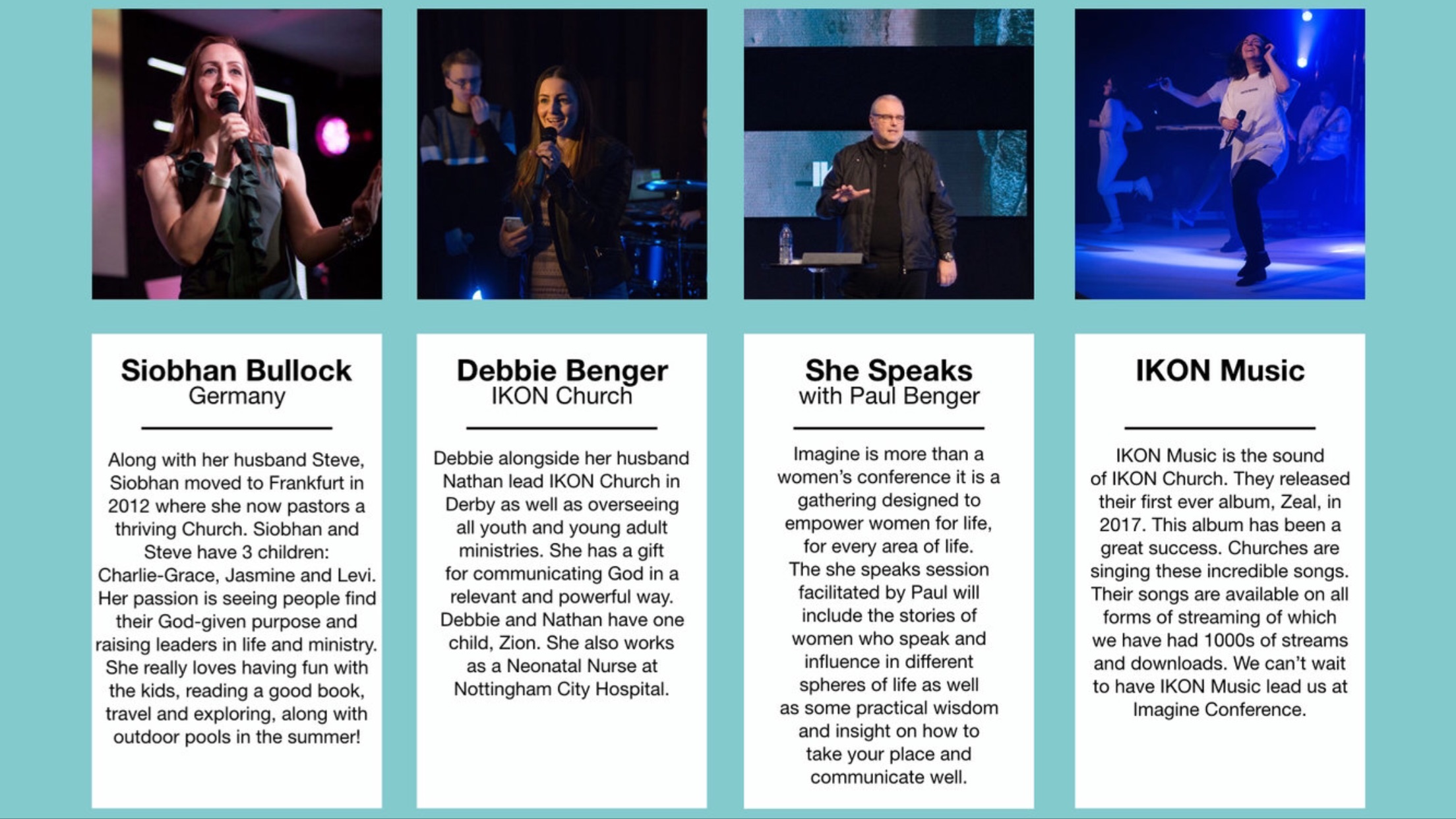
    “Wait a minute,” I hear you cry. “You are busy advertising your Imagine Women’s Conference on the 11-13th May and now you say you don’t do a women’s conference. What’s Going on?” Well, I’m glad you asked. Yes, imagine is a conference for women, its’ goal and design is to empower women for life. However, it is also designed to be so much more than a women’s conference, it’s designed to be a revolution.

    The facts are these:

    In Some Places Women Are Still Held Back

    And where that is true, and it is true in society but it is also true in the Church, we want to proclaim:

    This Is Not What Jesus Had In Mind

    It is also true that:

    In Some Places Women Are Only Partially Released

    Again, this is true in society but also in the Church. In society women still earn less than men and fill a small percentage of the most senior positions. In the Church they lead some ministries, women lead women, women lead children but often the possible release is still only partial. Where this is true we want to announce:

    This Is Not All That Jesus Had In Mind

    At IKON Church, and therefore through Imagine conference, we want to champion something far more positive and true than these positions. We want to:

    Model A Better Way

    And through modelling a better way we want to say:

    This Is Exactly What Jesus Had In Mind!

    In order to do that we need to fill the room. We need YOU to be in the room as  women to be empowered and as  leaders to be part of the conversation. Part of the solution. I’m urging you to be involved.

    This Matters! It matters because we cannot go another generation without seeing this problem fixed. Yes, we’ll deal with the objections and the opposition and we’ll answer or point to the answers for the tough questions. We’ll do everything with a spirit of grace and peace, but I also believe that together we will make a difference.

    Below is a little more information about the conference. I would love to see you there!

    6988F89F-AACF-4DF4-B8F6-5ECB32EF9815

    BOOK IN TODAY


    Conference Website:   IKON Church

  • SHAME OFF YOU
    • We carry shame around far too long, Jesus is trying to take shame off of us
    • Shame attaches itself to our lives because 1. Things we do 2. Things that are done to us…
    • You can have a positive God Filled future
    • You can know God’s best for your life you can hit mark of God’s will
    • You are made Holy in God’s sight through Jesus (NT saints)
    • You may have failed but you still have a future
    • Your choices will form your future
    • Shame is one of the main causes of low self-esteem – the reason people don’t feel good about themselves
    • Shame causes people to be aggressive – even abusive
    • When you are free from shame you live with new confidence & boldness
    • Shame is Part of a cycle
    • It is the reason some people don’t go to church or pray
    • Shame stays longer than it should – way after we’ve asked for God’s forgiveness
    • Remember this – conviction will bring you closer to God, you’ll want to pray, want to be in church, shame & condemnation will drive you away, that’s not what God has for you

    Romans 8:1 no condemnation to those in Christ

    SHAME OFF YOU!!!

    ❤

  • The Top Four Things That Derail Leaders

    Here are the top 4 things that Derail leaders: (adapted from a book by perry noble)

    1. FEAR OF MAN (See Proverbs 29:25)

    “fear of man will prove to be a snare”

    It is IMPOSSIBLE to please everyone (Galatians 1:10)! We know we are dealing with “fear of man” issues when we:

    ● Feel the need to respond every time someone attacks
    ● Get our “major insight” from @ replies and Facebook comments
    ● Allow the comments we receive (usually online, or second hand) to dictate our mood
    ● Prepare a sermon and ask, “Is this going to make people feel comfortable”

    2. FAILURE TO ASK FOR HELP

    The difference between an Amateur and a Professional is… an amateur resents coaching a professional pays for it.

    One of the biggest mistakes a leader can make is to assume that being a leader means you must have all of the answers—and when you don’t have the answers then make something up.

    Being a leader means surrounding yourself with people who know what you do not know and then creating an environment where they are free to say what needs to be said.

    3. FEAR OF MAKING THE WRONG DECISION

    If you haven’t meased up at some point, then you’re not leading well. Leaders take risks, and with some risks come reward while others provide us with an “educational experience.”

    The tragedy in making a wrong decision isn’t actually in making the wrong decision but rather in the unwillingness to admit a decision was wrong and then do what it takes to make it right.

    4. COMPARISON

    I cannot tell you the number of times I have personally been paralysed as a leader because I would look at someone else and think, “I will never be as good as them; why should I even try?”

    I honestly think this is one of the main weapons the enemy uses in his arsenal of WMD’s! (Weapons of mass destruction)

    We should always learn from other leaders, but we must never allow the measure of our success as a leader to be based on how the Lord chooses to bless other people.

  • 10 Warning Signs of A Leadership Crash

    We’ve all seen the breaking news headlines. It’s yet another leader who’s crashed and burned with a financial scandal, an affair, or a struggle with addiction.

    The leader’s family is wrecked. The organization blows up. Millions of dollars are lost in the brand’s tarnished reputation. Everything falls to pieces.

    And these scandals happen so frequently to our political and corporate leaders that we tend to assume they’re the inevitable result of pressure or some character flaw.

    IMG_0294Former Pastor Dr. Stephen Mansfield specializes in helping companies get back on track after their leaders falter. And over the years, he’s seen the same risk factors for leadership crashes crop up again and again. These aren’t the kind of warning signs you might immediately think of. But when you hear them, they make complete sense. And they’re powerful.

    I’m convinced what Stephen shares here will save some lives.

    Even if you feel like you’re on sure footing today, take this list to heart and share it with your colleagues. It can help you stay healthy and well balanced as you grow in leadership.

    Warning Sign #1: Being Out of Season

    Ever made a commitment with your spouse that you’d only stay at a job for, say, 12 months — only to find, two years later, you still haven’t moved on?

    Then you know what it’s like to be “out of season.”

    It’s the first sign of a leadership crash, which Stephen describes as that feeling where “you know that you’re not where you’re supposed to be.”

    Stephen says it’s dangerous because

    “you’re not going to be doing [your job] well. You’re going to start pushing. You’re going to start stressing. You’re going to start medicating. You’re going to try to fix it.”

    And “fixing it” usually makes it worse. Your “fix” for the financial situation you’ve gotten yourself into ends up as tax fraud. Your “fix” for that marital strain is an affair with a colleague.

    In those moments, Stephen says, we must take a hard but necessary step:

    “Stop whatever you’re doing. Do whatever you have to do to stop the daily pushing on something that’s out of season.”

    To go back to the example of overstaying your commitment at a job: Go to your spouse and say, “I know I said I’d stay 12 months and I realize it’s been two years. I know it needs to end. Let’s talk about it.” It’s going to feel scary. But if you’re out of season now, that means there’s different, better situation out there where you’ll be “in season.”

    Warning Sign #2: Choosing Isolation

    The second sign of a leadership crash is isolating yourself.

    Now, we’re not talking about pursuing solitude. All my fellow introverts know there’s nothing wrong with taking a little time to yourself to recharge.

    The idea of isolation goes deeper. When you isolate yourself, you’re continually cutting yourself off from feedback from those who know and love you.

    When you isolate yourself, you’re continually cutting yourself off from feedback from those who know and love you. It’s a natural inclination when we’re hiding something, because we think people will figure out whatever our dirty secret is.

    What do you do? In Stephen’s words, you

    “find your best friend, sit them down, and say, ‘I’ve screwed up.’”

    Better yet, surround yourself with people who aren’t afraid to stand up to you in the first place. These are the kind of people who can call you on your bull and challenge you when they see you trying to distance yourself.

    Warning Sign #3: Defining Episodes of Bitterness

    If you’re scanning this post, stop and read this point. As Stephen says, for most leaders who have a crisis,

    “this is the defining issue almost more than anything on this list.”

    Every single one of us is vulnerable to bitterness. Nobody gets through life without a trauma of some kind. A romantic relationship that went sour. A parent who walked out. A cruel bully back in school.

    “The question,” Stephen says, “is whether we surrender our souls to it.”

    “Never succumb to the temptation of bitterness.” – Martin Luther King, Jr.

    Part of Stephen’s work in these leadership crashes is to figure out what happened. And in every scenario, he sees a leader who held onto some kind of bitterness or wound, allowing it to cycle and re-cycle in his or her soul.

    Until we resolve those issues of bitterness and recognize when they rear their ugly heads, they can creep in and fuel our actions.

    We’ve got to resolve those issues of bitterness or else they’ll come back and leave us vulnerable in ways we may not expect.

    Warning Sign #4: Evading Confrontation

    When we evade small moments of confrontation, we set ourselves up for a large-scale disaster.

    “If we don’t have small healthy confrontations and explosions,” Stephen explains, “we’re going to have the great big, huge ones that blow up our lives.”

    What does that look like in everyday life?

    It’s a quick correction you give your assistant. It’s a small word of advice to your child. It’s a short conversation with your spouse about something amiss you noticed.

    These small, regular confrontations help us fine tune what’s going on in our relationships. Without them, our frustrations mount and we end up with a big explosion.

    Some small examples from Stephen include:

    “Hey, that blog post doesn’t make any sense.”
    “Hey, you’re being silly.”
    “You were a little harsh the other day in that meeting. What’s going on?”

    As a leader, it’s your job to invite this kind of feedback. Ask people to confront you. In fact, Stephen even writes it into the job descriptions at his company.

    Warning Sign #5: Losing Trusted Friendships

    One of the first questions Stephen asks when he consults with an organization is “What’s the recent history with the leader’s friendships?”

    Why? Because, as he sees it,

    “Friendships always reflect the state of the soul and the state of the individual. And when it comes to crashes, we’re always talking about the soul.”

    Friendships always reflect the state of the soul and the state of the individual.
    In almost every circumstance where there’s a leadership crisis, there’s some kind of dysfunction or fall-out with a leader’s closest friendships.

    It goes right along with choosing isolation and evading confrontation, doesn’t it? To protect yourself from a crash, prioritize your friendships.

    Warning Sign #6: Forgetting Fun

    “Most people,” according to Stephen, “are living in overly scripted lives.”

    IMG_0295We spend our days barreling through our to-do lists, working out, finishing projects, helping out with the kids’ homework, getting the oil changed in the car, whatever — and we simply forget to have fun.

    If you’ve found that your favorite trips, hobbies, and diversions have faded away, pay attention to that.

    High achievers tend to trivialize fun because they feel like it’s expendable on a list full of other seemingly more pressing tasks.

    High achievers tend to trivialize fun because they feel like it’s expendable on a list full of other seemingly more pressing tasks. But fun is critical to our happiness because, according to Stephen,

    “fun is where you find yourself again. It’s where the creative energy, the imagination, the fun and the frolic comes from. It’s where rest for a certain part of your soul happens.”

    So fight for the fun in your life. Embrace it as a healthy part of life and leadership.

    Warning Sign #7: Perpetuating an Artificial Image

    IMG_0296These days, everybody self-brands and self-projects an image. We carefully stage our Instagram posts and set up Google alerts for our names. It’s crazy.

    In leadership, sometimes we build or gain a “brand” that’s larger than reality. And living under the pressure of that false branding is exhausting.

    As a result, Stephen points out,

    “a lot of these crashes are about people blowing up a world they don’t want to live in anymore.”

    After awhile, you feel like you can’t confess that artificial image. Nor can you live up to it. So you destroy it — with an affair or too many drinks or embezzlement or whatever the crisis is. It may be subconscious, but it’s the only way out that some people can see.

    Warning Sign #8: Serving the Schedule

    I just have to quote Stephen here because I think so many of us can relate to this one, especially if we lead a business or division:

    “We all look down at our iPhones and go, ‘I’ve got seventeen meetings today. What are any of them about? How did this get scheduled?’ When we lose the purpose for the schedule, but we’re just going through the schedule, that’s when numbness sets in. That’s when resentment sets in. That’s when a deadness of soul sets in, and always, that leads to these crashes.”

    In other words, you look at your day and can’t see the larger, strategic purpose behind it.


    Warning Sign #9: Building a Third World

    This is one of those “soft signs” you might not think of at first. But it’s so obvious once you hear it.

    One sign of a crisis is building a “third world” outside of your home and your office. For many, it’s a bar. An apartment in the city. A casino. Stephen says it’s the place we’ve created “so we can avoid the discomfort and the unhappiness of home and work.”

    The truth is, success changes you. And often times, leaders let themselves be changed without bringing their spouses and families along for the ride. As a result, they feel misunderstood at home, and that’s what drives them to create this third world where they can indulge their vices or simply be someone else.

    If you’re married, Stephen’s advice for you is to “stay in a position where you value the input of [your] spouse.” When your spouse understands your world, you’re much less vulnerable to go build another one.

    Warning Sign #10: Losing the Poetry

    What does it mean to “lose the poetry?”

    Stephen recounts a movie called Broadcast News in which the main character, who’s a news producer, gets up and sees if the day’s news can still make her cry. One morning, it doesn’t.

    That’s losing the poetry.

    Whatever your role, you got into it for a reason. You believed in something. You were passionate about a subject. You wanted to improve people’s lives. When you lose sight of that reason, when you lose the heart of what you’re doing, that’s losing the poetry. And when that happens, you’re inviting destruction to come in instead.

    What captured your heart in the first place? What lit you up and propelled you to want to achieve success in your field? Stephen says, quite simply, “Hang onto that. Keep it central.”

    So how can we build sustainable lives as leaders and protect ourselves from these kinds of crashes? Here’s Stephen’s advice:

    Keep it simple. That’s the main thing. What’s simple? Simple is you stay with the marriage you had. Simple is you spend time with your kids. Simple is that you’re constantly improving. Simple is you believe in what your people are doing. You believe in them, and you inspire them. [That] pretty much captures the majority of the reason people fail and the majority of the reason people are successful.

    Remember this stuff isn’t just important so that you don’t have a miserable life experience. It’s important because people are watching your story, and they’re learning from it.

  • Could Your Disadvantage Be Working In Your Favour?

    At the start of the 20th Century, Alfred Adler suggested the counterintuitive Theory of Compensation. His thesis was that disadvantages can often work to our advantage because they develop within us attitudes, strengths and abilities that would otherwise not appear. His theory was that as we compensate for those disadvantages we discover our greatest gifts.

    Adler studied Art students and discovered that 70% of those he observed had some form of optivcal anomaly. He cited Mozart and Beethoven as two among a number of history’s great composers who had degenerative traces in their ears.

    IMG_0291More current writers such as Malcolm Gladwell and Matthew Syed of spoken of similar findings. Ethiopia continually produces world class long distance runners and it has been clearly documented that a large part of the reason for this is what we might term their ‘disadvantaged environment.’

    Due to the poverty they experience reducing the lack of travel options open to them and then the environmental conditions of the region, people run a lot and develop breathing patterns and capacities to do so.

    Some years ago it was discovered that British number one table tennis player Desmond Douglas had the fastest reactions of all professional table tennis players at that time. The reason? As he was learning the game the only place he could practice, which he did for thousands of hours was a garage. The confined space of that garage meant he developed super fast reactions in order to get back balls that were hit at pace towards him.

    In these examples and many others success was achieved not in spite of the disadvantage but because of it.

    David and Goliath

    When David requests to take on the Philistine Champion Goliath in one of the Bible’s most famous stories everything we think leads us to believe he’s at a disadvantage. His weaponry is not as technical, he has no armour, in fact he is unable to wear armour, it’s just too heavy for him. He’s a teenager, Goliath is a seasoned champion, he’s a shepherd and a lunch carrier for his brothers, Goliath is a champion.

    But David has one thing in his favour, something he never thought of has being in his favour. He had the lonely task of remote shepherding in dangerous places. This experience and I am sure the fear of wild animals had meant he was an expert sling shot.

    He was never going to need to engage Goliath. Goliath would be dead well before he got anywhere near to David. David’s disadvantage was the reason he was successful against the giant because it developed in him the very skills and qualities he would need.

    So often the things that we perceive as disadvantages we. try to change.

    What if, the circumstances we are trying to change are the very circumstances God is using to change us?

    I love what the Apostle Paul says in 2 Corinthians 4:17

    For our light and momentary troubles are achieving for us an eternal glory that far outweighs them all.

    I know that in the midst of trouble or carrying a ‘disadvantage’ it can be hard to see, but God is sovereign and God is good! Even if he didn’t send it, he will use it.

  • The Image Of God

    At the start of the story is the tantalising phrase in Genesis 1,

    “God created man in his own image: In the image of God he created him.”

    Of course, it does not occur in a vacuum. It is the climax of the entire creation narrative. The Earth, which was formless and empty (verse 1), was first given shape and was then filled: with good things, initially vegetation and then animal life.

    Verse 26,

    “Then God said, ‘Let us make man in our image, in our likeness, and let them rule over the fish of the sea and the birds of the air, over the livestock, over all the earth and over all the creatures that move along the ground. So God created man in his own image, both male and female he created them.”

    Two points of reference

    In trying to understand what is implied here, I take it that there are two points of reference. Firstly, the Image of God marks us out from all other living creatures, which by implication are not made in the Image of God. Genetically, we may be almost identical to our nearest animal relative, the Chimpanzee, but spiritually we are poles apart. So we will gain insight into understanding what the Image of God means, if we explore the differences between mankind and the rest of the animal kingdom.

    The second point of reference is of course God himself, so we will also understand the meaning of being made in his image if we explore what he has revealed of himself – in nature, in scripture and most especially in Jesus Christ.

    The image of God in man therefore distinguishes us from all other animals on the one hand and shows our family resemblance to God on the other. I take it that the words ‘image’ and ‘likeness’ amount to the same thing. They are not referring to different categories but are intended to emphasise & clarify the central idea.

    This process leads us to focus on 6 distinctive characteristics of humanity. Firstly, we are…

    1) Creative

    Animals are wonderfully uncreative. They do not change the world they live in. The creativity we observe in them is instinctive. So birds build their nests but every year it has the same design. They never think to build on an extension, create a loft conversion or develop their skills. They just do the same old instinctive thing.

    God on the other hand has been creative beyond anything we can comprehend. Both science and the Bible testify that the entire universe came into existence – out of nothing! Our knowledge of the expanding universe traces everything that exists, including time and space, back to an unimaginably small ‘singularity’ which came into existence from nothing. A humanist put to me recently that we have a straight choice – to believe in an eternal universe that has always existed or an eternal God who created a finite universe. He was wrong. We do not have that choice.

    The idea that the universe is an eternal static entity died in 1929 when Hubble observed the Red Shift – a Doppler effect in light from distant galaxies – which demonstrated that the universe is expanding.  We haven’t always had the universe. It began – apparently out of nothing, some 13-15 billion years ago.

    Now human creativity is of a different order from God’s, not least because we lack his astonishing power, intelligence and artistry. But nonetheless, we have original, creative ideas.

    2) Intelligent

    The mind that lies behind the creation is reflected, albeit in small measure, in our capacity for understanding and rational thought. The psalmist wrote, “Do not be like the horse and mule which have no understanding but must be controlled by bit and bridle” (Ps 32:8–9). Human intelligence is unlike anything found in the animal kingdom. We ponder the meaning of our existence, the significance of our actions and the prospects of our destiny. Unlike animals, man is a thinker and capable of being instructed and growing in understanding.

    Some religious beliefs which are anti-intellectual and belittle our need to study and learn, have failed to see the wonder of who we are. Approaches to evangelism which diminish the proper place of argument and persuasion diminish the humanity of the people we would reach. The extraordinary Mind behind the Universe has given us minds to enquire, to reason and, as Kepler put it, “To think God’s thoughts after him”. So the apostle Paul urges that we should be “transformed by the renewing of our minds” to discern the will of God (Romans 12:2).

    But as the creation itself defies atheistic understanding, so too, human intelligence and self-consciousness also defies secular analysis. Peter S Williams’ book, I Wish I Could Believe in meaning is full of good things that are essential to the subject at hand.

    He quotes Jerry Fodor, a leading philosopher of the mind saying,

    ‘Nobody has the slightest idea how anything material could be conscious. Nobody even knows what it would be like to have the slightest idea about how anything material could be conscious.’

    He quotes another authority, Ned Block as writing,

    “We have nothing worthy of being called a research programme, nor are there any substantive proposals about how to go about starting one” (p 322).
    Researchers are stumped by the very thing that drives them – they cannot understand their own understanding.

    Philosopher J. Bubziszewski recalls the dilemma of self-understanding he experienced as an atheist:

    My mind, I supposed, was nothing more than the activity of my brain, my brain nothing more than a computational device. Of course, we do not experience ourselves as machines, but I told myself that we are machines under a double curse – the illusion of being more than machines and the desire for the illusion to be true. How a machine could suffer such things as desires and illusions deeply troubled me. In fact, all the phenomena of consciousness troubled me. I was troubled by the redness of red, the deliberateness of choice, the preciousness of my loves, the sense I sometimes had of exerting my will against an inclination – I was even troubled by the experience of being troubled. I knew that I could not fit these things inside the theory that I was a machine, and I knew that the intuition that I was more than a machine made a better fit with reality. To get around this fact, I told myself that a machine is something that I know, whereas a soul is something that I do not know – conveniently forgetting that I experience myself, unlike machines, directly…In a sense, I thought I did not exist.

    Eventually, Budziszewski came to a realisation,

    “I had reached my conclusions not because of the data but in spite of it.”

    3) Aesthetic

    IMG_0114Thirdly then, our capacity to appreciate beauty. Genesis 2:9, “The Lord God made all kinds of trees grow out of the ground – trees that were pleasing to the eye.” God is not only the great artist who made a beautiful creation but has made us in his image so that we can appreciate beauty.

    One of the best things in life is finding yourself with a view that just takes your breath away. It amazes me that those views are all around us all of the time.

    4) Moral

    Fourthly, we are moral. The creator God, the mind behind the universe, was the artist who designed a beautiful world and created mankind who could understand his moral character & purposes. Animals suffer from fear but as far as we can tell, they have no natural sense of guilt or awareness of good and evil choices. Yet our daily lives are dominated by such awareness.

    Human conscience is a major aspect of our humanity. We battle with evil within ourselves and witness it in others. We long for the good but find all too often that the good that we would do we don’t do, while the evil we know we should not do – we end up doing. Paul’s description of this dilemma in Romans 7 struck me with great force when I first read it in my late teens.

    The world is like that. Morality fits the facts and points us to an ultimate, absolute moral being. Yet without God, morality is merely an arbitrary code of mutually agreed manners for diners at the human lunch club, of no more significance than agreeing that we should not blow our noses at the table.

    5) Relational

    If we want to understand what people in general believe to be of central importance in their lives, we have only to read novels or watch Soap Operas. The dominant theme of human existence, reflected in stories the world over, is about relationships. In a word, Love.

    We may be confused as to what love is; we may reduce it to intense emotions or sexual functioning. We may keep love entrapped within the limits of the nuclear family. But life and love go together so closely that the breakdown of relationships is the single biggest cause of people wanting to commit suicide. We know in our souls that we were not made to live in isolation.

    “No man is an island.”

    But where does love come from? How do we discover what it is? Where are the deepest descriptions of it? Has the world found any better exposition of the meaning of love than in the life, teaching and passion of Jesus? No it has not; and Jesus was emphatic that loving our neighbour was the second commandment about love, not the first. As Augustine so powerfully expressed it:

    “You created us for yourself, O God, and our hearts will not rest until they find their rest in you.”

    We are made for healthy relationship with God, Self, Others & Culture.

    6) Spiritual

    So man is incurably religious. Until the 20th century, every culture in human history has been dominated by belief in a God or gods. In the last century, atheism was imposed upon much of the world – across China, the Soviet Union and much of Europe. The overthrow of Communism and Nazism has led those oppressed people to return to their religious heritage. In the free world, where the demands of Christian belief have been cast aside by post-modernity, we have seen the enormous rise of superstitions such as astrology, spiritism and magical charms. We are Spiritual.

    Jesus the ultimate image-bearer

    All these themes then challenge our humanity and ask us if we are really alive? Are we creative, thinking, artistic, moral, relational beings, who hunger after God? Are we growing on all fronts? Are we well-balanced individuals, giving proper attention to each area?

    Now an image is but a reflection of the original. Sometimes the image may be hazy and distorted. But it does not exist on its own. Beyond the image is the reality. The Image of God in us not only helps us to see who we really are, but also reveals God to us. But we are not left searching through a haze to find hints and images of the One who made us.

    Here’s the good news: the one in whose image we are made, has come among us and revealed himself.

    “No-one has ever seen God, but God the only Son, who is at the Father’s side, he has made him known” (John 1:18).

    Paul wrote:

    ‘[Jesus] is the image of the invisible God, the firstborn over all creation. For by him all things were created…For God was pleased to have all his fullness dwell in him…’ (Colossians 1:15–19)

    It is therefore not a coincidence that these major themes are themselves the best evidences for God. The argument from Creation, from Intelligence, from Beauty, from Morality, from Love, from our intrinsic Hunger for God and of course from the person of Jesus himself in his teaching, deeds, character, claims, death and resurrection are the major lines of argument for the existence of God.

    Check out the series we recently did in Church called IKON for more on this…