• 5 Big Wins From Creating A Culture of Trust

    For 15 years two Stanford Professors, James Baron and Michael Hannan, collected data and studied high tech start ups in Silicon Valley. They were intrigued to discover the five distinct cultures that were represented by the start ups and also to observe the performance of these distinct cultures over time.

    Here are the 5 Cultures

    1. STAR CULTURE:These companies hired people from the elite universities like Harvard etc. or high performance employees from successful companies. These companies had employee autonomy believing that the high skill/intelligence factor would turn into high performance for the company.
    2. ENGINEERING CULTURE: These companies hired predominantly problem solvers people who could find ways to do things.
    3. BUREAUCRATIC CULTURE: These companies ended up with lots of middle managers, long job descriptions, employee handbooks, lots of meetings, company handbooks, huge policies and procedures manuals. Things in these cultures were done ‘by the book’.
    4. AUTOCRATIC CULTURE: These companies established clear ways of working  but it was all to please the boss. ‘Do what I say and you get paid.”
    5. COMMITMENT CULTURE: These companies established a set of values that employees owned. Often in these cultures growth was initially slow. These companies were hesitant to lay people off, had a high value of people and high value in respect of training and development. This became a culture of mutual trust.

    RESULTS

    How did these companies perform?

    Star culture companies were some of the biggest winners however, unexpectantly, these companies also failed in record numbers.

    The only culture that was a consistent winner was the commitment culture

    • Not one of these firms failed
    • They consistently out performed every other type of culture in all meaningful ways. They were the fastest to go public. They were leaner (fewer middle managers). They knew their customers better.
    • The sense of Trust between workers was high. This meant that people actually worked together and stood together when they faced set backs.
    • They experienced a much higher level of psychological safety which meant greater agility. (Openness to change, willingness to experiment etc.)

    The Agile method, as this culture became known, pushed decision making to whoever was closest to the problem. Successful companies that have done this and found great success include: GM & Toyota partnership at the NUMMI car plant, Pixar, The FBI in their sentinel programme, Hospitals that adopt ‘lean healthcare’ methods.

    LESSONS: The 5 Big Wins from a Culture of Trust

    1. People are willing to swing for the fences more (experiment) when they know that they wont be punished for missing the ball.
    2. Potential is unlocked in people who are given authority and ownership.
    3. People follow instincts more when they feel empowered.
    4. People generate more ideas when they know that their ideas are welcomed and will not be ignored, even if they are not implemented.
    5. People thrive when they have a real sense that others have their backs.

    All of these 5 big wins are related to people (employees), perhaps it’s true that a company’s greatest assets are the people.

  • 7 Reasons Churches Get ‘Stuck’

    When you are a person of vision and wanting to see things move forward it can be the most frustrating thing in the world to feel stuck. This is true in every field of work and life. Helping to identify why you are stuck is a huge help. Here are 7 reasons why churches get stuck.

    1. They are governed by large siced leadership teams and many committees.

    Sometimes the  structure for decision-making can be so complex that It feels like we need a committee to finding people to serve on committees. Ideadly one leadership team with 7-9 people is best (follow the pizza rule. A decision making meeting is ideal when everyone can be served by having no more than 2 full-size pizzas that are shared) The goal is to get everyone else serving on a ministry team rather than participating in committee meetings.

    img_0210

    2. They don’t empower volunteers.

    The first goal is to get staff or key volunteers leading ministry teams rather than reporting to committees (see above). Once that shift happens, the next goal is get staff and key volunteer to start building volunteer teams to do the ministry. It’s not unusual, though, for staff to hold on to doing all the ministry in mid-size churches. Think children’s ministry. Think pastoral care. Staff need to begin equipping God’s people to do the work of the ministry. Pastors need a mind shift here. So many that I meet think I need a staff person to do this or that we need to re-look at Ephesians 4:11-12.

    3. They’re unwilling to address facility constraints.

    Sometimes those constraints happen because of limited seating for adults. More oftentimes, though, the constraints aren’t as visible because they impact guests more than they do people who are already connected to the church. Those hidden constraints may include lack of parking, welcoming and obvious entrances, children’s ministry space, adequate lobby space, clear directional signage and so on. The key question is to consider how is the guest experience impacted by our facility? Also remember when a space is at 70-80% capacity it is full. It’s time to add another service or increase the space.

    4. Children’s ministry doesn’t become a priority.

    Ironically, churches tend to hire a youth pastor before they hire a children’s ministry pastor. Part of the reason why is that they’re really only focused on babysitting kids. The better space and the stronger leaders are focused on adults and students. The challenge is that unless churches give their best to children’s ministry, they’ll never reach their parents. That’s one of the reasons why some churches have a chasm of missing 25 to 35-year-old adults.

    5. They haven’t identified their primary purpose and distinctives.

    Here’s the challenge. Once you start reaching more people, it’s very easy to continue adding programming. Before you know it, things become very complex with multiple ministries competing for volunteers, leaders, money, space, promotions, etc. Mid-size churches need to define their mission, vision and strategy. By doing this, they’ll be in a better position to begin focusing resources on the areas of ministry that define who they are as a church. It will create a filter for leaders to begin saying no more often. That focus will increase ministry effectiveness and leverage resources for greater impact.

    6. The quality of weekend environments doesn’t reflect the size of the church.

    For good or bad, as the size of the environment grows, so do quality expectations. Of course, the primary place this will be felt is with the worship service environment for adults, but the same principle will apply in every environment including children’s ministry, students, guest experiences, courselves and so on. With worship, though, there needs to be more intentionality around planning, preparation and execution. That includes not only the teaching but everything else that happens during the service.

    7. They don’t raise their own leaders.

    I alluded to this earlier, but many times churches don’t empower proactively. At this stage, it becomes more and more important that churches begin to appoint leaders rather than doers. You’ll need to focus on staff/key volunteers who can grow ministries and reach more people. That means support roles (assistants, bookkeepers, associate pastors, etc.) may have to wait. These become great opportunities for volunteer engagement or outsourcing. The priority needs to be finding staff/volunteer leaders who can build volunteer teams, build healthy ministries and build a strategy to reach new people.


  • HOW TO MAKE A SIGN

    How to make a sign

    This post appeared first on Sethgodin.typepad.com

    There it is, at every entrance to the terminal at LaGuardia, one of the busiest airports in the world:

    TERMINAL CLOSED
    FOR MAINTENANCE

    between 12:00 a.m.
    and 4:00 a.m.
    until further notice.

    Ticketed Passengers &
    Employees ONLY
    will have access
    to Terminal.

    A few questions on our way to fixing this:

    Who is it for?

    What impact will it have on everyone else?

    To the sign maker: Are you angry? Frustrated? Trying to teach people a lesson?

    What does it sound like when you read it aloud?

    and… is it clear?

    When I look at this sign, I wonder why it needs to say, “until further notice.” After all, aren’t all rules in place until further notice?

    And why say 12:00 a.m. when midnight is so much more clear?

    Do we really need to alert employees to this rule every day?

    Mostly, though, the headline is confusing (every person reading this sign for the first time is sure the terminal is closed right this minute, until they read the next line).

    Perhaps, then, it might be a better sign if it said:

    Hi. To keep this terminal clean, it’s closed
    to visitors from midnight until 4 a.m. every night.
    Ticketed passengers are always welcome.

    Thank you.

    Want more on this? Check out Dan Pink

  • REDIRECT – How do we change the stories that we live by?

    For centuries philosophers have known that it is not primarily what we observe that influences us the most. It is how we interpret and make sense of those observation that has the most powerful influence upon us. This is because our brains are CLARITY junkies.

    YOUR BRAIN AND CLARITY

    Basically, the brain is constantly trying to do two things:
    1. Keep Us Alive
    2. Conserve Calories

    One of the ways it conserves calories is by deciding where it will commit its resources, i.e. Brain cells. So, unless retrained, the brain will interpret things in the quickest possible fashion that brings some clarity so that it doesn’t have to waste any energy on what it views unnecessary learning. The challenge of this is that the Brain can only make these decisions based on what it already knows, what it is already used to. This is why change can be so hard for us, we fight a brain that initially doesn’t want to commit any energy to things because it is quickly and efficiently filing stuff away saying, “I’ve seen that before. i know how this works.”

    STORY THE REAL POWER BEHIND CHANGE

    Have you seen this picture?
    img_0042

    What is it? A Duck or a Rabbit? The answer is not necessarily either, it depends on how your  brain interprets it. Now here’s the interesting thing. If we see this picture on Easter Sunday 82% of us will say, “It’s a bunny.” However, if we see this picture on a sunday in October 90% of us will see the Duck first. What that reveals to us is that context or story determines how we interpret things.

    When something happens to us our brains try to make sense of it and the way that they do that is by connecting it quickly and efficiently to the bigger stories of our lives.

    Therefore we desperately need a healthy bigger narrative story for our lives, that will help us interpret things that happen to us in a way that aids growth and progress.

    Several studies have shown that people of faith tend to be happier on average than people who declare no faith. I believe that this is one of the main reasons. Their faith gives them a bigger, clear story that they are a part of and this helps them to find meaning for events and circumstances they may find themselves a part of.

    This matters because if we find ourselves or our friends, or people we are trying to help stuck in a negative, self-defeating cycle there is hope and that hope lies in changing the story. There are three main ways that this can happen:

    1. STORY EDITING

    Many people find themselves trying to just banish the effects that circumstances or perceptions or culture or actions have created for them. This often proves only mildly helpful at best. Story editing seeks to target the long standing narratives that are creating the negative and destructive perceptions

    Editing these personal interpretations is like changing the start of a movie. A delayed writing exercise has been proven helpful in this regard. That is, rather than writing immediately about our feelings or what has happened to us people who delayed their responses proved more able to give meaning and thereby, as they take a step back they can reframe what has happened to them. Sometimes, immediately putting down our thoughts, feelings and responses to circumstances actually reinforces harmful perceptions and can make healing more difficult.

    Susan Sontag wrote this:

    I write to define myself – an act of self-creation, part of the process of becoming.

    For people of faith, I believe that prayer can be powerful in this regard. Through prayer we find meaning and reframe our world into a world that has purpose, meaning and justice. We prophecy through prayer that our past does not determine our future. We may not always realise it but through prayer we are changing the story of our lives and the story of future generations.

    2. STORY PROMPTING

    Sometimes we need a nudge. There are times when we do not have the energy to edit our own stories as described above and therefore we need a prompt, a nudge.

    e.g. A group of college students who all performed worse than they expected at the end of their first year were divided into two groups. One group was given a 30 minute session about other students who had struggled in year 1 but had ended college with good grades. The session included statistics and testimonies. The results were that this group had less students drop out in YR2 than the other group and they also achieved better grades than those who didn’t have the lesson. They were given a nudge into a better story

    3. STORY WRITING

    We could call this ‘acting our way into right thinking’. I think that all of the approaches have some biblical foundation but that this accords very strongly with a biblical view take for example 1 Peter 1: 13 which says,

    “So prepare your minds for action and exercise self-control…”

    The idea here is that we act in a way consistent with the better story we are a part of and has we do we find ourselves being changed. Consistency in the same activities means that the brain becomes willing to expend resources in that direction.

    Aristotle believed this strongly, he said, “We become just by performing just actions – courageous by performing acts of courage.”

  • How To Preach and it Actually mean Something

    “It happens way too often: You’re sitting there in the audience, listening to someone talk, and you know that there is a better and great talk in that person, it’s just not the talk he’s giving.” That’s TED’s Bruno Giussani, a man who cannot stand seeing potentially great speakers blow their opportunity.

    The point of a talk is to say something meaningful. But it’s amazing how many talks never quite do that. There are lots of spoken sentences, to be sure. But somehow they leave the audience with nothing they can hold on to. Beautiful slides and a charismatic stage presence are all very well, but if there’s no real takeaway, all the speaker has done—at best—is to entertain.

    WHAT’S YOUR “THROUGH-LINE”?

    The number-one reason for this tragedy is that the speaker never had a proper plan for the talk as a whole. The talk may have been planned bullet point by bullet point, or even sentence by sentence, but no time was actually spent on its overall arc.

    If there’s no real takeaway, all the speaker has done—at best—is to entertain.
    There’s a helpful word used to analyze plays, movies, and novels; it applies to talks, too. It’s “through-line,” the connecting theme that ties together each narrative element. Every talk should have one.

    Since your goal is to construct something wondrous inside your listeners’ minds, you can think of the through-line as a strong cord or rope onto which you will attach all the elements that are part of the idea you’re building.

    This doesn’t mean every talk can only cover one topic, tell a single story, or just proceed in one direction without diversions. Not at all. It just means that all the pieces need to connect.

    Here’s the start of a talk thrown together without a through-line:

    I want to share with you some experiences I had during my recent trip to Cape Town, and then make a few observations about life on the road . . .

    Compare that with:

    On my recent trip to Cape Town, I learned something new about strangers—when you can trust them, and when you definitely can’t. Let me share with you two very different experiences I had . . .

    The first setup might work for your family. But the second, with its through-line visible from the get-go, is far more enticing to a general audience.

    HOW TO CRAFT A POWERFUL THROUGH-LINE

    A good exercise is to try to encapsulate your through-line in no more than 15 words. And those 15 words need to provide robust content. It’s not enough to think of your goal as, “I want to inspire the audience” or “I want to win support for my work.” It has to be more focused than that. What is the precise idea you want to build inside your listeners? What is their takeaway?

    It’s also important not to have a through-line that’s too predictable or banal, such as “the importance of hard work” or “the four main projects I’ve been working on.” Zzzzz . . . You can do better! Here are the through-lines of some popular TED Talks. Notice that there’s an unexpectednessincorporated into each of them.

    * More choice actually makes us less happy.
    * Vulnerability is something to be treasured, not avoided.
    * Education’s potential is transformed if you focus on the amazing (and hilarious) creativity of kids.
    * With body language, you can fake it till you become it.
    * A history of the universe in 18 minutes shows a path from chaos to order.
    * Terrible city flags can reveal surprising design secrets.
    * A ski trek to the South Pole threatened my life and overturned my sense of purpose.
    * Let’s bring on a quiet revolution—a world redesigned for introverts.
    * The combination of three simple technologies creates a mind-blowing sixth sense.
    * Online videos can humanize the classroom and revolutionize education.

    Barry Schwartz, whose talk is the first one in the list above, on the paradox of choice, is a big believer in the importance of a through-line:

    Many speakers have fallen in love with their ideas and find it hard to imagine what is complicated about them to people who are not already immersed. The key is to present just one idea—as thoroughly and completely as you can in the limited time period. What is it that you want your audience to have an unambiguous understanding of after you’re done?

    The last through-line in the list above is from education reformer Salman Khan. He told Chris Anderson the founder of TED.

    img_0205

    There were a lot of really interesting things that Khan Academy had done, but that felt too self-serving. I wanted to share ideas that are bigger, ideas like mastery-based learning and humanizing class time by removing lectures. My advice to speakers would be to look for a single big idea that is larger than you or your organization, but at the same time to leverage your experience to show that it isn’t just empty speculation.

    Your through-line doesn’t have to be as ambitious as those above. But it still should have some kind of intriguing angle. Instead of giving a talk about the importance of hard work, how about speaking on why hard work sometimes fails to achieve true success, and what you can do about that?

    Instead of planning to speak about the four main projects you’ve recently been working on, how about structuring it around just three of the projects that happen to have a surprising connection? In fact, Robin Murphy had exactly that as her through-line when she came to speak at TEDWomen. Here’s the opening of her talk:

    Robots are quickly becoming first responders at disaster sites, working alongside humans to aid recovery. The involvement of these sophisticated machines has the potential to transform disaster relief, saving lives and money. I’d like to share with you today three new robots I’ve worked on that demonstrate this.

    Not every talk has to state its through-line explicitly up front like this. There are many other ways to intrigue people and invite them to join you on your journey. But when the audience knows where you’re headed, it’s much easier for them to follow.

    When the audience knows where you’re headed, it’s much easier for them to follow

    Think of your talk as a journey that the speaker and the audience take together, with the speaker as the guide. But if you, the speaker, want the audience to come with you, you probably need to give them a hint of where you’re going. And then you need to be sure that each step of the journey helps get you there.

    In this journey metaphor, the through-line traces the path that the journey takes. It ensures that there are no impossible leaps, and that by the end of the talk, the speaker and audience have arrived together at a satisfying destination.

    Many people approach a talk thinking they’ll just outline their work or describe their organization or explore an issue. That’s not a great plan. Without a powerful through-line, a talk is likely to end up unfocused and without much impact:

    From the book TED TALKS by Chris Anderson
  • TWEAK – small things can make a big difference

    In 2010, Dave Brailsford faced a tough job.

    No British cyclist had ever won the Tour de France, but as the new General Manager and Performance Director for Team Sky (Great Britain’s professional cycling team), Brailsford was asked to change that.

    His approach was simple.

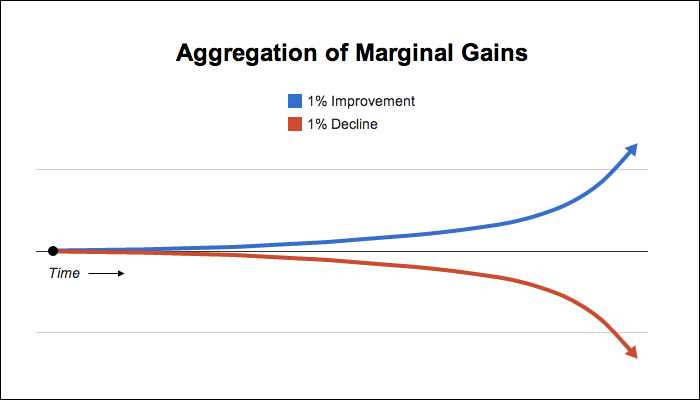
    Brailsford believed in a concept that he referred to as the “aggregation of marginal gains.” He explained it as “the 1 percent margin for improvement in everything you do.” His belief was that if you improved every area related to cycling by just 1 percent, then those small gains would add up to remarkable improvement.

    They started by optimizing the things you might expect: the nutrition of riders, their weekly training program, the ergonomics of the bike seat, and the weight of the tires.

    But Brailsford and his team didn’t stop there. They searched for 1 percent improvements in tiny areas that were overlooked by almost everyone else: discovering the pillow that offered the best sleep and taking it with them to hotels, testing for the most effective type of massage gel, and teaching riders the best way to wash their hands to avoid infection. They searched for 1 percent improvements everywhere.

    Brailsford believed that if they could successfully execute this strategy, then Team Sky would be in a position to win the Tour de France in five years time.

    He was wrong. They won it in three years.

    In 2012, Team Sky rider Sir Bradley Wiggins became the first British cyclist to win the Tour de France. That same year, Brailsford coached the British cycling team at the 2012 Olympic Games and dominated the competition by winning 70 percent of the gold medals available.

    In 2013, Team Sky repeated their feat by winning the Tour de France again, this time with rider Chris Froome. Many have referred to the British cycling feats in the Olympics and the Tour de France over the past 10 years as the most successful run in modern cycling history.

    And now for the important question: what can we learn from Brailsford’s approach?

    The Aggregation of Marginal Gains
    It’s so easy to overestimate the importance of one defining moment and underestimate the value of making better decisions on a daily basis.

    Almost every habit that you have — good or bad — is the result of many small decisions over time.

    And yet, how easily we forget this when we want to make a change.

    So often we convince ourselves that change is only meaningful if there is some large, visible outcome associated with it. Whether it is losing weight, building a business, traveling the world or any other goal, we often put pressure on ourselves to make some earth-shattering improvement that everyone will talk about.
    Meanwhile, improving by just 1 percent isn’t notable (and sometimes it isn’t even noticeable). But it can be just as meaningful, especially in the long run.

    And from what I can tell, this pattern works the same way in reverse. (An aggregation of marginal losses, in other words.) If you find yourself stuck with bad habits or poor results, it’s usually not because something happened overnight. It’s the sum of many small choices — a 1 percent decline here and there — that eventually leads to a problem.

    img_0203

    In the beginning, there is basically no difference between making a choice that is 1 percent better or 1 percent worse. (In other words, it won’t impact you very much today.) But as time goes on, these small improvements or declines compound and you suddenly find a very big gap between people who make slightly better decisions on a daily basis and those who don’t. This is why small choices don’t make much of a difference at the time, but add up over the long-term.

    What we understand from this is the power of scheduling. How small incremental additions or changes can make a huge difference

    The Bottom Line

    Success is a few simple disciplines, practiced every day; while failure is simply a few errors in judgment, repeated every day.
    —Jim Rohn

    You probably won’t find yourself in the Tour de France anytime soon, but the concept of aggregating marginal gains can be useful all the same.

    Most people love to talk about success (and life in general) as an event. We talk about losing 50 pounds or building a successful business or winning the Tour de France as if they are events. But the truth is that most of the significant things in life aren’t stand-alone events, but rather the sum of all the moments when we chose to do things 1 percent better or 1 percent worse. Aggregating these marginal gains makes a difference.

    There is power in small wins and slow gains. This is why average speed yields above average results. This is why the system is greater than the goal. This is why mastering your habits is more important than achieving a certain outcome.

    Where are the 1 percent improvements in your life?

    This post is a variation of the post “The aggregation of small gains” that appeared on Jamesclear.com
  • 10 Facts About First-Time Visitors to Your Church

    Here is something I recently shared with our staff at Christian Life Church: I have modified it slightly to share with you…hope it helps!

    1. You will have more than you think:
    2. Many are going through situations that mean they are responsive to God:
    3. First Impressions Matter: How easy is it for them to find the information they need (kids ministry, toilets etc.)? How good/genuine is the welcome? What is the atmosphere like?
    4. They are coming to you!!! (Bonus)
    5. Their visit could represent years of prayer by a church member.
    6. They will talk about their experience: statistics say between 8 and 15 times.
    7. Host teams can make a huge difference:
    8. We are to love strangers: Treating people well is one way we do that.
    9. When you invest in hosting and welcoming first-time visitors you are investing in every ministry within your church: Everything God has for the future of your ministry will come in the package of a first-time visitor.
    10. Visitors keep the air fresh: Do everything you can to create a culture of seeing more.
  • Met Mark several yeas ago and I love his work. Check out this from his blog.

    For the most part, our lives are defined by our relationships. And the joy of life is often determined by how well we function in those relationships. Yet ironically, this is the area of life we get the least amount of training and instruction in!

    As life unfolds the number and type of relationships we have increases greatly. As a child we have our  and a few school friends. As we go through life many different relationships are added…girl friend, boy friend, spouse, children, bosses, employees, employer, grandchildren, business partners etc.

    There is no doubt we need as much help as we can get to prepare us for life’s complexities in this arena!

    I believe there are two main areas we need help in: the skills in relating and the spiritual foundations of relationships. It is of course a very valuable exercise to get as much “up-skilling” as we can but my purpose in this article is to address the fundamental “spiritual” elements. A certain amount of relationship issues can be handled by learning skills; however most of it is best managed by continually applying the foundational principles and truths of God’s Word.

    Here are 6 key scriptural fundamentals that help us build a good foundation for how we should relate to one another:

    1. We are all flawed

    In 2 Corinthians 12:9-11 we get an insight into Paul’s revelation from Christ that he is not after perfection…because his power is made perfect through our weaknesses and it is his grace that we need. As we accept our own weaknesses we can accept the weaknesses in others. This then gives us a grace for others.

    People “feel” this grace from us because they know they don’t need to “be” or “act” perfect around us. Strangely it makes us more desirable to be around. People feel better about themselves in your presence!

    If you relate with others on the basis that we are all flawed and all have weaknesses, you will connect better with people. You will be humble and not proud in your dealings with them.

    I’ve also discovered that being on an equal footing with all others brings respect and grace into relationships.

    2. Learn to forgive and forget

    One of the most destructive forces in relationships is when we don’t let go of offences committed against us. Offences are inevitable, so unless we learn how to forgive AND forget, we will always be in conflict with the people we are closest to.

    Forgiveness is both central to the gospel and a core principle to the way the kingdom of God operates. In Matthew 6 when Jesus is teaching the disciples to pray, he includes our need to ask God to for forgiveness, and then immediately connects it with our need to forgive people who have offended us. Here we see that the two directions of the cross are connected and inseparable. The vertical part of the cross represents our forgiveness before God. The horizontal aspect of the cross represents our forgiveness of others. The first part of Ephesians 2 (verses 1-10) is about God’s forgiveness of us and the second part of Ephesians 2 (verses 11-18) is about the breaking of hostility between us and others…the second and just as vital aspect of Christ’s crucifixion! In fact I would suggest the first is of no consequence unless we can live out the second!

    Once we have the revelation and the habit of forgiving others as11a pattern in our lives, our relationships will become a lot “sweeter” and far less traumatic!

    Jesus led the way when he forgave the soldiers who were crucifying him (Luke 23:34) by showing us that the highest level of forgiveness is to forgive those who don’t even know they have offended you!

    3. Have faith in others

    1 Thessalonians 5:11
    Therefore encourage one another and build one another up, just as you are doing.

    Probably the greatest “fuel” of our relationships is encouragement. When you love someone, you encourage them. When you have faith in someone, you encourage them. When someone you know is discouraged, you encourage them.

    One of the keys for our relationships to flourish is to put faith in, hope in, and encouragement towards those we are doing life with. People are like emotional tanks on legs. As we live life our tanks are quickly drained; having a spirit of encouragement fills up the tanks of those around you. It’s almost impossible to give people too much encouragement!

    4. Be firm in your identity

    When you are secure in your identity before God, you can be relaxed and humble in your dealings with others. You are confident and can relate freely which will release others. Insecurity leads to actions that cause tension and the break down of relationships. In Philippians 2:1-8 we are encouraged to follow the example of Jesus who although he was God did not consider equality with God something to be grasped! He laid aside his status and humbled himself as a servant. What an amazing example of being secure enough in who he was to lay it aside for the sake of others!

    When we are secure in who we are in Christ we don’t have to prove ourselves to others. We are not in a relationship to get acceptance but to give it. This makes a significant difference in the platform that the relationship is built upon. You are able to put yourself and your ambitions aside and instead be helpful to others. You are free to not cling on to your rights and privileges.

    People wanted to be around Jesus. Why? He knew who He was, He was humble, and he focused on the needs of others.

    5. Be aware of the fight for relationships

    Ephesians 6:12
    For we do not wrestle against flesh and blood, but against the rulers, against the authorities, against the cosmic powers over this present darkness, against the spiritual forces of evil in the heavenly places.

    Every relationship will have a fight. You can either fight in it, or fight for it. We generally don’t see the devil’s schemes (Ephesians 6:11) directly and openly. These “schemes” usually come through the relationships in your life via tension, conflict, confusion and communication breakdown. We need to understand that our battle is not against people but against the forces that are trying to breakdown relationships in our world. Once we begin to fight for people, rather than seeing them or their behaviour as our enemy then we can start to create a spirit of unity and peace that will enhance our lives!

    Nehemiah 4:14
    And I looked and arose and said to the nobles and to the officials and to the rest of the people, “Do not be afraid of them. Remember the Lord, who is great and awesome, and fight for your brothers, your sons, your daughters, your wives, and your homes.”

    Always ask for God’s will and wisdom to overcome when there is conflict or confusion. Fight for your families, homes, church family and community.

    6. In my Father’s house

    One of the major keys to maintaining great relationships is building them within the right context. I believe the best context is the house of God. When we live under the covering of our pastors and in the Christ-centred community of the church, then we have a protection and grace that is not found outside of that community.

    Too often I’ve seen people forsake their connection with the house of God for some other priority in their lives. Jesus himself placed his Father’s house as a priority and in doing so challenged even his own parents who had lost him and were searching for him for three days! When he was found in the temple, his response was: “Why were you looking for me? Did you not know that I must be in my Father’s house?”

    When we place the seeking of and the commitment to the house of God at the top of our agenda, blessing and favor gets on our relationships. People often ask us why our kids are blessed and doing well. As much as I’d like to say it was our amazing parenting skills, I must admit it probably has been our commitment to the house of God that has created the environment for them (and all of us) to live under the blessing from God!

    MARK KELSEY

  • 20 Good Books I Read in 2016
  • Vive la Révolution!

    I LOVED THIS SO MUCH I HAD TO REPOST

    Vive la Révolution!
    Brian Zahnd

    Pagan astrologers read it in the stars — a new king of the Jews had been born. And so the magi came from the Orient bearing their gifts and accidentally got tangled up with the current King of the Jews — a debauched and murderous megalomaniac named Herod who decades earlier had been made an imperial client king by the Roman Senate.

    Not long after that the death squads were breaking down doors and killing baby boys in Bethlehem.

    An angel got Mary and Joseph and the baby king out of town in the nick of time. And so the Holy Family became refugees seeking asylum in a foreign country in order to escape a violent regime in their homeland.

    All this was happening while Augustus Caesar was the Roman Emperor. The coinage of the Roman economy bore the image of the “august” Caesar with imperial titles like, Son of God, Savior of the World, King of Kings, Prince of Peace. Sitting in his palace on Palatine Hill, Augustus could never have imagined that in less than forty years these titles would be re-appropriated for a Galilean peasant who had suffered a state sponsored execution under the jurisdiction of a Roman governor. Much less could Caesar Augustus have imagined that within a few centuries millions of people throughout the Roman Empire would pledge their allegiance to the crucified Jesus of Nazareth, calling him the risen King of all kings.

    But that’s what happened.

    If this all sounds very political, you’re right, it was…and it is.

    The baby Jesus didn’t become a refugee fleeing a despotic regime for spiritual reasons, but for political reasons.

    Jesus the Messiah wasn’t executed by the Roman government for spiritual reasons, but for political reasons.

    The early Christians weren’t persecuted by the Roman Empire for spiritual reasons (Rome was remarkably tolerant of religions), but for political reasons.

    The seminal Christian confession of “Jesus is Lord” was not a benign spiritual platitude, but a subversive political claim.

    The intuition of King Herod and Pontius Pilate who persecuted Jesus at his birth and authorized his execution was correct — this single Jew posed a threat to the present world order. And so Herod attempted and Pilate succeeded in killing this single Jewish life. But the life that the principalities and powers persecuted with death, God vindicated in resurrection. Everything Jesus ever taught or did as he announced and enacted the government of heaven was endorsed by God on Easter Sunday.

    The Kingdom of God is not the disembodied bliss of a Platonic heaven, but God’s alternative arrangement for human society. Under the reign of King Jesus (whom Christians confess is Lord now, not Lord-elect) the poor are blessed, the sick are healed, sinners are forgiven, war is abolished, mercy triumphs over judgment, and love trumps everything. Of course the implementation of God’s alternative society does pose a serious challenge to the status quo. Jesus plainly said so. “Many who are first will be last, and the last first.” Such provocative rhetoric was enough to impel the very rich and the very powerful to conspire to kill Jesus. And thus Herod Antipas and Pontius Pilate became friends on Good Friday. (See Luke 23:12)

    But — even though the Kingdom of God is without coercion, persuading by love, witness, Spirit, reason, rhetoric, and if need be, by martyrdom, but never by force — to resist the Kingdom of God always leads to a self-inflicted Gehenna. Opposition to the Kingdom of Love is the highway to hell — not the retributive hell of an angry god, but the consequential hell of going against the grain of love. If God is love, then to oppose love is to hurl oneself into a godless abyss.

    Politics at its best is the pursuit of the common good and equal justice for all. Of course politics is all too prone to fall prey to the demonic pursuit of power. This was the third temptation of Christ — to pervert the pursuit of the common good into the demonic pursuit of power. Jesus overcame this most seductive of all temptations in the wilderness and embodied his fidelity to God all the way to his crucifixion at Calvary.

    Because I believe that Jesus died in fidelity to the truth of God and was vindicated in resurrection, I also believe in the revolutionary politics of Jesus. I’m not a Republican or a Democrat. I’m not a conservative or a liberal. I’m a revolutionary Christian. I believe the Sermon on the Mount is our Constitution and the Beatitudes is our Bill of Rights.

    As a follower of Jesus I am not permitted to dismiss Jesus’ command to care for the poor and love our enemies as “impractical in the real world.” No! The world of greed and war is a fake empire, a giant falseness, a colossal lie. The real world is the world of God’s unconditional love and infinite mercy — it’s what Jesus called the kingdom of God. So when a Roman governor in the grand fake empire asked Jesus if he was a king, Jesus affirmed that he was indeed a king and that his life bore witness to the truth of God — a truth that contradicted the grand lie of Rome at every turn.

    This is why, in the end, Herod and Pilate had to kill Jesus.

    And this is why, in the end, God overruled Herod and Pilate and all the principalities and powers by raising Jesus from the dead!

    The revolution began at Bethlehem.
    The revolution culminated at Calvary.
    The revolution continues wherever Christians dare to take the red letters seriously.

    Vive la Révolution!