• Proven Techniques for Developing Your Talent. Tip #1

    Some years ago I read the book “The Talent Code” by Daniel Cole. In that book Coyle dispels the myth that talent is intrinsic. rather he puts forth an argument that talent is developed and grown.

    He came to this conclusion by researching what he calls talent hot beds like:

    • A ramshackle Moscow tennis club that had, over the previous three years, produced more Top 20 women players than the entire United States.
    • A humble Adirondacks music camp where students accomplish one year’s worth of progress in seven weeks.
    • A San Mateo, California, inner-city charter school that, in four years, transformed a student population perennially ranked at the bottom of state math scores into one that scored in the ninety-sixth percentile.
    • A Dallas vocal studio that has, over the past decade, developed millions of dollars’ worth of pop-music talent.
    • A ski academy in Vermont with an enrollment of a hundred that has produced fifty Olympic skiers over the past forty years

    In the book The Little Book of Talent Coyle distils his findings into 52 tips. I made a short video about tip No.1 which is

    STARE AT WHAT YOU WANT TO BECOME

    Coyle discovered that people in talent hotbeds stare. They observe closely and intently people who are the leaders in their field. The short video below delves a little more deeply into this first tip.

  • 5 Characteristics of Movements

    It is common to hear about “movements” today. We may refer to our student/youth ministry, local church network or denomination as a movement.

    We want to see “movements to Christ” among unreached people groups and rapid reproducing “church planting movements” where today there are few disciples. Our hearts long for a “movement” across the Church prioritising the great commission as it was intended.

    God is building true movements around the world but we need to understand what they are.

    A professor from Fuller Theological Seminary, Dr. Bobby Clinton, has studied movements for many years. He not only studies Christian movements, but secular movements, religious movements of all kinds, historical movements, social movements, etc.

    His conclusion is that movements have similar characteristics no matter their type. There are commonalities that exist whether the movements surround an ideology or a ministry.

    There are five common commitments made on the part of those involved in a movement. These apply the same to a movement like communism or a movement seeking to outlaw abortion.

    We want to understand and embrace these five commitments as we work to see the “movements” developed, matured and spread across the Church globally.

    Clinton defines a movement as

    A groundswell of people committed to a person or ideals and characterized by the following important commitments.

    1) Commitment to Personal Involvement
    2) Commitment to Persuade Others to Join
    3) Commitment to the Beliefs and Ideals of the Movement
    4) Commitment to Participate In a Non-Bureaucratic, Cell-Group Organization
    5) Commitment to Endure Opposition and Misunderstanding

    Any movement toward seeing the fulfillment of the great commission requires each of these five commitments to be internalised by those pursuing it.

    We don’t participate in movements by standing on the sideline. We are either in or not in as there is very little middle ground.

    The Christian movement started in the book of Acts had each of these five in full effect. Those preclaiming Jesus as Lord are part of an incredible movement with committed roots.

    Like these five characteristics, Jesus calls us to a life of personal commitment and potentially embracing difficulty in order to follow Him in His movement.

    In order to work alongside Him as He works out His purposes in the earth, we need to be wholehearted in commitment to these characteristics.

    The most effective movements have been through those who not only bought into these five characteristics, but who did so with great zeal and sacrifice.

  • THEOLOGY: Who Killed Junia?

    Part 1

    “Greet Andronicus and Junia, my fellow Jews who have been in prison with me. They are outstanding among the apostles, and they were in Christ before I was.” Romans 16:7 (NIV 2011)

    Paul had already named women as coworkers in Romans 16 and would go on to name several more. Naming someone or giving them prominence in one way or another was a meaningful act in the first century. Paul names 25 people in this chapter, praising seven women and five men as being most crucial to his work and to the church. Women get most of the “high fives,” you might say.

    I had read the verse in question many times without giving much thought to what it meant.
    Frankly, I wasn’t wired to be an iconoclast and I generally accepted what my church taught without question for the first 30 years of my life. Still, I was bothered by a few things, including Paul’s statements on women in two seemingly isolated passages.

    When I first began wondering how to harmonize my church’s restrictions on women’s public participation in worship and ministry with some of the passages I found in scripture, I came across a mention of “Junia, a female, who was also an apostle,” and it startled me. Running back to Romans 16:7 I found the idea interesting, but my reading of the verse did not compel me to believe that it clearly stated that Junia was an apostle.

    I had several questions that needed to be answered:
    • Was “Junia” a female name?

    • Is this verse saying that Junia was an outstanding apostle or merely that she was esteemed by the apostles?

    • If this Junia was a female, could she have been in prison with Paul, a man?

    • Why were some Bibles printing the name as “Junias,” “Junius,” or “Julian”?

    I read several books on the subject but still had questions.
    So I was happy to find the book “Junia, the First Woman Apostle” by Eldon Jay Epp. Epp is Professor of Biblical Literature (Emeritus) at Case Western Reserve University and a former President of the Society of Biblical Literature (2003–4). He is the author of Studies in the Theory and Method of New Testament Textual Criticism (Eerdmans, 1993) and the editor of several works. That all sounds impressive, but what I liked was that he approached this subject like a scientist; He first gathered all the material out there and then looked through it. He made no conclusions until he laid out every fact at his disposal.

    He laid out some “introductory matters” like these:

    1. The name in Romans 16:7 was considered a female name in the early church by all writers “without exception.”

    2. Greek versions of the scripture continued to spell it as a female name with the exception of Alford in 1852 and didn’t even note that it could be a male name in the appendix until Weymouth in 1892.

    3. Early translations such as the Old Latin, Vulgate, Sahidic, Bohairic Coptic, and Syriac versions spell it as a feminine name.

    4. English translations read it as “Junia” until the last part of the 1800s when it was suddenly changed to a male name “Junian” or “Julian” or some variation.

    5. While some believe that this was a nickname for the male name “Junias”, Junias never appears as a name in the first several centuries after Christ and, therefore, wouldn’t need a nickname form.

    One of the first collectors of manuscripts was Erasmus, who was able to secure rare and previously unavailable documents from all over the known world. He made a note on this passage that all manuscripts agreed that this was both a woman and an apostle – a highly esteemed apostle. When Epp finished his own manuscript gathering he concluded:

    “Junia” occurs in all Greek manuscripts except for five that have a variant of another kind, namely, “Julia”. But Julia is clearly a woman’s name – the most popular by far of all names in Rome…How, on any scheme, then, did scholars get to a masculine term and to a man Junias?” (Epp, p.31)

    I do not want to go into what the word “apostle” meant¹. Clearly, there were more than twelve apostles as Matthias was added when Judas committed suicide. Paul was added later, as were others. Some go to Paul’s defense of his apostleship in the books of Corinthians and try to backwards engineer a definition, but there are times that the word is used to mean “messenger” or “leader” or “emissary” as well. Regardless, it is clear that Andronicus and Junia are leaders in the early church…or at the very least, highly esteemed by them.

    Chrysostom raved about Junia in his comments on this passage.

    “To be an apostle is something great. But to be outstanding among the apostles – just think what a wonderful song of praise that is! They were outstanding on the basis of their works and virtuous actions. Indeed, how great the wisdom of this woman must have been that she was even deemed worthy of the title of apostle.” (in ep. Ad Romans 31:2; PG 60.669-870 as quoted by Epp and Pederson).

    I find it striking that Chrysostom has such effusive praise for Junia when he wasn’t keen on women in general (massive understatement) and because he was writing in the late 300s/early 400s when Junia was STILL considered a female apostle in the early church.

    So what changed?
    Martin Luther (who, if you remember, said that the purpose of women was to bear children and if they died in childbirth, so what?) translated the Bible into German, following a translator named LeFevre who had changed “Junia” into “Juniam.”² (Ed. Note: please see clarification below.) His translation was as influential in Europe as the King James Version was in the English-speaking world. From that point on, people took Luther’s translation and worked from it, never going back into the older manuscripts.

    What was LeFevre’s justification for this change? What was Luther’s? From what we can find so far – they had none. Perhaps they just couldn’t imagine a woman being an apostle (and in the 1500s that is understandable, although changing the text is not). So they made the change, assuming the texts were corrupted somehow. Voices were raised against this (Locke, Drusius, et al) but once Luther’s translation was out there, it steamrolled over anything in its path. (Interestingly, the KJV kept Junia as a female name.)

    Rena Pederson, a thirty year investigative reporter and editor for the Dallas Morning News, wrote the book The Lost Apostle: Searching for the Truth about Junia. She spent years and a great deal of retirement money interviewing experts in the Vatican and Oxford and all points in between. She is convinced that the villain here is Giles of Rome (1298), sometimes called Giles of Colonna or Aegidus Romanus. According to Pederson, he was the first to refer to Andronicus and Junia as “honorable men.”

    Giles changed “Junia” to “Julian” – and this is critical – assuming it had to be a male name since it belonged to an apostle.
    Giles served the popes, including the incredibly corrupt Boniface VIII, known for his rabid opposition to women in any position of power, secular or spiritual. He suppressed convents and took missions and teaching roles away from nuns, forcing them into cloistered lives. Boniface was in constant battle with another corrupt leader of the day – King Phillip IV of France. Phillip was the king who trumped up charges against the Templars, outlawed their order, and hunted them to the ends of Europe so he could confiscate their wealth. Each side had their theologians or lawyers to write defenses of what they wanted to do.

    Giles was charged by the popes he served to craft treatises of sufficient weight to give them license to do what they wanted to do. This is called “scholasticism” – deciding what you believe or do and then using scripture to gain the warrant for doing it. Boniface – whose adultery was so well known that he felt free to casually say that adultery was of “no more harm…than rubbing your hands together” – directed Giles to defend his edict stripping women of their place in the church. One of the ways he did so was to replace Junia with Julian, a male name.

    But Giles was not alone. This tale gets even more twisted, but that will have to wait until Part II. For now, I find it sad and interesting that Microsoft Word tells me that there is no word spelled “Junia.”

    It seems Giles, et al, were quite successful in silencing an early Christian leader…and half of the church.

    When it comes to figuring out who killed Junia (as in, “removed her from the record and changed her name to the male form”) we could pick any of a number of powerful men who added weight to the concept and value of male-only leadership.

    Part 2

    In Part 1 Pederson pointed us to Giles, a bishop who wrote theological treatises defending whatever Pope Boniface (a truly reprehensible human being) wanted defended. Giles (1243-1316) may have written the first arguments making Junia a male but he didn’t sway the majority of scholars of his day.

    Eldon Epp surveyed all collections of scripture available to us today and found that Junia remained a female with a female name until Alford’s 1858 edition of the Greek New Testament. Alford changed Junia to a male name but did not explain why in the notes to his text.

    Other versions of the Greek New Testament kept Junia female until Nestle’s text which, once again, changed the name into a male name without explanation. Epp was astounded to see that the earliest manuscripts, records of names in the first few centuries after Christ, and all translators other than Alford and Nestle indicated that Junia was a female AND an apostle.

    Why the change?

    We can sum up the entire argument against Junia being a female by referencing just one scholar – Joseph Barber Lightfoot. As the 19th century became the 20th, he wrote in his notes on this text that Junia MUST be Junias, or male, because Paul called her/him an apostle and only men can be apostles.

    That’s it.

    Since most translators in modern times use Nestle, Westcott, Hort, Barber, et al, they follow them in re-naming Junia “Junias.” Since 1970, this has sometimes been corrected as translators go back to the extant manuscripts and bypass the homogenized, collected, and edited editions by scholars of the late 1800s. When Epp published a chart of which translation had Junia as female and which named her Junias/Junian/Julian (sometimes with alternate readings in the notes, often without them), my jaw dropped at how clear it was that sabotage and assumptions, not Greek or history, killed Junia.

    Epp lists manuscripts and collections all the way up to Baljon (1898) and they all have Junia as female, except for Alford (1858). That is 31 authoritative editions of the Greek text against 1.

    Epp then traces editions from Nestle (1898) to the United Bible Society’s 3rd printing of 1998. It was the Nestle-Erwin edition of 1927 that changed Junia to male. The Majority Text compiled by Hodges-Farstad (1982) changes her back to female.

    Epp then searches English versions of the New Testament from Tyndale (1525) to the New Living Translation (1996). He finds that Junia is female until the Dickinson version of 1833/7. The majority of English versions after this time refer to Junia by a male name until the New American Bible of 1970.

    Then, as if by magic, most English versions have her as female once again. That includes the New King James Version (the original had her as female also), New Century Version, New American Bible (1987), Revised English Bible, New Revised Standard Version, Oxford Inclusive Version, and New Living Translation.

    Those still listing Junia by a male name (with or without alternative readings in their notes) are the Living Bible (1971), the NIV of 1973, New Jerusalem Bible, The Message, and the Contemporary English Version. Epp makes a compelling case that the only reason these versions have Junia as male is because they rely on older Nestle texts, circa 1927, instead of doing the hard work of going into linguistics, history, and earlier compilations of the text.

    But there might be another reason.

    The power of women in the church was eroded heavily by early Christian Fathers whose misogynistic rants are embarrassing to read – truly cringe worthy. When Constantine organized the early church he did so with Roman eyes and attitudes. Men ruled Roman society so he assumed that was the only proper way to rule the church, ignoring the fact that there is no male or female, Jew or Greek, slave or free in the new community of faith. He ignored the daughters of Philip, Dorcas/Tabitha, Junia, Julia, a slew of Marys, Priscilla, Phoebe, and more.

    Then came Giles and Pope Boniface who stripped nuns of their powers and authority in the church, shoving them into a cloistered, separate existence.

    Martin Luther launched the Reformation but he was more anti-women than most priests of his day. He considered them nothing more than child-bearers, incubators for men’s seed.

    Victorian England made male and female roles even more rigid and defined by “decency” and “acceptable standards.”

    The American South enthusiastically championed those roles and attitudes. They became part of American fundamentalism and the text was changed to match the attitude of the times.

    When the New International Version first announced a translation that used inclusive language, Americans rebelled. Articles were written, sermons preached, and threats were made so that they abandoned their plans and published it only in Europe. It would take from the mid 1980s until 2010/2011 before they would republish the NIV using inclusive language in the US, not because the text didn’t support it, but because of opposition from the prevailing male culture of the church.

    It isn’t pretty…but it’s true.

    Even in the early church, some men were so heavily influenced by Greek and Roman attitudes toward women (not good!) that Paul’s endorsement of Junia and other women, calling them leaders, ministers (Phoebe, anyone?), and more would have been scandalous. So…many of them decided he couldn’t have meant that at all.

    Chrysostom believed Junia was female and an apostle even though he couldn’t stand women. But a few others, (Epiphanius, for example, who also thought Prisca was a man) called Junia “Junias” because they could not imagine a woman having any prominence or power in the church. They didn’t get their attitudes from Jesus or – I dare say – Paul, but from the dominant culture of the day. Scholars today agree that “Junias” did not appear in early Christian centuries as a name, male or female. It was bias and nothing more that caused Epiphanius and Origen to decide Junia was a man (and that they should change the name found in the text to a non-existent one).

    When I contemplate all I’ve read concerning these matters, I rejoice that God called us into a new community where the barriers are dropped and where we can all use our gifts to serve God, and I am troubled, wondering what cultural forces and assumptions are working on my attitudes and beliefs presently.

    Much more could be said…but I have probably said enough.

    I will simply say this: we are all ONE in Christ Jesus. Our chains are gone, we’ve been set free. Jesus thought that Mary, sitting at his feet in the traditional posture of a student of the rabbi, was in the right place even though that was unheard of in his day. Instead of creating more Marthas to stay in the kitchen and cook for the church, Jesus said they belonged with him – and the men – learning alongside them as equals.

    If it’s good enough for Jesus…

    Now that scholars agree overwhelmingly that Junia was a woman, those opposed to women in leadership have tried to make the case that she must not have been a “real” apostle. Scot McKnight (author of Junia is Not Alone) gives the broader picture and Suzanne McCarthy provides extensive documentation on the meaning of Junia being “outstanding among the apostles” in her Junia files.


    References

    ¹For an extensive study on Junia and what it meant to be “outstanding among the apostles”, see Suzanne McCarthy’s series on Junia, the Apostle.

    ²” Thanks to Suzanne McCarthy for this clarification: “Juniam” is the accusative case of the feminine form. What Luther did was place a masculine article “den” in front of “Juniam” and it is this article which indicates Juniam was masculine. He was quite right to use Juniam but he added a masculine article not in the Greek, because this is more colloquial in German to use articles. Why did he use the masculine article? That is the question. Clearly he had read some commentary that referred to Junias as a possible masculine name. The affair is complicated – the Greek manuscript has Iounian, an accusative case, in which the name is the object of the verb, and this could equally be masculine or feminine in form if the masculine name Iounias existed, which it didn’t. So the hypothetical set is this –

    Nominative form Iounia is feminine, and accusative case is Iounian.

    Nominative form Iounias is masculine and accusative case is Iounian.

    However, they are accented differently. In the 9th century AD accents started being used and the accent pattern for Iounian indicated that scribes believed she was feminine.”


    This is article first appeared on the Junia blog, author Patrick Mead.

    https://juniaproject.com/who-killed-junia-part-one/

  • 3 habits of influential people

    Growing up in a tiny, dot-on-the-map town in rural Missouri, Dale Carnegie was a “skinny, unathletic, and fretful” son of a pig farmer, writes Susan Cain in her book on introverts, Quiet. After observing a charismatic public speaker traveling through his hometown, Carnegie, despite his innate introversion and with much determination, became a speaking champion and leader himself. He eventually launched the Dale Carnegie Institute, devoted to helping businessmen overcome their insecurities. Though published in 1937, his book How to Win Friends and Influence People remains one of the best motivational books in history, addressing a question that’s core to everyone’s existence: How do you get along with people?

    Carnegie identified a few major recurring characteristics or habits of highly influential people, from Abraham Lincoln to Thomas Edison to Charles Schwab. Time-tested to this day by current leaders like Oprah Winfrey, these habits are still widely relevant and apply to practically every industry and relationship. Read on below to learn three fundamental traits in people who successfully handle others.

    They Don’t Complain, Criticise, or Complain.

    “When dealing with people, let us remember we are not dealing with creatures of logic,” writes Carnegie. “We are dealing with creatures of emotion, creatures bristling with prejudices and motivated by pride and vanity.” Criticism, he advises, can strike people’s emotions, causing them to give up—even driving them to suicide.
    “Any fool can criticize, condemn, and complain—and most fools do,” writes Carnegie. “It takes character and self-control to be understanding and forgiving.” Instead of condemning your children, your direct reports, your teammates, your family, or your friends, Carnegie says, “Let’s try to understand them. Let’s try to figure out why they do what they do. That’s a lot more profitable and intriguing—it breeds sympathy, tolerance, and kindness.”

    They Give Honest and Sincere Appreciation

    The big secret of dealing with people, Carnegie points out, is recognizing that everyone is driven by a desire to be important, to be appreciated, and to be great. This is echoed in the theories of many philosophers, from Sigmund Freud to John Dewey. Even Lincoln recognized this: “Everyone likes a compliment,” the president once began a letter.
    How we get our feelings of importance is one significant factor in what distinguishes us—for some it’s driving the latest car, for others it’s making an impact in our childrens’ lives, or it’s being recognized for our philanthropic efforts. Many people will go to great lengths (crime, insanity) to achieve this feeling, so “imagine what you and I can achieve by giving people honest appreciation,” Carnegie poses.
    As Charles Schwab, one of the first-ever millionaires in business, put it, “I have yet to find the person, however great or exalted his station, who did not do better work and put forth greater effort under a spirit of approval than he would ever do under a spirit of criticism.”

    They Arouse in the Other Person an Eager Want

    As Harry A. Overstreet wrote in his book Influencing Human Behavior, “Action springs out of what we fundamentally desire… and the best piece of advice which can be given to would-be persuaders, whether in business, in the home, in the school, in politics, is: First, arouse in the other person an eager want. He who can do this has the whole world with him.” For instance, Carnegie tells parents, “If you don’t want your children to smoke, don’t preach at them, and don’t talk about what you want; but show them that cigarettes may keep them from making the basketball team or winning the hundred-yard dash.”
    He advises, “The only way on earth to influence other people is to talk about what they want and show them how to get it.” The most influential people are those who can find a way to relate their own goals to another person’s perspective and personal goals, inspiring others to take action in their own self interests.

  • Cultures of encouragement are conducive to personal development. It’s an environment that can deal with failure.

    LEADERSHIP SETS

    longevity
    1. Your job is not to fill people’s cups but to empty yours:
    2. Yourself and your services are not the same thing: Jesus – John 2. You must be delivered from people before you can serve people. Your services are relatively limitless yourself is not.
    3. No one who leaves you, limits you: what does limit you is clinging to people who should go. Jesus never hung on to reluctant people. It is your destiny for people to leave you, there’s a miracle in who’s left…there’s a miracle in leftovers.  Don’t look for leaders, look for ingredients of leaders. Leaders don’t come fully formed they come in kit form. Look for fragments…courage, risk-taking, work-ethic, etc.

    pain management
    1. Don’t pick a dream beyond your pain threshold: you can’t have a million pound vision and a 50p problem.
    2. Pick your pain Hebrews 11:24: pain is  loud progress is quite. In pain we think no progress is being made.
    3. Plunder your pain: There is seed in every sorrow. Make pain give you what it owes you. Make your past pay for your future.

    enemy tactics
    1. If the devil can’t stop you he’ll distract you: you still move but wth weakened focus. Distracted is diluted. Pharaoh to Moses “men can go but leave women and children” Moses said No…comparison, conflict, success, failure, issues can distract.
    2. Not counting what counts: David counting fighting men. You are not defined by numbers. Money, popularity, size not the things that count. (Who told you it’s a barrier) Health, love, friendship.
    3. The fear of appearing ordinary: the narcissism of social media. 2Timothy 3:5 – people will be lovers of themselves…rooted in the never enough syndrome

    communication
    1. Great preaching does not build the church speaking about what matters does: A lot of spitting and shouting can give the appearance that something important is going on.
    2. Aim to grow people and not things:
    3. Address issues not behaviour. Tell us the cause…that empowers us

    personal reinvention
    1. You are not the same person thoughout your life:
    2: The next thing comes out of the next you: You have to keep figuring you out. Specialising is the gift of maturity. Young is not the time to specialise young  is the time to experiment. As you get older reduce your repitoire. You have to figure you out.
    3.Master transitions: transition is the 5th season, the season between seasons.  In the Dna of the soup (caterpillar soup) is the butterfly.

  • Lead Summit – Paul Scanlon 2

    Luke 7:1-10

    Jesus was amazed. What amazes Jesus is worth taking note of.

    THE CENTURION FACTOR
    Our resources are in Our Relationships
    When we only build relationships with people who are like us it is usually an ever decreasing circle.

    Build a wide circle of relationships. The centurion helped build the Synagogue…

    WHAT AMAZED JESUS
    – Man’s understanding of power not requiring presence
    – 1st time healing happens with Jesus not present

    Centurion factor is a kind of faith that gets God to do what no one knew that God could do, that God would do.

    God would rather walk down roads for your comfort than suggest a better way because this operates according to our faith and not God’s ability. What roads is God walking down that he doesn’t need to because we have limited him?

    The Centurion factor is a human being interrupting Divine intention. God calls us friends which means he’s open to our suggestions. WOW!

    Why did he do this for the Centurion? – The Centurion Asked!

    Who knew the Sun could stand still? Who Knew a Man could walk on Water? Who knew that sick people could be healed in a shadow

    Are we all just defaulting to asking for business as usual. We have to open up to the idea that God can do for us things we’ve never thought of. You will be surprised how little God will work with.

    John 20:30 – many miraculous signs which are not recorded here.

  • LEAD SUMMIT – Jurgen Matthesius 1

    God puts things in front of you to raise what is in you.

    Genesis 1:28
    Matthew 28:18-20 – this is the same plan as Gen 1:28… Just a different out working.

    Everything in the kingdom reproduces after its own kind
    Genesis 1:29 – everything I have given you everything you need – SEED
    However, you can’t take citrus seeds and grow them in Alaska. Culture/ Environment is key.

    Jurgen’s passion was to create people who passionately pursue Christ and purposefully produces Christ followers. We realised we needed a process.

    4 PHASES

    Connect: Connect to God, connected to people, connected to the vision of the church… In teachable is unreachable.

    Grow: HS baptism, Spiritual gifts, Motivational gifts, tithing

    Serve: You don’t need a gift of serving, you just serve. Genesis 14:14 (servants born in the house)

    Lead: through connect grow serve.

    In respect of our sin God doesn’t just concern himself with what – he knows the what but he also knows the why.

    Systems create Growth.

    God is an environmental God. He creates environments for growth, you can’t grow oranges in Alaska.

    BUILD SYSTEMS CREATE CULTURE…

  • LEAD SUMMIT 2016 – Paul Scanlon 1

    We should never attempt to grow the church we should be always be seeking to grow BIG PEOPLE.

    1 Kings 8:14-19
    It really mattered to God to let us know that David had the dream to build to build the temple in his heart although he was not the one who built it.

    image

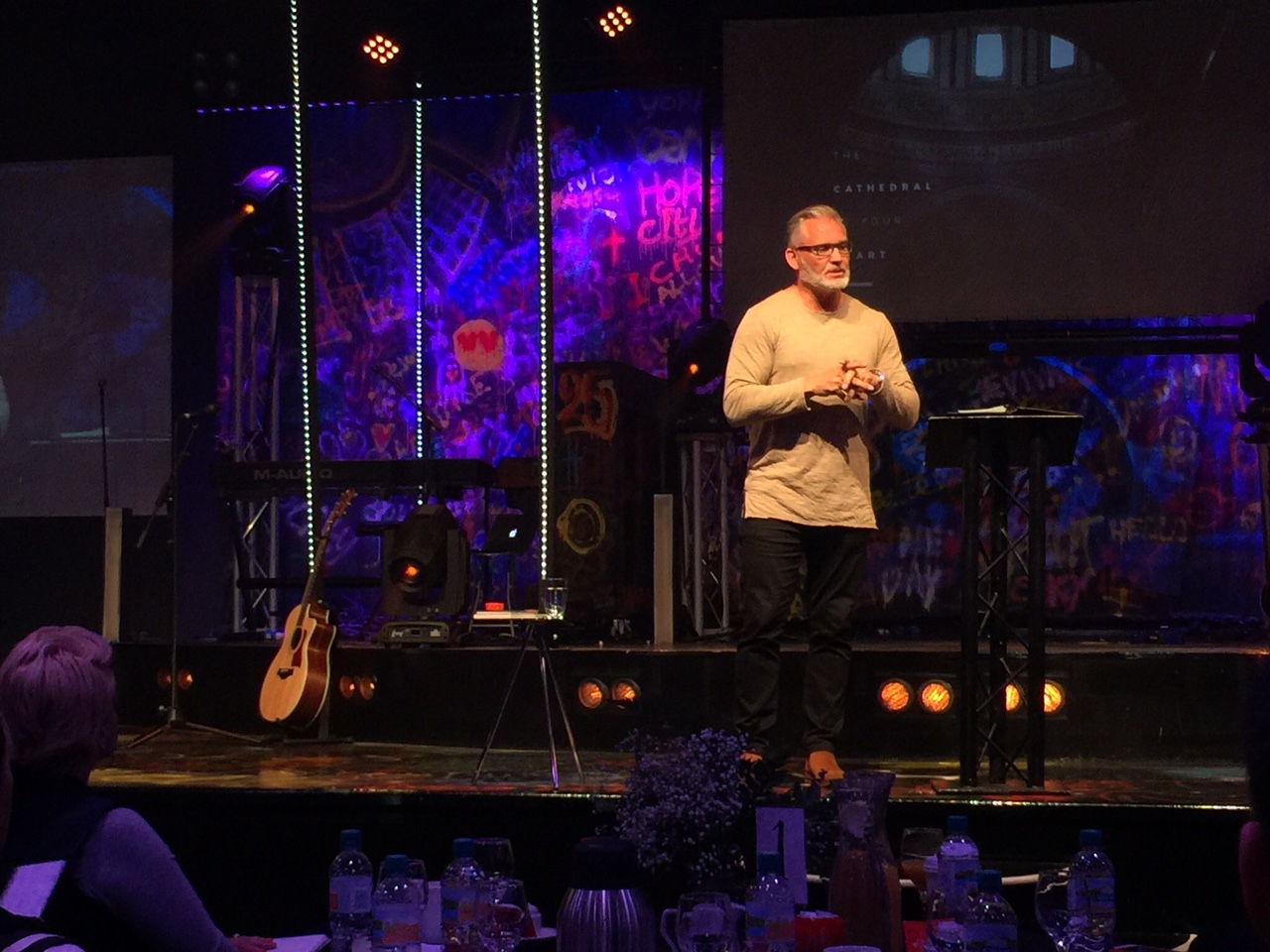
    THE CATHEDRAL IN YOUR HEART

    Cathedral’s took between 2-500 years to build. Society thrives when people plant trees under which their children will never sit.

    Many of us grew up with a “Final generation mentality”. – nothing good came from that theology. This theology is still here. It has taken on new clothes. It comes disguised in the immediate, live for now don’t build for the future ideologies in Church.

    A Cathedral sized dream means you will live and build and invest in something that you may or may not see within your own lifetime. We must re-examine our approaches and our language because we are creating inertia as we wait for revival.

    The big R should not stand for Revival but RESPONSIBILITY!

    How come we are always ‘going to’ the move of God. How come the “move of God” is always where I am not.

    The local Church is the greatest move of God! If you could GPS the address of God. You and I would show up. The local church would show up.

    If people would commit, give themselves, apply themselves – maybe then we could, in time, see something we might call a move of God.

    The greatest strategy for church growth is what I’m looking at. You!

    The problem in the church is not the lack of an outpouring of God, he poured out 2000 years ago, the problem is that we need an outpouring of you.

    Whatever God is going to do in the next 20years isn’t in heaven it’s in you!!!!!!

    God is saying it’s not my move…Peter said, “This is that.” Newsflash: It is still that!

    God will wait generations to find someone he can use… God is drawn to movement, God is drawn to motion. He will attach himself to unlikely people

    What is in your heart that you need to get out.

    History

  • This post was written by my friend Andrew Cherrie and edited by me. Andrew leads home Church in St Albans and will be one of the guest lecturers on our 2016/17 Internship programme.

    Ever wondered why now everyone is in a hurry to volunteer for your project or sign up to your team? The ones that do are wonderful people but sometimes just not the people you had in mind right…..? Here are 10 reasons the best volunteers don’t sign up and suggestions on how you might change change their minds.

    1. They are too busy.

    Simple but true. They are not sitting around wondering what to do with their time – they are passionate and motivated, busy changing the world. If you want these busy people to volunteer you may have to rethink what it means to volunteer on your team. Which do you value most – are you looking for ABILITY or AVAILABILITY?

    2. They didn’t notice the need.

    And because they are busy people they often don’t see the need. Not because they don’t care, just that they didn’t see. Great leaders help potential volunteers see and understand the cause and help them get involved. Leaders give people the Why…

    3. They think volunteering is not flexible enough for them.

    Flexibility is important for people with full lives. They need to know they are not going to let you down, they care enough not to commit at all if they felt that was going to be the case. As highlighted earlier, ability is often more valuable than availability – don’t make the mistake of treating everyone the same!

    4. The volunteer team is poorly led.

    The very best potential volunteers will only follow really good leaders. They’re looking for people of character and vision to get behind, not someone who will end up wasting their time and not some badly structured and unclear experience.

    5. You didn’t ask them.

    The best volunteers are often than not recruited. Ask them.

    6. When you asked them you didn’t convince them.

    You need to be convincing, passionate and most of all likeable if you are going to convince anyone to volunteer. Assuming that you’re going all out to recruit the best volunteers you can find, you’ll have to polish your pitch, know what you want and get your head in the game. If not, you’ll be left disappointed.

    7. They are looking for a cause not a job.

    Giving up valuable time is a big deal for everyone, more so if you’re already trying to negotiate a full week of work and family life. This is why they only thing that’s going to attract the best volunteers is a cause, not another task. Talk cause not task and they’ll get it. Here’s the why again.

    8. They are already leading on another team.

    Great potential volunteers are snapped up quickly by those who care and go after them. If you aren’t looking, and ready, you won’t recruit them.

    9. Your organisation skills and procedures are average.

    It will take the best to attract the best. How good do you organise the team and do you strive for excellence? It makes a difference, don’t underestimate the attraction of a spirit of excellence.

    10. Their last volunteer experience was a shambles.

    Unfortunately many people simply won’t volunteer their time because of a poor volunteering experience in the past. You can’t do anything about the past but applying some of the principles listed above, you may be in with a chance of changing their perspective of what it means to volunteer.

    If you are the leader of a volunteer team right now it’s time to change up the volunteer experience for everyone on your team. Think through the points above and find 3 actions points that you can adopt in the next 6-8 weeks.

    If you’d like more from Andrew check out http://www.leadershiplocker.com

  • It seems that every leader and organisation wants to be innovative. Innovation, as we all know, is crucial to the continuing success of an organisation.

    innovation

    But innovation is often misunderstood. It’s far more than just doing something new or novel. It’s doing something new or novel that advances our core mission. Otherwise it’s not a genuine innovation. It’s simply something new and different – and often becomes more of a distraction than anything else.

    Innovation takes more than a great idea and openness to change. It also needs adaptability, honest feedback, and a willingness to kill the sacred cow or to admit defeat.

    These are the three keys to serial innovation that most people who want to innovate never think about.

    Adaptability

    I find that innovation is a lot like an old Polaroid picture. It starts out fuzzy and becomes clearer over time. What appeared at first glance to be a telephone pole, sometimes ended up being a picture of a person.

    When it comes to innovation, few things end up as they were originally envisioned. Whether it’s in business, technology, finances, or ministry, hardly anything new ends up working out exactly as those who dreamed it up thought it would be.

    That’s why genuine innovation requires adaptability. We can’t force our template onto reality. The real world often refuses to respond in the ways that we’d like it to or expect it to. Adaptability and the willingness to make mid-course corrections are essential when it comes to innovation. Those who stubbornly stick to a course that isn’t working waste time, money, and energy; and worse, they squander their leadership credibility. The question is:

    What needs Adjusting?

    Evaluate Results

    As we’ve seen, just because something is new or has never been done before doesn’t make it an innovation. The better mousetrap that nobody buys may be an invention – but it’s not an innovation.

    That’s where honest feedback comes in. It’s crucial to continually step back and ask if our new idea or program is really working and accomplishing what we set out to do. Otherwise, we’ll end up with lots of new ideas, initiatives, and programs, but in actuality, be making little progress in the fulfillment of our mission.

    Every organisation has to ask, “Is this really working?  Without meaningful evaluation and honest feedback, we have no idea whether a project, a ministry, even the organisation itself is succeeding or failing. One thing I’ve observed over and over again is that the purpose for why a thing gets started can be changed if it fails to achieve what it was intended for. We have to be honest enough to evaluate and monitor so that we can keep mission focussed.

    Frankly, it takes a lot of courage to cut a program that appears to be successful but isn’t doing anything to advance the cause. But it must be done. If something is not actually meeting its predetermined goals, it needs to be cast aside. The question is:

    What should we be monitoring?

    Willingness To Admit Defeat

    A third hallmark of a truly innovative organisation is that it knows when to cut its losses. It doesn’t throw good money or good energy after bad. Unfortunately, admitting defeat is hard to do. So rather than cutting our losses when a great idea proves to be not-so-great when released into the wild, we pour more money into it or redouble our efforts in an attempt to keep a glaring failure alive.

    You’ve heard the old saying, “the definition of insanity is doing the same thing over and over again and expecting different results.” It’s true. When it comes to innovation, if something is not working, doing more of it won’t produce success. It will simply produce more failure.

    At the end of the day, innovative organisations know what they’re aiming at. When their results are close, but not quite spot-on, they make changes. They quickly adapt, making the needed midcourse corrections to put them back on target.

    In addition, they seek honest feedback. They aren’t afraid of the truth. They search it out. And then they respond in light of it. And when the truth is that great idea wasn’t so great after all, they admit defeat. They don’t put dead and dying programs on life-support. They give them a nice Christian burial and move on to the next thing.

    What needs a funeral?