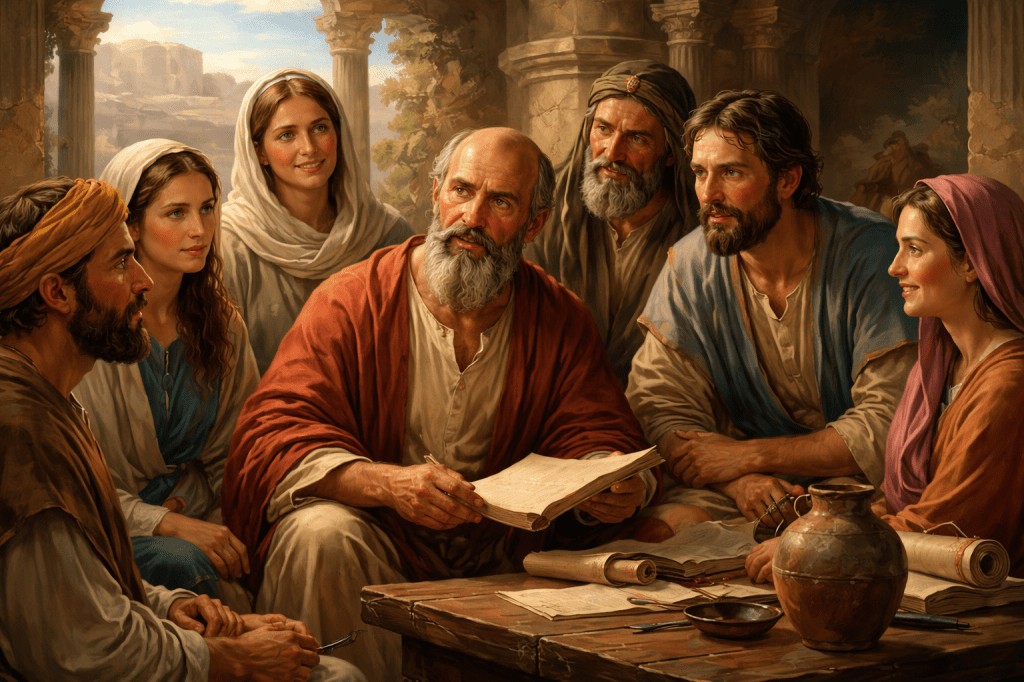
Paul the Team Leader
“Paul, an apostle of Christ Jesus by the will of God, and Timothy our brother.”
Two names. One apostle.
That line opens 2 Corinthians, and versions of it appear across Paul’s letters. Timothy gets named. So do Silas, Sosthenes, and others. But the pattern never varies: Paul names himself first, Paul claims the apostolic title, and the co-senders are introduced relationally — “our brother,” “servants.” They’re honoured, included, visible — but they’re not co-directing. They’re serving within a mandate that was given to Paul.
In my previous post, I made the case that Paul’s ministry was fundamentally team-based. That’s true. But here’s the necessary counterbalance: every team needs a leader, and in Paul’s case, there was never any ambiguity about who that leader was.
The Mandate That Shaped Everything
Paul didn’t volunteer for apostleship. He was conscripted.
On the Damascus road, Paul received not just a conversion but a commission. Jesus said, “I have appeared to you to appoint you as a servant and as a witness… I am sending you to open their eyes and turn them from darkness to light” (Acts 26:16-18). Paul understood this as the defining event of his life: “God, who set me apart from my mother’s womb and called me by his grace, was pleased to reveal his Son in me so that I might preach him among the Gentiles” (Galatians 1:15-16).
N.T. Wright makes a crucial observation here.
Paul’s theology, Wright argues, was not separate from his mission — it was his mission. His missionary mandate shaped the rest of his life, his writing included.
This wasn’t a hobby Paul pursued in between writing dense theology. The mission was the engine, and everything else — the letters, the teams, the strategy — served it.
This matters because it reframes how we understand every co-worker who joined Paul’s orbit. Timothy didn’t bring his own mandate. Titus didn’t have a separate commission. Priscilla, Aquila, Phoebe, Tychicus — were stepping into a mission that had been given to Paul by the risen Christ, and they were serving synergistically within it.
Gordon Fee puts it in pneumatological terms:
Paul’s authority wasn’t institutional — it was Spirit-empowered.
The Spirit had called and equipped Paul for a specific work among the Gentiles. Those who worked alongside him were participating in that Spirit-given mandate. They weren’t lesser. But they were following his lead.
Sent, Not Self-Sent
The practical evidence is hard to miss once you start looking.
Paul sends Timothy to Corinth — not with Timothy’s message, but with Paul’s: “He will remind you of my way of life in Christ Jesus, which agrees with what I teach everywhere in every church” (1 Corinthians 4:17).
Paul leaves Titus in Crete with specific instructions: “Put in order what was left unfinished and appoint elders in every town, as I directed you” (Titus 1:5).
Paul dispatches Tychicus to Ephesus “for the express purpose that you may know about our circumstances” (Ephesians 6:22). He rotates personnel — planning to send Artemas or Tychicus to replace Titus so Titus can come to him at Nicopolis (Titus 3:12).
This is not a flat team where everyone brings their own vision to the table. This is a team deploying, directing, positioning, and reassigning people in service of a shared mission — a mission that originated with Paul’s calling. The skills, vision and passion brought by others complimented and completed what was given to Paul.
Fee, in his commentary on the Pastoral Epistles, makes the vital point that Timothy and Titus were not local church pastors. They were apostolic delegates — extensions of Paul’s own authority into specific situations. When Paul wrote to Timothy and Titus, he was writing to churches through them. The “you” at the end of all three Pastoral Epistles is plural. These letters weren’t private correspondence. They were apostolic instructions delivered via trusted representatives who carried Paul’s authority into places Paul couldn’t physically be.
Eckhard Schnabel, whose work on early Christian mission is some of the most comprehensive modern study we have, makes a helpful distinction. Paul used the word synergoi — co-workers — primarily for his own missionary assistants. These weren’t independent apostles doing their own thing. Schnabel describes them as functionally “junior partners” whose work should not be seen as inferior to Paul’s, (important) but whose ministry was an outworking of a unified mission, not a separate enterprise.
The Leader Who Knew His People
Romans 16 is the passage that brings all of this together.
Over twenty-six individuals and several households are named in Paul’s closing greetings — the most extensive personal section in any of his letters. And far from being a polite social gesture, it’s a window into the way Paul led.
He recommends Phoebe as “a deacon of the church in Cenchreae” and a benefactor — entrusting her with carrying his most significant theological letter to Rome. He honours Prisca and Aquila as synergoi who risked their lives for him. He notes that Epaenetus was “the first convert to Christ in the province of Asia” — Paul tracked his converts and knew who belonged to his mission field. He acknowledges Urbanus as “our co-worker in Christ.” He names Tertius, the scribe who physically wrote the letter. He greets Gaius, whose hospitality supported the whole church, and Erastus, a city official within his network.
James Dunn observes that Paul’s language in Romans 16 reveals a carefully maintained relational hierarchy. Paul distinguishes between apostoloi (missionaries), adelphoi (brothers — equals), synergoi (co-workers), and tekna (his converts). These aren’t random terms. They reflect Paul’s awareness of his role relative to others and theirs relative to him.
This isn’t autocracy. It’s intentional, relational leadership — the kind where a leader knows every person’s name, contribution, and place within the mission.
Outstanding Among the Apostles
And then there’s Junia.
“Greet Andronicus and Junia, my fellow Jews who have been in prison with me. They are outstanding among the apostles, and they were in Christ before I was” (Romans 16:7).
The scholarly consensus on this verse has shifted decisively. Junia was a woman. Until the twelfth century, no one in the history of the church interpreted this name as masculine. John Chrysostom, writing in the fourth century, had no hesitation: “How great the wisdom of this woman must have been that she was even deemed worthy of the title of apostle.” The masculine “Junias” has no attestation in the ancient world — not a single inscription, not a single literary reference. The female name Junia, by contrast, appears over 250 times.
Douglas Moo, in his NICNT Romans commentary, argues that the Greek construction — episēmoi en tois apostolois — means “outstanding among the apostles,” not merely “well known to the apostles.” If Paul had meant the latter, Moo notes, he would have used different grammar. Wright and Dunn read it the same way.
Junia was not simply known by apostles. She was one of them — and an outstanding one at that.
Now, this isn’t primarily a post about women in ministry. But Junia’s presence in Romans 16 powerfully reinforces the argument about Paul’s leadership. Here is a woman — imprisoned for the gospel, recognised as outstanding among apostles, a believer longer than Paul himself — and Paul names her publicly, celebrates her, honours her.
He doesn’t minimise her. He doesn’t sideline her. And yet she, like Timothy, like Titus, like Prisca and Aquila, appears within the orbit of Paul’s apostolic network. She is greeted in his letter, to his intended mission field, as part of his relational web.
That’s what genuine apostolic team leadership looks like, a relational web. It doesn’t suppress the callings of others — even when those callings are outstanding. It amplifies them.
The Genius of Seeing What Others Carry
But here’s what separated Paul from a mere organisational leader: he didn’t just direct people — he saw people. He had an extraordinary gift for recognising what the Spirit had placed in others and deploying them accordingly.
Look at the evidence. Paul spots Timothy in Lystra — a young man spoken well of by the believers — and sees not a junior assistant but a future apostolic delegate who will carry Paul’s own authority into Corinth, Thessalonica, and Philippi (Acts 16:1-3). He describes Timothy as someone who “as a son with his father has served with me in the work of the gospel” (Philippians 2:22). That’s not a CEO managing an employee. That’s a leader who has identified the gift in someone else and drawn it out through relationship.
He sees Titus — a Gentile convert — and recognises in him the organisational strength and cultural intelligence needed to sort out the mess in Crete: “appoint elders in every town, as I directed you” (Titus 1:5). He spots Phoebe and entrusts her with carrying his most theologically significant letter to Rome — not because she was available, but because she was a prostatis, a benefactor and leader in her own right (Romans 16:1-2). He celebrates Junia as outstanding among the apostles. He names Prisca before Aquila — a detail that almost certainly reflects her prominence in ministry — and trusts them to teach Apollos (Acts 18:26).
In my book Empowered, I draw on Robert Clinton’s clustering of gifts into three categories: word gifts that clarify God’s nature, power gifts that demonstrate His presence, and love gifts — administration, helps, mercy, giving, hospitality — that manifest His heart in practical ways. Paul lists administration alongside miracles and puts helps next to healings (1 Corinthians 12:28). In God’s economy, there is no hierarchy of gifts — only different functions within the body.
Paul understood this instinctively. He didn’t just build a team of preachers. He built a team, driven relationally, that covered the full spectrum. Timothy brought pastoral sensitivity. Titus brought organisational steel. Phoebe brought financial strength and relational influence. Prisca and Aquila brought teaching depth and the gift of hospitality — their home was the church in several cities. Onesiphorus brought the gift of helps, searching for Paul in Rome and refreshing him in chains (2 Timothy 1:16-17). Even Tertius, the scribe, gets named — because the person who physically writes the letter is part of the team too (Romans 16:22).
This is what makes Paul’s leadership genuinely apostolic rather than merely autocratic. He retained authority. He carried the mandate. He made the hard calls — correcting Peter publicly at Antioch (Galatians 2:11-14), parting company with Barnabas over Mark (Acts 15:39). But he exercised that authority in a way that amplified the gifts of everyone around him. He didn’t suppress the callings of others to protect his own prominence. He fanned them into flame.
As I write in Empowered: “if it’s not a spiritual gift, it’s a spiritual discipline.” Paul modelled both. The gifts he didn’t carry himself, he recognised in others and released them to exercise. And the discipline of building a team that was stronger than any individual — including himself — was something he practised relentlessly.
Gordon Fee captures the heart of it: Paul was creating “a people for God’s name” — not building a personal empire. The mandate was Paul’s. The mission was shared. And the genius was in seeing what the Spirit had placed in each person and deploying them where they could flourish.
A Word for Today
The church doesn’t need more lone rangers with big platforms. But it also doesn’t need leaderless teams where nobody carries the mandate and everybody defers to everybody else.
It needs what Paul modelled: a leader with a divine commission who is simultaneously a genius at seeing the gifts in others. Someone who retains authority without hoarding it. Someone who deploys people not as assistants to their own ministry but as carriers of genuine, Spirit-given gifts that the mission needs.
Paul’s teams worked because he led them. But they also worked because he saw people — really saw them. He saw Timothy’s faithfulness before anyone else did. He saw Junia’s apostolic calling when the culture would have overlooked her. He saw that Phoebe could be trusted with Romans. He saw that the person making coffee and the person preaching the sermon were both operating in the power of the same Spirit.
That’s apostolic team leadership. Someone has to lead it. But the best leaders are the ones who see what the Spirit has placed in others — and build the team around it.
 Paul Benger