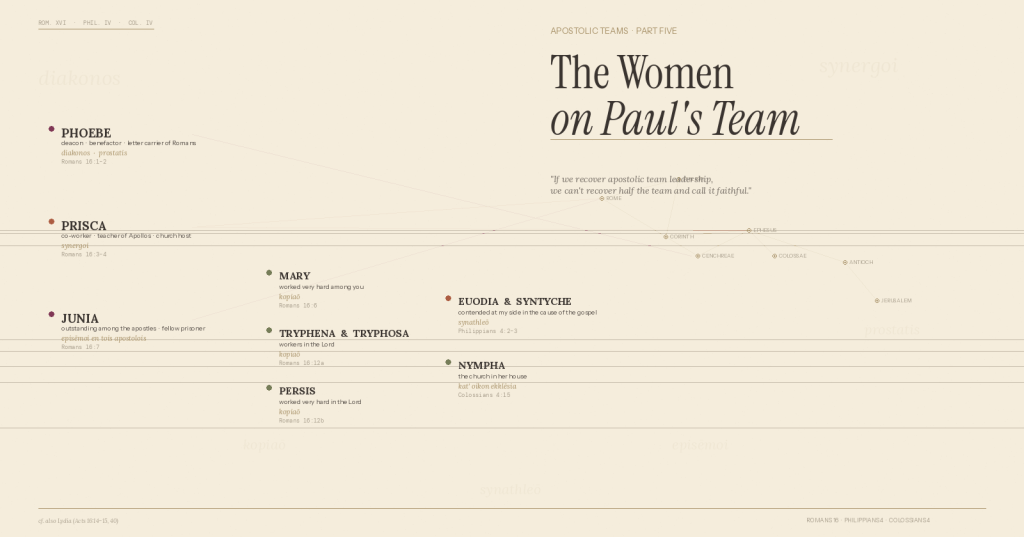
The Women on Paul’s Team
Open Romans 16 and start counting.
Of the twenty-six-plus individuals Paul greets by name, at least nine are women. Not wives mentioned in passing. Not silent supporters. Women Paul names with the same language of ministry, labour, and partnership that he uses for his male co-workers. Women he calls deacons, co-workers, and apostles.
This isn’t a post about the modern debate over women in ministry. It’s something simpler and, I think, more powerful than that. It’s a post about what Paul actually did. Because when you look at the evidence — not through the lens of later church debates, but through the lens of what Paul wrote with his own hand — you find women everywhere on his team. And he wasn’t embarrassed about it. He was pleased with it.
Phoebe: The Woman Who Carried Romans
Paul opens his greetings in Romans 16 with a commendation — and the first person he commends is a woman.
“I commend to you our sister Phoebe, a deacon of the church in Cenchreae. I ask you to receive her in the Lord in a way worthy of his people and to give her any help she may need from you, for she has been the benefactor of many people, including me” (Romans 16:1-2).
Three things to notice. First, Paul calls Phoebe diakonos — deacon. Not diakonissa, the later feminine form invented to soften the title, but the same word Paul uses elsewhere for male leaders including himself (1 Corinthians 3:5, 2 Corinthians 6:4). Douglas Moo, in his NICNT Romans commentary, and N.T. Wright both argue that the addition of the phrase “of the church in Cenchreae” strongly suggests an official leadership role, not merely a general description of service.
Second, Paul calls her prostatis — a word variously translated as “benefactor,” “patron,” or “helper.” In the Greco-Roman world, a prostatis was a person of means and influence who provided resources, legal protection, and social support. Paul says Phoebe was a prostatis to “many people, including me.” Paul — the apostle — acknowledges that this woman had supported and benefited him.
Third, and perhaps most significant: there is an overwhelming scholarly consensus that Phoebe was the letter carrier of Romans. Paul’s commendation follows the standard form of an ancient letter of recommendation — introducing a trusted emissary to the recipients. Wright argues that in the ancient world, the person who delivered a letter was typically the one who read it aloud and answered questions about it. If that’s correct, then Phoebe — a woman — was the first person to publicly read and explain the most theologically significant letter Paul ever wrote. As Scot McKnight and others have noted, that effectively makes Phoebe the first commentator on Romans.
Paul entrusted a woman with the delivery, reading, and initial interpretation of his masterwork. That tells us everything we need to know about what Paul thought women were capable of.
Prisca: Named Before Her Husband
“Greet Prisca and Aquila, my co-workers in Christ Jesus. They risked their lives for me. Not only I but all the churches of the Gentiles are grateful to them” (Romans 16:3-4).
Paul calls Prisca (Priscilla) and Aquila synergoi — the same “co-workers” language he uses for Timothy, Titus, and other key team members. But notice the order. In four of the six New Testament references to this couple, Prisca is named first — here in Romans 16, and in Acts 18:18, Acts 18:26, and 2 Timothy 4:19. In a culture where the husband’s name conventionally came first, reversing the order almost certainly signals that Prisca was the more prominent partner in ministry.
Acts 18:26 gives us a concrete example. When the eloquent Apollos arrived in Ephesus preaching with incomplete understanding, it was Prisca and Aquila who “took him aside and explained to him the way of God more adequately.” A woman, alongside her husband, correcting and instructing a gifted male teacher. And Luke, far from hiding this, names her first in the account.
Paul says they “risked their lives” for him — language that suggests imprisonment or mortal danger. Prisca wasn’t a background supporter. She was a frontline co-worker who put her life on the line for the apostolic mission and whose home served as the meeting place for the church in multiple cities (Romans 16:5, 1 Corinthians 16:19).
Junia: Outstanding Among the Apostles
We’ve already encountered Junia in an earlier post in this series and I’ve written blogs about her before, but she belongs at the heart of this one too.
“Greet Andronicus and Junia, my fellow Jews who have been in prison with me. They are outstanding among the apostles, and they were in Christ before I was” (Romans 16:7).
The scholarly consensus is now decisive: Junia was a woman. No one in the history of the church interpreted the name as masculine until the thirteenth century. John Chrysostom, writing in the fourth century, had no hesitation — he celebrated the wisdom of “this woman” who was “deemed worthy of the title of apostle.” The masculine “Junias” has no attestation anywhere in the ancient world. As Scot McKnight puts it in Junia Is Not Alone, the creation of Junias was effectively a sex change performed on the text by editors who couldn’t accept that a woman could be an apostle.
McKnight goes further. If Junia was an apostle — and Paul says she was outstanding among them — then, as McKnight writes, “she was in essence a Christ-experiencing, Christ-representing, church-establishing, probably miracle-working, missionizing woman who preached the gospel and taught the church.” That’s not a marginal role. That’s apostolic ministry at its fullest.
Moo confirms the grammar: the Greek episēmoi en tois apostolois means “outstanding among the apostles,” not merely “well known to the apostles.” Wright and Dunn read it the same way. Junia wasn’t simply known by apostles — she was one of them.
And she’d been in prison with Paul. The word synaichmalōtos — “fellow prisoner” — is one Paul uses only three times, for people who shared his chains for the gospel. Junia had suffered for the mission. She had paid the price. And Paul honoured her publicly for it.
The Workers and Contenders
Junia, Phoebe, and Prisca are the most prominent women on Paul’s team, but they are far from alone.
In Romans 16 alone, Paul greets Mary “who worked very hard for you” (v.6) — the verb kopiaō is the same word Paul uses for his own apostolic labour in 1 Corinthians 15:10 and Galatians 4:11. He greets Tryphena and Tryphosa, “those women who work hard in the Lord” (v.12), using kopiaō again. He greets Persis, “the beloved, who has worked very hard in the Lord” (v.12). He greets Julia and the mother of Rufus (v.13, 15). These aren’t decorative mentions. Paul is using his strongest language of ministerial labour for these women.
In Philippians, Paul writes: “I plead with Euodia and I plead with Syntyche to be of the same mind in the Lord… these women have contended at my side in the cause of the gospel, along with Clement and the rest of my co-workers” (Philippians 4:2-3). The verb is synathleō — “to contend together,” “to fight alongside.” It’s athletic, combative language. Euodia and Syntyche didn’t just help Paul — they fought beside him in the gospel. And Paul lists them alongside his male co-workers without distinction.
In Colossians 4:15, Paul sends greetings to “Nympha and the church in her house” — a woman who hosted and presumably led a house church. In Acts 16, Lydia — a dealer in purple cloth — responds to Paul’s preaching in Philippi, is baptised with her household, and her home becomes the base for the Philippian church (Acts 16:14-15, 40). The first European convert and the first European church host was a woman.
What the Evidence Demands
Let me be clear about what I’m not doing in this post. I’m not trying to resolve the broader theological debate about women’s roles in the church. Trusted scholars I respect — Wright, Fee, Moo, McKnight — land in different places on some of those questions. What I am doing is letting the evidence of Paul’s actual practice speak for itself.
And when it speaks, it says this: Paul’s apostolic teams included women at every level. Women who were deacons. Women who were co-workers. Women who were apostles. Women who carried letters, hosted churches, taught gifted men, contended in the gospel, risked their lives, went to prison, and worked so hard that Paul used the same language for their labour that he used for his own.
In Empowered, I argue that the Spirit distributes gifts “to each one, just as he determines” (1 Corinthians 12:11) — not according to gender, age, or social status. What we see in Paul’s practice is exactly what that theology would predict. If the Spirit gives gifts without regard to gender, then the teams built on those gifts will naturally include women exercising the full range of their callings.
Paul wasn’t a modern egalitarian operating with twenty-first-century categories. He was a first-century Jewish apostle operating in a patriarchal culture. And yet his teams were more gender-diverse than many church leadership teams today. That should give us pause.
Scot McKnight titled his study of Junia Junia Is Not Alone. He’s right. She wasn’t alone. She had Phoebe beside her, and Prisca, and Mary, and Tryphena, and Tryphosa, and Persis, and Euodia, and Syntyche, and Nympha, and Lydia. Paul saw what the Spirit had placed in each of them, and he gave them room to flourish.
If we’re serious about recovering apostolic team leadership, we can’t recover half the team and call it faithful.
Discover more from Paul Benger
Subscribe to get the latest posts sent to your email.
 Paul Benger