Harvard confirms what the Bible already knows.
Everyone wants to be happy. That’s not controversial. The question isn’t whether we want it — it’s whether we know how to find it.
Arthur C. Brooks is a Harvard professor, bestselling author, and one of the world’s leading researchers on human happiness. He teaches the most oversubscribed elective at Harvard Business School — a course called “Leadership and Happiness” — and has spent years distilling decades of social science, neuroscience, and longitudinal research into a remarkably clear picture of what makes human beings flourish. His conclusions are fascinating. They’re also deeply familiar — because the Bible got there first.
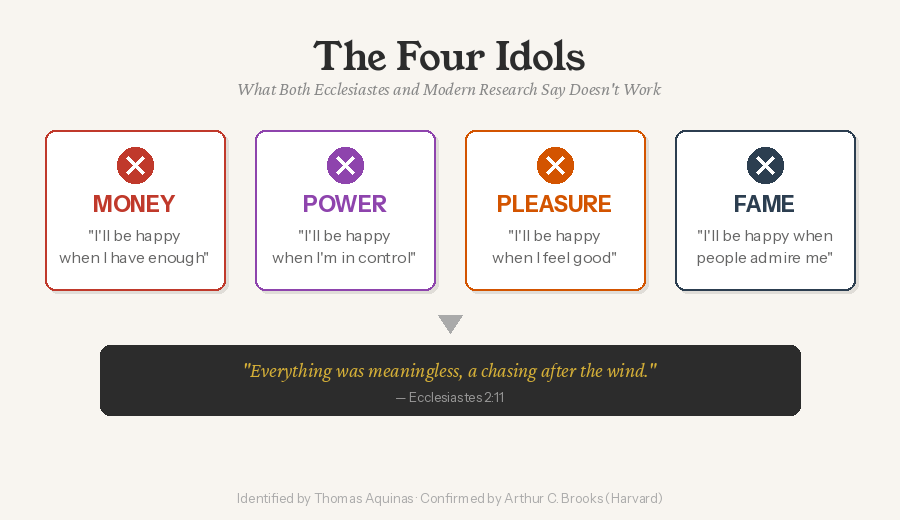
The Four Idols
Brooks argues that most people pursue happiness through what he calls the four “idols”: money, power, pleasure, and fame. These pursuits, he says, are not inherently bad, but they become toxic when we treat them as ultimate goals. They promise fulfilment and deliver diminishing returns. The more you chase them, the less they satisfy.
Three thousand years before Brooks arrived at that conclusion, the Teacher in Ecclesiastes ran the same experiment. He tried everything — wealth, projects, pleasure, prestige — and delivered his verdict: “Everything was meaningless, a chasing after the wind” (Ecclesiastes 2:11). Tim Keller put it memorably: an idol is whatever you look to for things that only God can give. The tragedy isn’t that we want too much. It’s that we’re settling for too little — and calling it ambition.
Brooks and the Bible are reading from the same page. The idols don’t deliver. They never have.
The Three Macronutrients
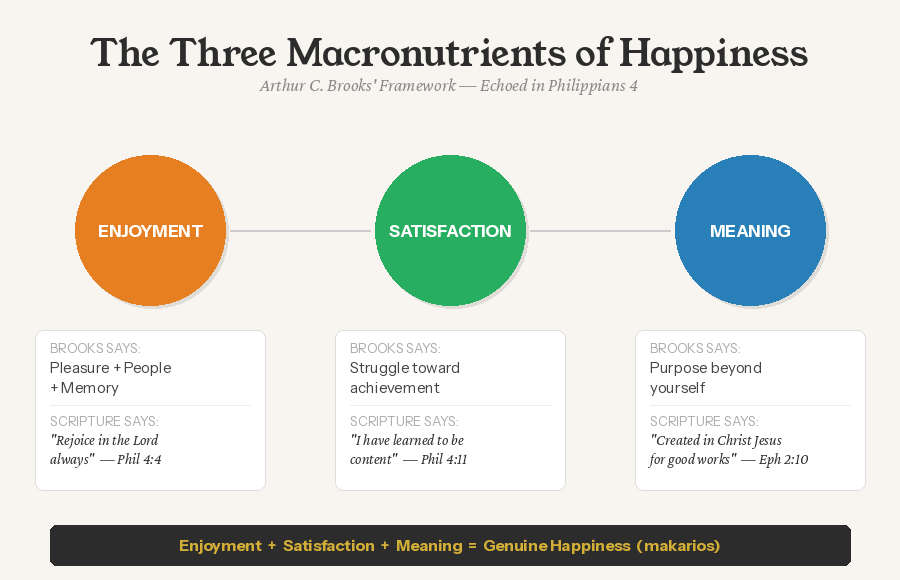
Brooks describes happiness not as a feeling but as a practice — something built from what he calls “the three macronutrients”: enjoyment, satisfaction, and meaning.
Enjoyment isn’t the same as pleasure. Pleasure consumed alone becomes addictive and hollow. Enjoyment, Brooks says, is pleasure combined with people and memory. It’s shared. Satisfaction isn’t comfort — it’s the reward that comes after struggle, the deep sense of having done something hard and done it well. And meaning is the big one: the “why” of your life, the sense that your existence serves a purpose beyond yourself. Brooks says we are living through a “meaning crisis” — people increasingly can’t answer the most basic questions about why they’re alive or what they would give their life for. Scripture has always had an answer. Ephesians 2:10 says we are God’s poiema — his crafted work, created in Christ Jesus for good works he prepared in advance. You are not an accident searching for a reason. You have a purpose — and it was set in place before you arrived.
Notice what Paul writes from a Roman prison cell in Philippians 4: “I have learned to be content whatever the circumstances. I know what it is to be in need, and I know what it is to have plenty. I have learned the secret of being content in any and every situation” (Philippians 4:11–12). Two things stand out. First, Paul says he learned it. Contentment is a practice — exactly as Brooks describes. Second, Paul had none of the four idols. No wealth, no power, no comfort, no reputation. And yet he writes what may be the most joyful letter in the entire New Testament.
Brooks says happiness is a direction, not a destination — a process of becoming incrementally happier through better habits and deeper self-understanding. Paul would agree. He practised it. He cultivated it. And he found it in the last place the world would look.
The Four Pillars
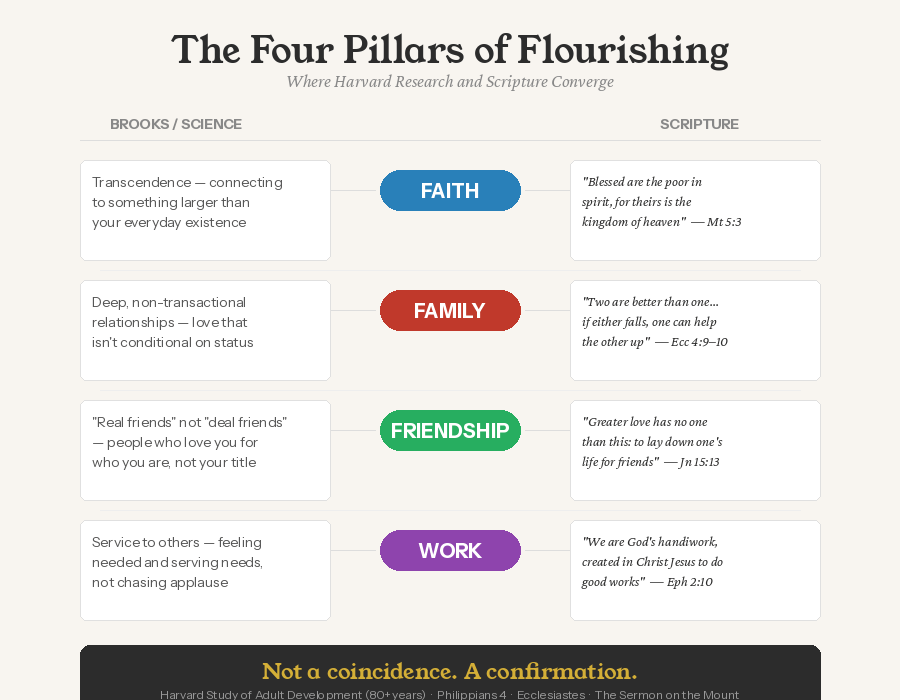
This is where Brooks’ work becomes truly striking. After years of research, he identifies four pillars that consistently appear in the lives of the happiest people: faith, family, friendship, and meaningful work. He’s explicit that these aren’t optional extras — they are the architecture of a flourishing life.
Faith, Brooks says, is about transcendence — connecting to something larger than your everyday existence. Family and friendship are about deep, non-transactional relationships. He draws a sharp distinction between “deal friends” and “real friends.” Deal friends are utilitarian — they care about your job title and what you can do for them. Real friends, like family, love you for who you are. And meaningful work is about service — feeling needed and serving the needs of others.
The Harvard Study of Adult Development — the longest longitudinal study on human wellbeing, tracking hundreds of people over more than 80 years — arrived at the same conclusion: the single greatest predictor of long-term happiness is the quality of a person’s relationships.
Now open your Bible. Genesis declares that it is not good for man to be alone. Ecclesiastes says two are better than one, because if either falls, the other can help them up (4:9–10). Jesus says the greatest love is to lay down your life for your friends (John 15:13). Paul tells the Colossians to work at everything with all their heart, as working for the Lord (3:23). And as Ephesians 2:10 reveals, we are God’s poiema — his crafted work, created for good works he prepared in advance.
Faith. Family. Friendship. Meaningful work. Brooks arrived at these four pillars through decades of empirical research. Scripture has been proclaiming them since Moses.
The Convergence
Brooks himself closes many of his lectures with a line that sounds like it could come straight from a pulpit: “The world says use people, love things, and you are the centre of everything. But the right formula is to love people, use things, and worship the divine.”
This is not a coincidence. It’s a confirmation. The most rigorous modern research on human flourishing — after thousands of subjects, decades of data, and billions of dollars in funding — keeps arriving at the same place the Bible has always been.
God didn’t design you for the endless pursuit of more. He designed you to flourish through trust, through love, through purpose, through belonging. The world’s happiness strategy is to get more, achieve more, experience more. God’s happiness strategy is to love more, trust more, give more, belong more.
Paul — chained, stripped of every idol, writing by lamplight in a Roman cell — puts it like this: “I can do all this through him who gives me strength” (Philippians 4:13). His contentment wasn’t dependent on his circumstances. It was dependent on his connection — to Christ, to community, to calling.
That same contentment is available to you. Not when the circumstances change. Now.
The scientists are catching up. The Bible has been waiting.
Discover more from Paul Benger
Subscribe to get the latest posts sent to your email.
 Paul Benger