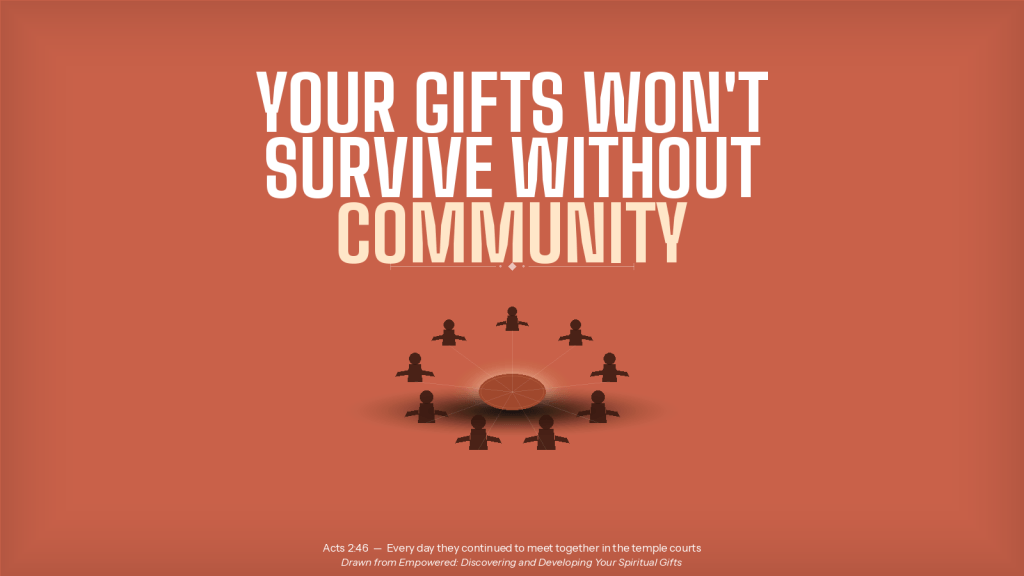
From the series: Empowered — Discovering and Developing Your Spiritual Gifts
Sarah sat nervously at the edge of the prayer circle. Three months into this church, she still felt like an outsider looking in — quiet by nature, uncertain of her place, more likely to slip out unnoticed than to step into anything. When the pastor asked if anyone would pray for a family facing a medical crisis, something stirred in her she couldn’t explain. Before she’d fully decided to speak, words were already forming. She prayed. And when she finished, the room was still.
Afterwards, a church leader found her. “You have a gift of prayer,” he said simply. “Specifically intercession. We need that here.”
Sarah didn’t know but she had carried it for years, because the gift had never had a context in which to emerge. It needed a room, a need, a community gathered around a shared burden. Without those things, it would have remained exactly where it was — dormant, unnamed, unused.
This is not an unusual story. It is, in fact, the normal way that spiritual gifts work.
Gifts Are Not Private Property
There is a particular cultural assumption about spiritual gifts that the New Testament consistently resists — the idea that they are personal possessions, individual endowments to be explored in private and deployed at will. The language we use tends to reinforce this: my gifts, discovering my gifts, what I have been given.
But Paul’s framing in 1 Corinthians 12 is stubbornly communal. The gifts are not given to individuals for individual benefit. “To each one the manifestation of the Spirit is given for the common good” (1 Corinthians 12:7). The common good. Not your good, not your ministry, not your platform — the good of the body. The body is the whole point.
Gordon Fee, whose scholarship on the Spirit in Paul’s letters is excellent, makes this explicit: “God is not simply saving diverse individuals and preparing them for heaven; rather He is creating a people for His name, among whom God can dwell and who in their life together will reproduce God’s life and character.”
A gift exercised outside of community is not functioning as Paul describes. At best it is incomplete. At worst, as the charismatic world has discovered to its cost, it can become something dangerous — unchecked, unaccountable, shaped more by an audience’s response than by the community’s discernment.
The gifts are covenantal, not personal. They belong to the body, entrusted to individuals for the body’s sake.
We Are Part of an Unfinished Story
Luke begins the book of Acts with a telling phrase: “In my former book, Theophilus, I wrote about all that Jesus began to do and to teach” (Acts 1:1). That word — began — carries immeasurable weight. Luke is telling Theophilus, and us, that the Gospels are not the conclusion. They are the introduction. What Jesus started, he continues through his Church, empowered by the same Spirit.
Acts itself ends with the same open-ended logic. There is no neat resolution, no closing summary, no “The End.” Paul is in Rome, “proclaiming the kingdom of God and teaching about the Lord Jesus Christ with all boldness and without hindrance” (Acts 28:31) — and the narrative simply stops. Because the story hasn’t finished.
It is still unfolding. In your city. In your church. In the gifts that are operating, dormant, or just beginning to surface in the people around you.
This is what it means to be the Church — not admirers of a completed historical project, but active participants in Christ’s ongoing work. The gifts aren’t accessories for the especially devout. They are the means by which that work continues. And they are discovered, developed, and deployed not in isolation, but in the community that carries the story forward together.
Temple and Table — The Two Rhythms That Change Everything
The early church in Jerusalem had a simple rhythm captured in a single verse: “Every day they continued to meet together in the temple courts. They broke bread in their homes and ate together with glad and sincere hearts” (Acts 2:46).
Temple and table. These two spaces created the ecosystem in which spiritual gifts flourished in the first century, and they remain the essential rhythms for gift development today.
The temple represents the gathered community — corporate worship, teaching, prayer, and shared encounter with God. It is where the prophetic word finds a platform, where teaching gifts are exercised in public, where leadership is tested and recognised. It is where the community witnesses the Spirit moving across the broader body. Acts 4 gives us a striking picture of what can happen when the temple experience is taken seriously: “the place where they were meeting was shaken. And they were all filled with the Holy Spirit and spoke the word of God boldly” (Acts 4:31). That was not an individual experience. It was a communal one. The boldness that followed flowed from their unity in prayer, not from private spiritual practice.
The table represents something different but equally essential — the intimate, unhurried rhythms of shared life. Small groups, shared meals, embracing new people, the kind of relationships where people are truly known rather than merely noticed. It is around these tables, metaphorical and literal, that the quieter gifts find space to emerge: mercy, encouragement, wisdom, helps, administration. It is where a reserved woman in a home group discovers she has the gift of intercession when someone she loves needs prayer. It is where a tradesman discovers he has the gift of teaching when teenagers start leaning in.
Neither rhythm is sufficient alone. Temple without table becomes a performance — impressive, even inspiring, but ultimately hollow, because there is no intimacy to root it. Table without temple becomes comfortable fellowship without direction, warm and relational but slowly drifting from the mission that gives community its purpose.
Both are the work of the Spirit. Both are the soil where gifts grow. The question is not which to choose — it is how to cultivate both with intention.
The Modern Problem: Together, But Alone
Sociologist Robert Putnam coined the phrase “bowling alone” to describe a troubling shift in American culture: people were ten pin bowling more than ever, but bowling league membership was plummeting. More activity, less community. Physically present, relationally absent.
The Church has not been spared this cultural current. We have become skilled at creating shared experiences — gatherings, events, services, conferences — whilst remaining strangers to one another. We cherish our individuality and our personal spiritual journey. We want the inspiration of corporate worship without the accountability of intimate fellowship. We want the affirmation that comes from exercising gifts in public without the correction that comes from people who know us well.
But biblical Christianity knows nothing of isolated discipleship. The very concept would have been foreign to the early church. Faith was inherently communal, gifts were inherently relational, and growth was inherently corporate. You cannot develop a gift of mercy without people to show mercy to. You cannot discover a gift of encouragement without relationships deep enough to require it. You cannot test a prophetic gift without a community of discernment around you.
The individualisation of faith does not just impoverish the community — it actively damages the individual. It eliminates the relational context in which many gifts are discovered in the first place. It removes the accountability that keeps gifts healthy and properly directed. And it eliminates the feedback loop — encouragement, gentle correction, increasing responsibility — through which gifts actually mature.
A prophetic gift without the testing of mature community can veer easily into pride or error. A teaching gift without relationship becomes dry and impersonal. Leadership detached from mutual submission grows controlling. We need each other not just for warmth, but for the very formation that makes our gifts safe and life-giving to those around us.
When Gifts Come Alive
Three stories from Chapter 4 of Empowered stay with me because they each illustrate how unpredictably and how specifically community creates the conditions for gifts to emerge.
Liz was quiet by nature. She attended her home group more out of obligation than enthusiasm, preferring to listen rather than speak. When a fellow member mentioned an upcoming cancer surgery, the group prayed — and Liz found words flowing through her with unusual clarity, boldness, and faith. The prayer carried a spiritual authority everyone in the room could sense. Over the following months, people began asking specifically for her prayers. Eventually her pastor invited her to lead the church’s prayer ministry. Over the years, she witnessed God perform miracles in response to those prayers. Her gift had been present for years. It emerged in community, in a specific moment of shared need, and it never would have been discovered in isolation.
James was a tradesman with no formal education. When his church asked him to help with youth ministry, he protested — “I’m not a teacher. I barely finished school myself.” But at a weekend retreat, he found himself explaining theological concepts to teenagers using analogies from his construction work. A concrete foundation as a metaphor for building faith in Christ. Scaffolding as spiritual support. The teenagers leaned in. Five years later, he leads the church’s mentoring programme, helping young men navigate faith and life with the same practical wisdom that first surfaced at that retreat. His gift would have remained dormant without the community that pushed him into service before he felt ready.
Maya was eighteen. A youth leader noticed that when someone in the group was excluded or struggling, Maya would appear with words that restored confidence and reminded people of their worth in God’s eyes. She had an uncanny ability to see past people’s facades to their true potential. After observing the pattern for several months, the youth pastor pulled her aside and explained what she had been doing — the gift of encouragement (Romans 12:8). With that understanding, what had been an intuitive response became an intentional ministry. Maya began mentoring younger girls and eventually developed a peer support network that transformed the youth group’s culture.
In each case, the gift didn’t announce itself through a spiritual gifts inventory or a private revelation. It emerged through relationship, within the ebb and flow of shared life, often when nobody was looking for it. Gifts are discovered not in assessment moments but in the messy, beautiful reality of people serving together.
Gifts Need Accountability, Not Just Encouragement
There is a dimension to community’s role in gift development that we tend to underemphasise because it is less comfortable: community doesn’t just affirm gifts — it also corrects and constrains them.
Paul’s extended teaching on spiritual gifts in 1 Corinthians 12–14 is not primarily about discovery or even deployment. It is about order. The gifts are to be exercised under authority, submitted to communal discernment, evaluated by those with wisdom. Two or three prophets speak; the others weigh carefully what is said (1 Corinthians 14:29). Everything is done in a fitting and orderly way (14:40).
This structure is not bureaucratic interference with the Spirit’s freedom. It is the protection that allows the gifts to be genuinely trusted. When gifts operate outside of this structure — when a minister or individual insists their gift speaks for itself and requires no testing — the community is not protected, and the gift itself becomes vulnerable to distortion.
The most powerful expressions of spiritual gifts — reconciliation, peacemaking, pastoral care through seasons of genuine hardship — often emerge precisely in the difficult places of community, when relationships have been tested, when conflict has been navigated, when the cost of commitment has been paid. Gifts don’t flourish in transient, consumer relationships. They flourish in covenant ones.
Practising Temple and Table Today
The rhythms of Acts 2 remain as vital as they were in the first century, though they take different shapes. For those wanting to engage them more intentionally, three postures are worth cultivating.
Join a ministry team. Serving alongside others in a shared task is one of the most reliable environments for gift discovery — because it combines the inspiration of shared mission with the intimacy of working relationships. The worship team member who discovers a pastoral gift while praying with fellow musicians. The children’s ministry helper who uncovers teaching abilities they never imagined. The hospitality volunteer who realises they have a gift for administration as they coordinate events. The context does the work that a spiritual gifts questionnaire cannot.
Participate actively in a small group — the key word being actively. Simply attending is not enough. Gifts emerge through engagement: sharing prayer requests, offering to help with practical needs, contributing to discussions, taking on small responsibilities. The safe space of table fellowship is where the quieter gifts — mercy, encouragement, wisdom, helps — have room to breathe and be named.
Invite honest feedback from trusted people. Most of us are poor judges of our own spiritual gifts. We either dismiss obvious gifts as “just being helpful” or assume we have gifts we don’t actually possess. Ask people who know you well what they observe in you. Their perspective reveals what we cannot see in ourselves. This requires humility — the willingness to receive both affirmation and gentle correction. But it is one of the most significant gifts that community can offer.
The Soil Cannot Be Replaced
The opening of Acts tells us that Jesus began his work. The closing tells us it is still unfolding. Somewhere between those two bookends is your story — and the story of the people around you, each carrying something the body needs, each requiring the soil of community to discover it, develop it, and offer it for the common good.
Spiritual gifts do not thrive in private. They were never designed to. They are planted in you for the sake of others, and they grow through the friction and grace and shared life of belonging to a community that is trying, together, to embody the kingdom of God.
Your gift needs your community. And your community needs your gift.
The soil cannot be replaced. But it can be cultivated. And the harvest, when it comes, belongs to everyone.
This post is drawn from Empowered: Discovering and Developing Your Spiritual Gifts by Paul Benger. Available on Amazon.
Discover more from Paul Benger
Subscribe to get the latest posts sent to your email.
 Paul Benger