From the series: Empowered — Discovering and Developing Your Spiritual Gifts
There’s a pattern I’ve noticed in churches over the years. You walk through the door, spend a few weeks in the services, and fairly quickly you start to sense what the community values most. For some churches it’s the teaching — careful, expository, scholarly. For others it’s the atmosphere — the worship, the spontaneous prayer, the expectation of something supernatural happening. For others still it’s the community — the warmth, the hospitality, the sense that people here genuinely care for one another.
None of those emphases is wrong. But each on its own is incomplete.
In the book of Corinthians, Paul paints a picture of a church where spiritual gifts operate in extraordinary diversity. There are gifts of teaching, prophecy, healing, administration, mercy, tongues, helps, faith, and more. Far from trying to organise these into a tidy hierarchy, Paul insists they are all expressions of the same Spirit, distributed with intention, and necessary to the health of the whole.
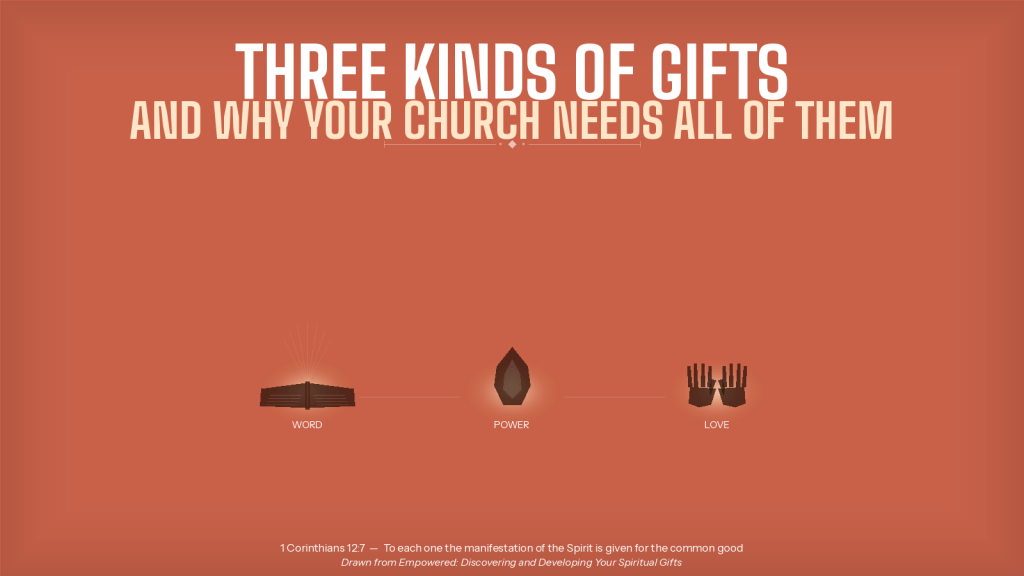
The theologian Robert J. Clinton, whose work I draw on heavily in Empowered, helps us see these gifts in three distinct clusters. Understanding these three clusters — and recognising which ones your church leans into most — may be one of the most important things you can do for your community’s health.
The Three Clusters
Word gifts are the gifts that clarify God’s nature and truth. They include teaching, prophecy, encouragement, evangelism, shepherding, and apostleship. These gifts deal in revelation — bringing God’s truth into the room and making it accessible, applicable, and life-changing. A church rich in word gifts tends to produce theologically grounded disciples who know what they believe and why.
Love gifts are the gifts that reveal God’s heart. They include administration, helps, mercy, giving, and hospitality. These are often the least celebrated and most undervalued gifts in the church — and yet they are, as I describe in the book, the connective tissue that holds everything else together. Without them, even the most powerful sermon or miraculous healing loses its impact. They are the soil in which every other gift takes root.
Power gifts are the gifts that demonstrate God’s presence. They include faith, healing, miracles, tongues, and interpretation. These gifts operate in the realm of the supernatural — they are visible signs that the kingdom of God is not merely a theological concept but a present, active reality. They point beyond what is humanly explicable and say: God is in the room.
The Problem of the Lopsided Church
Here is what I observe again and again: most churches lean heavily into one of these clusters and neglect the others. You end up with what I call “word churches,” “power churches,” and “love churches.”
Word churches are excellent at doctrine and preaching. They produce biblically literate congregations. But they can become cold — intellectually rigorous without being relationally warm or spiritually alive. The gifts of mercy and healing rarely feature. People learn a great deal but don’t always encounter God.
Power churches are spiritually electric. Things happen. There is expectation in the room. But without the grounding of word gifts, spiritual experience can become unmoored from Scripture — and without the love gifts, the vulnerable and broken can sometimes fall through the cracks in the rush towards the spectacular.
Love churches are warm, inclusive, and deeply pastoral. They create communities where people feel seen and cared for. But without word gifts, they can drift from theological clarity. Without power gifts, the supernatural work of the Spirit can feel quietly absent — nice people doing nice things, with little that would require God to be real.
The New Testament vision is all three clusters operating together. As I put it in the book: a church that is doctrinally sound, supernaturally empowered, and practically loving gives the watching world a complete picture of Jesus. They see His truth proclaimed clearly, His power demonstrated tangibly, and His love expressed practically. That three-dimensional witness is what makes the church compelling rather than irrelevant.
Why Every Gift Matters
One of the most striking things in Paul’s teaching is how deliberately he refuses to create a hierarchy of spiritual significance.
Paul lists administration alongside apostleship (1 Corinthians 12:28). Let that sit for a moment. The gift of steering a church well — managing its systems, coordinating its people, creating the structures that allow mission to happen — Paul places it in the same sentence as the gift of pioneering new ground for the gospel. They are not in competition. They are equally essential.
The Greek word for administration is kubernēsis — a word that means helmsman. It’s the person who steers the ship towards its destination. Not the person who owns the ship. Not the person who draws the map. The one who reads the wind, manages the crew, and makes a thousand daily decisions that keep everything on course. Without them, the ship drifts.
Similarly, the gift of helps — the person who sees what needs doing and quietly does it before anyone else has noticed — sits alongside miracles in Paul’s list (1 Corinthians 12:28). The person who makes sure the room is set up, who checks in on the speaker before they preach, who arrives early and leaves late, who notices the detail everyone else walked past — that person is operating by the same Spirit who raises the dead.
This is not flattery. It is theology. The same Spirit who empowers the evangelist also empowers the administrator. The same divine energy that flows through miraculous healings also flows through acts of hospitality and mercy.
Paul goes further. In 1 Corinthians 12:22-25, he insists that the parts of the body that seem weaker are indispensable, and that the parts we think of as less honourable are to be treated with special honour. God intentionally structures it this way — so that there is no division in the body, but that its parts should have equal concern for each other.
What Does Your Church Need More Of?
There is a question worth sitting with honestly: which cluster does your church most undervalue?
If you are in a word church, you may need to create more space for the power gifts — not as a performance, but as a sincere expectation that God moves supernaturally among His people. You may also need to ask whether the love gifts are sufficiently honoured — whether the person serving coffee is celebrated as genuinely as the person preaching.
If you are in a power church, you may need to deepen your roots in Scripture and theological formation. Supernatural experience without doctrinal grounding can drift in dangerous directions. You may also need to examine whether compassion for the ordinary, ongoing needs of people — grief, loneliness, financial hardship, mental health — is as prioritised as the dramatic.
If you are in a love church, you may need to ask whether you are expecting too little of God. Whether a culture of warmth and care has inadvertently replaced an expectation of the Spirit’s power. Whether theological depth has been sacrificed on the altar of accessibility.
A Vision for the Whole
Jon Tyson puts it well: “We need the tension of difference to be the beauty of unity.” The gifts are not given to a body that all looks and operates the same. They are given to a body of remarkable diversity, where every member brings something that the others cannot supply.
The administrator makes space for the healer to operate. The one with the gift of mercy creates the relational safety in which prophecy can be received. The teacher grounds the community in truth so that spiritual experience can be tested and kept healthy. The giver releases resources that make hospitality possible on a scale that would otherwise be impossible.
Each cluster needs the others. A healthy church is not one that has perfected a single expression — it is one that makes room for all three, values each equally, and keeps asking the question: what is missing here, and who among us carries the gift to supply it?
Spiritual gifts are not given for personal fulfilment or individual advancement. They are given for the common good (1 Corinthians 12:7). Every gift, however unspectacular it may seem, is a grace given to the whole community. And every community that truly wants to represent Jesus to the world will need the word gifts that make Him known, the love gifts that make Him feel near, and the power gifts that make Him undeniable.
The question is not: which gifts do we prefer? The question is: are we making space for all of them?
Paul Benger is the lead pastor of Ikon Church and the author of Empowered: Discovering and Developing Your Spiritual Gifts. Find the book here: https://www.amazon.co.uk/s?k=empowered+paul+benger
Discover more from Paul Benger
Subscribe to get the latest posts sent to your email.
 Paul Benger